The Tariff Pass-Through Puzzle: Why Tariff Absorption Split So Unevenly in 2025

Working across research, policy, and data-driven analysis, the Editorial Board ensures that published pieces reflect a consistent institutional perspective grounded in quantitative reasoning and long-term structural assessment.
Authored On
Modified
Foreign exporters absorbed nearly half the 2025 tariff shock, new data show
Toyota cut export prices instead of raising costs for American buyers
Currency depreciation added a second, quieter discount alongside price cuts
Toyota closed the books for the April-June 2025 quarter with operating profit down 37 percent from a year earlier, a slide worth about 450 billion yen in this quarter alone, and the company tracked almost all of the United States' tariffs. Instead of raising sticker prices for American buyers, Toyota lowered its own export price and left room to absorb the blow. Dozens of Japanese, Korean and Chinese exporters have made a similar bet throughout the year, and their choices are at the center of a battle that trade economists have been waging for more than a year. Who really pays for a tariff wall like the one the United States built in 2025? The absorption of tariffs happened, and it happened on a smaller number of shoulders than most people assume.
How Foreign Exporters Absorbed the 2025 Tariff Shock
Most meteorologists treated the 2025 tariff round as a mere tax on American buyers. Legal rates for U.S. imports rose from about 2.6 percent in January to about 13 percent by the end of the year, and comments at the time assumed that retail prices would rise accordingly. For the most part they didn't. Retail inflation has remained close to target, and import-heavy sectors have continued to operate without much disruption. Trade theory offers an explanation for the gap, known as the terms of trade effect, in which a country large enough to move global prices can prompt foreign sellers to lower their own prices rather than lose the sale. As the world's largest single import market, the United States fits this description as well as any economy could.
Research using shipment-level data for the fifty largest U.S. trading partners tested this directly, weighing trade flows by their actual dollar value rather than counting each shipment equally. Once weighed in this way, foreign exporters had absorbed about 40 to 50 percent of the 2025 tariff increase through lower export prices, according to the preferred specification, with U.S. buyers paying about 53 cents for every dollar of tariffs and exporters eating up the remaining 47. A previous snapshot from June 2025 told a different story. Importers still bore about 64 percent of the cost then, exporters only 14 percent, and consumers the rest. The distance between these two metrics says less about which study got it wrong and more about how the absorption of the tariffs gradually increased, as the dominant exporters tested how much margin their profit margins actually had before committing to keeping prices low forever.
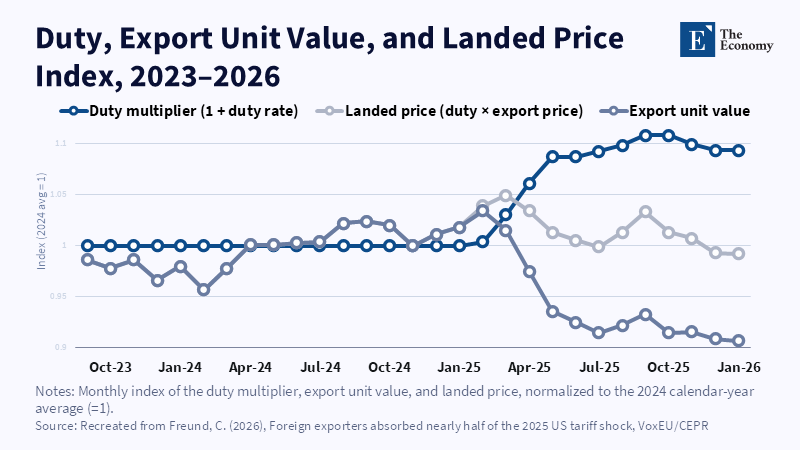
Most coverages as of mid-2025 locked into this early number and rarely revisited it once better data arrived months later. The revision is more important than any single title at the time. It shows a process that is unfolding, not a fixed result that journalists simply missed on day one. Dominant exporters needed time to see how far U.S. buyers would let them go to lower prices before they lost volume, and this learning curve is easy to miss if a reader checks the numbers only once, at the beginning of the year, and never returns to them.
Why National Averages Hide the Real Tariff Burden
Other careful studies came to the opposite conclusion, and none of them were mathematically wrong. Economists at the Federal Reserve Bank of New York, working on customs data through November 2025, place the foreign share of the tariff burden close to 10 percent. A team at the Kiel Institute for the World Economy looked at more than 25 million shipment records worth nearly four trillion dollars and found that exporters only absorb about 4 percent, with 96 percent going straight to American buyers. A widely cited paper by Harvard and Chicago economists, based on shipping and customs records rather than survey estimates, puts U.S. import prices at nearly 94 percent. Three groups, three datasets, three careful results. The disagreement is reduced to a unique methodological choice and not to a mistake in anyone's arithmetic.
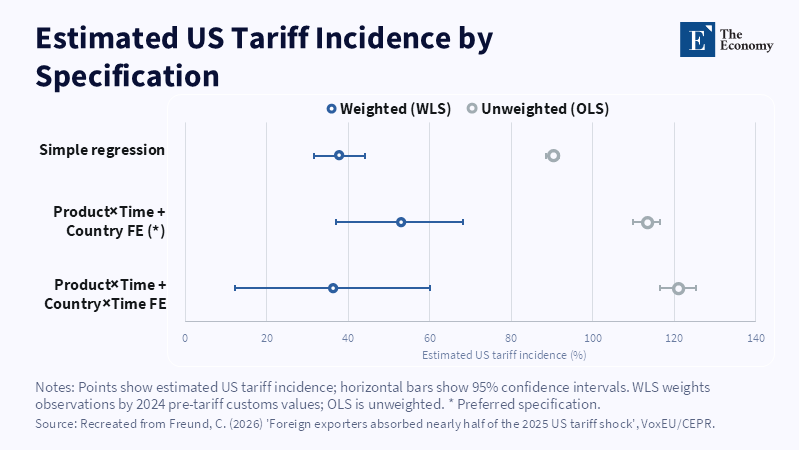
U.S. imports are extremely lopsided. About the top one percent of product categories by number account for more than half of the total import value, while thousands of sub-product lines together make up less than one percent of trade. Treat the coupling of each product country as equally important, and a small shipment of buttons counts the same as an eighty-billion-dollar flow of passenger vehicles. This approach captures what a typical exporter does. Most small exporters actually passed the tariffs in full because they had no power to do otherwise. It says little, however, about what American households and manufacturers actually spend their money on, which is a much smaller and much more concentrated list of goods than the full trade book suggests.
Weigh the data against the dollars involved, and the picture changes. The largest supplier of a given product, the country that holds the largest share of this U.S. import market, absorbed up to 70 percent of its tariff increase on average, and absorption quickly fell below this top tier. Suppliers with a market share of three or four percent passed almost the entire tariff, which matches what the low-absorption studies found. Chinese toy and doll exporters, hit by a 28 percentage point increase in tariffs, reduced their export prices by 22 percent and absorbed about 80 percent of the shock. Korean automakers, facing a 22-point increase, cut prices by 12 percent and absorbed about half. Indian linen manufacturers landed in the same range, cutting prices by 16 percent against a 28-point increase in tariffs. None of the three had to guess how much space they had. Their market share told them.
Toyota Shows What Tariff Absorption Costs in Practice
A real company makes it easy to trust these numbers. Toyota's operating profit for the April-June quarter fell to 841 billion yen, from 1.33 trillion yen a year earlier, and tariffs accounted for about 450 billion yen of that decline, close to $3 billion in a single quarter. Company executives said vehicle export volumes to the United States remained stable even when the cost of tariffs was partially absorbed, which is a polite way of saying that profit margins took the hit instead of customers. By the end of its fiscal year, Toyota estimated the impact of full-year tariffs at close to 1.45 trillion yen, about $9.7 billion, with annual operating profit falling by 21.5 percent and quarterly profit margins falling from about 9 percent to 4.5 percent. None of this evidence came from a rounded estimate buried in a footnote. They came from the company's own quarterly filings, the same numbers that investors used to reduce the stock.
Hyundai reported a comparable hit from South Korea, with U.S. tariffs costing the company 4.1 trillion won and slashing operating profit by 19.5 percent, even as global revenue continued to rise due to strong hybrid sales. No company passed on these costs purely to American buyers. Both treated it as the price of maintaining their share of the U.S. market, calculating that a smaller profit margin this year outweighs the permanent loss of customers from competitors assembling cars on American soil. It is the same behavior described by the weighted studies among the dominant suppliers and is not at all similar to how a small exporter without tariff power would have to respond to an identical tariff. A supplier without Toyota's brand or balance sheet cannot carry out this transaction. Either he raises his price and risks the order, or he holds the price and eats up a loss that he can't afford for long.
How Currency Weakness Helped Exporters Absorb Tariffs
Export price reductions were not the only lever available to Asian exporters. The foreign exchange markets also did some of the work, quietly and in the background. The dollar itself fell by about 9 to 10 percent against a basket of major currencies in 2025, the steepest first-half decline in more than fifty years by some measures, and theoretically this should have made U.S. imports more expensive and left less room for foreign sellers to cut anything further. Several Asian currencies have fallen even faster than the dollar over their own recent history. The yen was rated as the worst-performing major currency in the last quarter of 2025 and fell to an eleven-month low in December, even though the dollar was weakening widely elsewhere. South Korea's won sank to its lowest level since March 2009, surpassing 1,500 per dollar, pressured by capital outflows and trade uncertainty adding to the tariff dispute. China has taken a different path, keeping the yuan comparatively subdued through active currency management, with its real currency-weighted exchange rate falling by 4.6 percent over the course of the year to September.
For a country like Japan, the two effects are stacked on top of each other. A weaker yen reduced the dollar cost of each unit shipped, and a lower export price additionally reduced the gap that the tariff was intended to create even further. Between the two, a Toyota buyer in Ohio or Texas barely felt the 15 percent tariff that Tokyo finally negotiated from 27.5 percent because the cost never reached the price. Instead, it was absorbed upstream, split between a corporate margin and a foreign exchange office. Korean exporters experienced a harsher version of the same trade. A weaker won helped Hyundai's dollar cost on paper, but capital outflows and regional tension drove that currency down for reasons that had nothing to do with trade policy, which made the actual bite of the tariff difficult to separate from anything else pulling the exchange rate at once.
What Unequal Tariff Absorption Means for Trade Policy
The obvious objection is that most of the rigorous literature is still overwhelmingly passed on to American buyers, which may make the claim of substantial tariff absorption seem like a selective choice. This objection deserves an answer, not a shrug. Both readings are valid once the unit of analysis is formulated. Count each trade relationship as equally important, and the transit seems almost complete, because most exporters are really small and have no pricing power. Weigh these same relationships with the dollars that Americans actually spend, and a different reality emerges among the few dominant suppliers who bear the brunt of that spending. Negotiators working on specific sector-specific agreements for cars, semiconductors, or heavy machinery are dealing with this very kind of high-share concentrated supplier, the kind with the incentive and balance sheet margin to squeeze a margin rather than pass on an invoice in its entirety. Negotiators facing smaller, more fragmented supplier bases should expect the opposite almost by definition, as these exporters simply have nowhere to absorb anything.
A second consequence deserves to be clearly stated. Tariffs that extract real price concessions from dominant foreign sellers produce a real, albeit narrow, trade gain for the country that imposes them, and this is the same logic that scholars have used for decades to explain why reciprocal trade agreements exist. Large countries can improve their own terms of trade through tariffs, which is why rules-based agreements have been created to prevent them from doing so at the expense of their neighbors. None of this settles whether the 2025 tariffs were worth their broader costs, including distorted trade, a smaller variety of products, and retaliation from partners who now have real reasons to move away from rules that once kept them in check. A dollar of tariffs absorbed by some exporter's margin is not the same as a dollar of national prosperity earned, and treating the two as identical is a mistake that both sides of this debate continue to make.
Whoever weighs the 2025 tariffs must have two events at once. Toyota actually gave up billions in margin instead of raising prices on American roads, opting for smaller profits over a smaller share of a market it spent decades building. Millions of smaller shipments from smaller exporters actually passed their tariffs straight without resistance, simply because they never had the strength to do anything else. Both are valid in the same year, in the same trade war, which comes from the same customs data. The next round of trade policy, whatever the objectives, should be built around this split and not smoothed out by it. A single national average that flattens both stories into one number will continue to mislead negotiators, executives, and the households that depend on it into figuring out what a tariff actually does.
This article reflects the analytical judgment of The Economy Editorial Board and does not constitute policy advice or the official position of any affiliated institution.
References
Amiti, M., Flanagan, C., Heise, S. and Weinstein, D.E. (2026) 'Who Is Paying for the 2025 U.S. Tariffs?', Liberty Street Economics, Federal Reserve Bank of New York, 12 February.
Bagwell, K. and Staiger, R.W. (1999) 'An Economic Theory of GATT', American Economic Review, 89(1), pp. 215–248.
Freund, C. (2026) 'Foreign exporters absorbed nearly half of the 2025 US tariff shock', VoxEU, Centre for Economic Policy Research, 15 August.
ISI Markets (2026) 'US tariffs bite Japanese exports as automakers lift prices', CEIC Data Insights, August.
Sobel, M. (2025) 'Japanese foreign exchange policy riddled in contradictions', OMFIF, 1 December.
Steil, B. (2025) 'Who Pays Trump's Tariffs?', Council on Foreign Relations, Geo-Graphics, 4 November.
Weinberg, N. (2026) 'Who's really paying for the Trump administration tariffs?', University of Chicago News, 29 January.
Working across research, policy, and data-driven analysis, the Editorial Board ensures that published pieces reflect a consistent institutional perspective grounded in quantitative reasoning and long-term structural assessment.