Work Meetings and Productivity: When Meetings Create Real Value

Working across research, policy, and data-driven analysis, the Editorial Board ensures that published pieces reflect a consistent institutional perspective grounded in quantitative reasoning and long-term structural assessment.
Authored On
Modified
Meetings consume substantial time but can support coordination
Meeting intensity correlates with wages, revenue and learning
Purpose, participation and preparation determine whether meetings pay

The average worker in Norway spends 4.7 hours a week in work meetings, about 12 percent of a typical weekly schedule, according to a 2025 survey conducted by researchers at the Harvard Kennedy School and the Norwegian School of Economics on about 9,000 employees and linked to administrative data of employers and employees. When this time is measured in terms of wages, companies allocate about 14 percent of their salary expenditure to work meetings, and the percentage does not include preparation, commuting or the concentration lost every time a job is interrupted. Such an allocation would be expected to have gone through rigorous performance control, but public opinion in the workplace has long condemned it, usually without distinguishing which meetings are judged and what happens within them. Whether the cost is an investment or a waste depends precisely on the distinction between good and bad.
What Distinguishes a Good Meeting from a Bad One
A bad meeting is easily recognized because most people have lived through it: the supervisor talks for forty minutes, the rest take notes that they won't open again, and no one asks anything, since the decision has already been made elsewhere. Knowledge at Wharton, the business analysis publication of the Wharton School of the University of Pennsylvania, documented how people get to this point, with the first indication being a 2015 Harris and Clarizen poll of 2,066 adults in the US, where 46 percent said they would endure any unpleasant activity instead of sitting in a meeting. Organizational psychologist Roger Schwarz describes two reactions of participants: withdrawal and reactive behavior. The former are physically present and absent in terms of the information they could offer, and when the information is missing, decisions are delayed and costs increase.
A good meeting is defined by the opposite set of characteristics, with purpose first. Schwarz proposes as a starting point the question of what exactly the group has to discuss, on the grounds that anyone who sits in a room without depending on others to get their work done is already wasting their own time and that of others. The agenda formulated as a question, for example how to divide the space of a floor after new hires, gives participants something to think about before they arrive and a clear ending, because the meeting ends when the question is answered. Preparation carries the same weight, and Wharton Professor Nancy Rothbard observes that those who come prepared are more disappointed than everyone else, while others treat the meeting as the only time they will think about the topic.
Patrick Lencioni of the consulting firm Table Group, author of the book Death by Meeting, classifies meetings into four types, each with its own goal: the daily short five- or ten-minute appointment, the progress meeting on a subject that has already been agreed, the long strategic discussion lasting about two hours, and the quarterly evaluation of the team's progress. The total should, in his estimation, not exceed 15 percent of the staff's time. Meetings that exist only to convey information fit in an email that is read whenever it is convenient, while the majority of the others must come to decisions.
The Cost of a Bad meeting Doesn't Run out on the Clock
The clock measures the most visible part of the damage. The same 2015 poll recorded 4.5 hours per week in progress meetings and another 4.6 hours of preparation for them, that is, the time leading up to it almost doubles the time of the meeting itself. The phenomenon is not new: a study by Rollie Tillman in the Harvard Business Review in 1960 showed that executives spent an average of 3.5 hours per week in scheduled meetings, and by 1973 the number had doubled, according to research by P. L. Rice in Business Horizons. Each participant added to an hour of discussion adds an hour of salary to the bill, so a bad meeting of ten people costs ten man-hours without a return.
The cost of attention is harder to measure and just as real. Researchers at Harvard and the Norwegian School of Economics explicitly considered the possibility that interruptions to concentrated work, fatigue and constant rotation of tasks outweigh the benefits, so businesses with many meetings would be less efficient than others. Rothbard adds an explanation of how many of the unnecessary meetings arise: bosses, pressured by the workload, invite people to a common room to ensure their attention, while the problem would be solved more quickly with individual work. What of all this applies to each business remains open, and the answer does not lie in the average of hours.
When Good Work Meetings Become the Norm
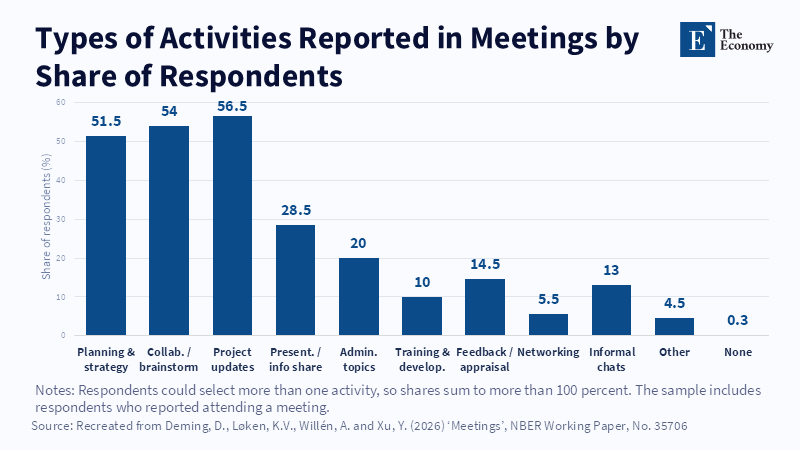
Data from Norway show, first and foremost, what work meetings are for in a modern business. The most common activities are planning and strategy, collaboration and problem-solving, updating project progress and exchanging information, while administrative work, networking and informal conversation come much further back. This mix remains almost the same across occupations, industries and forms of work, and managers and highly skilled professionals spend significantly more time in meetings than the rest. About a fifth of the variation in weekly meeting hours is explained by the company itself, and the corresponding link to the perceived productivity of meetings is much weaker.
Rothbard gives an example that explains why roles with great responsibility bring together so many encounters: to build a semiconductor, it is not enough to have one person in a garage, and every improvement in the chips results from the interaction of many specialties. As the work becomes more specialized and interdependent, the knowledge is dispersed among more people, and someone has to bring it to the same table. Wharton Professor Matthew Bidwell argues that rules can ensure some coordination, but the more complex the issue, the longer people need to sit together, since direct communication conveys body signals and tone faster and more completely.
This is where the most interesting dimension arises. A good meeting leaves behind a decision and perhaps a better understanding between two colleagues, and this benefit seems small when viewed individually. But when good meetings are repeated week after week, information flows, relationships, and problem-solving ways accumulate, and researchers describe just that as an investment in organizational capital. Research doesn't separate good from bad meetings, so the conclusion that the benefit comes from the former remains an interpretation, not a measurement.
Wages, Income and Learning: What the Data Show
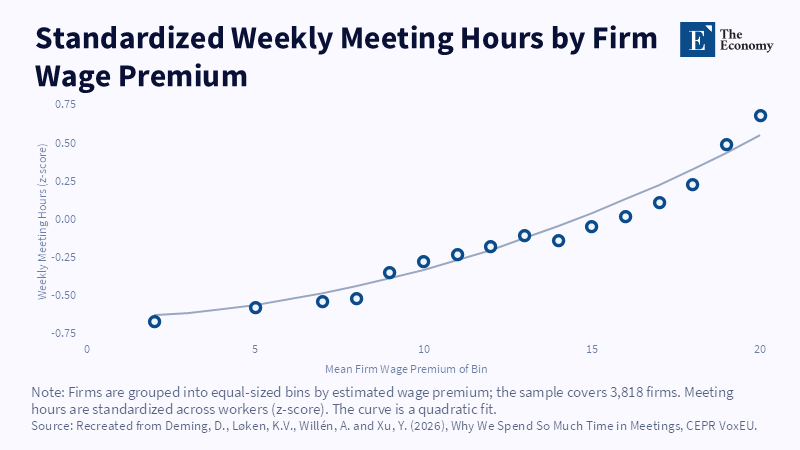
At the company level, the picture from the 3,818 companies with an available salary bonus estimate is unexpected for those who consider meetings a waste. Meetings are more frequent in companies with higher firm wage premia, higher revenues and higher revenues per employee. The firm wage premium is of particular importance because companies that pay well have a higher opportunity cost for each hour that brings together the same people, and yet they meet more, not less. Measures of the work climate, such as clarity of roles, shared responsibility and support within the team, are hardly linked to financial results, which makes it difficult to interpret that meetings simply accompany a better working environment.
At the employee level, those who spend more time in meetings experience faster salary increase, even after checking for the characteristics of the person, occupation, industry, business, and starting salary. Meeting time is more strongly associated with this increase than other uses of working time, including concentrated individual work, administrative tasks, education, commuting, and email. Workers in multi-meeting environments also report greater learning at work, and the picture agrees with the idea that knowledge spreads where people talk to each other in real time.
The obvious objection is that correlations do not prove causality, and the researchers themselves recognize it: employees with greater competence or more complex responsibilities may simply end up in positions with many meetings, and companies that use them intensively may differ in other unobservable characteristics. The objection has weight, but two patterns in the data are nevertheless consistent with the investment interpretation. The same standard applies where employee time is more expensive, and it applies while the working climate remains essentially unrelated to the results. A bit of uncertainty, however, is not eliminated by either observation.
What Does this Mean for Managers and Teams?
For managers, the first practical conclusion concerns measurement: a team's calendar can be classified into meetings that reach a decision and meetings that convey information, and the latter are the first candidates for replacement by text message. Norway's average of 4.7 hours, or 12 percent of the time, is within the 15 percent threshold proposed by Lencioni, while 14 percent of wage costs are higher because the most highly paid workers meet more. A company that exceeds these percentages without being able to show what decisions or coordination resulted has reason to suspect that some of those hours belong to the category of bad meetings.
The second conclusion concerns the composition of the room. Schwarz's question about who really depends on whom reduces the number of guests before the meeting begins, and the agenda formulated as a question gives those present a reason to speak instead of silently listening to the supervisor. For HR departments, the finding of learning and salary increases has a different meaning, since those who are systematically excluded from meetings where the real issues are discussed may also lose the source from which their knowledge grows. Given that the finding is descriptive, the solution is not to add people at all, but to check who is invited and why.
At 4.7 hours per week and 14 percent of payroll spending, every discussion about work meetings finally returns, and the Norwegian survey shows what is behind these numbers in companies with high wage premia and high revenues per employee. But it does not show how many of these hours were good, because firm effects explain much less variation in perceived meeting productivity than in meeting intensity. This means that the quality is decided by each meeting, with its purpose, people and agenda, and not by the culture of the entire company. If what emerges from the data also applies to businesses that were not measured, 14 percent of the wage bill will only be an investment where someone has checked what is left of the last hour.
This article reflects the analytical judgment of The Economy Editorial Board and does not constitute policy advice or the official position of any affiliated institution.
References
Deming, D., Løken, K.V., Willén, A. and Xu, Y. (2026) ‘Why we spend so much time in meetings’, VoxEU, Centre for Economic Policy Research, 19 September. CEPR
Knowledge at Wharton (2015) ‘Meetings: The Good, the Bad and the Ugly’, Knowledge at Wharton, 16 September. Knowledge at Wharton
Loehnert, T. (2023) ‘Meetings aren’t bad. We are bad at using meetings’, Medium, 3 November. Tdpeterson1980
The Economy Strategy Review (2026) ‘The Hidden Balance Sheet: Measuring Firm-Specific Intangible Assets Before They Break’, The Economy Strategy Review.
Swiss Institute of Artificial Intelligence (2026) ‘How Firms Build AI Workforce Capability’, SIAI Research.
Working across research, policy, and data-driven analysis, the Editorial Board ensures that published pieces reflect a consistent institutional perspective grounded in quantitative reasoning and long-term structural assessment.