Europe Joined the AI Race: The Real Gap Is Scale

Authored On
Modified
Europe has adopted AI; scaling remains the harder challenge
Capital depth and fragmented markets constrain international expansion
Vertical AI wins through distribution, retention and capital efficiency

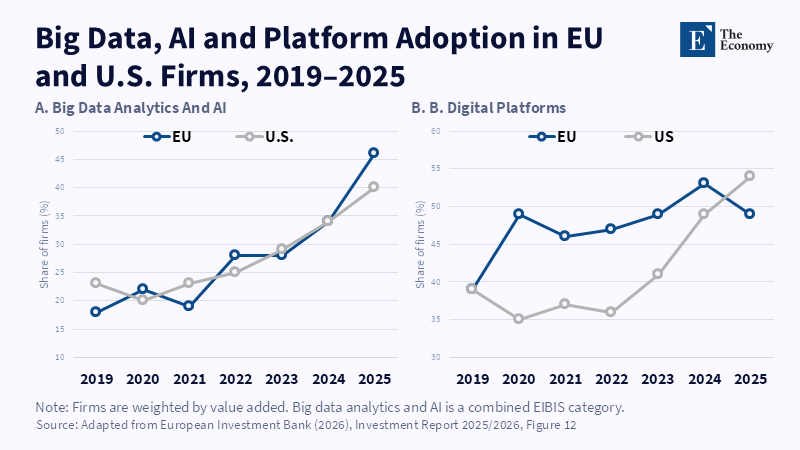
Europe has largely moved beyond the question of whether companies will adopt AI. The harder question is whether that adoption can produce globally competitive businesses. In 2025, 46% of businesses in the European Union used big data analytics and AI, compared to 40% in the U.S., according to the European Investment Bank. For AI in Europe, the finding changes the starting point of the debate, without demonstrating technological superiority. This is a combined category of technologies, not an exclusive measurement of artificial intelligence. The European economy now has companies that use these tools in their daily operations, beyond research laboratories and first tests. But there is still a long way to go between buying a tool and creating a company that can serve customers internationally, finance its expansion and maintain a competitive product. For founders and investors, that's where the next problem lies. The spread of use creates potential customers for European AI companies. It does not ensure that these companies will get the size or commercial networks they need to tap into demand.
AI in Europe Is Moving Beyond Experimentation
The economic significance of this diffusion is beginning to become measurable. The European Investment Bank estimates that the use of big data and AI contributed to about 12% of aggregate total factor productivity gains between 2019 and 2025. The percentage describes an estimated contribution to the increase, not an equal increase in productivity. For a business looking at the software market, the useful consequence is specific: the technology can be justified in economic terms, as long as it improves a task that already costs money. The supplier therefore needs to demonstrate what changes after installation, how long it takes to adapt and what part of the savings remains after infrastructure and support have been paid for. The ability to produce an impressive result in a test has limited commercial value when daily use requires constant correction by the customer.
Funding reflects interest, albeit with strong concentration. According to Crunchbase data presented by Gené Teare, European startups raised $17.6 billion in the first quarter of 2026, with $9.2 billion going to AI companies. The amounts are for Europe, including the UK and not just the European Union. In the same period, the number of deals fell by 40% year-on-year. The increase in total funds therefore does not mean that an ordinary founder found easier access to funding. Large transactions can change the picture of the entire quarter, while smaller companies are still competing for limited attention. For AI in Europe, this concentration requires a closer reading of the investment recovery and leaves open the question of funding those who already have a product but need time to prove repeat sales.
The depth of use also remains uneven. Among businesses using big data and AI, the European Investment Bank reports that 55% of EU firms using big data and AI invest in generative AI in at least two business areas, compared with 81% in the U.S. In a different survey, Alexander Bick and colleagues found that 43% of U.S. workers at the beginning of 2026, compared with an average of 32% across six European countries. The second comparison concerns employees and a limited set of countries. It does not negate the first, but prevents the easy generalization that Europe has covered all distances. For software vendors, the metrics indicate different commercial opportunities: the initial purchase of a tool can be followed by an expansion to more functions, as long as the first application proves useful. Growing within an existing customer requires working with their management and making changes to their processes, not just additional licenses.
The Funding Gap Widens at Scale
As the use expands, the more important the ability of suppliers to finance their next phase becomes. The European Investment Bank estimates the annual financing gap vis-à-vis the U.S. at around €120 billion for start-ups and growing businesses, including €80 billion at the scale-up stage. This is a comparative estimate, not a sum of rejected applications. The size shows the difference in funding available, without suggesting that any additional investment would be profitable. A company that has acquired stable customers now needs capital to hire a sales team, support facilities in other countries and endure the time between the first contact and the signing of a large contract. These costs precede revenues and are often not covered by a small upfront funding, even when the demand for the product is real.
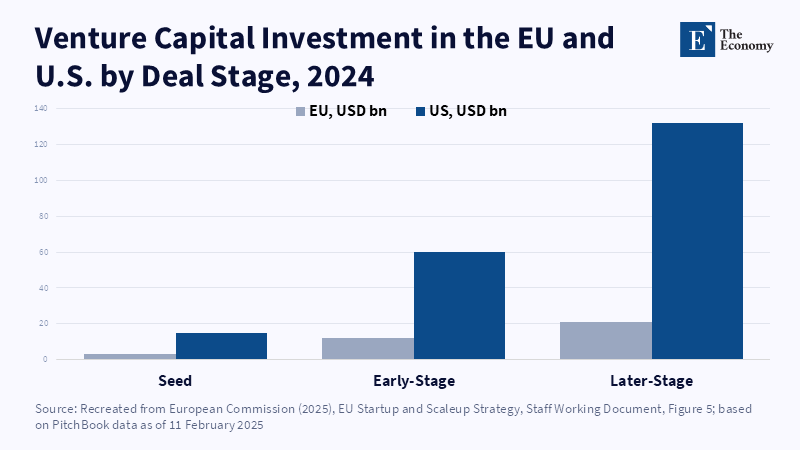
The bigger picture agrees with this difficulty. Josh Lerner records European venture capital investment of €66.2 billion in 2025, about 22% of the American total. The figure covers Europe, not the EU alone. A reasonable objection is that good companies can raise money from anywhere, so the origin of the investor matters little. Indeed, a U.S. investor can provide access to customers and useful experience of international expansion. Reliance on a narrower group of financiers, however, limits the options available when a new round is needed. The challenge for AI in Europe is for founders to be able to compare reliable proposals and choose the geography of growth based on commercial criteria. Raising foreign capital does not automatically entail a loss of European activity, just as European funding does not guarantee that a company will remain competitive.
A Fragmented Market Raises Expansion Costs
The lack of large funding rounds is linked to how easily a company can grow after the round. In the European Investment Bank's survey, 62% of EU businesses report difficulties in intra-European exports due to fragmented rules. For a software company, entering a new country may require tailored contracts and different procurement processes, in addition to translating the product. If each new market needs almost a separate commercial and operational setup, the development costs remain high even when the technology is replicated cheaply. The single market gains practical value when the experience from the first customer can be reused for the next, without the business rebuilding the sales and service process each time. This is where regulatory simplification can reduce the financing needs of an expansion.
Similarly, the ability to go public or sell a stake affects the funds investors raise for future placements. When the exit remains uncertain, committing money for many years becomes more difficult, particularly for organizations that need to explain to their own financiers when returns are expected. The debate on AI in Europe therefore needs to link the company's financing to the operation of the entire investment cycle. More subsidies at the beginning do not secure buyers for a mature participation. Not even a high valuation in the last round means that there is sufficient revenue to support it. For founders, the practical priority is to plan the expansion based on sales costs and service needs, leaving room for delays, rather than assuming that the next round will cover any deviation. This should influence the choice of the second market.
Public Funding Needs Private Follow-On Capital
European policy has begun to address the growth phase more directly. On 4 August 2026, the European Commission announced that the legal set-up of the Scaleup Europe Fund has been completed, with EQT as its manager and a target of raising €5 billion. The target does not equate to an amount already invested. The initiative involves public and private investors and covers critical technologies, including AI. Its usefulness will be judged by the companies that will be able to implement development plans that would otherwise be postponed or restricted. A large publicly backed fund can broaden funding options, but it needs to be positioned on terms that allow other investors to participate in subsequent rounds as well. Public presence is of greater value when it helps to shape recurring investment activity around companies with convincing demand, without substituting for their commercial evaluation.
The objection that more money may simply inflate valuations deserves attention. The concentration of funding recorded by Crunchbase shows that rising total amounts can coexist with fewer transactions. It is therefore not enough to announce larger funds and consider the problem of access solved. The assessment of public participation needs to consider whether it attracts additional private capital and whether the funded companies generate revenues that hold up after initial support. Investment discipline also requires the ability to reject a firm with weak customer retention, even if it operates in a politically desirable industry. Governments can also reduce barriers to cross-border sales so that the same amount of funding covers more real expansion. A fund that constantly finances the costs of fragmentation will constantly need support, while its companies will still face the same commercial problem.
Vertical AI Is Judged on Distribution and Revenue
For investors, a significant opportunity lies in vertical AI applications that solve specific problems in industries such as real estate, financial services and industry. Advanced models remain important, but a startup can create a useful product by leveraging existing technology as long as they understand the process they want to improve. Investment evaluation must then go beyond the AI label.It needs to consider customer retention, capital efficiency and whether margins remain satisfactory after computational and human-support costs. Access to distribution networks can prove to be just as demanding as software development. International expansion needs to be included in the initial design, along with clear limits on customizations per customer.
Zing Coach and Placy show two different applications of this logic. Zubr Capital, of which the author is the founder and CEO, has invested in both companies. Zing Coach's partnership with Paris Saint-Germain illustrates one route to an established international audience. The partnership alone does not prove profitability or long-term subscriber retention. Placy, funded by Zubr in 2024, develops AI tools for real estate agencies. Its value must be judged on the time that professionals save and whether they continue to pay for the service. The examples explain the investment rationale, without proving that these companies have already solved the problem of international growth. This remains the subject of commercial execution and control of their actual results.
The initial indication of widespread use of AI technologies in Europe therefore matters as a basis for potential demand. For European companies to gain a stable position in this market, they need customers who convert trials into contracts and investors who can finance the expansion when contracts start to repeat. Founders have a responsibility to show that revenue growth does not require a proportionate increase in manual support. Policymakers need to make it easier to sell the same product in more countries by maintaining clear rules for its use. The European fund aimed at €5 billion adds a financing option, the return on which will be seen in the investments and businesses that will follow. The next substantial sign of progress will be the ability of these companies to renew international contracts and finance subsequent rounds of growth, with revenues that justify the funds they are requesting.
The views expressed in this article are those of the author and do not necessarily reflect the views of The Economy, its Editorial Board, or any affiliated institution.
References
Bick, A., Blandin, A., Deming, D., Fuchs-Schündeln, N. and Jessen, J. (2026) ‘Differences in AI adoption in Europe and the US: Explanations and implications for productivity growth’, VoxEU, 9 April.
European Commission (2026) ‘Scaleup Europe Fund to start making investments’, 4 August.
European Investment Bank (2026) Investment Report 2025/2026: Capitalising on Europe’s Strengths. Luxembourg: European Investment Bank.
Lerner, J. (2026) ‘The venture capital challenge for Europe’, VoxEU, 20 February.
Teare, G. (2026) ‘AI Drives Europe’s Second Straight Quarter of Funding Gain as Deal Volume Falls Sharply’, Crunchbase News, 14 April.
Zing Coach (2026) ‘Paris Saint-Germain partners with Zing Coach until 2027 to encourage fans to get active through interactive fitness experiences’, 6 January.
Zubr Capital (2024) ‘Real Estate Startup Placy Raises €1M in Pre-Seed Funding from Zubr Capital’, 3 September.