Workplace Flexibility and the Return-to-Office Reversal for American Mothers

Working across research, policy, and data-driven analysis, the Editorial Board ensures that published pieces reflect a consistent institutional perspective grounded in quantitative reasoning and long-term structural assessment.
Authored On
Modified
Workplace flexibility helped mothers sustain employment after COVID-19
Return-to-office mandates coincided with renewed employment retrenchment
Care responsibilities make inflexible work disproportionately costly for women
Between January and June 2025, about 212,000 American women over the age of 20 stopped working or looking for work, while the male labor force increased by 44,000 over the same period, according to an analysis of federal labor data from the Washington Post. The reversal hit mothers of young children hardest, whose labor force participation fell from 69.7% to 66.9% in six months, the steepest six-month decline in more than three years. The timeline aligns closely with a separate change: full-time office requirements among Fortune 500 companies nearly doubled over the same period, rising from 13% to 24%, according to the Flex Index workplace tracker. Two numbers rarely move so clearly. Flexibility in the workplace, or its sudden absence, has become a significant predictor of whether the women who fueled the labor market recovery in the pandemic era will continue to appear in it.
Workplace Flexibility and Women’s Labor Supply
Bureau of Labor Statistics data shows that women's labor force participation increased for most of the twentieth century, then stabilized around the late 1990s and has rarely exceeded that level since. The stall widened the gap between the United States and other wealthy economies. An essay by Sandra Black, Diane Whitmore Schanzenbach and Audrey Breitwieser, published by the Hamilton Project at the Brookings Institution, found that women's labor force participation in the United States declined from sixth to seventeenth place among twenty-two OECD countries between 1990 and 2010, even as most peer nations continued to rise. Francine Blau and Lawrence Kahn, writing in the American Economic Review, identified much of this discrepancy in family policy: paid time off, subsidized childcare and the right to reduce hours without a steep pay penalty, all more generously abroad than in the United States. Flexibility in the workplace, in other words, is not a privilege above a functioning labor market. For three decades, it served as one of the few levers available to women by balancing paid work with caring responsibilities that still weigh much more heavily on them than on men.
The absence of a federal paid leave mandate, piecemeal childcare subsidies and a labor market that rewards continuous, in-person presence over flexible arrangements left millions of women to choose between reduced hours, with wage costs that researchers have documented for decades, or abandoning paid work altogether. For most of this period, flexibility was something that individual employers provided on a case-by-case basis, usually to a narrow group of senior professionals, rather than something embedded in the way most jobs were structured. This arrangement remained largely unchallenged for decades, until an unplanned experiment forced employers to test it on a scale no one had chosen. Few had a reason to know what would happen if this scale was changed at once.
COVID-19 Temporarily Relaxed the Constraint
The COVID-19 recession in 2020 initially cost women more jobs than men, was concentrated among workers in high-contact service occupations such as restaurants, retail and hospitality, where remote work was never an option and was exacerbated by school and daycare closures that forced many mothers to give up paid work to supervise children learning from home. Bureau of Labor Statistics data for that year shows that women's employment declined faster and more than men's in the early months of the pandemic recession, a reversal of the usual pattern in which women's employment tends to be less susceptible to declines. What followed was contrary to expectations based on decades of stagnant participation.
By 2023, participation among prime-age women had rebounded and then advanced further, setting records. A subsequent analysis of Census Bureau data by KPMG found that labor force participation among university-educated mothers with children under five was approaching 80 percent that year, a level unmatched in the series. Overall, prime-age women's labor force participation reached 78.4 percent in August 2024, the highest level on record, according to research by the Hamilton Project. What changed wasn't a sudden expansion of childcare capacity or a new federal law on leave. What changed was that workplace flexibility, forcibly expanded in 2020, then remained and gave millions of workers control over where and sometimes when their hours were performed, decoupling the flexibility required by care from the penalty of reduced hours that has always been associated with it.
Return-to-Office Mandates Reverse the Gain
The reversal began quietly in 2023 and accelerated through 2025. Jones Lang LaSalle's mid-year office market research found that the share of Fortune 100 companies requiring full-time, five-day office presence increased from 5 percent in 2023 to 54 percent in 2025, while the percentage offering hybrid arrangements fell from 78 percent to 41 percent in the same two years. Pew Research Center surveys of employees whose jobs can be done from home found that the percentage reporting a formal requirement to be in the office increased from 63 percent in early 2023 to 75 percent in late 2024. Amazon, Disney and JPMorgan Chase were among the major employers that eliminated hybrid options during this period and in January 2025 the federal government, the nation's largest employer, ordered its own workforce to return to a five-day office schedule.
The Pew survey also found that women, workers under fifty and full-time work-from-home workers were the groups most likely to say they would look for a new job rather than quit remote work altogether and nearly half of today's remote workers said they would be unlikely to stay in their jobs if that option disappeared. The mismatch mattered because remote-enabled jobs are concentrated in the same professional and managerial occupations where women's earnings had been concentrated post-pandemic, meaning that workers who were most willing to quit due to flexibility were disproportionately the ones driving participation gains that mandates are now easing. The shift therefore created a test of how strongly employment depended on flexibility. By 2025, the sharpest retrenchment was appearing among mothers.
Why Inflexibility Matters Most for Mothers
Between January and June 2025, a Washington Post analysis found that labor force participation among mothers aged 25 to 44 with children under five fell to its lowest level in three years. KPMG's October analysis of the same population, a subsequent KPMG analysis, showed that participation among mothers of very young children with a university education fell to 77% in August 2025 from a high of near 80% two years earlier, even though participation among fathers in the same demographic group increased slightly. Nestler's report linked the pattern to a conflict between return-to-office programs and a childcare market that hasn't recovered: pandemic-era federal childcare funding expired in 2023 and the sector remains about 100,000 workers away from where continued support would leave it, pushing prices up to nearly double the rate of overall inflation. Nestler's analysis argues that when a family's work schedule and care arrangement stop aligning, it's typically the mother, not the father, who cuts back hours or leaves paid work.
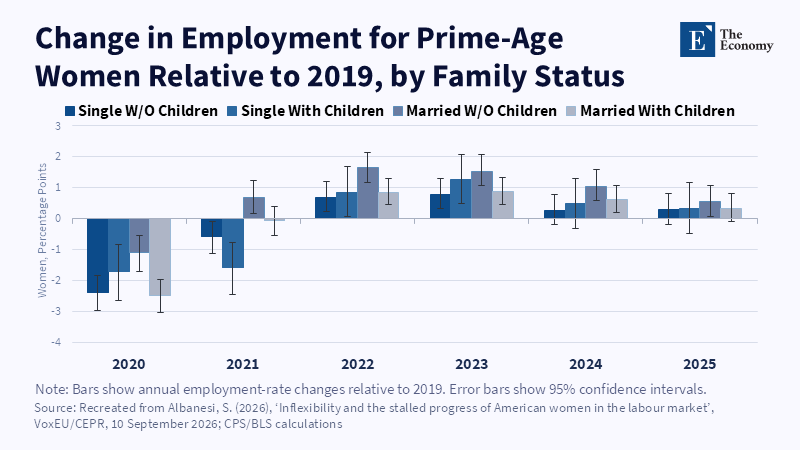
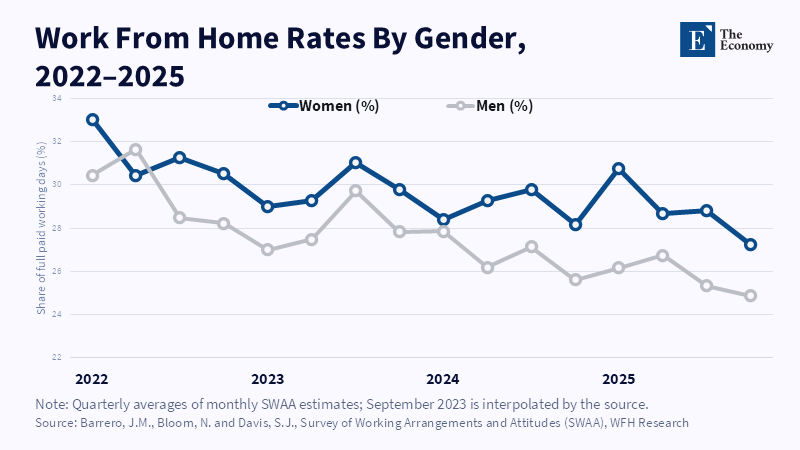
The Bureau of Labor Statistics' time-use data directly captured the gender divide. Among workers who did some work from home on workdays, men's share fell from 34 percent in 2023 to 29 percent in 2024, while women's share remained stable at 36 percent both years. Men returned to the office in larger numbers as orders became stricter. Women mostly didn't and 2025 labor force data suggests that the 2025 participation data are consistent with flexibility becoming a binding constraint for some women, although aggregate data cannot identify each worker’s reason for leaving. The gap says less about ambition or weakening attachment to paid work than it does about a caring load that hasn't shifted even as employer expectations reverted to a 2019 baseline based on the assumption that someone else is handling school pickup.
The Visibility Trade-Off of Remote Work
Executives pushing for full-time employment often argue that orders serve the interests of women as much as anyone else. KPMG's 2024 CEO Outlook survey of more than four hundred CEOs found that 86% planned to reward employees who showed up in person with better assignments, raises and promotions, a finding that some of the same executives have read as evidence that being in the office accelerates careers rather than delays it. UC San Diego researchers, who study gender differences in management at the University of California, San Diego, offered a more complex picture in an interview with the university's news service. Campbell noted that women continue to shoulder most caring responsibilities regardless of where the office is located and that remote and hybrid arrangements make it easier to maintain that balance rather than signaling a weaker commitment to a career. Lyons pointed out a distinct risk: employees who remain remote while their colleagues return in person may lose visibility for informal opportunities, including coaching and high-profile assignments, which often decide who gets promoted.
The KPMG survey shows how executives intend to reward office visibility, not whether attendance itself causally improves women’s careers., participation among the women most impacted by the new orders should have increased with them rather than decreased. It didn't. The same eighteen months that produced the steepest increase in Fortune 500 and Fortune 100 office requirements were those in which mothers of young children left paid work at the fastest rate since the pandemic began. Nor is the underlying productivity hypothesis as settled as the mandate's announcements suggest: economists at the Bureau of Labor Statistics found that overall factor productivity growth correlated positively with the share of remote workers in sixty-one private sector industries between 2019 and 2022, a relationship that was maintained even after calculating pre-pandemic trends. The practical implication for employers is that an order that eliminates workplace flexibility solves a visibility problem for some workers while creating an exit problem for others and the number that should matter to a CEO weighing that trade-off is the talent retained, not the number of workers in a building on a given Tuesday. For lawmakers, the same eighteen months have argued that public investment in childcare and paid leave now carries more weight than when employer-provided flexibility quietly did some of that work.
The 212,000 women who left the workforce in the first half of 2025 were not, for the most part, choosing between career and family in the abstract. They were leaving during a period when workplace flexibility was being withdrawn while childcare constraints remained severe: the withdrawal of workplace flexibility that had briefly left a school schedule, a childcare waiting list, or a household budget that stopped working when someone had to be home until three to fit in alongside a paid job. Whether this reversal turns out to be temporary, as the 2020 recession did, or lasting, as the plateau did after 1997, depends on decisions that have yet to be made, on companies still deciding how many days to take and on a Congress that has spent three decades refusing to legislate the paid leave and childcare support that most of its peer economies have long since settled.
This article reflects the analytical judgment of The Economy Editorial Board and does not constitute policy advice or the official position of any affiliated institution.
References
Albanesi, S. (2026) ‘Inflexibility and the stalled progress of American women in the labour market’, VoxEU, Centre for Economic Policy Research, 10 September.
Aron-Dine, A., Bauer, L. and Powell, E. (2025) ‘Seven economic facts about prime-age labor force participation’, The Hamilton Project, Brookings Institution.
Bhattarai, A. (2025) ‘Mothers are leaving the workforce, erasing pandemic gains’, The Washington Post, 11 August.
Blau, F.D. and Kahn, L.M. (2013) ‘Female labor supply: Why is the United States falling behind?’, American Economic Review, 103(3), pp. 251-256.
Bureau of Labor Statistics (2026) American Time Use Survey: 2025 Results. Washington, DC: U.S. Department of Labor.
Clark, C. (2025) ‘Is the Return to Office Leaving Women Behind?’, UC San Diego Today, 12 August.
JLL (2025) United States: Office Market Dynamics, Q2 2025. Jones Lang LaSalle.
KPMG (2024) 2024 U.S. CEO Outlook. KPMG LLP.
KPMG (2025) ‘The great exit: College-educated mothers of young children leaving the labor force’, KPMG Economics, 1 October.
Pabilonia, S.W. and Redmond, J.J. (2024) ‘The rise in remote work since the pandemic and its impact on productivity’, Beyond the Numbers: Productivity, 13(8). U.S. Bureau of Labor Statistics.
Pew Research Center (2025) ‘Many remote workers say they’d be likely to leave their job if they could no longer work from home’, 13 January.
Pew Research Center (2026) For Working Parents, the Boundary Between Work and Family Is Often Blurred, 16 June.
Working across research, policy, and data-driven analysis, the Editorial Board ensures that published pieces reflect a consistent institutional perspective grounded in quantitative reasoning and long-term structural assessment.