Economic Cost of War in Ukraine: The Hidden Productivity Collapse

Working across research, policy, and data-driven analysis, the Editorial Board ensures that published pieces reflect a consistent institutional perspective grounded in quantitative reasoning and long-term structural assessment.
Authored On
Modified
War destroyed capital, labor and allocation efficiency
Misallocation compounds losses beyond visible physical destruction
Rebuilding Ukraine’s productive base could take decade
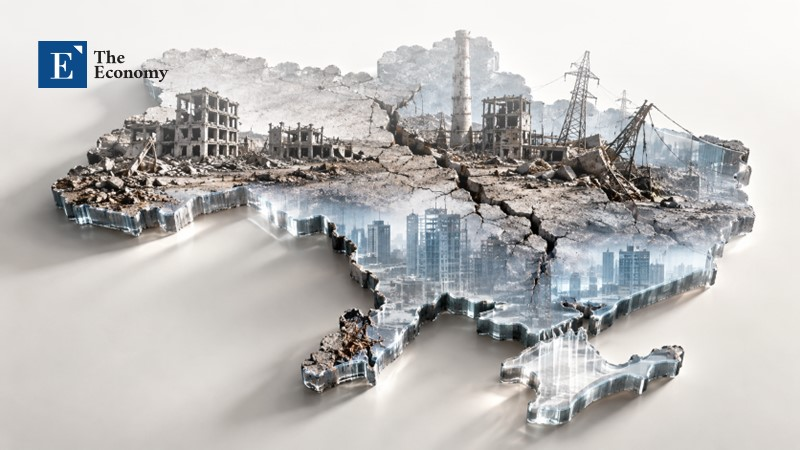
By 2024, allocative productivity in Ukraine had fallen about 20 percent below the 2021 level, according to an analysis of enterprise-level financial data by Marvin Amann, Yuriy Gorodnichenko and Oleksandr Talavera. This means that about half of the country's production losses did not come from bombs or missiles, but from the fact that surviving workers and capital ended up in low-value positions. Economic theory expresses what happened with mathematical precision: in the basic production function Y=f(K, L), Ukraine lost much of the capital K, an even larger portion of the labor force L and the remaining inputs were used less efficiently as the economy stopped effectively allocating what was left of it. The cumulative effect of these losses is less like a recession and more like a time slip: an economy that took two decades to build its base of productive inputs has found itself back toward an earlier productive scale, just four years after the Russian invasion. This is an economic cost of the war in Ukraine that rarely appears in damage estimates.
Ukraine’s Shrinking Capital and Labor Base
The figure with which most analyses of Ukraine's economy begin is the collapse of real GDP by 28.8 percent in 2022. The recovery that followed was real but slow: 5.5 percent in 2023, 3.2 percent in 2024, just 1.8 percent in 2025, according to estimates by Ukraine's Ministry of Economy. Real GDP remains about 21 percent below the pre-war level. In nominal dollar terms, the economy appears to be approaching $210 billion in 2025, according to the IMF, a figure close to 200 billion in 2021. But this nominal convergence is misleading because it ignores dollar inflation of about 19 percent in the period 2022-2025, which means that the real purchasing power of Ukrainian production remains dramatically lower.
What makes the damage structurally deep and not just cyclically deep is the scale of loss of productive inputs. The World Bank's Fifth Rapid Damage and Needs Assessment puts direct physical damage at $195 billion by the end of 2025, an 11 percent increase over a year. Housing, transportation, energy: these three sectors absorbed the most damage. Electrical generating capacity, according to the International Energy Agency, fell from 38 gigawatts before the war to just 12 gigawatts after the concentrated shock waves of spring 2024. Much of this involves the permanent destruction of units that cannot be quickly replaced and the construction market is 38 percent below 2021 levels in dollar terms, according to the GMK Center, despite a 12 percent year-over-year increase.
Beyond capital, the variable L. The study by Giacomo Anastasia, Tito Boeri and Oleksandr Zholud, published in Economic Policy, estimates that the labor force in government-controlled territories shrank by about 22 percent compared to 2021. The justification is divided into several categories: about 2.8 million workers were lost through refugee flows, 500,000-600,000 through mobilization, with additional reductions from combat losses and reduced participation. The Kyiv School of Economics places the population decline from 44,3 to 37,9 million between 2021 and 2024. The International Labour Organization estimates that the country will need 8.6 million additional workers in the coming years, a figure that reflects both war losses and a demographic downward trend that existed before them.
Misallocation as an Economic Cost of War in Ukraine
The usual discussion of reconstruction costs focuses on what was destroyed: how many buildings, how many gigawatts, how many kilometers of roads. However, the findings of Amann, Gorodnichenko and Talavera reveal a second, parallel damage channel. Using the Hsieh-Klenow methodology to measure misallocation, the researchers analyzed a balanced panel of Ukrainian enterprises for the period 2018-2024 and five reference countries. Allocative productivity was relatively stable until 2021. Then it collapsed. By 2024, it was around 20 percent below the base level, while none of the comparison countries, including Bulgaria, Croatia, Estonia, Poland and Romania, showed a similar deterioration.
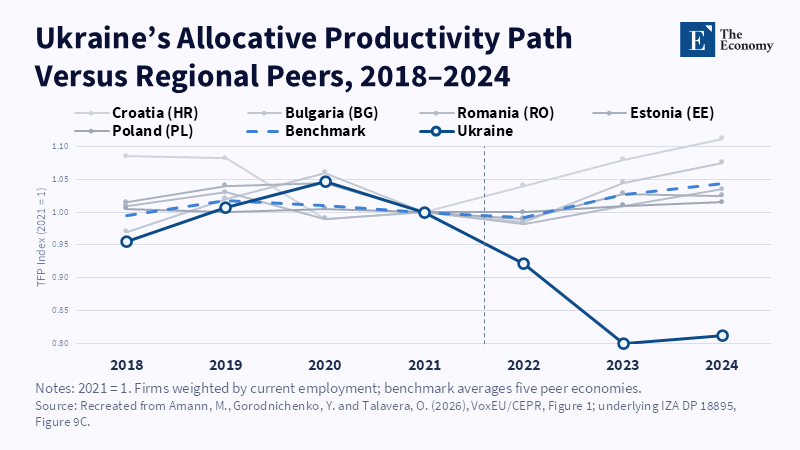
These figures mean something very specific: that even if no factories had been bombed and no workers had left, a significant part of the production capacity would have been lost anyway, because the remaining resources were no longer allocated to the right uses. Job posting data from the platform Jooble.org confirms this picture: wage dispersion within the same occupation increased by 50 percent above pre-war levels in 2023-2024, a sign that similar workers are paid drastically differently depending on where they are, not what they do.
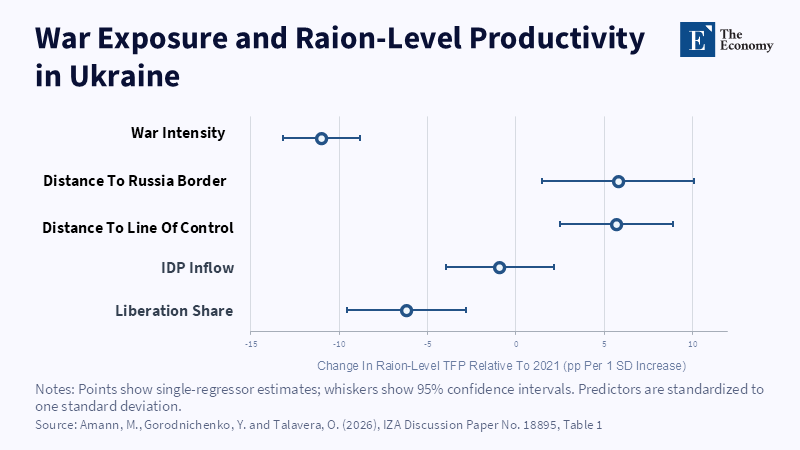
It is particularly noteworthy that the intensity of the attacks, rather than the geographical distance from the front line, determines where the damage falls in terms of effectiveness. An increase by one standard deviation in local war damage is associated with an 11 percentage point decrease in allocative productivity. The intensity of the attacks alone explains more than 60 percent of the variation in productivity losses between regions. Once the intensity is taken into account, the distance from the Russian border and the line of control becomes statistically insignificant. Kyiv is a prime example: far from the front line, under intense aerial bombardment and with corresponding productivity losses. But it deserves an important clarification: the misallocation, as opposed to destroyed capital, can theoretically be reversed without new investment, through reforms that allow workers and businesses to move to where their marginal contribution is highest. But the word "in theory" hides something enormous. Internal population displacement in Ukraine has been largely local: households have moved to the nearest region that would receive them, often an area that is still under regular attack, meaning that the displaced labor force is concentrated where its marginal output has fallen disproportionately.
Why Productivity Loss Weakens Innovation
What is often lost in the discussion of physical damage and misallocation is the third variable of the production function: the technology itself, f. When an economy receives a negative productivity shock of this scale, firms tend to abandon research and development activities in favor of short-term profitable activities. This reaction is rational at the individual level: when survival is uncertain, no firm will commit resources to an R&D program that will pay off after five years. Cumulatively, however, the impact is catastrophic.
The data for Ukraine confirm this pattern with remarkable clarity. R&D spending as a percentage of GDP has been on a downward trajectory for years, from 0.75 percent in 2010 to 0.38 percent in 2021, but the war has dramatically accelerated the decline: to 0.33 percent in 2022 and 2023, according to Ukraine's State Statistics Office. Industry innovation spending fell by 49 percent between 2021 and 2023, falling to $191 million, according to data published by the GMK Center. Spending then doubled in 2024, largely through defense R&D. This figure represents the spending of the entire industrial sector of a country of 38 million people, an amount less than the annual R&D budget of a modest multinational pharmaceutical company.
The clearest exception was defense technology. Production of drones skyrocketed from 1,200 units in 2022 to 1,7 million in 2024, according to the StateWatch think tank and production of electronic warfare equipment increased from 53 units to 34,700 in the same period. This defense innovation, while impressive, does not compensate for the pervasive collapse of non-defense R&D. In fact, it likely exacerbates it, as it diverts technical personnel and resources from activities that could improve overall productivity. At the same time, it is estimated that about 10 percent of the country's researchers had gone abroad by the end of 2022, a brain drain with long-term consequences for national innovation systems, as the literature on Nazi Germany shows. If technological progress were the variable that could compensate for losses in K and L, this compensation mechanism weakens at the exact moment it is needed most.
Why Recovery Could Take Decades
The question that arises effortlessly is how long the reversal will take. The answer is not encouraging. Yuriy Gorodnichenko and Maurice Obstfeld estimate that Ukraine needs at least $40 billion in new investment annually: $20 billion to replace damaged capital, $10 billion to keep it from falling behind Eastern European comparison countries and $10 billion to start closing the gap. The World Bank puts the total cost of reconstruction at $588 billion over the next decade, nearly three times the GDP of 2025. Growth remained weak in 2026, at 0.4 percent year on year in Q2. A broader study of a sample of 150 years and 60 countries, published in the American Economic Review, finds that a medium-intensity war is associated with a drop in production of about 10% in the host country, while major wars lead to drops of more than 30 percent five years after it began.
None of these numbers fully embodies the point about the production function. The Ukrainian economy does not just need to rebuild factories and roads. It needs to rebuild an input base, in capital and labor, that is able to produce efficiently on a scale similar to 2021. This scale assumes a population of 40+ million, an energy system capable of powering heavy industry and a market of size capable of justifying economies of scale. Instead, the country operates on a base more reminiscent of the early-mid-2000s, when nominal GDP hovered around $40-50 billion and the population, although larger in numbers, supported an economy that had not yet developed the supply chains, domestic markets and export capacities built over the next fifteen years.
This comparison is not an exact match, but it captures something substantial. An economy with 22 percent less labor, tens of billions in destroyed capital, 20 percent lower allocative productivity and R&D spending at historic lows is essentially operating at an optimization level that does not match the size or complexity it had built up to 2021. In the early 2000s, Ukraine was facing a similar problem of under-optimization, albeit from a different starting point: a smaller internal market, less sophisticated supply chains, a lower capital buffer per worker. Now the country faces the same structural obstacles again, this time lacking the population dynamism and external winds that helped then.
Experience of post-conflict reconstruction in other countries suggests that recovery, even under favorable conditions, takes decades rather than years. Poland, the most commonly cited analogy, took nearly two decades of massive foreign direct investment, EU structural funds and institutional reforms to triple its per capita income after the transition. Ukraine is starting from a worse position: greater physical destruction, a deeper demographic crisis, an energy system still recovering from severe wartime damage and an ongoing conflict. The business activity expectations index returned below neutral in August 2026, at 48.3, according to the National Bank of Ukraine, which reflects the damage from the large-scale destruction of production facilities.
One possible counterargument concerns the defense industrial sector as a driver of future growth: if the war industry becomes the core of a new industrial model, perhaps Ukraine will be able to turn its combat capabilities into an export power. Defense company Ukrainian Defense Industry recorded a 69 percent year-on-year increase in revenue in 2023, reaching $2.2 billion, according to SIPRI. However, this picture is misleading: the defense industry employs a narrow segment of the workforce; dependence on it increases the distortion of misallocation already being recorded and experience shows that countries that rely too heavily on the war industry for their economic growth rarely achieve widespread prosperity, since defense R&D is rarely transferred to civilian applications quickly enough or widely enough to compensate for the generalized technological retreat. The Soviet Union was, after all, the most typical case of an economy that directed its best resources to defense while the civilian economy underperformed.
The all-pervasive 20 percent loss identified by Amann, Gorodnichenko and Talavera can theoretically be recovered through reforms: better housing and transport links for the displaced, war insurance for businesses, air defense as a productivity policy. But losses in capital and labor cannot. A country that took two decades, from the early 2000s to 2021, to build the base of productive inputs that the war destroyed could require decades to rebuild it, even if reconstruction begins tomorrow in ideal conditions. This recession will never show up in these popular charts showing destroyed buildings. It is hidden within the function of production, in the silent retreat of technology, optimization and scale. Four years of war set the economy back decades. The reset will not take four years.
This article reflects the analytical judgment of The Economy Editorial Board and does not constitute policy advice or the official position of any affiliated institution.
References
Amann, M., Gorodnichenko, Y. and Talavera, O. (2026) ‘The Allocative Cost of War: A View to a Kill…ing of Productivity’, CEPR Discussion Paper, No. 21886.
Anastasia, G., Boeri, T. and Zholud, O. (2026) ‘A Wartime Labor Market: The Case of Ukraine’, Economic Policy, 41(125), pp. 7–60.
Federle, J., Meier, A., Müller, G.J., Mutschler, W. and Schularick, M. (2026) ‘The Price of War’, American Economic Review, 116(3), pp. 791–827.
GMK Center (2025) ‘Innovation Spending in Ukraine Doubled in 2024 Due to Defense R&D’.
Gorodnichenko, Y. and Obstfeld, M. (2026) ‘You Only Live Twice: Financial Inflows and Growth in a Westward-Facing Ukraine’, Economic Policy, 41(125), pp. 166–229.
International Energy Agency (2025) Ukraine’s Energy Security: A Pre-Winter Assessment. Paris: IEA.
International Labour Organization (2024) ILO Support to Ukraine Recovery. Geneva: ILO.
State Statistics Service of Ukraine (2026) Gross Domestic Product of Ukraine in 2022–2025: Dynamics, Structure and Factors of Change. Kyiv.
Stockholm International Peace Research Institute (2025) The Transformation of Ukraine’s Arms Industry Amid War with Russia. Stockholm: SIPRI.
World Bank Group, Government of Ukraine, European Commission and United Nations (2026) Ukraine: Fifth Rapid Damage and Needs Assessment. Washington, DC: World Bank Group.
Working across research, policy, and data-driven analysis, the Editorial Board ensures that published pieces reflect a consistent institutional perspective grounded in quantitative reasoning and long-term structural assessment.