Anti-Foreigner Sentiment in Japan Defies Economic Logic

Working across research, policy, and data-driven analysis, the Editorial Board ensures that published pieces reflect a consistent institutional perspective grounded in quantitative reasoning and long-term structural assessment.
Authored On
Modified
Japan needs foreign workers as its population shrinks
Anti-foreigner attitudes are rising despite that dependence
Economic pressure may amplify but not fully explain backlash

Japan recorded 42.68 million international visitor arrivals in 2025, a record number of arrivals according to data from the Japan Tourism Organization. In the same year, the 2025 census recorded the largest population drop in the country's history, 3.10 million fewer inhabitants than in 2020, according to the Ministry of Internal Affairs and Communications. A country that is losing inhabitants at an unprecedented rate and that at the same time receives as many visitors as almost any other destination in the world might therefore be expected to view foreign labour and visitor spending primarily as ecomight therefore be expected to view foreign labour and visitor spending primarily as economic assets. In practice, the opposite is happening. Political discourse is hardening, permanent residency conditions are becoming stricter and a party built around the slogan "Japan First" has won fourteen seats in a matter of months. The contradiction is not accidental, it is the starting point for understanding what really fuels the anti-foreign climate in Japan.
Jobs And Security Usually Drive Immigration Backlash
Almost nowhere in the world is the arrival of foreigners accepted unconditionally. Public opinion surveys in dozens of countries consistently conclude that two fears explain most of the reaction: that newcomers will take jobs from locals and that they will make neighborhoods less safe. But where foreign capital or a foreign workforce creates visible jobs, finances infrastructure, or upgrades public services, the reaction usually subsides, sometimes to the point of reversing into an open reception. The same pattern is confirmed experimentally. Experimental evidence from the Stanford Japan Barometer found that economic framing increased support for immigration, while security and cultural-threat framing reduced it.
The same survey revealed that Japanese public opinion does not reject foreigners in general, but chooses based on specific criteria. Fifty-five percent of respondents said they favored prospective immigrants from the United States and Germany, fifty-one percent favored Vietnamese, forty-eight percent favored South Koreans, while the percentage dropped to thirty-seven to thirty-nine percent when it came to candidates from China. Language proficiency, level of education and industry of employment weighed equally heavily on the decision. In other words, it is an audience that reacts to motivation and information, not to a non-negotiable ethnic barrier. This is precisely what makes it harder to explain why Japan, an economy that is as dependent as few on foreign labor, ended up heading toward the most severe policy shift in decades.
Japan's Labour Shortage Weakens The Jobs Argument
The number of foreign workers in Japan reached 2.57 million in October 2025, an increase of 11.7 percent over the previous year and a record for the thirteenth year in a row, according to data from the Ministry of Health, Labor and Welfare. The total foreign resident population exceeded 4.1 million at the end of 2025. These numbers do not reflect any sudden attraction to the country; they reflect a demographic need that leaves no room for choice. The country's working population is shrinking every year, births remain at the lowest levels since records began and industries such as manufacturing, aged care and construction are now largely operating thanks to workers who were not born in the country.
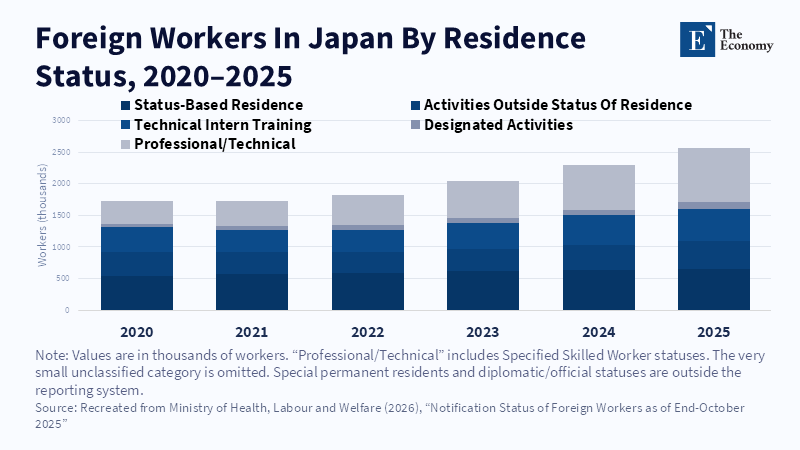
In other words, much of the growth in foreign employment is occurring in sectors already facing persistent labour shortages. This weakens one of the two main arguments that usually fuel the reaction to immigration internationally. Nevertheless, the political debate did not follow this logic. The Innovation Party of Japan and Sanseito openly called for a cap on the percentage of foreign residents in the total population during the February 2026 election campaign, while the government, although it did not adopt such a limit, paved the way for discussion around it through an advisory committee it set up. The need for labor and the political will to limit it are now moving in opposite directions.
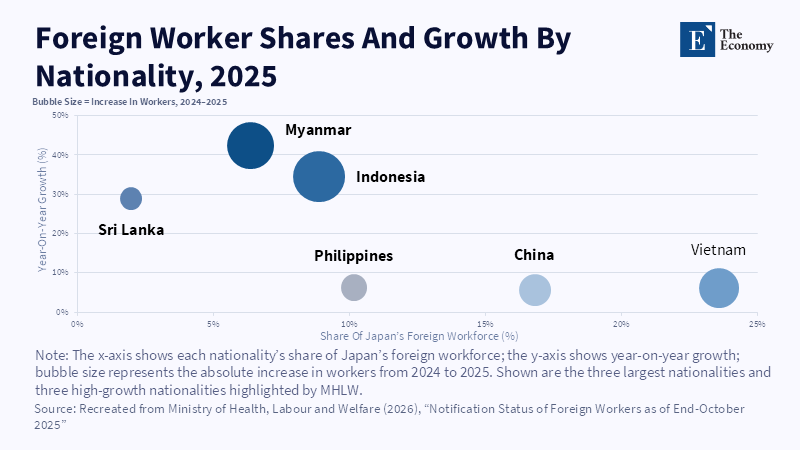
Anti-Foreigner Sentiment In Japan Hardens Despite Economic Need
In 2025, Sanseito, a party that built its identity around the anti-immigrant slogan "Japan First", won fourteen seats in the Upper House elections, a result that showed for the first time that an openly anti-immigration platform can garner significant popular support in the country. This momentum also carried over to the Lower House elections in February 2026, where the Liberal Democratic Party won a landslide victory in the February 2026 Lower House election while hardening its stance on immigration. The Takaichi government has since proceeded with a series of measures that would have been unthinkable a decade ago. From 1 October 2026, the permanent-residence application fee will rise from ¥10,000 to ¥200,000 (about US$63 to US$1,267) and the minimum period of residence for naturalization will rise from five to ten years.
Public opinion followed the same direction, or perhaps preceded it. A telephone poll by Asahi Shimbun in November 2025 recorded that 66 percent of respondents viewed Takaichi's tougher immigration policy positively, while 56 percent said the country needed fewer visitors and fewer immigrants. A separate survey of 1,500 Japanese adults, conducted immediately after the February elections, found that about two-thirds support stricter rules for buying land from foreigners and expect foreign residents to follow Japanese customs. These attitudes were not uniform, the younger generations appeared clearly more tolerant, but the general climate leaves no doubt about the direction in which the public debate is moving.
Tourism And Public-Safety Fears Extend The Backlash
If the backlash towards permanent immigrants could still be attributed to fear of competing for jobs, hostility towards tourists has no excuse. The forty-two and a half million visitors who arrived in the country in 2025 are not claiming any jobs, they just leave money and leave. However, the Japanese tourism industry is steadily moving towards measures that look like an extension of the same anti-foreign climate, explicitly targeting foreign visitors. Himeji Castle, a UNESCO World Heritage site, increased the ticket price for non-residents from one thousand to two and a half thousand yen in March 2026, keeping the price for residents unchanged. The Japan Tourism Organization is now preparing national guidelines for double pricing in dozens more places, following a pilot program that increased revenue by twenty percent.
In Fujikawaguchiko, a local authority installed a barrier to block the view of Mount Fuji from a point where tourists crowded for photos, while in Kyoto's Gion district, signs were posted warning of a fine of ten thousand yen to anyone who photographs geisha and maiko without consent, with private streets in the neighborhood now completely closed to visitors. A 2025 JTB survey found that 68 percent of Japanese support double pricing, not just as a revenue tool but as a way to put a limit on the presence of foreigners in public space. The moment when a country begins to build barriers so that its visitors cannot see it is the moment when the explanation of competition for jobs ceases to stand and something more pervasive than mere economic concern is revealed.
Economic Pressure Offers A Different Explanation
The argument of insecurity does not stand up to scrutiny any better. According to the National Police Service, foreign nationals accounted for 5.5 percent of people cleared for non-traffic Penal Code offences in 2024. Cases cleared involving foreign nationals fell from an all-time high of 43,622 in 2005 to 18,861 in 2024, a drop of about fifty percent, while the foreign resident population almost doubled over the same period. The long-run total remains well below its 2005 peak, although cases increased again in 2023 and 2024. Despite this decline, a survey by the same police agency in October 2025 found that 79.7 percent of respondents believe that public safety has deteriorated over the past decade, a percentage up 3.1 points over the previous year's corresponding survey.
The gap between what the data show and what the public thinks is not explained by the presence of foreigners per se; it is better explained by something much more domestic: declining economic prosperity. Real wages in Japan fell 1.3 percent in 2025, the fourth year in a row of declines, as inflation at 3.7 percent outpaced a 2.3 percent increase in nominal earnings, according to data from the Ministry of Health, Labor and Welfare. The price of rice, a staple food, jumped 60 percent over the same period, as reported by Julian Ryall in the South China Morning Post. Tarō Saitō, head of economic research at the NLI Research Institute, noted that inflation over the past two years has become wider and touched almost every sector of the economy. In such a climate of economic pressure, the visible stranger becomes an easier target than the invisible inflationary spiral, even when the evidence itself does not incriminate him.
Japan is not in a dead end because it does not understand what it needs. It understands better than most advanced economies that without a foreign workforce and without the income of its forty-two million visitors, its demographic crisis would be much deeper. The question is not whether the country will continue to accept foreigners, since demography itself leaves no other choice; the question is whether its institutions will be able to separate the real concern for economic prosperity from the easier narrative that one person gives to that concern. A country that once extended its influence across East Asia is now erecting barriers so that its visitors cannot see it. Whether the anti-foreigner climate of recent months proves to be a relief valve for political pressure or whether it hardens into something more permanent, it remains open and the answer will be judged not on the borders but on wages.
This article reflects the analytical judgment of The Economy Editorial Board and does not constitute policy advice or the official position of any affiliated institution.
References
Australian Broadcasting Corporation (2026) ‘Anti-immigration sentiment rises in Japan despite growing demand for foreign workers’, ABC News, 8 June.
Chai, P. (2026) ‘As Japan’s popularity booms, a new survey shows strong anti-foreigner sentiment’, The Conversation, June.
Immigration Services Agency of Japan (2026a) Number of Foreign Residents as of the End of 2025.
Immigration Services Agency of Japan (2026b) Revision of Residence Permit Fees Effective 1 October 2026.
Japan National Tourism Organization (2026) Visitor Arrivals to Japan, December and Full Year 2025.
Kobayashi, T. (2026) ‘How Japan’s anti-immigration politics runs on imported narratives’, East Asia Forum, 9 September. The publication and date are independently confirmed by Waseda University.
Ministry of Health, Labour and Welfare (2026) Notification Status of Foreign Workers as of End-October 2025.
Ministry of Justice (2026) Nationality Q&A.
Ministry of Justice, Research and Training Institute (2025) White Paper on Crime 2025.
Ronkin, N. (2026) ‘Japanese Public Sets High Bar for Immigrants’, Stanford Freeman Spogli Institute for International Studies, 30 March.
Statistics Bureau of Japan (2026) Preliminary Counts of the 2025 Population Census of Japan, 25 June.
Working across research, policy, and data-driven analysis, the Editorial Board ensures that published pieces reflect a consistent institutional perspective grounded in quantitative reasoning and long-term structural assessment.