Chinese Innovation Has Outgrown Catch-Up Industrial Policy

Working across research, policy, and data-driven analysis, the Editorial Board ensures that published pieces reflect a consistent institutional perspective grounded in quantitative reasoning and long-term structural assessment.
Authored On
Modified
Private firms and universities drive China’s critical technology patents
China already leads in batteries and solar manufacturing
Tariffs built for a follower need rethinking now
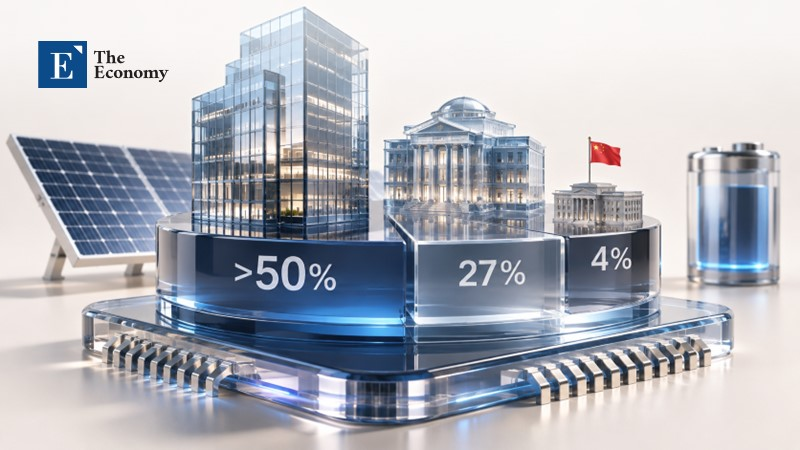
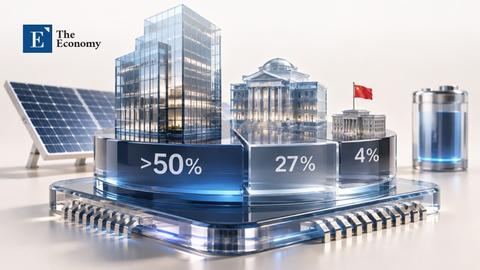
Less than 4 percent of Chinese patents in critical technologies came directly from state-owned enterprises or government agencies. This was found in a working paper published by the National Bureau of Economic Research in July 2026 that examined almost 14 million Chinese patent publications and isolated those related to the technologies designated as critical by the U.S. Department of Defense. Over half were from private companies and another 27 percent were from universities. Universities in the United States account for 3.3 percent of critical technology patents. This flies in the face of what many corporate boards and trade ministries still believe about Chinese innovation: that its patent count is manipulated and that a few companies do all the work. There is much more to the Chinese story than that. However, the implication of this is that policy in the US, Europe, Japan and South Korea has been based on China being behind.
Chinese Innovation Runs Wider Than the State Sector
The paper also investigated the two main arguments for why Chinese patents overstate Chinese capability. The first is that Chinese patents were driven by overseas Chinese who received education in the United States and returned home with their knowledge. The paper found that fewer than 10 percent of Chinese patents in critical technologies included an inventor with a background in the United States. The second argument is that Chinese patents are not as high quality because local officials were incentivized to increase their patent count. To test this, the authors used four metrics that used the text of the patent to decide its quality and found no difference between Chinese patents and U.S. patents as the Chinese patent count increased. The Information Technology and Innovation Foundation wrote in August 2026 that Chinese patents gained textual importance relative to U.S. patents in nearly all critical technology areas from 2006 to 2021 and in several areas are closer to the scientific frontier than U.S. patents.
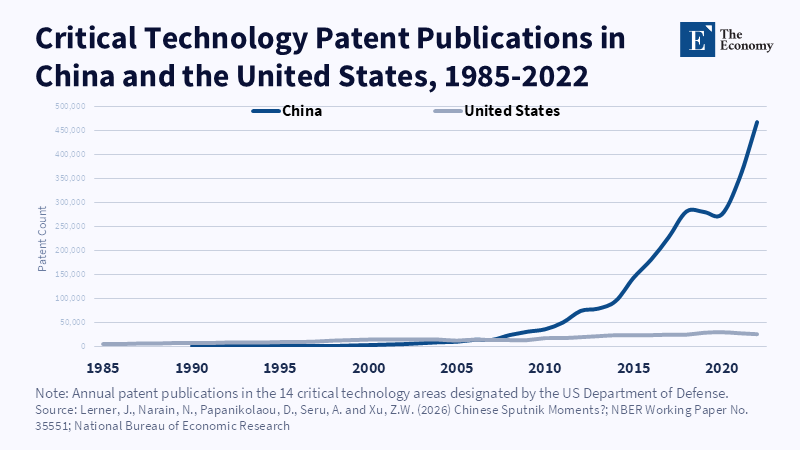
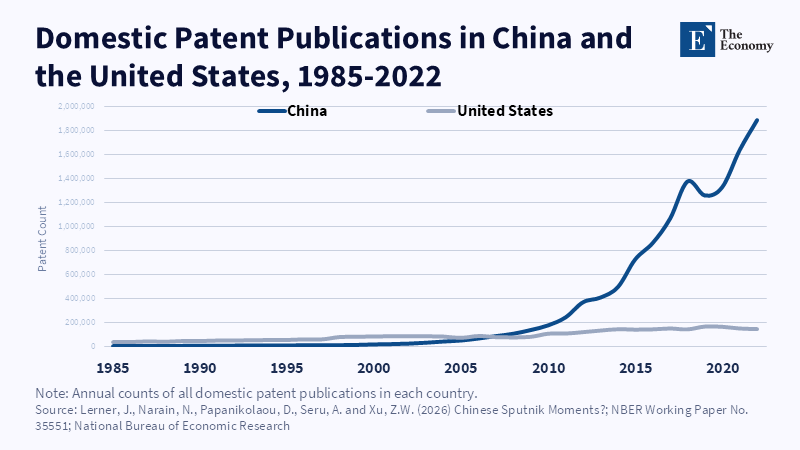
The quality of these patents is important to understand. In 2011, a VoxEU study covered 20,000 Chinese manufacturing companies and found that Huawei handled a third of the patents from those companies between 1985 and 2006, with ZTE making up another 10 percent. It concluded that China did not have a wide enough patent base to move from an imitator to innovator. Since then, that base has expanded greatly, according to the NBER paper, with many small companies and universities making up the patent count. A country with only a few key companies that produce the bulk of its patents is easy to target with export controls, as the U.S. did with Huawei in 2019. Targeting many small companies and universities will be much more difficult, though that is easier to say about patents than about the actual products those patents create.
State Money Built the Base, Private Firms Scaled It
This does not mean that the Chinese government has not played a role in its innovation. China spent 3.613 trillion yuan (approximately US$502 billion) on research and development in 2024, according to the National Bureau of Statistics. That was an increase of 8.9 percent year over year and represented 2.69 percent of GDP, which is higher than the EU's 2.11 percent and close to the OECD average of 2.73 percent. Part of that goes to universities and public research institutions. The Australian Strategic Policy Institute Critical Technology Tracker shows that the Chinese Academy of Sciences leads the world in high-impact research in 31 out of 64 critical technologies. Having 27 percent of critical technology patents from universities would mean nothing if they were never commercialized and Eurasia Group's China analyst told Fortune that commercialization rates for Chinese university patents stay low. Batteries and solar are where China has moved technology into production most successfully.
Industrial policy helped Chinese companies scale before their technology was fully developed. The International Energy Agency released a special report in 2022 that showed China invested 10 times more than Europe in new solar supply since 2011 and attributed some of the decrease in cost to Chinese government policy. It credits Chinese policy with helping to bring solar costs down by more than 80 percent. This allowed private companies to grow and learn how to produce these technologies on a scale. Western debate tends to treat Chinese industrial policy as simply giving away money, though a lot of that money allowed companies to gain experience that Western companies have not had the opportunity to gain. Of course, there were downsides to this policy as well. The IEA noted that these policies created supply-demand imbalances in the solar supply chain.
China Still Trails in Chips and Basic Research
While China may be ahead in many areas, it is not ahead in all of them. The Australian Strategic Policy Institute found that China led high-impact research in 57 out of 64 critical technologies from 2019 to 2023. However, the United States still leads in quantum computing, vaccines and medical countermeasures, genetic engineering and natural language processing. Natural language processing is a key part of large language models, which are currently seeing massive amounts of investment on both sides of the Pacific. Only 6.91 percent of China's R&D spending went to basic research in 2024, according to the National Bureau of Statistics. This suggests that while China is good at developing and creating new products, it is not as advanced in its basic research as the US. China still needs to import chips and equipment from the Netherlands, Japan, the US, Korea and Taiwan to make its advanced chips. With U.S. export controls starting in October 2022, this is something China will have to address. While China may be ahead in research papers, it is still behind in making the most advanced chips.
Suppose that China is already ahead in certain industries. CATL made up 37.9%. The figure is one company’s share, not China’s. BYD made up another 17.2 percent in 2024, according to SNE Research, a Korean company that would have no reason to overstate Chinese market share. China's market share of solar production is even higher, with the IEA finding that China produces more than 80 percent of each part in the solar supply chain, with wafers reaching 97 percent of global capacity in 2021. ASPI noted that China's lead in electric batteries is one of its clearest advantages in high-impact research. Both batteries and wafers require large amounts of automation and capital to produce, which means that cheap labor is not why Chinese firms are ahead in these industries. Assuming that China will fall behind once tariffs are implemented is something that many trade policies are built on. That assumption looks weaker if Chinese firms already lead.
Why Tariffs Don't Work Against an Innovative Country
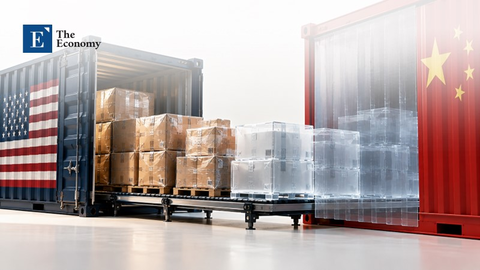
U.S. and European trade policy was built on the assumption that China was catching up. The U.S. increased its tariffs on Chinese EVs to 100 percent, EV batteries to 25 percent and solar cells to 50 percent after a four-year review by the Biden Administration. These tariffs went into effect on September 27th, 2024. The EU imposed tariffs of 17.0 percent on BYD, 18.8 percent on Geely and 35.3 percent on SAIC for five years starting October 30th, 2024, on top of its 10% tariff on cars. These tariffs were implemented because the European Commission found that Chinese subsidies gave companies an unfair advantage. The idea behind these tariffs is to give domestic companies time to build capacity. But if Chinese companies are more innovative than domestic companies, then these tariffs will not help.
China is able to produce solar at 10 percent less than India, 20 percent less than the U.S. and 35 percent less than Europe, according to the IEA's 2022 estimates. A tariff on Chinese products only increases the cost of that product for domestic companies and does not teach them to produce at the same level as China. Many companies will move their production behind the tariff wall, as BYD has done by building a car plant in Hungary.
One could argue that these tariffs have helped Korean and Japanese battery companies grow in the U.S. market. Due to incentives from the IRA, they have been able to build production in the US. However, LG Energy Solution, the largest battery company outside of China, has seen its market share drop from 13.8 percent to 11.6 percent between the first 11 months of 2023 and 2024. Meanwhile, its installations increased by 6.9 percent in that time. SNE Research even suggested that Korean battery companies need to find ways to stay competitive.
What the U.S., Europe, Japan and Korea Should Do Next
There are steps that the U.S. can take to stay competitive with China. First, it can continue to spend on research in areas where the U.S. is ahead in. Quantum computing, biotech and LLMs are some of these areas. It can keep tariffs on batteries and solar cells where they help secure supply chains for the military. Another option is to allow companies to license technology from Chinese companies. Ford decided to license technology from CATL to build a battery plant in Michigan in 2023, while this was frowned upon by many members of Congress. It is like how Japanese and Korean companies learned from American technology. It also allows Americans to learn this technology and possibly become innovative in it as well. Beijing has since narrowed that route by adding battery and lithium processing technologies to its export control list in July 2025. Blocking American companies from licensing technology from China only limits the US.
Europe has a harder time competing with China in these areas. It does not have a leading company in any of these industries as the U.S. does with its software companies. After Northvolt sought Chapter 11 protection in the United States in November 2024 and filed for bankruptcy in Sweden in March 2025, the EU could look at what China did when it was behind and require companies to produce in Europe with European suppliers and researchers. Japan and Korea can continue to focus on areas that they are ahead in, such as semiconductor materials and equipment and new battery technologies. But they may have to accept a smaller market share in lithium-ion batteries if they want to stay ahead in new battery technologies.
With less than 4 percent of Chinese critical technology patents coming directly from state-owned companies or agencies, targeting them alone will not slow Chinese innovation. Tariffs designed for a China that was catching up will not stop a China that leads in these fields. Whether China can do the same in other areas such as chips and airplane engines remains open. The EU has until October 2029 to decide if it wants to continue its tariffs on Chinese EVs.
The views expressed in this article are those of the author and do not necessarily reflect the views of The Economy, its Editorial Board, or any affiliated institution.
References
Australian Strategic Policy Institute (2024) ASPI’s two-decade Critical Technology Tracker: the rewards of long-term research investment. Canberra: ASPI.
Eberhardt, M., Helmers, C. and Yu, Z. (2011) ‘Is the dragon learning to fly? An analysis of the Chinese patent explosion’, VoxEU.
European Commission (2024) Commission Implementing Regulation (EU) 2024/2754 of 29 October 2024 imposing a definitive countervailing duty on imports of new battery electric vehicles originating in the People’s Republic of China. Brussels: European Commission.
International Energy Agency (2022) Solar PV Global Supply Chains: An IEA Special Report. Paris: IEA.
Lerner, J., Narain, N., Papanikolaou, D., Seru, A. and Xu, Z.W. (2026a) Chinese Sputnik Moments? NBER Working Paper 35551. Cambridge, MA: National Bureau of Economic Research.
Lerner, J., Narain, N., Papanikolaou, D., Seru, A. and Xu, Z.W. (2026b) ‘Assessing China as a technological innovator’, VoxEU, 30 October.
Liu, J. (2025) ‘China puts new restrictions on EV battery technology in latest move to consolidate dominance’, CNN, 17 July.
National Bureau of Statistics of China (2025) China’s Expenditure on Research and Experimental Development (R&D) Exceeded 3.6 Trillion Yuan in 2024. Beijing: NBS.
Northvolt (2025) Northvolt files for bankruptcy in Sweden, 12 March. Stockholm: Northvolt.
Office of the United States Trade Representative (2024) Notice of Modification: China’s Acts, Policies, and Practices Related to Technology Transfer, Intellectual Property, and Innovation. Washington, DC: USTR.
Osmonbekov, M. (2026) ‘Forget DeepSeek. China’s real “Sputnik moment” is happening on campus as American universities lose their advantage’, Fortune, 10 August.
Ostertag, M. (2026) ‘Fact of the Week: Chinese Patents in Several Critical Technologies Are Closer to the Scientific Frontier Than Their US Competitors’, Information Technology and Innovation Foundation, 10 August.
SNE Research (2025a) From Jan to Nov 2024, Global EV Battery Usage Posted 785.6GWh, a 26.4% YoY Growth. Seoul: SNE Research.
SNE Research (2025b) From January to December 2024, Global EV Battery Usage Posted 894.4GWh. Seoul: SNE Research.
Working across research, policy, and data-driven analysis, the Editorial Board ensures that published pieces reflect a consistent institutional perspective grounded in quantitative reasoning and long-term structural assessment.