China's Trade Strategy Was Never About Joining the West's Order

Working across research, policy, and data-driven analysis, the Editorial Board ensures that published pieces reflect a consistent institutional perspective grounded in quantitative reasoning and long-term structural assessment.
Authored On
Modified
China’s export-first strategy delivered a record $992 billion surplus in 2024
Heavy subsidies helped Chinese industries, especially EVs, outpace Western competitors
China and the West are now managing rivalry, not pursuing convergence
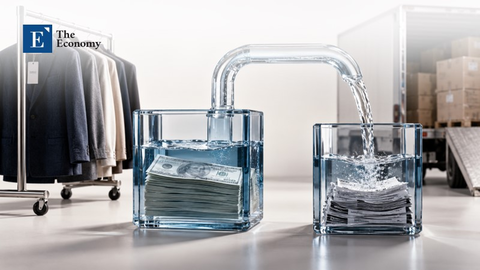
China banked in net trade ninety-two billion dollars a month through 2024, a year that closed with a record $992 billion surplus, the largest any single country has ever posted in one year. December alone brought in $101.6 billion, the first month on record to clear the $100 billion line. These are not the numbers of a country drifting toward a Western-style trade balance. They are the numbers of a country running the same playbook it opened around the time it joined the World Trade Organization, only faster now and backed by far more state money. For twenty-five years, Washington and Brussels waited. They wanted China to become a normal trading partner: open, balanced, bound by shared rules. China's trade strategy was built for one outcome. Capture the world's demand. Protect the home market. Treat every rule as negotiable the moment it stops serving that goal.
The Logic Behind China's Trade Strategy
Start with what China actually said it wanted, back when it entered the global trading system. The goal was never to become more like the West. It was scale. A billion-plus people needed jobs. The fastest route to that was building export capacity big enough to soak up global demand. Waiting for domestic spending to grow on its own would have taken too long and China did not wait. That is a sound strategy for a poor, crowded country in its early years. However, it also treats trade surpluses as permanent, not as a bridge to balance that gets crossed once and left behind. Two decades on, that bridge is still standing. Household consumption in China still sits well below 40 percent of GDP, among the lowest shares of any major economy. Exports keep doing the work that domestic demand was supposed to do by now.
The recent data confirms the pattern rather than breaking it. China's exports hit $3.58 trillion in 2024, up 5.9 percent from the year before, while imports crawled up just 1.1 percent to $2.59 trillion. That gap is not a rounding error. It is the entire structure of the relationship. The bilateral surplus with the United States reached $361 billion in 2024, a rise of nearly 7 percent even as tariff threats mounted. The surplus with the European Union crossed $240 billion, close to a quarter of China's total. The newest current account figures, covering 2025, show the trend has not cooled. China's full-year current account surplus hit $735 billion in 2025, up sharply from the year before. A goods surplus kept climbing even as Washington layered on new tariffs. Whatever pressure the West applied, Chinese exports simply found other doors.
Subsidies Are the Point, Not a Side Effect
Here is where the argument sharpens. Western officials often describe Chinese subsidies as a distortion. A flaw that better rules could fix, in their telling. That framing misses the size and the intent of the support. The OECD's own firm-level database, built on data through 2024, tells a different story. Chinese companies received, on average, three to eight times more government support than firms based in OECD countries, depending on the sector. In the most subsidized industries, solar panels, semiconductors, steel and shipbuilding, the gap widens further. About 22 percent of the global market share gains won by growing firms worldwide between 2005 and 2023 can be traced back to subsidies. For Chinese firms alone, that figure jumps to roughly 60 percent. That is not background noise in a trade relationship. That is the mechanism doing most of the work.
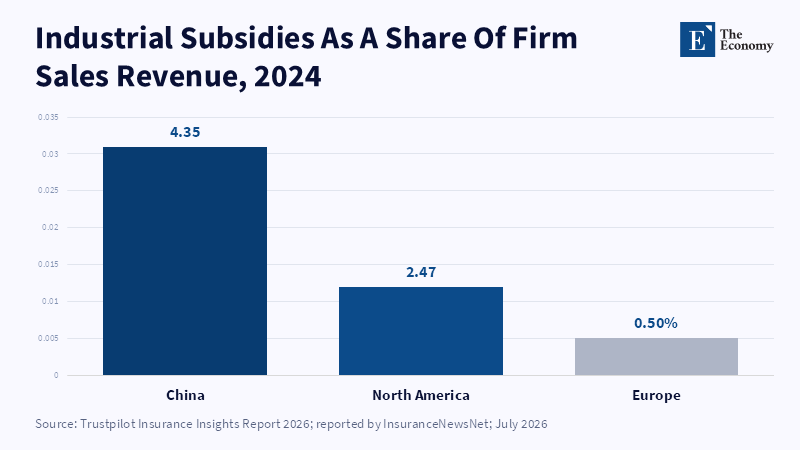
Independent researchers who have tried to put a single number on this keep landing in the same place, even using different methods. A Kiel Institute study led by Frank Bickenbach counted only the easiest subsidies to measure and still found China's industrial support came to about €221 billion or 1.73 percent of GDP, in 2019 alone. That is several times the equivalent spending in large EU and OECD economies. The IMF's own more recent estimate puts total industrial subsidies closer to 4 percent of China's GDP. A separate CSIS report by Gerard DiPippo, Ilaria Mazzocco and Scott Kennedy compared China against seven other major economies, including the United States, Japan and Germany. It reached the same broad conclusion through a third method: China's industrial policy spending dwarfs its peers, both in raw size and relative to its economy. Three research teams. Three different approaches. One shared answer.
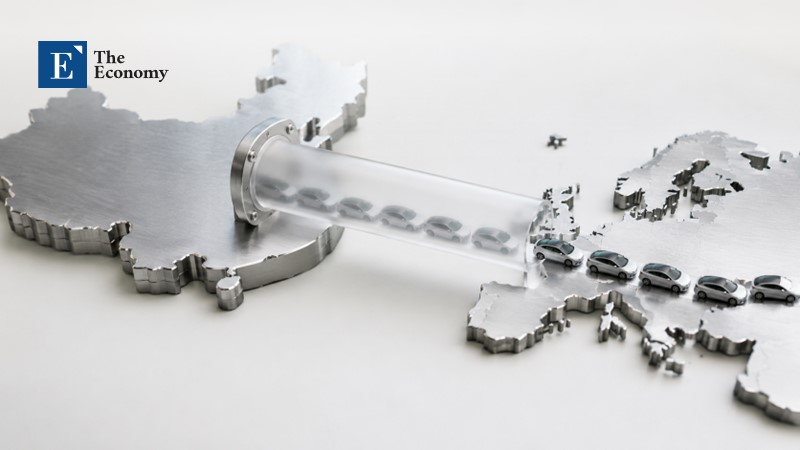
The electric vehicle sector shows what this support buys in practice. Chinese-built EVs, including foreign brands assembled in China, rose from 3.5 percent of the EU market in 2020 to 27.2 percent by the second quarter of 2024. Chinese brands alone grew from 1.9 percent to 14.1 percent of all EVs sold in Europe over the same stretch. That is not a story of slowly improving cars. It is a compressed, subsidy-fed sprint. Brussels eventually responded with countervailing duties as high as 38.1 percent, stacked on top of the EU's standard 10 percent car tariff. Rates later settled around an average of 20.8 percent, varying by producer. Washington went further still, layering 100 percent tariffs on Chinese EVs and 25 percent on EV batteries. Neither response was subtle. Both were reactions to a subsidy scale that regulators judged too large to treat as ordinary competition.
Why the West Read China's Trade Strategy Wrong
This is the part worth sitting with. It explains why the conflict escalated the way it did in 2026, instead of settling into routine friction. Western policymakers, especially in Washington, expected China to follow something close to the Japan model. Export-led growth in the early decades, then market opening, a floating currency and a slow move toward shared trading norms. Many also thought economic opening would loosen the Communist Party's grip, the way market reforms helped unravel the Soviet Union under glasnost and perestroika. Both bets rested on the same idea: that China would, sooner or later, start playing by the same rules as everyone else.
Anyone who has done business across Asia over the past few decades could have told them otherwise. Chinese merchants carry a long, well-known reputation across the region. They treat agreements as opening offers, not binding commitments. They remove themselves from deals once those deals stop paying off, leaving the other side to absorb the cost. That is not a slur. It is a pattern regional trading partners have adjusted to for generations, long before Beijing joined the WTO. Japan built its postwar export machine while slowly opening its own market and accepting currency realignment under pressure, a process that ended in the 1985 Plaza Accord. China has resisted that kind of adjustment for twenty-five years. It has run surpluses that dwarf anything Japan produced at its peak, while treating its own market access as a favor it grants, not an obligation it owes. The West assumed a shared destination. China never signed up for one.
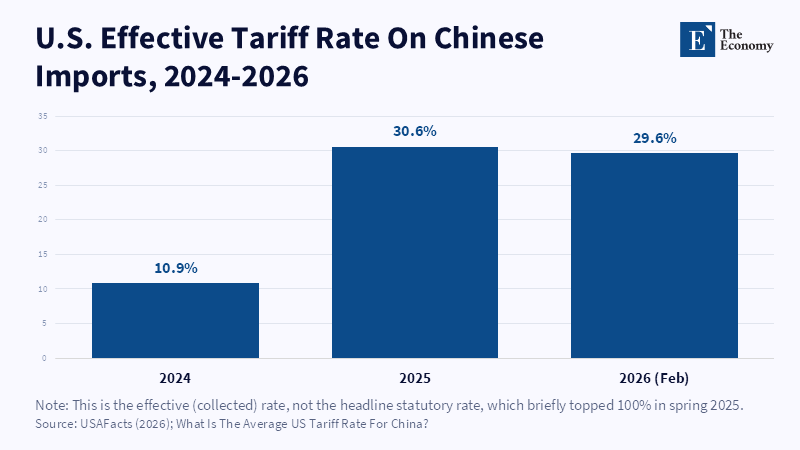
The tariff war that has defined 2025 and 2026 is the direct result of that miscalculation. US effective tariffs on Chinese goods spiked above 145 percent in April 2025. A series of truces later brought the blended rate down to roughly 31 to 33 percent by mid-2026. That is still six times higher than the 5 percent average that held for the two decades before the fight began. China has hit back in kind, pushing its own average tariff on US goods to around 32 percent, alongside export controls on key inputs and blocklists on American firms. Neither side is negotiating toward a shared rulebook anymore. Both are just managing a standoff.
What Comes After the Illusion Breaks
Some will say this framing is too harsh. China's export strategy, the argument goes, simply reflects the same development playbook every rising economy has used, including the United States and Britain in their own early years. There is some truth in that comparison. But it breaks down at scale. Nineteenth-century American tariffs protected a young industrial base for a few decades before giving way to freer trade. China's export subsidy regime has run for a quarter century with no comparable wind-down, even as its economy grew into the world's second largest. Others will point to Europe's own experience. A full year after the EU's EV tariffs took effect, researchers found little evidence that consumer prices actually rose. Tariff revenue for the EU budget has become a modest fiscal bonus rather than a market-closing wall. That is a fair point. Tariffs have not delivered the clean industrial rescue their backers promised. But a policy that fails to protect European carmakers does not mean the subsidy gap behind it was imagined. The OECD's own data settles that question.
None of this argues for abandoning trade with China. It remains too large and too woven into global supply chains for a clean break to be realistic or wise. It argues for dropping one assumption: that patience alone will make China act more like the West. Firms operating in or against Chinese-subsidized sectors need pricing and investment plans built around a rival that treats state support as permanent, not as a temporary crutch. Regulators need subsidy tracking as sharp as the OECD's new firm-level database. Vague estimates invite the kind of dismissal Beijing has offered for years. Policymakers need to stop calling every new tariff round an aberration in an otherwise normal relationship.
It is the relationship. Every rulebook China joined since 2001 came with an unspoken bet attached: that market access would eventually run in both directions. Twenty-five years of data say otherwise and no amount of patience has changed the course. Firms betting on a softer Beijing next decade are betting against the whole record laid out above. Governments that keep treating each new subsidy story or export surge as a one-off will keep getting caught flat-footed, the way Brussels was caught by the EV surge and Washington was caught by the pace of the 2024 surplus. Neither outcome was hidden. Both were visible years in advance to anyone reading the trade data instead of the diplomatic statements.
China built a trade strategy to make itself rich through export dominance and it has succeeded on its own terms. A $992 billion surplus is proof of that and so is a subsidy regime running three to eight times larger than its OECD peers. The West spent twenty-five years waiting for China to change its terms instead of responding to the ones already on the table. That wait is over now, whether by choice or by exhaustion and the strategy on the other side of the table was never really a mystery. It was always right there in the numbers, for anyone willing to read them plainly instead of hopefully.
The views expressed in this article are those of the author(s) and do not necessarily reflect the official position of The Economy or its affiliates.
References
Bickenbach, F., Dohse, D., Langhammer, R.J. and Liu, W-H. (2024) Far from normal: an augmented assessment of China's industrial subsidies. Kiel Policy Brief. Kiel: Kiel Institute for the World Economy.
Center for Strategic and International Studies (2024) Unpacking the European Union's provisional tariff hikes on Chinese electric vehicles. Washington, DC: CSIS.
Congressional Research Service (2026) China: recent developments in US-China tariff actions. Washington, DC: CRS.
DiPippo, G., Mazzocco, I. and Kennedy, S. (2022) Red ink: estimating Chinese industrial policy spending in comparative perspective. Washington, DC: Center for Strategic and International Studies.
Ferreira, J. (2026) 'China posts record current account surplus in Q4 2025', Trading Economics, 13 February.
Kennedy, S. (2024) 'The Chinese EV dilemma: subsidized yet striking', Trustee China Hand, CSIS blog, 20 June.
Organisation for Economic Co-operation and Development (2026) OECD MAGIC database of industrial subsidies: full report. Paris: OECD Publishing.
Raman, G.V. (2026) 'China's changing vision of globalisation', East Asia Forum, 25 July.
Raman, G.V. (2026) 'How China's rise changed the logic of globalization', Asia Times, July.
Sopinska, J. (2025) 'China's global trade surplus in 2024 nudged $1 trillion; around a quarter with EU', MLex, 13 January.
South China Morning Post (2025) 'China posts record trade surplus as export wave finds shores outside US', South China Morning Post, 14 January.
Swiss Institute of Artificial Intelligence (2025) 'Fair trade for a fast transition: why Chinese EV tariffs are a necessary bridge to real cooperation', SIAI Review, 9 December.
The Economy (2026) 'OECD targets China's subsidy-driven growth model as EU opens a new front in trade offensive against Beijing', The Economy, June.
USAFacts (2026) What is the average US tariff rate for China? Bellevue, WA: USAFacts.
Working across research, policy, and data-driven analysis, the Editorial Board ensures that published pieces reflect a consistent institutional perspective grounded in quantitative reasoning and long-term structural assessment.