Deposit Switching Costs: Faster Rate Pass-Through, Faster Bank Runs

Working across research, policy, and data-driven analysis, the Editorial Board ensures that published pieces reflect a consistent institutional perspective grounded in quantitative reasoning and long-term structural assessment.
Authored On
Modified
Lower switching costs make deposit rates respond faster to central-bank moves
The same digital convenience can accelerate deposit flight during stress
Bank supervision must now operate in hours, not weeks

On March 9, 2023, depositors pulled $42 billion out of Silicon Valley Bank in a single day. By the next afternoon, another $100 billion was ready to follow. Regulators later confirmed customers had lined up to withdraw $142 billion in 48 hours, roughly 81 percent of the bank's entire deposit base. A decade ago, a run of that size would have taken weeks, maybe months, to unfold. It happened before most people finished their morning coffee. That speed didn't come from panic alone. It came from an app that let you move your money in four taps and a customer base with almost nothing tying it to the bank except a login. Low deposit switching costs, the very feature fintech marketers sell as convenience, is quietly becoming one of the more consequential variables in how central banks move the economy.
Deposit Switching Costs and the New Speed of Monetary Policy
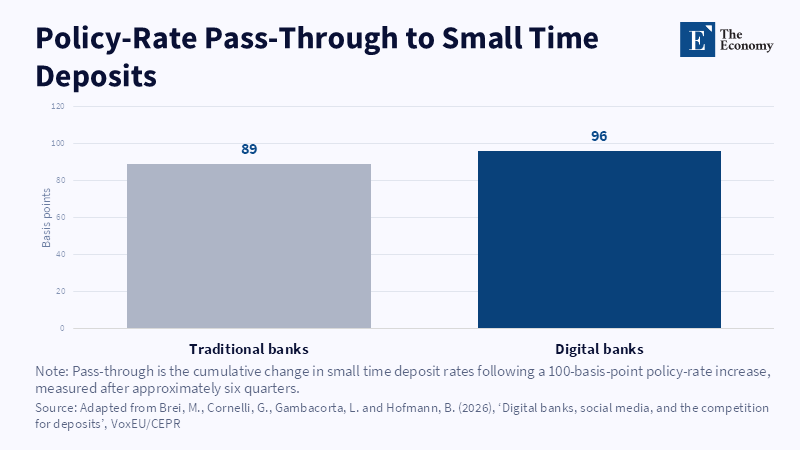
For most of the postwar era, the textbook story of monetary policy ran through lending. The central bank moves the policy rate, banks adjust what they charge on loans and businesses and households respond by borrowing more or less. Deposits sat quietly in the background, treated as sticky, almost inert. People kept checking accounts at the same branch for decades out of habit, loyalty, or plain inertia. That assumption is becoming less reliable. A branch-level study of the US banking sector covering data through the mid-2020s found that digital banks pass a 100 basis point policy rate increase through to small time deposit rates at a rate of 96 basis points, compared with 89 basis points at traditional banks. That gap sounds modest until you realize it means digital banks nearly fully compensate depositors within about a year and a half of a rate move, while branch-based banks lag.
Why does this happen? Because switching banks used to cost something real. You had to close an account in person, update your paycheck deposit, cancel a stack of automatic payments and trust that a new relationship manager would treat you fairly. Digital banking stripped almost all of that friction away. Comparison shopping for interest rates now takes a few minutes on a phone and moving money between institutions can happen the same day. When switching is nearly free, a bank that under-prices its deposits doesn't lose customers slowly. It loses them almost immediately and every depositor knows it, which forces banks to compete harder on rate the moment policy shifts. That competitive pressure is precisely the transmission mechanism central bankers rely on. Lower switching costs don't just make banking more convenient. They strengthen policy-rate transmission.
What the Data Actually Shows
The European evidence tells a similar story and it comes from inside the euro area's own central bank. A working paper from the European Central Bank mapped more than 170 digital banks operating between 2016 and 2025 and compared how they responded to the ECB's 2022–2023 tightening cycle against branch-based peers. Household deposit rates at digital banks rose by roughly 38 basis points more than at traditional banks over the same period and retail funding spreads compressed by over a full percentage point less. In plain terms, digital banks paid up faster and by more to keep deposits from walking out the door, particularly on overnight accounts where switching is essentially instantaneous. The paper's author, an ECB monetary policy adviser, described the pattern as digital banks reacting more aggressively to hold onto deposit inflows, even at real cost to their own profit margins.
Social media activity makes this effect stronger, not just faster. Research using geotagged data from more than a billion tweets found that digital bank branches located in counties with heavier social media use set noticeably higher deposit rates than branches in quieter counties and that their rates tracked the policy rate more closely when local online chatter was high. Information about where to park your money spreads through group chats and timelines now, not through a teller's recommendation or a newspaper's Sunday finance section. Younger depositors are the clearest example of this shift in action. A 2025 study surveying nearly 500 Gen Z digital banking users in Vietnam found that switching costs function as both a partial mediator and moderator between satisfaction and loyalty, meaning that when switching is cheap, satisfaction alone no longer guarantees that a customer stays. Separate industry research puts a number on the behavior: Gen Z customers switch banking providers two to three times more often than their parents and roughly four times more often than their grandparents did. One in three Gen Z and Millennial consumers changed their primary bank in the past year alone. Loyalty, in other words, has become conditional and reversible in a way it never used to be.
The SVB Warning Buried Inside the Speed
Faster transmission sounds like an efficiency gain and in a narrow technical sense it is. Central banks want their rate decisions to reach the real economy quickly, without long and unpredictable lags. But the SVB collapse is the financial-stability risk within that story because it shows what happens when the same mechanism that makes deposits responsive also makes them fickle. A slow-moving credit problem didn’t undo SVB. It was undone by a concentrated depositor base, mostly startups and venture funds, who communicated with each other constantly on the same digital platforms and moved money with a few clicks the moment doubt set in. Commentators at the time called it the first Twitter-fueled bank run and the label wasn't hyperbole. Multiple prominent venture investors posted public warnings within hours of the bank's capital raise announcement and by the next business day the bank had a negative cash balance of nearly $958 million.
There's a term for what happened next that researchers have started using more formally: the digital bank walk. It describes something short of a classic panic-driven run, a steadier, quieter migration of deposits toward whichever institution is currently paying the best rate or looking the most stable. Separate research on US online banks found they transmit monetary policy more strongly to their own deposit rates than traditional banks do, attracting inflows when rates rise while branch-based competitors bleed deposits out. That's good for policy transmission in calm periods. It's much less comforting during a crisis, when the line between a bank walk and a bank run gets thin fast. Other work on the 2023 US banking stress found that reliance on uninsured deposits, the kind that isn't protected by the FDIC and therefore has every incentive to flee first, was a major predictor of which banks came under the most severe pressure. Low switching costs and low deposit insurance coverage turn out to be a dangerous combination, because even inaccurate information can trigger coordinated withdrawals. It just needs to move together and a viral rumor moves a crowd just as effectively as an accurate one.
A Faster and More Volatile Transmission Channel
None of this argues for putting the friction back into banking. Nobody wants to return to closing accounts by mail or waiting three days for a wire. But treating deposit switching costs purely as a competition and consumer-welfare issue misses half the picture. Bank supervisors evaluating funding stability now need to weigh not just how many uninsured deposits a bank holds, but how digitally mobile that depositor base is and how tightly it's networked on social platforms. A concentrated customer base of tech founders following the same handful of influential accounts is a different risk profile than a diffuse base of retail savers, even if both hold identical dollar amounts in uninsured deposits. Stress tests built around historical withdrawal speeds from the 2008 crisis or earlier are measuring the wrong clock. A run that once took weeks can now take hours and supervisory liquidity requirements calibrated to a slower era leave a real gap.
Skeptics will point out that digital banks paying higher rates to retain deposits is simply competition doing its job and that framing switching costs as a financial stability problem risks punishing banks for treating customers well. That criticism has some force. Competitive deposit pricing genuinely benefits savers and nobody should want to engineer artificial friction just to slow down bank runs. But the SVB episode shows the two effects aren't separable. The same mechanism that rewards responsive pricing during normal times amplifies withdrawal speed during stress and pretending otherwise leaves regulators flat-footed. The more useful response is asymmetric: let competition on deposit pricing continue, since it's plainly good for consumers and for the pace of monetary transmission, while building supervisory tools, faster liquidity backstops and social-media-aware early warning indicators that match the actual speed money moves today. The $42 billion that left Silicon Valley Bank in a single day wasn't an anomaly born of one bad balance sheet. It was a preview of how every future liquidity event involving a digitally native, socially connected depositor base is likely to behave and the institutions and regulators who plan around last decade's withdrawal speeds will keep being surprised by this decade's.
The views expressed in this article are those of the author(s) and do not necessarily reflect the official position of The Economy or its affiliates.
References
Barr, M.S. (2023) Testimony on Recent Bank Failures and the Federal Regulatory Response, before the Senate Committee on Banking, Housing, and Urban Affairs, 28 March.
Brei, M., Cornelli, G., Gambacorta, L. and Hofmann, B. (2026) 'Digital banks, social media, and the competition for deposits', VoxEU/CEPR Column, 30 July. Also published as Bank for International Settlements Working Paper No. 1357 and CEPR Discussion Paper No. 21609.
Budnik, K. (2026) Digital Banking and the Evolving Monetary Policy Transmission. European Central Bank Working Paper Series No. 3206. Frankfurt: European Central Bank.
California Department of Financial Protection and Innovation (2023) Order Taking Possession of Property and Business of Silicon Valley Bank, 10 March.
Erel, I., Liebersohn, J. and Yannelis, C. (2023) Online Banks and Monetary Policy Transmission. Cited in European Central Bank Banking Supervision speech, 'Digitalisation and Depositors' Behaviour', 7 October 2025.
Jiang, E.X., Matvos, G., Piskorski, T. and Seru, A. (2023) 'Monetary tightening and U.S. bank fragility in 2023: mark-to-market losses and uninsured depositor runs?', National Bureau of Economic Research Working Paper No. 31048.
Koont, N., Santos, J.A.C. and Zingales, L. (2024) Digital 'Bank Walks': Evidence from the Deposit Market. Cited in European Central Bank Banking Supervision speech, 'Digitalisation and Depositors' Behaviour', 7 October 2025.
Mastercard (2025) 'How Gen Z is reshaping digital banking expectations', Mastercard Global, 15 September.
The Financial Brand (2026) 'Gen Z is redefining primary banking relationships faster than banks realize', The Financial Brand, 13 April.
Tuong, V.D., Thach, N.H., Khanh, P.N.K., Han, L.T.B. and Thanh, P.T.K. (2025) 'Understanding Gen Z's digital banking loyalty: the role of switching costs and consumption values', Journal of Organizational Behavior Research, 10(1), pp. 44–57.
Weinstein, A. (2023) '$42 billion in one day: SVB bank run biggest in more than a decade', Fortune, 11 March.
Working across research, policy, and data-driven analysis, the Editorial Board ensures that published pieces reflect a consistent institutional perspective grounded in quantitative reasoning and long-term structural assessment.