Do AI Note-Takers Cut Managers' Work or Just Create More of It?

Authored On
Modified
AI note-takers make meeting records cheap, but the meeting itself costs as much as before
Workplace trials find time saved on documentation, with little sign of higher output
Whether managers end up with less work depends on how the group sets its meeting load
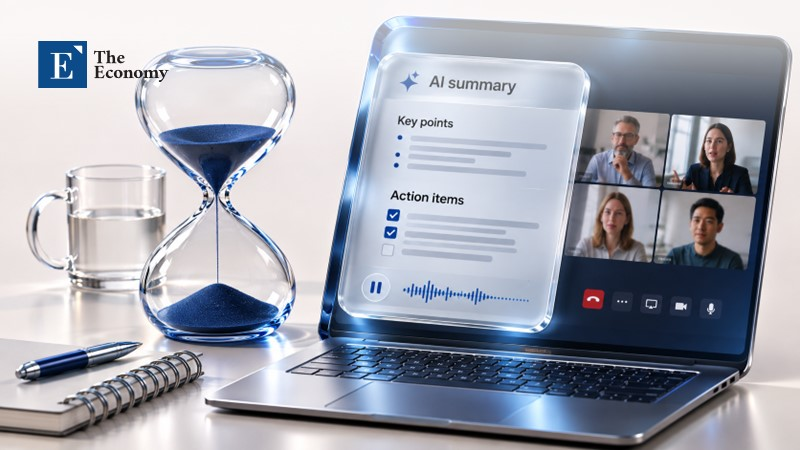
When the UK's Department for Business and Trade gave 1,000 staff Microsoft 365 Copilot for three months in late 2024, the most common thing they used it for was transcribing or summarizing meetings. Users reported saving time. Yet the department's evaluation concluded that it "did not find evidence that time savings have led to improved productivity." That gap sits at the center of the debate about AI note-takers. Writing up a meeting has become close to free, and the cheaper something becomes, the more of it tends to get made. The saved time can go back to managers, or it can be absorbed by more meetings and follow-up. The evidence so far is consistent with both outcomes, and read together it points to meeting habits more than to the software.
AI Note-Takers Make Only the Write-Up Cheaper
A meeting has two costs. The larger one is the time of everyone in the room, and it grows with each name added to the invite. The smaller one is the work that follows, where someone drafts the minutes, corrects them, sends them out and chases the actions. AI note-takers go after the second cost only.
On that narrower task, the savings look real. The department's evaluators estimated that each meeting transcription or summary saved staff about 0.7 hours on average, after adjusting for outputs nobody used and for tasks staff wouldn't have done without the tool. A larger cross-government experiment run by the Government Digital Service, covering 20,000 public employees in 12 organizations, found that users reported saving an average of 26 minutes a day.
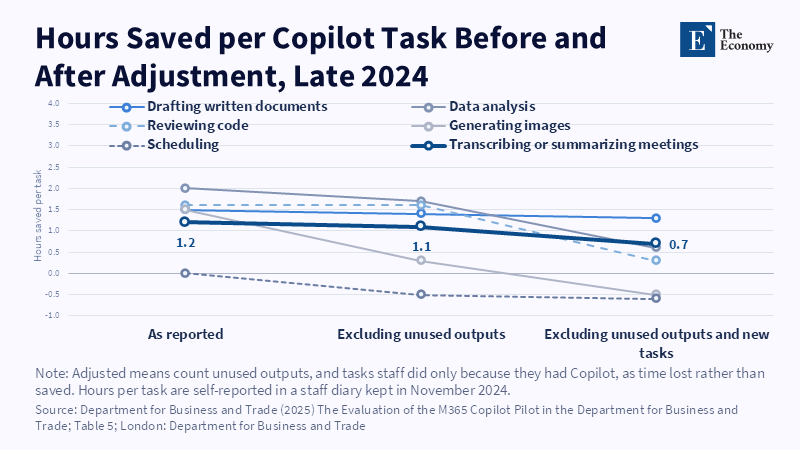
Both figures are self-reported. The cross-government report says plainly that "it was not possible to identify how time saved was spent." The department's own evaluators acknowledged that productivity was not a major research aim of their study, so they gathered only limited data on whether time saved led to increased output.
Saved Minutes Stay with Tasks One Person Controls
The most direct evidence on this comes from a six-month randomized field experiment conducted by Microsoft Research across 66 large organizations and 7,137 knowledge workers, of whom approximately half received access to Microsoft 365 Copilot. People who used it reduced their weekly email time by two hours on average, or about 17%. Their time in Teams meetings didn't change significantly, and neither did the number of meetings they participated in, although summarizing meetings in Teams was one of the most common ways they used the tool. An earlier version of the paper summed up the pattern by saying the tool "primarily impacted behaviors that could be changed independently and not behaviors that required coordination to change." The revised version comes to a comparable conclusion, finding no shift in how much work people did or what kind, beyond the individual time savings. A manager can decide alone to answer email faster. Nobody decides alone how many meetings to hold, how long they run or who attends, because those choices sit in shared calendars, team habits and the expectations of whoever called the meeting.
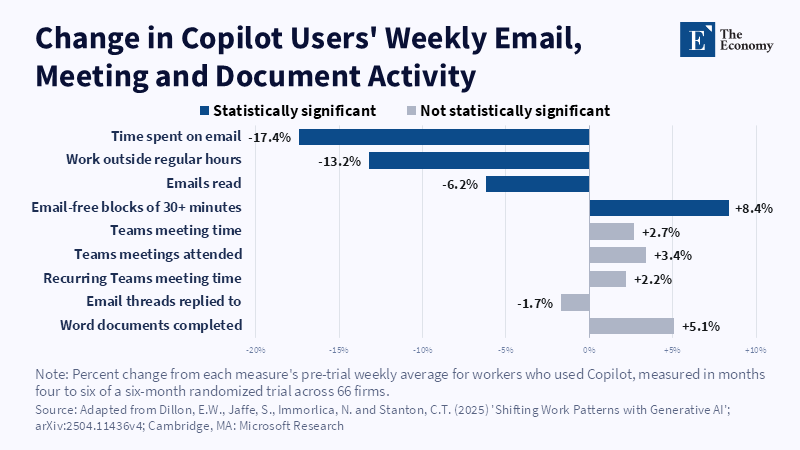
Task-level savings and organizational output can drift apart for other reasons too. A Bank of Korea survey of 5,512 workers found that generative AI lowered working time by 3.8%, but there was little link between this and output. Another bank-funded study found that most of the benefit went to on-the-job leisure. The bank itself cited, in part, the lack of incentives to do more. With meetings, one person saves the write-up time but the group sets the schedule.
Cheap Records Invite More Records
In 1865, the economist William Stanley Jevons argued in The Coal Question that more efficient steam engines would raise Britain's coal consumption rather than cut it, because cheaper power made new uses worth paying for. The same logic may apply to some AI services, where cheaper output can, under certain conditions, expand demand enough to eat into the labor it saves. Meeting minutes look like a candidate, though the comparison is an analogy, not a measurement. The large-scale experiment that is most relevant to this analogy seems at first to cut against it: The Microsoft study found no increase in meetings attended by people who were given the tool. In that study, the tool was distributed to people across the teams, with most participants having few teammates who also had it, so a group-level response of the kind Jevons described was largely invisible to it.
Before AI note-takers, a written record cost someone's time, and organizations documented selectively. Quick check-ins, informal calls and many internal discussions went unrecorded because writing them up wasn't worth the effort. Once a summary costs almost nothing, that filter weakens. A call that would once have ended with a short chat message can now produce a recap, an action list and a follow-up thread, each of which someone is expected to read.
Whether managers gain depends on how strongly the demand for records responds to their lower cost. If the organization keeps asking for the same documentation, the saved time is a real gain. When it asks for more recaps, longer invite lists and status updates built from the transcripts, the gain shrinks and can disappear.
Health care offers a measured example of saved documentation time going back into work. A JAMA study published in April 2026 followed 8,581 clinicians at five US academic health care institutions and compared those who adopted AI scribes with those who didn't. Adoption was associated with 16.0 fewer minutes of documentation per eight scheduled patient hours and 0.49 more patient visits a week, while after-hours time in the electronic health record didn't change significantly. For a hospital, extra visits may be exactly what it wants. The finding still suggests that some of the saved time went into seeing more patients rather than into a lighter day.
Checking the Record Falls to the Manager
A cheaper record still has to be read. Herbert Simon made the general point in his 1971 essay "Designing Organizations for an Information-Rich World," where he wrote that "a wealth of information creates a poverty of attention." Every transcript, summary and action list competes for the same limited hours.
The output also needs checking. The department's evaluation found Copilot's outputs mostly accurate but noted that "hallucinations do occur," and 22% of the staff who completed its diary study said they had spotted one. A randomized trial of two AI scribes at UCLA, published in NEJM AI, found that physicians reported occasional clinically significant errors in the generated notes, most often information that had been left out. In a meeting, an error might be an action assigned to the wrong person or a decision recorded that nobody actually agreed to.
Those best placed to catch the errors are the ones who were in the room, while those most likely to rely on the record are the ones who weren't. In many teams, closing that gap falls to the manager, who is accountable for what the record says, signs off on the actions and has to judge whether each assignment makes sense for the person it lands on. It's a meeting-room version of a wider problem, where fast first drafts are counted as gains while review and rework go uncosted.
Recording Changes What People Say
The note-taker also changes the meeting it records. Korn Ferry, the consultancy, reports that "by far the single biggest concern among leaders" about recorded meetings is a loss of candor. People who expect their words to appear in a searchable transcript may keep doubts to themselves, avoid challenging a senior colleague or hold sensitive points for later. Those points are likely to move somewhere the tool doesn't reach, such as a private call after the meeting or a direct message to one colleague. That can add a second, unrecorded meeting after the recorded one, and the second may be where the frank discussion actually happens.
Legal exposure adds to the caution. Four lawsuits filed against Otter.ai in federal court in California between August and September 2025 have been combined into a single class action suit, alleging that its note-taker records meetings without consent from attendees who aren't Otter users. In August 2026, the judge allowed the core wiretap and privacy claims to proceed, while dismissing others. That ruling isn't a finding that Otter broke the law, but it does show there's a legal risk to recording a meeting.
Recording may also have an upside. A report by the meeting assistant company Read AI, written with organizational behavior expert Rebecca Hinds and drawn from nearly 160,000 meetings its tool captured, found that when AI was present, managers spoke only about 3% more than individual contributors once talk time was adjusted for how many of each were in the room. Read AI sells note-taking software, its data cover only meetings it recorded, and the report says it can't tell whether the AI itself drives the pattern. At most, it hints that having AI in the room may give quieter staff more of a voice. Some meetings suit a recording better than others. Meetings still earn their place when they help a group decide, and those are also the meetings where candor counts most.
The Meeting Count Decides Whether Managers Gain
The write-up is the only part of a meeting these tools make cheaper. A meeting may even become easier to justify once it produces a tidy summary, because it looks more productive than one that doesn't. How many meetings to hold, who attends, what must be documented and which reports get built from the transcripts are collective decisions, often made by people further up the organization. Those people can gain visibility from more records without producing the records themselves or checking them.
The same tool can leave managers with more work or less. Workload is likely to fall where an organization treats cheaper documentation as a reason to hold fewer or shorter meetings, for example, by replacing a weekly status meeting with a recap people read in their own time. It holds steady or rises where the saved minutes go into extra invites and checking recaps.
The UK pilot measured the minutes saved per task. It didn't measure whether teams held fewer meetings, and that's the number that would show whether managers got their time back.
The views expressed in this article are those of the author and do not necessarily reflect the views of The Economy, its Editorial Board, or any affiliated institution.
References
Bank of Korea (2026) Does AI Adoption Raise Productivity? An Analysis of Effects in the First Three Years. Seoul: Bank of Korea.
Department for Business and Trade (2025) The Evaluation of the M365 Copilot Pilot in the Department for Business and Trade. London: Department for Business and Trade.
Dillon, E.W., Jaffe, S., Immorlica, N. and Stanton, C.T. (2025) ‘Shifting Work Patterns with Generative AI’, arXiv working paper 2504.11436.
Government Digital Service (2025) Microsoft 365 Copilot Experiment: Cross-Government Findings Report. London: Government Digital Service.
Hinds, R. (2026) Power Dynamics in Meetings Report 2026. Seattle: Read AI.
In re Otter.AI Privacy Litigation (2026) No. 5:25-cv-06911-EKL, Order Granting Motion to Dismiss in Part (N.D. Cal., 13 August).
Jevons, W.S. (1865) The Coal Question. London: Macmillan.
Korn Ferry (2026) ‘Are You Recording This?’, This Week in Leadership, 25 August. Los Angeles: Korn Ferry.
Lukac, P.J., Turner, W., Vangala, S., Chin, A.T., Khalili, J., Shih, Y.-C.T., Sarkisian, C., Cheng, E.M. and Mafi, J.N. (2025) ‘Ambient AI Scribes in Clinical Practice: A Randomized Trial’, NEJM AI.
Rotenstein, L.S., Holmgren, A.J., Thombley, J. et al. (2026) ‘Changes in Clinician Time Expenditure and Visit Quantity with Adoption of Artificial Intelligence-Powered Scribes: A Multisite Study’, JAMA, published online 1 April.
Simon, H.A. (1971) ‘Designing Organizations for an Information-Rich World’, in Greenberger, M. (ed.) Computers, Communications, and the Public Interest. Baltimore, MD: Johns Hopkins Press, pp. 37-52.
Suh, D. and Oh, S. (2026) ‘Generative AI and the Reallocation of Time: Productivity, Leisure, and Fulfilling Work’, arXiv working paper 2602.12695.