AI Financing: The Bond Market Lends Cheaply to Infrastructure and Dearly to Implementation

Working across research, policy, and data-driven analysis, the Editorial Board ensures that published pieces reflect a consistent institutional perspective grounded in quantitative reasoning and long-term structural assessment.
Authored On
Modified
Hyperscalers borrow 29 basis points cheaper since ChatGPT’s launch
Lenders favour resellable infrastructure over company-specific AI implementation
Spreads will shift once implementation must pay the bills

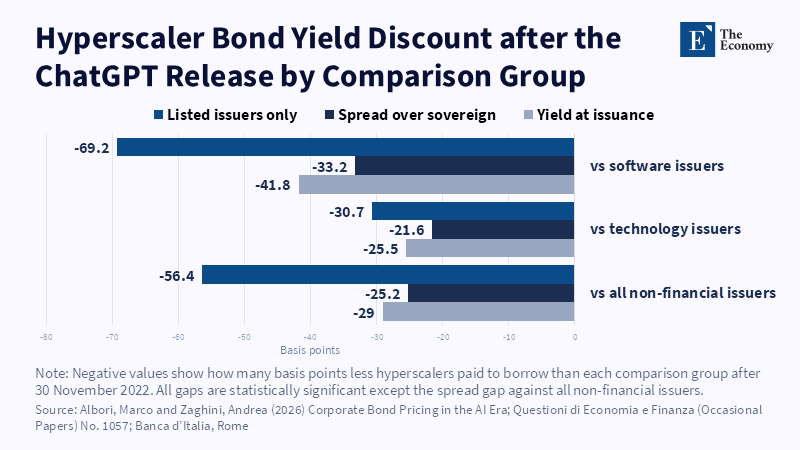
In 2025, the five hyperscalers, namely Alphabet, Amazon, Meta, Microsoft and Oracle, put about $108 billion in bonds on the market, while their average annual volume in 2023 and 2024 was close to 20 billion. By the usual criteria, borrowing five times as much should make money more expensive for the borrower. The opposite happened. Economists at the Bank of Italy, looking at bond issues by US non-financial companies from January 2020 to February 2026, found that after the launch of ChatGPT on November 30, 2022, yields on hyperscaler bonds fell by about 29 basis points relative to the rest of the companies and by 42 points relative to the software companies. The public debate about whether AI financing is fueling a bubble and whether companies will make the profits they promise on time is being conducted mainly in terms of shares, while the bond market has already answered a more prosaic question: who gets cheap money and who gets expensive money.
The answer favors those who build the physical layer of technology, data centers, substations and accelerators and burdens those who try to turn models into revenue within specific businesses. The preference is explained by the logic of collateral, because an electrified building finds a buyer while a failed integration program finds none. This arrangement belongs to a certain stage of the cycle, however and the current margins will not stay where they are.
A 42-Basis-Point Discount for Those Who Build
The method of the Bank of Italy’s study is simple to conceive and therefore convincing. The public launch of ChatGPT is treated as an exogenous shock that changed investor expectations without touching the accounting figures of the companies, since no balance sheet was transformed overnight in November 2022. The bond yields of hyperscalers are compared before and after the event with those of other issuers, with checks on the characteristics of each bond and each company and on the conditions that were changing simultaneously in the market, such as the Federal Reserve’s cycle of interest rate hikes that followed shortly after. The difference of about 29 basis points was baptized hyperium, by analogy with the greenium of green bonds. In the authors’ interpretation, investors read capital expenditures on AI as an investment that will generate large cash flows in the future and profitability expectations outweighed concerns about rising leverage.
The second figure says more than the first. When the comparison is limited to software companies, the discount rises to 42 basis points, meaning that the market divided the tech sector into those who supply the infrastructure and those who risk seeing their business model eroded by the same technology, a fear that traders have already christened SaaSpocalypse. The picture of the favored ones, however, is not uniform. The Bank for International Settlements recorded in its March 2026 quarterly review that credit default swap spreads on hyperscalers went up, mainly for those with a lower credit rating, due to the volume of supply and uncertainty about the performance of projects. For a credit portfolio manager the discount is therefore relative, the absolute cost of protection has also risen for the favored and the hierarchy among the five has begun to open.
The pace did not drop in 2026. In the first weeks of the year, the five raised more than $56 billion and according to the Bank for International Settlements, most issues had maturities of more than five years, in order to lock in financing for construction spread over many years. Economists from the same organization, in a January 2026 bulletin, noted that stock prices have run far ahead of debt market pricing, an observation that will be needed later when the conversation turns to the bubble, because it shows that bondholders, no matter how cheaply they lend, have not adopted the scenarios embodied in equity valuations.
Why Lenders Trust Buildings More than Business Plans
In October 2025, Meta and Blue Owl Capital formed a joint venture for Hyperion, a data center complex in Richland Parish, Louisiana, with a budget of $27 billion, in the largest private credit transaction on record. Blue Owl funds hold 80 percent and Meta the remaining 20 percent, while debt was issued at the project level and left off Meta’s balance sheet, with Pimco buying about 18 billion in bonds, BlackRock about 3 billion and S&P Global Ratings rating them A+. The most instructive detail lies in the terms. Meta leases the premises with an initial term of four years and the right to renew and has guaranteed that the property will maintain a minimum value for the first sixteen years, covering the difference itself if it leaves and the market value falls below the guaranteed amount. The lenders financed, in other words, an asset that can be passed on to another tenant and asked for protection for exactly the day it will be needed.
An implementation project leaves nothing like it behind. Integrating a model into an insurance company’s claims settlement process or a bank’s credit approval flow produces code tailored to specific systems, data contracts and staff training, which have no buyer if the project fails. Failure is the usual outcome, after all. MIT NANDA’s 2025 report, based on research from the first half of the year, estimated corporate spending on generative AI at $30 billion to $40 billion and found that 95 percent of the organizations in the sample had no measurable effect on their results. About 60 percent evaluated specialized enterprise tools, 20 percent reached pilot implementation and just 5 percent went into production. For a credit analyst, a loan with such a failure rate and near-zero recovery looks more like venture capital than debt.
For the CFOs of companies investing in implementation, the conclusion is uncomfortable but practical, since borrowing for integration projects will be priced based on the balance sheet of the entire company, as the project itself offers no collateral and this pushes funding towards internal cash flow and towards smaller, phased projects that can be halted before consuming a full year’s budget, a pattern that fits poorly with management teams announcing multi-year transformations on earnings calls. The asymmetry is not due to some lender bias towards software. It arises from what is left in their hands the day after a failure and in the physical layer that balance remains significant even for companies that the general public has never heard of.
AI Financing Beyond the Big Five Follows the Collateral
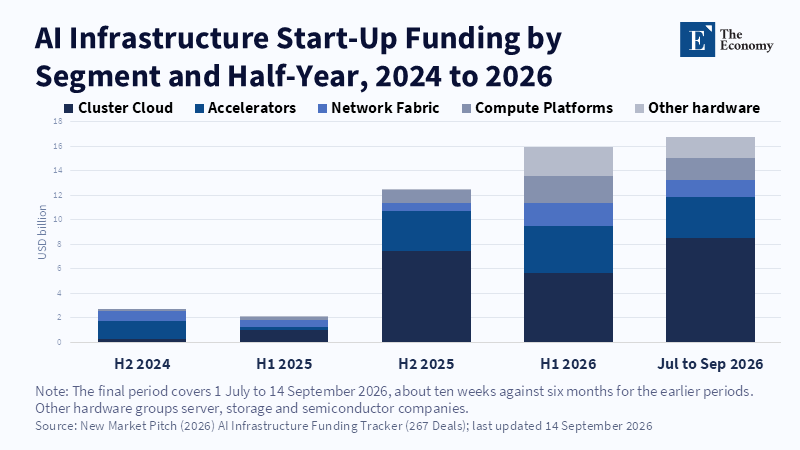
The same logic appears, with greater intensity, in startups that do not issue bonds and are therefore missing from any credit margin study. The list maintained by New Market Pitch, last updated on September 14, 2026, records 267 funding deals across 193 AI infrastructure companies, totaling $52.54 billion. Most deals are small, with the median round at 38.5 million versus an average of 202.1 million, while 93 percent of the disclosed capital is in rounds of 100 million and above. In September 2026 alone, Crusoe raised over 2 billion, Fluidstack 1.5 billion and Tenstorrent 1.3 billion, while in March Nscale had raised around 2.57 billion. The sheer volume of transactions, more than their size, indicates a booming infrastructure market that stretches far beyond Alphabet and Microsoft, in companies that no bond study will include.
The breakdown by category says more than the total. GPU cloud providers, so-called neoclouds that set up data centers full of accelerators, raised 24.86 billion in 53 deals with a median round of 100 million. Software platforms that sit on top of hardware and are closest to the application closed 68 deals with a median round of just 19 million, amounts reminiscent of conventional software funding. Strategic investors appear in 116 rounds with a median of 120 million, clustered around the physical layer. The explanation is the same as Hyperion’s. If a neocloud fails, the electrified site, the cooling and the racks of accelerator cards can be passed on to a buyer who is still looking for capacity to build their own infrastructure and as long as the demand for such spaces remains strong, it doesn’t take long for such a buyer to be found.
But the collateral argument has limits that lenders are well aware of. A Columbia Business School study estimates that a representative 200-megawatt model training complex costs about $8.2 billion, of which two-thirds is for IT equipment and only one-third for building and energy infrastructure. Buildings and substations have a long lifespan, while high-density accelerators and servers can quickly lose value when models, chips or compute architectures change. Meta’s guarantee on Hyperion is for the property. For those who lend to neoclouds, this translates into different funding rates for the shell and for silicon and an uncomfortable realization that the largest piece of value of each megawatt is also the most vulnerable.
Implementation Pays the Uncertainty Premium
On the other side of the discount is software. In February 2026, Morgan Stanley estimated that about $235 billion in leveraged loans from software companies are under pressure from fear of disruption, in an industry that accounts for about 16 percent of a $1.5 trillion U.S. leveraged loan market, with about half of those loans rated at B- or lower. At the same time, Creditflux reported that loan deals for software companies were pulled from syndication due to investor concerns, while BlackRock warned that industry bonds and loans could lose five to ten points at the first indication that AI is eating an issuer’s business. Most of these loans finance private companies owned by private equity funds and carry floating rates, so each basis point added to the margin is transferred directly to the interest paid today, on revenues projected in a world before the tools that now threaten them.
The most serious objection to this reading is that the hyperium itself is a symptom of a bubble. Cheap money for those who spend more and off-balance-sheet structures that hide some of the debt are reminiscent of telecommunications in the late 1990s. Debt market data do not support this scenario. The discount was measured against other issuers and with controls for the interest rate environment, so it does not reflect generalized easing and the CDS of lower-rated hyperscalers rose, which describes a market that sets issuers apart from each other. Hyperion bondholders hold A+-rated claims, backed by real estate and an investment-grade company guarantee. If there is an exaggeration, it is where the economists of the Bank for International Settlements identified it, in the stocks that ran ahead of the bonds. The comparison with telecommunications also cuts the other way, since the optical fiber that was laid then was eventually used by other owners and at other prices, which is exactly the scenario that the lenders of the infrastructure are pricing today.
The consequence of this allocation tends to reinforce itself. Economists at the Bank of Italy point out that, by reducing costs for infrastructure providers and increasing the relative costs for those threatened, the bond market can concentrate investment and power in a few companies and create refinancing problems for those seen as losers of the transition. A software company that has to invest precisely in integrating AI to survive finds the money for that investment more expensive because the market fears it will not survive. For CLO managers and private credit funds, where software carries a heavy weight, the distinction between issuers who can show revenue from AI and issuers who simply announce it now determines underwriting.
Today’s Credit Spreads Will Not Outlast the Build-Out
Infrastructure construction does not continue indefinitely at the same pace and the scale of current plans makes the end of the phase visible. According to the Columbia Business School study, the capital expenditures of Oracle, Microsoft, Amazon, Meta and Alphabet rose from about $97 billion in 2020 to over $400 billion in 2025, are projected to exceed 800 billion in 2026 and, with current estimates, will exceed their total operating cash flow for the first time. The same study estimates, in a 183-gigawatt construction scenario in the United States between 2025 and 2032, investments of about $10.3 trillion, or 3.63 percent of GDP each year. Every lease payment that serves a vehicle like Hyperion’s is ultimately paid by someone who makes money using the capacity, that is, by the application layer. Infrastructure revenue depends on implementation revenue, however much the bond market currently prices them as two independent stories.
When capacity catches up with demand, the value of each additional megawatt will be judged by its utilization and utilization will be judged by whether 5 percent of projects reaching production becomes a multiple. The Bank for International Settlements has already outlined the channels through which a disappointment will pass, namely refinancing pressure at the level of special purpose vehicles, procyclical shifts in the allocation of private credit and the activation of guarantees, while the Columbia study asks supervisors to map leases, residual value guarantees and refinancing needs before disappointment comes. Before any crisis, a change in order of preference is most likely, with implementation companies that can show measurable gains from AI starting to borrow cheaper and issuers of infrastructure with lower ratings and silicon-heavy collateral seeing their own premium grow, a shift that CDS spreads on lower-rated hyperscalers seem to have already started recording before any bond index sees it.
The $108 billion of 2025 and the 29 basis points describe a market that has decided who builds, without yet having the data to decide who will win. Hyperium is the price of a specific phase, one where the scarce good is the electrified megawatt and the collateral is easily resold to someone in a hurry to build. AI financing will change direction when the scarce good becomes the application that pays and no one can say for sure whether the transition will be through smooth repricing or through a vehicle that fails to refinance. A trace of the answer is already written in Hyperion’s terms. Meta committed to an initial four-year lease and guaranteed the property’s value for sixteen and in the space between the two numbers it will be seen if implementation performed well enough to fill the buildings that the market so willingly funded.
The views expressed in this article are those of the author(s) and do not necessarily reflect the official position of The Economy or its affiliates.
References
Albori, Marco and Zaghini, Andrea (2026) Corporate bond pricing in the AI era. Questioni di Economia e Finanza (Occasional Papers), No. 1057. Rome: Banca d’Italia.
Aldasoro, Iñaki, Doerr, Sebastian and Rees, Daniel (2026) Financing the AI boom: from cash flows to debt. BIS Bulletin, No. 120, 7 January. Basel: Bank for International Settlements.
Bank for International Settlements (2026) ‘Financing the AI infrastructure boom: on- and off-balance sheet borrowing’, BIS Quarterly Review, March. Basel: Bank for International Settlements.
Challapally, Aditya, Pease, Chris, Raskar, Ramesh and Chari, Pradyumna (2025) The GenAI Divide: State of AI in Business 2025. Cambridge, MA: MIT NANDA.
Creditflux (2026) ‘Software loans face further declines as AI fears persist’, Creditflux, Issue 283, February.
MarketWatch (2025) ‘Meta, Blue Owl and AI: here are the details of Wall Street’s biggest private-credit deal ever’, MarketWatch, 22 October.
Marray, Michael (2025) ‘Meta, Blue Owl sign US$27 billion data centre campus deal’, The Asset, 29 October.
New Market Pitch (2026) AI Infrastructure Funding Tracker (267 deals). Updated 14 September. New Market Pitch.
Siddarth S. (2026) ‘AI-led software selloff may pose risk for $1.5 trillion U.S. credit market, says Morgan Stanley’, Reuters, 10 February.
Van Nieuwerburgh, Stijn (2026) ‘Financing the AI buildout before the risks go off balance sheet’, VoxEU.org, 10 October. London: Centre for Economic Policy Research.
Working across research, policy, and data-driven analysis, the Editorial Board ensures that published pieces reflect a consistent institutional perspective grounded in quantitative reasoning and long-term structural assessment.
Similar Post