Private Credit's Trillion-Dollar Growth Meets Its AI Debt Test

The Economy Markets Editorial Board is a multidisciplinary group of researchers, analysts and sector specialists covering the structure and evolution of global professional and institutional markets. Its work examines competitive landscapes, market positioning, buyer choice and the forces reshaping industries across advisory services, capital markets, wealth management, healthcare and other specialist sectors.
The Board also contributes to The Economy’s ranking research, where its members assess firms, institutions and market participants using structured research, sector evidence and comparative analysis. This combination of market research and ranking coverage gives the Board a continuing view of how competitive positions develop within individual industries and how firms differentiate themselves as markets evolve.
Through The Economy Markets, the Board translates this research into accessible analysis of market structure, competitive dynamics and institutional change, complementing The Economy’s rankings, Wiki profiles and broader research coverage with a comparative view of the markets in which ranked organisations operate.
Authored on
Modified
Private credit nears $2 trillion, up tenfold since 2009
AI data center financing is testing private credit's limits
Analysts say systemic risk remains low for now
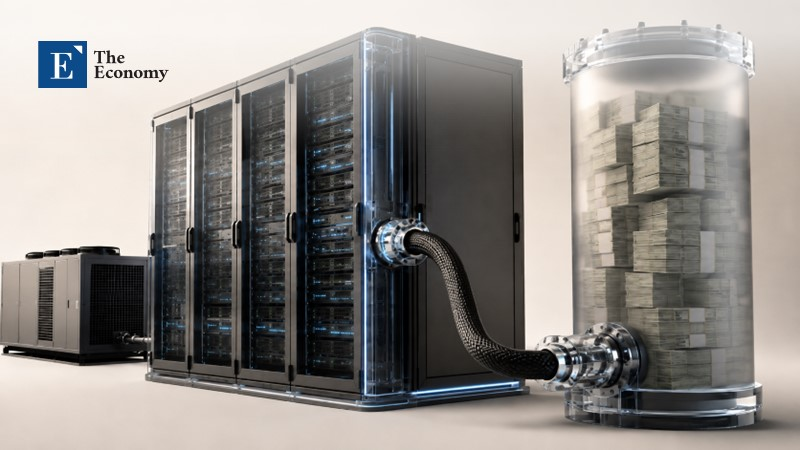
Private credit approached $2 trillion at the end of 2023, about ten times the size of 2009, putting private credit among the fastest-growing segments of the financial system over the past fifteen years. It is closely linked to the interest rate hike cycle that began in 2022 and the contraction of available capital in public debt markets, two factors through which borrowers were pushed towards alternative sources of financing. At the same time, the market's scale is also drawing greater scrutiny. The close relationship between private credit and the financing of artificial intelligence infrastructure, where unprecedented capital requirements are increasingly pushing even the largest technology companies towards external sources of funding rather than relying entirely on equity, opens a new chapter in the market's development, and one with more uncertain ramifications.
The Scale of Private Credit Expansion
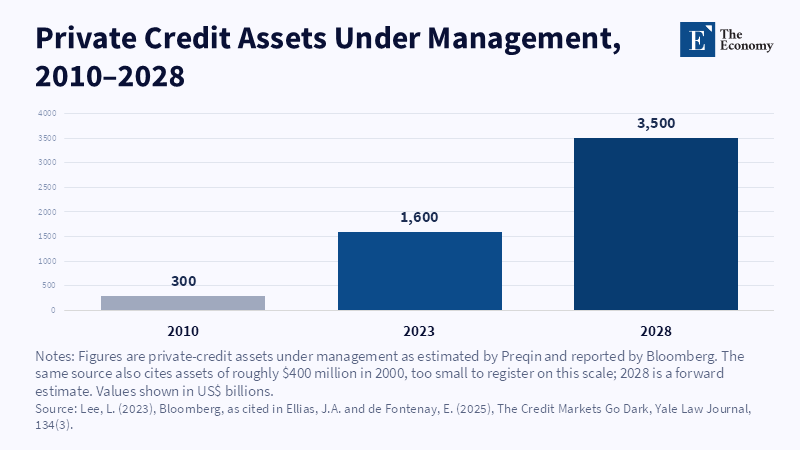
Estimates of the market's size vary with the definition used. Yale Law School researchers recently estimated assets under management in private credit investment funds at $1.6 trillion in 2023, starting at about $400 million in 2000 and $300 billion in 2010, with estimates placing it at $3.5 trillion by 2028. McKinsey estimates that the addressable U.S. market could exceed $30 trillion, as private financing continues to take share from bank lending and public-market alternatives.
Growth is also visible in the size of individual funds. The average private-credit fund size increased from $627 million in 2020 to $1.05 billion in 2024, allowing these funds to finance larger transactions and expand into previously underserved sectors. At the same time, 86% of private-credit fundraising since 2022 has been captured by managers with at least four previous generations of funds, while new entrants received just 4%, an indication that scale, established investor relationships and experience in restructurings have become increasingly important when capital is expensive and investors are less willing to back managers without a long record.
Volatility and the Cost of Capital
Volatility in public markets has acted as an additional catalyst for private credit, especially after 2022. Periods of strong volatility reinforce the importance of certainty in terms of execution and financing conditions, which private credit seeks to provide even when public debt markets are disrupted. Short periods of volatility reinforce the importance of execution certainty, while prolonged months of uncertainty significantly complicate matters for companies that cannot postpone time-sensitive financing needs.
Private credit's market share in the broader leveraged finance landscape, which includes high-yield bonds and leveraged loans, has grown steadily over the past decade, with a particularly strong rise in periods of liquid-market disruption such as 2022. Greater market share has gradually been captured by private credit during successive economic cycles since the global financial crisis and, because each disruption has given managers another opportunity to demonstrate certainty of execution, some of those gains have remained even after public markets reopened. However, the same momentum that fueled growth is now beginning to be linked to a new and much more specific source of risk: AI infrastructure funding.
Private Credit's Exposure to AI Infrastructure Debt
The scale of private credit's involvement in AI data-center funding became particularly evident in July 2026, when a $14 billion joint venture between Meta and BlackRock was announced to build a data center in El Paso, Texas, with BlackRock owning 80% through managed funds while Meta will lease the entire facility upon completion, in a structure reminiscent of sale-and-leaseback financing. The $12.55 billion bond financing was priced at about 7.5% annually, a spread of 2.875 percentage points above U.S. Treasury bonds, a yield more commonly associated with considerably riskier debt even though the bonds themselves were investment grade, with the additional annual interest cost for Meta exceeding $50 million and the total additional cost to maturity approaching $1 billion.
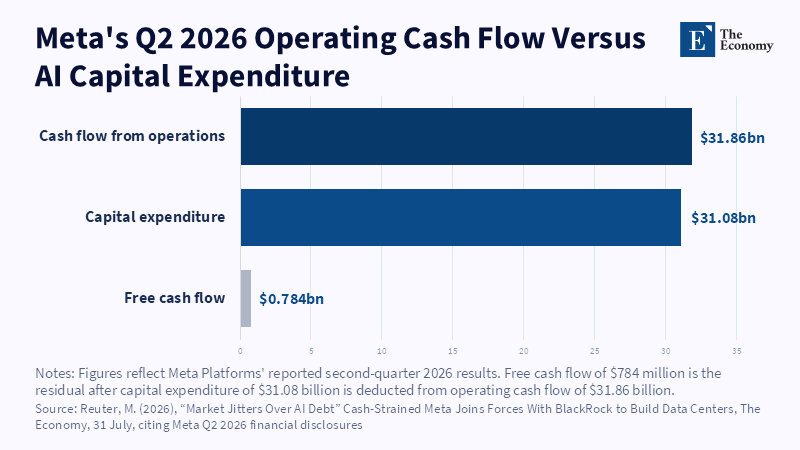
The fact that the offer book did not lead to a narrowing of the spread despite demand exceeding the amount offered suggests that additional AI-related debt was being absorbed only at a higher premium. At the same time, the $26 billion HPS Corporate Lending Fund received redemption requests of $1.2 billion, or 9.3% of net asset value, in the first quarter of the year, while only 5% was satisfied under the fund's contractual quarterly limit. Meta's operating cash flow reached $31.86 billion in the second quarter of 2026, against capital expenditure of $31.08 billion, leaving free cash flow of just $784 million. In separate secondary transactions, tender offers for interests in non-traded private-credit vehicles were made at discounts of roughly 15% to 30% to net asset value, a sign of liquidity pressure in parts of the market, though not evidence that all private-credit assets were trading at those levels.
The Systemic Risk Question
Despite the concerns, analysts at J.P. Morgan Private Bank estimate that private credit is not yet of a size that would allow it to pose a systemic threat, accounting for about 9% of total U.S. corporate borrowing, while the investment base remains mainly institutional at around 80%, which reduces the likelihood of sudden capital outflows. Interconnection with banking institutions also remains limited relative to the overall financial system, as bank and non-bank lending to private-credit companies is estimated at between $410 billion and $540 billion, compared with total U.S. bank lending of roughly $14 trillion.
The more immediate risk, according to the same analysis, is at the industry level rather than the system level. Private-credit exposure to software alone is around 21%, already significantly higher than in several other debt markets, with exposure increasing further when broader technology and business-services categories are included, which makes the market more vulnerable to AI-induced changes in software business models but does not, in itself, amount to a macroeconomic credit event. Demand for capital in data centers is expected to continue increasing, with McKinsey estimating more than $1.7 trillion of cumulative infrastructure investment by 2030, excluding IT hardware, while power demand could rise from 82 gigawatts in 2025 to about 220 gigawatts in 2030, with AI installations accounting for roughly 70% of the total.
Table 1: Private Credit Growth and AI Risk Indicators
| Indicator | Figure | What It Shows |
|---|---|---|
| Private credit market | Nearly $2tn | Roughly 10x 2009 levels |
| Experienced managers | 86% of fundraising | Capital favors established platforms |
| Meta El Paso financing | $12.55bn at about 7.5% | AI financing carries higher costs |
| HPS redemptions | 9.3% requested | Liquidity pressure is visible |
| Private credit share | About 9% of corporate borrowing | Systemic exposure remains limited |
The period since the 2022 rate hikes has pushed private credit further into mainstream corporate finance, with the market now approaching two trillion dollars in size and still having room to expand towards the multi-trillion-dollar levels anticipated by major industry estimates, while at the same time AI infrastructure is beginning to absorb a much larger share of the capital available for private transactions and this is making financing costs, liquidity and manager selection more important than they were only a few years ago. The shift is visible in the higher borrowing cost attached to the Meta-BlackRock transaction and in the redemption pressure seen at HPS, even if neither development alone points to a systemic crisis. Close monitoring of redemption ratios, yield spreads across managers and the pricing of risk in new bond issues will show whether the market will continue to absorb the capital it attracts successfully, or whether AI debt exposure will become its first real stress test.
This article reflects the analytical judgment of The Economy Markets Editorial Board and does not constitute business advice or the official position of any affiliated institution.
References
Ellias, J.A. and de Fontenay, E. (2025). ‘The Credit Markets Go Dark’, Yale Law Journal, 134(3).
Faridi, F., Spivey, J., Kwek, J-H., Torbey, H. and Bionducci, L. (2024). ‘The Next Era of Private Credit’, McKinsey & Company, 24 September.
Lynam, A. and Patterson, M. (2025). ‘Market Volatility: Another Factor Driving Private Credit’s Expansion’, HPS Investment Partners / BlackRock, 29 July.
McKinsey & Company (2026). ‘Colocation Data Centers: The Infrastructure Race Behind AI’, 30 June.
Meta Platforms, Inc. (2026a). ‘Meta Announces New Strategic Venture with BlackRock to Develop Data Center in El Paso’, 28 July.
Meta Platforms, Inc. (2026b). ‘Meta Reports Second Quarter 2026 Results’, 29 July.
Reuter, M. (2026). ‘“Market Jitters Over AI Debt” Cash-Strained Meta Joins Forces With BlackRock to Build Data Centers’, The Economy, 31 July.
Singh, J. (2026). ‘Meta, BlackRock Partner on $14 Billion El Paso Data Center Venture’, Reuters, 28 July.
Sundar, S. (2026). ‘Private Credit Still Earns Its Place in Portfolios, With the Right Approach’, J.P. Morgan Private Bank, 16 April.
The Economy Markets Editorial Board is a multidisciplinary group of researchers, analysts and sector specialists covering the structure and evolution of global professional and institutional markets. Its work examines competitive landscapes, market positioning, buyer choice and the forces reshaping industries across advisory services, capital markets, wealth management, healthcare and other specialist sectors.
The Board also contributes to The Economy’s ranking research, where its members assess firms, institutions and market participants using structured research, sector evidence and comparative analysis. This combination of market research and ranking coverage gives the Board a continuing view of how competitive positions develop within individual industries and how firms differentiate themselves as markets evolve.
Through The Economy Markets, the Board translates this research into accessible analysis of market structure, competitive dynamics and institutional change, complementing The Economy’s rankings, Wiki profiles and broader research coverage with a comparative view of the markets in which ranked organisations operate.
- Previous “South Korea Is the World’s Craziest Stock Market”: Cars, Steel and Chemicals Lose Ground to China as Semiconductors Race Ahead Alone
- Next [Market Intelligence] Competitive Discovery in Technology Advisory 2026: Who Buyers Find, Whom AI Recommends, and Which Firms the Market Is Learning to Associate with the Work
Similar Post