Private Credit Lending Models as Banks Retreat

The Economy Markets Editorial Board is a multidisciplinary group of researchers, analysts and sector specialists covering the structure and evolution of global professional and institutional markets. Its work examines competitive landscapes, market positioning, buyer choice and the forces reshaping industries across advisory services, capital markets, wealth management, healthcare and other specialist sectors.
The Board also contributes to The Economy’s ranking research, where its members assess firms, institutions and market participants using structured research, sector evidence and comparative analysis. This combination of market research and ranking coverage gives the Board a continuing view of how competitive positions develop within individual industries and how firms differentiate themselves as markets evolve.
Through The Economy Markets, the Board translates this research into accessible analysis of market structure, competitive dynamics and institutional change, complementing The Economy’s rankings, Wiki profiles and broader research coverage with a comparative view of the markets in which ranked organisations operate.
Authored on
Modified
Banks are retreating as private lenders expand
Parallel lending spreads risk across larger borrower pools
Manager experience may matter more through the next cycle

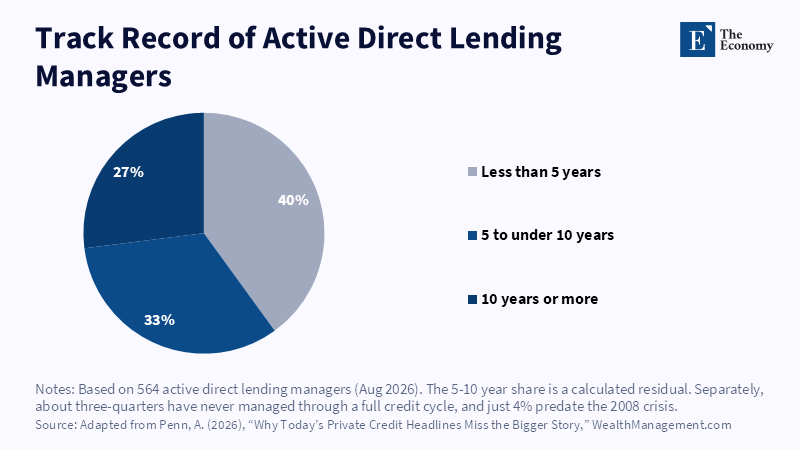
Private credit now counts hundreds of active direct lending managers, but only 27% have operated for at least a decade and just 4% were active before the Global Financial Crisis. This statistic accurately captures the dual nature of a market that has grown rapidly in recent years, but remains largely unexamined through a full credit cycle. As banks limit the allocation of capital due to regulatory requirements, private lenders are called upon to fill a funding gap that is not just quantitative but also structural. The question is no longer whether private credit will retain its role, but which lending models will prove more resilient when conditions tighten further.
Direct Lending: Speed at the Cost of Concentration
Direct lending remains the most established model of private credit. In this structure, the manager provides financing directly to a business, usually without a banking intermediary, building a relationship that allows for tailored terms, faster decision-making and greater certainty of execution than traditional banking processes. Transactions are often structured as unitranche facilities, combining senior and subordinated debt within a single instrument, which simplifies the borrower's capital structure while giving the lender the ability to negotiate monitoring terms and protection clauses directly.
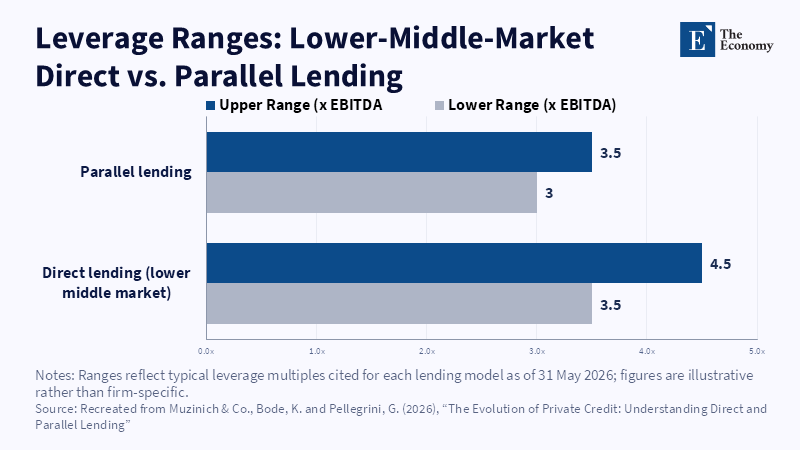
Leverage in this market segment typically ranges between 3.5 and 4.5 times earnings before interest, taxes, depreciation and amortization, with larger transactions having attracted intense competition and, in some cases, weaker lender protection. In contrast, the lower middle market offers a more diversified set of opportunities, as it is dominated by businesses that remain outside the scope of large bank lending. Proximity to management, stricter clauses and more frequent financial reporting make up a more defensive risk profile there and stronger covenants are often negotiated, even if performance remains inextricably linked to the discipline of the respective manager.
Parallel Lending and Club Deals: Sharing Risk Across Lenders
Alongside direct lending, a complementary model is emerging where private lenders cooperate with banks rather than substitute them, participating in the same financing under harmonized economic terms. Banks retain the role of customer origination and local knowledge, while the private lender adds additional lending capacity and long-term capital. The result is that borrowers gain access to larger pools of funding without losing continuity of their banking relationship, while banks limit their exposure to capital constraints.
The distinguishing feature of these portfolios is their granularity. By working with multiple banks in different markets, managers can build exposure to over a hundred borrowers simultaneously, so risk is spread across a broader borrower base rather than concentrated in a few large transactions. Leverage here tends to be lower, around 3.0 to 3.5 times profits, with more conservative documentation and interest payments entirely in cash. The trade-off is a more complex decision-making process, as multiple parties are involved in negotiating and managing a potential restructuring.
Manager Quality Separates the Market
The rapid growth of the market has obscured a more difficult truth: private credit is not a single asset class. The 2026 Private Credit Market Leaders ranking also shows substantial differences in institutional positioning, placing several global platforms in Tier I while established specialist lenders appear in lower tiers, reflecting differences in scale, breadth, origination and cycle experience. Among active direct loan managers today, four out of ten have less than five years of experience and almost three out of four have not managed a portfolio through a full credit cycle. The industry's rapid expansion has attracted companies built in a period of unusually favorable credit conditions, with many knowing well how to disburse loans but less how to manage them when conditions deteriorate.
The issue is not the asset class itself, but weak underwriting discipline in parts of the market. Excessive leverage, loose underwriting, excessive capital chasing the same trades and a focus on fundraising rather than protecting it make up a pattern that repeatedly emerges behind recent headlines about troubled portfolios. Larger borrowers attract dozens of lenders, competitive tenders squeeze margins and weaken protection clauses, whereas the core middle market, with businesses typically generating between ten and fifty million EBITDA, offers less competition, lower leverage and more frequent financial reporting. Manager quality is increasingly being tested as credit conditions normalize.
Europe and the Rise of Club Deals
In Europe, where the bank-centric corporate lending system remains deeply entrenched, club deals emerge as a burgeoning form of transaction origination. They allow multiple private lenders to share funding amounts, provide additional capacity through delayed capital drawdowns and support complex acquisitions without each side taking disproportionate risks. Trust among stakeholders, harmonization of documentation and consistency in underwriting philosophy become crucial factors when timelines are squeezed.
Table 1: Private Credit Lending Models at a Glance
| Funding Model | Typical Leverage | Structure | Main Advantage | Main Risk |
|---|---|---|---|---|
| Direct lending | Roughly 3.5x-4.5x EBITDA* | Unitranche or senior secured | Speed and customized terms | Greater deal concentration |
| Parallel lending | Around 3.0x-3.5x net debt/EBITDA* | Bank and private lender co-lending | Diversification and bank origination | More parties involved |
| Club deal | Transaction-specific | Several private lenders | Larger capacity and shared exposure | Lender alignment |
Bank balance-sheet constraints and Europe's bank-centric lending system reinforce this trend, as more businesses seek alternative sources of capital beyond traditional bank lending. The limited experience of many managers is not simply a U.S. concern, because the broader question is whether underwriting discipline, transaction structure and risk sharing through models such as club deals or parallel lending will hold up when the next credit cycle becomes more difficult and portfolios can no longer be judged mainly by performance during favorable years. The question posed by the original statistics remains open and the answer will not be given by the volume of funds flowing into the market, but by the discipline with which they are channeled.
This article reflects the analytical judgment of The Economy Markets Editorial Board and does not constitute business advice or the official position of any affiliated institution.
References
Bode, K. and Pellegrini, G. (2026) ‘The Evolution of Private Credit: Understanding Direct and Parallel Lending’, Muzinich & Co., 4 June.
Capital - Private Credit Desk (2026a) ‘Top 30 Non-Bank & Specialty Lending 2026’, The Ranking News, 1 May, updated 13 August.
Capital - Private Credit Desk (2026b) ‘Top 30 Private Credit Market Leaders 2026’, The Ranking News, 1 May, updated 13 August.
Capital - Private Credit Desk (2026c) ‘Top 30 Structured Credit & Capital Markets 2026’, The Ranking News, 1 May, updated 13 August.
Chambers and Partners (2026) ‘Private Credit 2026’, Global Practice Guides.
Penn, A. (2026) ‘Why Today’s Private Credit Headlines Miss the Bigger Story’, WealthManagement, 21 August.
The Economy (2026) ‘Private Captial Markets’, The Economy Wiki, last reviewed 24 August.
The Economy Markets Editorial Board is a multidisciplinary group of researchers, analysts and sector specialists covering the structure and evolution of global professional and institutional markets. Its work examines competitive landscapes, market positioning, buyer choice and the forces reshaping industries across advisory services, capital markets, wealth management, healthcare and other specialist sectors.
The Board also contributes to The Economy’s ranking research, where its members assess firms, institutions and market participants using structured research, sector evidence and comparative analysis. This combination of market research and ranking coverage gives the Board a continuing view of how competitive positions develop within individual industries and how firms differentiate themselves as markets evolve.
Through The Economy Markets, the Board translates this research into accessible analysis of market structure, competitive dynamics and institutional change, complementing The Economy’s rankings, Wiki profiles and broader research coverage with a comparative view of the markets in which ranked organisations operate.
Similar Post