The Mid-Market Advantage in Healthcare Private Equity

The Economy Markets Editorial Board is a multidisciplinary group of researchers, analysts and sector specialists covering the structure and evolution of global professional and institutional markets. Its work examines competitive landscapes, market positioning, buyer choice and the forces reshaping industries across advisory services, capital markets, wealth management, healthcare and other specialist sectors.
The Board also contributes to The Economy’s ranking research, where its members assess firms, institutions and market participants using structured research, sector evidence and comparative analysis. This combination of market research and ranking coverage gives the Board a continuing view of how competitive positions develop within individual industries and how firms differentiate themselves as markets evolve.
Through The Economy Markets, the Board translates this research into accessible analysis of market structure, competitive dynamics and institutional change, complementing The Economy’s rankings, Wiki profiles and broader research coverage with a comparative view of the markets in which ranked organisations operate.
Authored on
Modified
Mid-market healthcare funds have outperformed larger private equity peers
Healthcare IT and biopharma services are gaining deal share
Specialization and operational execution increasingly matter more than scale

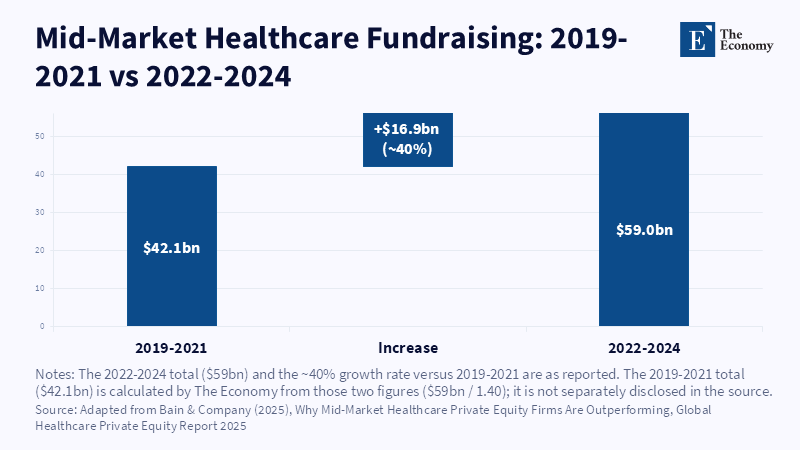
Mid-market private equity funds with healthcare exposure have raised approximately $59 billion since 2022, exceeding fundraising in the previous three years by about 40%. The increase reflects a shift that has been building for years, as an aging population, rising chronic conditions, and the digitalization of care have transformed a traditionally defensive industry into a field for more active portfolio restructuring. The middle market, typically defined as funds with between $500 million and $4 billion under management, has consistently outperformed larger funds in recent years while maintaining buyout activity and exits even as the broader healthcare acquisition market struggled. There is no single explanation for this discrepancy. It is more about the convergence of several structural trends that have changed both where capital is directed and the way managers create value.
How the Healthcare Middle Market Expanded After 2017
The course of the market from the end of the 2010s until today shows steady, although not linear, growth. The annual number of transactions in the US middle healthcare market increased from 137 in 2007 to a peak of 668 in 2021. The 2022-2024 period brought an expected slowdown due to higher interest rates, more expensive financing and general uncertainty in the markets, but activity remains well above pre-2017 levels. This in itself shows that this is not just a result of the extremely easy money of the previous decade.
At the same time, the share of healthcare in the total US middle private equity market expanded significantly, from 8.7% in 2007 to a peak of more than 16% in 2020 and 14.8% in 2021. Although the rate fell to the 12% region in 2023-2024, it is still above long-term averages. The change is not purely cyclical. Healthcare has taken over a larger part of the middle market itself, while investors have also started to become much more selective about the type of exposure they want.
The Shift Toward Healthcare IT and Biopharma Services
Historically, transactions in healthcare providers accounted for approximately 55% of deal volume in the middle market, with a significant portion involving physician groups or retail healthcare providers in the United States. But the market has started to move. More capital is now being directed toward services, technology, and infrastructure companies around providers that can benefit from the same long-term trends with a different risk profile.
Investment exposure in these provider-adjacent categories has increased at a compound annual rate of approximately 36% since 2022. Providers face increased labor costs, staff shortages, complicated reimbursement processes, and pressure to invest in digital infrastructure, so companies that can reduce these costs or make operations more efficient gain greater strategic value. In many cases, in fact, these business models are less exposed to the day-to-day operational difficulties of the providers themselves.
In the biopharma sector, middle-market activity has also maintained much of the momentum gained during the 2021 deal boom, despite a broader slowdown in other healthcare segments. Deeper expertise has been built in clinical trials, data, commercial services and support platforms, allowing specialized funds to take technical risk that more generalist healthcare investors often avoid.
Transactions such as WindRose Health Investors' acquisition of SubjectWell and GI Partners' majority investment in eClinical Solutions are typical of this direction. Both cases place capital not just in the provision of care, but in the infrastructure and services that make a more digital and complex health system work.
Why Specialized Healthcare Managers Have an Advantage
Mid-market healthcare funds have historically outperformed larger funds, while many managers in this segment have also developed deep sector specialization. The two points should not be treated as identical, but they often reinforce each other as the healthcare market becomes more complex. The logic is quite similar to choosing between a general practitioner and a specialist: the more complex the problem, the more value specialized knowledge acquires.
The first factor is better access to transactions. Managers who have been active for years in certain sub-sectors have relationships with founders, management teams, advisers and other investors, which can give them access to companies before they reach fully competitive sale processes. The second is the ability to assess technical and regulatory risk. In healthcare, two businesses with similar financial sizes may have a completely different actual risk profile due to reimbursement, regulation, or clinical exposure.
The third reason is operational specialization. Value creation is no longer just about leverage or buying smaller competitors. Process redesign, better use of data, technological upgrading and more careful personnel management are often needed. The fourth is the ability to choose sub-sectors with a better growth and risk balance, particularly when the overall market becomes more challenging. And the fifth is experience with exits. At a time when assets are held longer and buyers are more demanding, knowing who can buy an asset and under what conditions has real economic value.
Artificial intelligence, digital health and new therapeutic platforms are making that specialization more valuable. These technologies create opportunities with high potential returns, but also more ways for an investment thesis to go wrong, and in this environment general healthcare exposure is not necessarily enough.
Exits, Liquidity and a Still-Uneven Recovery
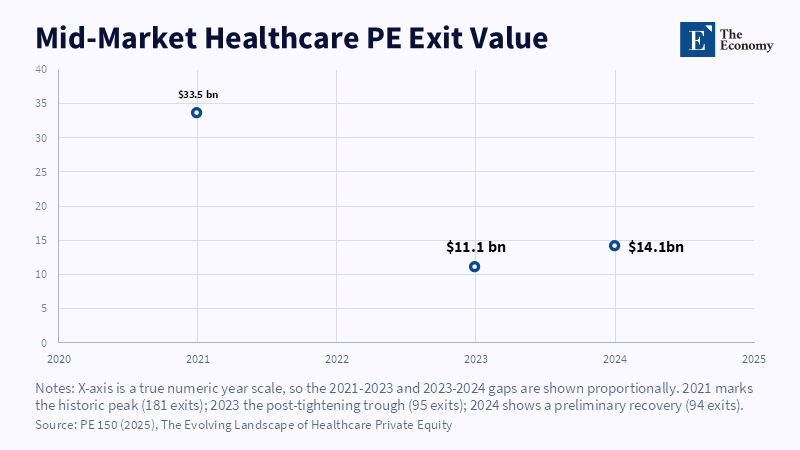
The trajectory of healthcare exits largely follows the broader cycles of the private equity market. Activity accelerated through the decade after the global financial crisis and reached unusually high levels around 2021, when financing was cheap and valuation conditions were more favorable. That backdrop changed quickly once monetary policy tightened.
That momentum was sharply reduced after 2021 as interest rates rose. Financing became more expensive, the valuation gap between buyers and sellers widened, and public-market exit routes became less dependable. Assets have therefore been held for longer and distributions to investors have remained under pressure across much of private equity.
Mid-market healthcare has nevertheless shown more resilience than the broader healthcare buyout market. Bain notes that these funds maintained buyout activity and exits from 2020 onward even while the wider market struggled, although the same report also points to continuing macroeconomic pressure on sponsor exits. The recovery is there, but it is still uneven and much more selective than the conditions seen in 2021.
For mid-market managers, the difference is significant. Raising new capital depends heavily on the ability to return capital to existing investors, and an industry that maintains even limited exit channels in adverse cycles can therefore have an advantage over sectors where liquidity almost disappears.
Beyond Scale: Home Infusion and the Next Phase of Value Creation
The buy-and-build strategy through successive acquisitions has for years been one of the key drivers of performance in mid-market healthcare, particularly in fragmented provider sectors. Purchasing a platform, adding smaller businesses, and achieving greater scale could create significant value, especially when borrowing costs were low and exit valuations were increasing.
Today's environment is less lenient. Higher interest rates, longer holding periods, and stressed valuations mean that scale alone is no longer enough. More emphasis is being placed on centralized operational infrastructure, better procurement and billing processes, data usage, automation, and the development of new services. Value creation thus becomes more tailored to the asset itself and less a standardized takeover recipe.
Home treatment with intravenous administration of drugs is a good example of this next phase. The global home infusion therapy market is estimated at approximately $26.18 billion in 2025, with a prospect of reaching about $41.49 billion by 2032, corresponding to a compound annual growth rate of approximately 6.8%. In the United States, the market is expected to nearly double, from $10.26 billion in 2024 to about $20.59 billion by 2033.
Growth is being fueled by several parallel trends: an ageing population, more chronic diseases, pressure to transfer care out of hospitals, and increasing capacity to provide complex treatments at home. At the same time, fragmentation in the subsector creates consolidation opportunities for mid-market investors, while the operating model can be less capital-intensive than traditional hospital care.
Generative AI adds another differentiator. Its applications are not limited to clinical decisions, but extend to billing, revenue management, staff scheduling, data analysis, and administrative functions that absorb a large part of the cost of a health system. For funds investing in healthcare IT or services around biopharmaceuticals, understanding these tools is gradually becoming part of the investment know-how itself rather than just a technological addition, and this is one area where general playbooks can become outdated pretty quickly.
Where Mid-Market Healthcare Private Equity Is Finding Growth
| Area | What the Data Shows | Why It Matters |
|---|---|---|
| Fundraising | About $59B raised in 2022-2024, around 40% above 2019-2021 | Investor demand has remained resilient |
| Healthcare Providers | Historically about 55% of mid-market healthcare deal volume | Providers remain important, but their share is declining |
| Healthcare IT and Services | Provider-adjacent deal volume grew about 36% annually since 2022 | Capital is shifting toward technology and services |
| Biopharma Services | Activity has largely held its post-2021 pace | Specialist knowledge supports investment in complex assets |
| Home Infusion | Global market projected from $26.2B in 2025 to $41.5B by 2032 | Home-based care offers another expanding investment area |
What Will Sustain the Mid-Market Advantage
The outperformance of mid-market healthcare private equity does not appear to be based on a temporary market cycle. It reflects a combination of demographic change, technological transformation and specialized management capability that has developed over more than a decade. The nearly $59 billion raised since 2022, along with the ongoing shift toward healthcare IT, biopharma services and home care, shows a market that is still attracting capital even as the broader acquisition environment remains challenging.
The next phase, however, will probably be more demanding than the previous one. Leverage and the simple consolidation of smaller businesses are not enough in the way they used to be, while longer holding periods make real operational improvement more important. Managers who can combine deep sub-sector knowledge, technology, and tailored value-creation strategies are better positioned to maintain the advantage that the mid-market has shown over the past decade. The clearest test may be where liquidity returns first, and which managers can turn it into distributions.
This article reflects the analytical judgment of The Economy Markets Editorial Board and does not constitute business advice or the official position of any affiliated institution.
References
Bain & Company (2025), Global Healthcare Private Equity Report 2025. Bain & Company.
Coherent Market Insights (2025), Home Infusion Therapy Market Analysis & Forecast, 2025-2032. Coherent Market Insights.
FTI Consulting (2025), Four Critical Value Levers for Infusion Services. FTI Consulting.
GI Partners (2024), eClinical Solutions Announces Growth Investment by GI Partners to Further Its Mission of Helping Bring Treatments to Patients Faster. GI Partners.
Healthcare150 (2025), The Evolving Landscape of Healthcare Private Equity. Healthcare150.
Research and Markets (2025), United States Home Infusion Market Size and Share Analysis: Growth Trends and Forecast Report 2025-2033. Research and Markets.
WindRose Health Investors (2024), WindRose Health Investors Completes Majority Growth Investment in SubjectWell. WindRose Health Investors.
The Economy Markets Editorial Board is a multidisciplinary group of researchers, analysts and sector specialists covering the structure and evolution of global professional and institutional markets. Its work examines competitive landscapes, market positioning, buyer choice and the forces reshaping industries across advisory services, capital markets, wealth management, healthcare and other specialist sectors.
The Board also contributes to The Economy’s ranking research, where its members assess firms, institutions and market participants using structured research, sector evidence and comparative analysis. This combination of market research and ranking coverage gives the Board a continuing view of how competitive positions develop within individual industries and how firms differentiate themselves as markets evolve.
Through The Economy Markets, the Board translates this research into accessible analysis of market structure, competitive dynamics and institutional change, complementing The Economy’s rankings, Wiki profiles and broader research coverage with a comparative view of the markets in which ranked organisations operate.
Similar Post