[Family Office] Why Digital Infrastructure Is Now Essential

The Economy Markets Editorial Board is a multidisciplinary group of researchers, analysts and sector specialists covering the structure and evolution of global professional and institutional markets. Its work examines competitive landscapes, market positioning, buyer choice and the forces reshaping industries across advisory services, capital markets, wealth management, healthcare and other specialist sectors.
The Board also contributes to The Economy’s ranking research, where its members assess firms, institutions and market participants using structured research, sector evidence and comparative analysis. This combination of market research and ranking coverage gives the Board a continuing view of how competitive positions develop within individual industries and how firms differentiate themselves as markets evolve.
Through The Economy Markets, the Board translates this research into accessible analysis of market structure, competitive dynamics and institutional change, complementing The Economy’s rankings, Wiki profiles and broader research coverage with a comparative view of the markets in which ranked organisations operate.
Authored on
Modified
Family offices are modernizing data and investment workflows
AI adoption is rising but governance remains essential
Outsourcing helps smaller teams fill specialist capability gaps

Cerulli Associates estimates that $124 trillion will change hands in the United States through 2048, including wealth transferred to heirs and charities, while Deloitte estimates that family offices globally manage roughly $3.1 trillion in assets and serve families holding about $5.5 trillion in wealth. But size does not automatically translate into readiness. Seven in ten family offices reported being engaged in direct investments in 2025, according to Citi Wealth, while 44% of U.S. family offices surveyed by BNY Wealth cited understaffing as a key challenge for new direct investments. The demand for specialized infrastructure is clear but the ability to provide it remains uneven and technology is increasingly filling that gap, not simply as an auxiliary tool but as part of the operating model itself.
Wealth Concentrates and the Pressure to Organize Follows
The rise of family offices is not only due to the amount of capital they manage. It also reflects their long-term horizons, concentrated decision-making authority and ability to become operationally involved in assets in ways that traditional investment structures do not always permit. But as more families move from passive capital allocation toward active portfolio management and direct investing, more of the pressure is being shifted onto internal organization.
Many family offices still operate with fragmented systems, legacy software and data stored in spreadsheets accumulated over decades. Reporting to family members is often delayed by the manual processing of information received from banks, custodians and fund administrators, while the ability to analyse scenarios quickly can also be constrained by inconsistent data. Creating a single source of truth is therefore no longer mainly a matter of convenience. It has become part of timely investment and operational decision-making.
Technology Becomes a Performance Multiplier
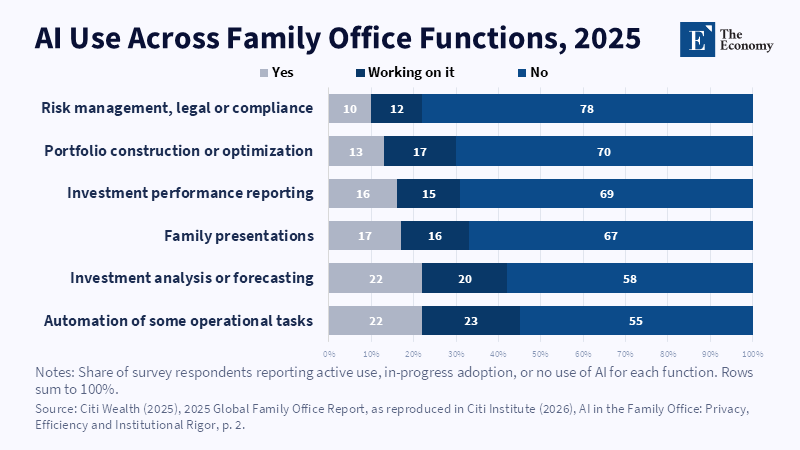
AI has begun to change how relatively small investment teams conduct research, compare opportunities and maintain more consistent decision frameworks across large volumes of information. Nine out of ten family offices believe AI could enhance investment returns and half have already tried it, according to the 2025 Bank of America Family Office Study.
At the same time, allocations to private equity increased from 22% of the average family office portfolio in 2021 to 30% in 2023, according to Deloitte, while public equity allocations fell from 34% to 25%. Private equity therefore surpassed public equity in Deloitte's survey for the first time.
That shift puts additional pressure on investment infrastructure because private assets generally require more sourcing, due diligence, monitoring, document processing and valuation work than listed securities and this work becomes harder when the investment team remains small, data comes from multiple providers, historical information is poorly standardized and decisions still need to be made quickly enough to compete for opportunities. Human judgment remains essential but its reach can be expanded when it is combined with machine-assisted analytical scale. Better data can also make portfolio changes, concentration and market pressure visible sooner.
Why Technology Implementation Is Never Final
Choosing software is not a one-time project. Deloitte estimates that a typical technology adoption process can take eight to twelve weeks while implementation can extend for another three to six months depending on the software and use cases involved.
The process requires continuous staff training, early involvement by stakeholders and in many cases coordination across several specialized providers responsible for functions ranging from data ingestion and portfolio management to accounting and communication. This makes implementation less like installing a single product and more like changing an operating system while the organization is still using it, which can become difficult quite fast when ownership of the project is unclear or the data was not prepared properly in advance.
The technology infrastructure being built today also needs to remain flexible as leadership and family requirements change. As younger generations become more involved, pressure is increasing for more immediate access to information, digital reporting and modern communication rather than dependence only on periodic reporting. Data and reporting tools are therefore increasingly being developed as systems that continue to evolve rather than as finished projects.
The Cost of Fragmented Infrastructure
Without effective software governance, technology projects can be pushed off schedule and stakeholder engagement can weaken. A trusted internal sponsor should be assigned clear authority over the implementation, whether that person is the CFO, CIO or another senior executive who can keep competing priorities from gradually taking over the project.
Understaffing remains an important constraint, particularly where specialist talent is difficult to recruit. Functions such as accounting, tax structuring, technology support and parts of investment management are often outsourced to specialist providers or multi-family offices. This does not necessarily mean that investment authority is handed outside the family. Citi's 2025 research found growing use of external suppliers while major decision-making generally remained in-house.
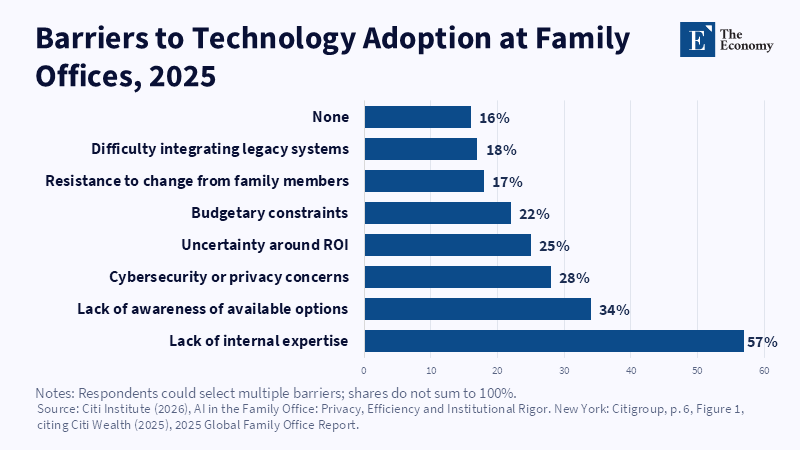
The same logic is contributing to interest in outsourced chief investment officer services. BlackRock's 2025 Global Family Office Survey found that 22% of family offices had either used or would consider using an OCIO, while respondents also reported large internal capability gaps in reporting, deal sourcing and private-market analytics. For smaller and mid-sized offices, outsourcing can provide institutional capabilities without requiring every specialist function to be recreated internally from scratch.
The Next Phase Depends on Continuity, Not Installation
The private wealth market is becoming harder to operate with static systems. Generational wealth transfers, greater private-market exposure and demand for faster analysis are increasing the amount of information that must be collected, reconciled and interpreted across relatively lean organizations. Technology is consequently becoming part of the basic operating infrastructure rather than a separate investment project, although software on its own still does not solve weak governance, poor data or staffing problems.
Table 1: Where Technology Changes Family Office Operations
| Area | Current Pressure | What Technology Adds | Risk Without It |
|---|---|---|---|
| Data Integration | Fragmented systems and spreadsheets | Consolidated reporting and cleaner data | Delays and reporting errors |
| AI and Automation | Large research and monitoring workload | Faster screening and analysis | Slower decision cycles |
| Private Markets | More direct and private equity exposure | Better diligence and portfolio monitoring | Capability and liquidity pressure |
| OCIO and Outsourcing | Specialist talent gaps | External institutional expertise | Overloaded internal teams |
Investing in technology only pays off when governance, staff capacity and continuous improvement are built around it. The numbers already show the direction of travel: direct investments remain widespread, private-market allocations have increased, AI is moving into investment research and operations and external specialists are increasingly being used where internal capability is limited. Offices building this infrastructure now are better positioned to absorb the next stage of wealth transfer without allowing growing complexity to outrun the systems responsible for managing it.
This article reflects the analytical judgment of The Economy Markets Editorial Board and does not constitute business advice or the official position of any affiliated institution.
References
Bank of America Private Bank (2025) Bank of America Family Office Study: Perspectives Shaping Today’s Family Office. Bank of America.
BlackRock (2025) 2025 Global Family Office Survey. BlackRock.
BNY Wealth (2025) 2025 Investment Insights for Single Family Offices. BNY.
Cerulli Associates (2024) The Cerulli Report: U.S. High-Net-Worth and Ultra-High-Net-Worth Markets 2024: The Great Wealth Transfer: Capturing Money in Motion. Cerulli Associates.
Citi Wealth (2025) 2025 Global Family Office Report. Citi Wealth.
Deloitte Private (2024) Defining the Family Office Landscape. Family Office Insights Series, Global Edition. Deloitte.
Deloitte Private (2024) Family Office Technology Solutions. Deloitte.
Deloitte Private (2024) The Top 10 Family Office Trends, 2024. Family Office Insights Series, Global Edition. Deloitte.
The Economy Markets Editorial Board is a multidisciplinary group of researchers, analysts and sector specialists covering the structure and evolution of global professional and institutional markets. Its work examines competitive landscapes, market positioning, buyer choice and the forces reshaping industries across advisory services, capital markets, wealth management, healthcare and other specialist sectors.
The Board also contributes to The Economy’s ranking research, where its members assess firms, institutions and market participants using structured research, sector evidence and comparative analysis. This combination of market research and ranking coverage gives the Board a continuing view of how competitive positions develop within individual industries and how firms differentiate themselves as markets evolve.
Through The Economy Markets, the Board translates this research into accessible analysis of market structure, competitive dynamics and institutional change, complementing The Economy’s rankings, Wiki profiles and broader research coverage with a comparative view of the markets in which ranked organisations operate.
Similar Post