Technology Private Equity: Scale, Due Diligence and the Small-Cap Advantage

The Economy Markets Editorial Board is a multidisciplinary group of researchers, analysts and sector specialists covering the structure and evolution of global professional and institutional markets. Its work examines competitive landscapes, market positioning, buyer choice and the forces reshaping industries across advisory services, capital markets, wealth management, healthcare and other specialist sectors.
The Board also contributes to The Economy’s ranking research, where its members assess firms, institutions and market participants using structured research, sector evidence and comparative analysis. This combination of market research and ranking coverage gives the Board a continuing view of how competitive positions develop within individual industries and how firms differentiate themselves as markets evolve.
Through The Economy Markets, the Board translates this research into accessible analysis of market structure, competitive dynamics and institutional change, complementing The Economy’s rankings, Wiki profiles and broader research coverage with a comparative view of the markets in which ranked organisations operate.
Authored on
Modified
Private equity capital is concentrating among fewer global managers
Smaller technology funds have historically delivered stronger relative returns
Technical diligence increasingly separates capital from genuine investment capability

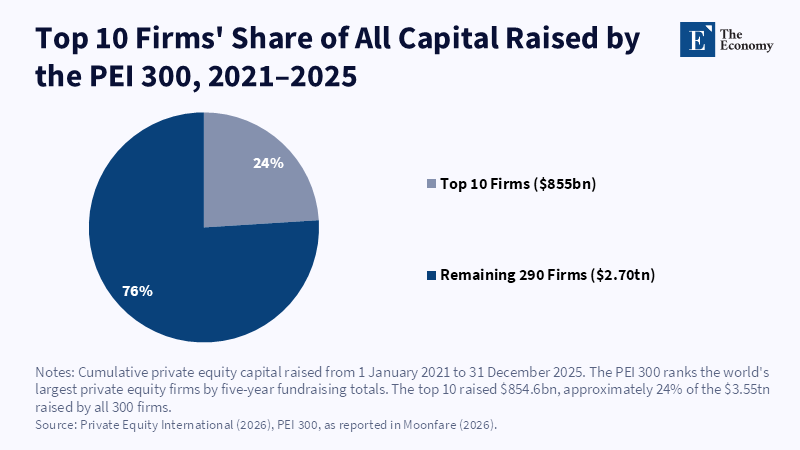
Ten fund managers raised $855 billion between 2021 and 2025, nearly a quarter of the $3.6 trillion raised by the 300 largest global private equity managers combined, according to Private Equity International's PEI 300 ranking. The minimum entry amount to the list reached $2.8 billion, a record. At the same time, total global capital raising fell to its lowest level since 2020, at $735 billion in 2025. The tech sector has become the largest sub-sector of private equity in both value and number of deals, according to a report by Bain & Company and perhaps that's why it captures this dichotomy more clearly than anyone else: capital is concentrated in fewer and fewer hands but the ability to understand the very product being bought doesn't always follow the same path.
The Private Equity Market Is Splitting
Polarization is not a new phenomenon but it is accelerating. Investors are now asking for real cash returns instead of paper valuations, which leads them more to expand already tested relationships and less to start new ones. The top ten managers, including KKR, EQT and Hg, raised nearly a quarter of the total amount raised by the world's 300 largest. At the same time, the number of new private equity firms fell by about 18% annually between 2020 and 2025, according to a report by McKinsey & Company. The result is a market where established managers find it easier to raise capital, while newer firms face a much harder fundraising environment.
The same polarization is reproduced within technology. Specialized mega technology buyout funds have accounted for about 62% of technology fundraising since 2016, leaving less room for mid-sized players who have traditionally covered the gap between venture capital and buyout. Holding periods are also getting longer. McKinsey reports that the typical portfolio company is now held for more than six and a half years, so the technology acquired must not only be good on deal day but continue to evolve for several years under new management and enough pressure to perform.
Scale Does Not Guarantee Better Returns
Scaling offers a bargaining advantage but it doesn't automatically produce better returns. The basic problem of larger funds is quite simple: they have to find targets large enough to effectively absorb the capital they have already raised. Trading volume in the first half of 2026 fell by 34%, while the average deal size almost quadrupled compared to the previous year, according to a report by PwC. Capital is increasingly being directed toward fewer, larger investments, where conviction must be higher and the margin for error often smaller.
The pressure is clearest in cash distributions. Five-year rolling distributions as a share of total private equity AUM fell to roughly 10% in June 2025, the lowest level recorded by McKinsey. Portfolio assets are increasingly being transferred into continuation vehicles managed by the same GP, which can provide liquidity to existing investors without requiring a full sale of the asset. The mechanism is useful but it also shows how difficult the classic path from buyout to exit has become.
Smaller Tech Buyout Funds Gain Ground
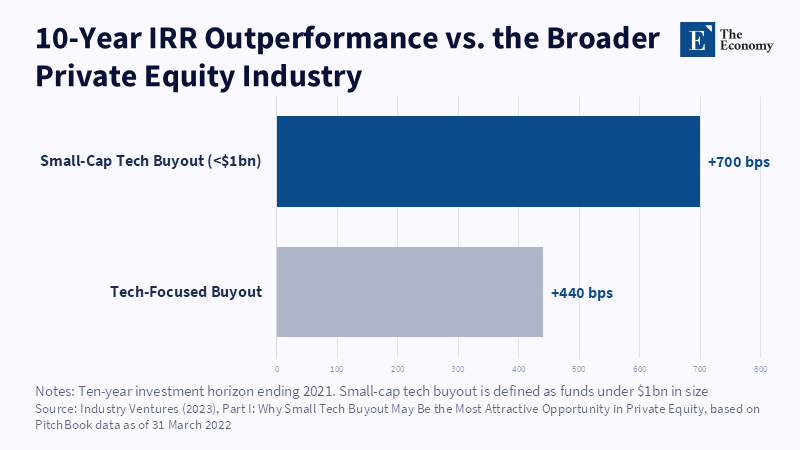
On the other side of the market, smaller niche technology funds seem to benefit precisely from the bottleneck created at the top. Technology buyout funds under $1 billion have outperformed the broader private equity sector by 700 basis points over a ten-year horizon ending in 2021, according to PitchBook data cited by Industry Ventures. Tech-focused buyout overall outperformed the broader industry by 440 basis points over the same period. In other words, much of technology's outperformance seems to come not from the largest funds but from the smallest segment of the market.
Firms like Banneker Partners, founded by a former Vista executive and Luminate Capital Partners, founded by a former Silver Lake investor, operate in a segment where competitive pressure is lower and entry valuations are often more reasonable. The difference in valuations reaches 5.4 times EBITDA between small-scale deals and mega fund deals, while top-quartile managers in the smaller segment achieved an investment multiplier (MOIC) close to 4x, compared with roughly 2x to 3x for larger segments. It doesn't mean that smaller size is an advantage in itself. But it does mean that it allows access to a different set of companies and often at prices that leave more room for operational improvement after the acquisition.
The Technical Understanding Gap
Behind the discussion about fund size, valuations and returns there is a less measurable problem. Many private equity firms that buy technology companies do not have the technical expertise internally to fully evaluate what they are buying and the problem often becomes visible only after the deal is closed. Bain & Company found that 31% of buyouts in its 2022 analysis involved pure-play technology companies, yet tech-specific due diligence was carried out in only around 9% of buyouts overall. Large deals can receive extensive financial scrutiny while still resting on technical assumptions that have been tested far less thoroughly.
Recurring gaps in product roadmap governance and R&D measurement were identified across 180 EY-Parthenon diligence engagements involving software and software-enabled companies, issues that can go almost unnoticed during diligence and appear months later. Technical debt, inadequate security posture and limited scalability remain among the hidden risks that can complicate technology acquisitions. Reliance on outside advisors has also become normal in this part of the market; Bain says its technology due diligence practice has completed more than 200 projects across industries.
This does not mean that technology investment only acts as a defense against risk. A 2024 Harvard Business School study found that private equity portfolio companies that significantly increase digital investment after acquisition are associated with stronger sales growth, employee growth and innovation. Technical understanding, therefore, is not just about identifying what can go wrong. It is also about the investor understanding where the value really is.
Retaining Critical Technical Talent
The cost of this gap becomes even more apparent after the deal closes, when the departure of technical executives can take away exactly the knowledge for which the acquisition premium was paid. The loss of a key software architect or security engineer at this stage is not just a human resources issue; it can delay the entire transformation of the portfolio company, particularly in buy-and-build strategies where technological integration is at the center of the investment thesis.
The managers who seem to do best are those who treat talent retention as part of due diligence rather than as an issue to be resolved after signing. Retention bonuses, equity rights conversion and a clear organizational chart before completion can reduce some of the uncertainty that drives key executives toward exit. Smaller specialists may have an advantage here because they can stay closer to the engineering teams they acquire, realize earlier where the critical technical knowledge is and intervene with less organizational friction than a mega-fund platform, although this still depends a lot on the manager and the company being acquired.
Table 1: Technology Private Equity At A Glance
| Indicator | Evidence | What It Means |
|---|---|---|
| PEI 300 concentration | Top 10 raised $854.6bn of $3.55tn | Fundraising is increasingly concentrated at the top |
| Mega tech fundraising | 62% of technology fundraising since 2016 | Large specialist funds dominate capital formation |
| Small-cap tech returns | +7.0 percentage points IRR vs broader PE | Smaller tech funds historically outperformed |
| Entry valuations | 5.4x difference in median entry multiples | Smaller deals offer substantially more valuation headroom |
| Technology due diligence | Tech represented 31% of buyouts but tech-specific diligence was about 9% overall | Technical underwriting has lagged technology exposure |
| Software diligence gaps | 30% had roadmap-governance gaps; 66% lacked R&D performance KPIs | Important technical weaknesses can remain hidden before acquisition |
The same momentum that raised $855 billion in the world's ten largest managers leaves behind a gap that capital alone cannot fill. Scaling ensures access to larger deals, not necessarily a better understanding of the technology being purchased, nor does it guarantee that the engineers who created it will remain after signing. With technology underpinning a large part of expected value creation, technical due diligence should be treated as part of core underwriting rather than as another standard process next to legal and financial scrutiny. Companies that invest in technical evaluation capability and retain engineering teams before closing, rather than when problems have already arisen, are ultimately the ones most likely to transform tech private equity from a capital-raising exercise into real value creation.
This article reflects the analytical judgment of The Economy Markets Editorial Board and does not constitute business advice or the official position of any affiliated institution.
References
Baik, B.K., Chen, W.X. and Srinivasan, S. (2024) Private Equity and Digital Transformation. Harvard Business School Accounting & Management Unit Working Paper No. 24-070.
Bain & Company (2022) Is Your Tech Due Diligence Good Enough? Global Private Equity Report 2022.
Bain & Company (n.d.) Tech Due Diligence. Bain & Company.
Banneker Partners (n.d.) Stephen Davis: Managing Partner, Banneker. Banneker Partners.
EY-Parthenon (2022) Three Hidden Private Equity Value Opportunities in Software Deals. EY, 16 August.
Industry Ventures (2023a) Sharma, L., Wong, J. and Berman, B., Part I: Why Small Tech Buyout May Be the Most Attractive Opportunity in Private Equity. Industry Ventures, 17 February.
Industry Ventures (2023b) Sharma, L., Wong, J. and Berman, B., Part II: Accessing Superior Returns in Small Tech Buyout. Industry Ventures, 6 April.
Luminate Capital Partners (n.d.) Hollie Moore Haynes. Luminate Capital Partners.
McKinsey & Company (2026) Global Private Equity Report 2026: Clearer View, Tougher Terrain. McKinsey & Company.
Private Equity International (2026a) PEI 300: The World's Largest Private Equity Firms. Private Equity International, 1 June.
Private Equity International (2026b) Fundraising Report: Full Year 2025. Private Equity International.
PwC (2026) Private Equity: US Deals 2026 Midyear Outlook. PwC, 17 June.
The Economy Markets Editorial Board is a multidisciplinary group of researchers, analysts and sector specialists covering the structure and evolution of global professional and institutional markets. Its work examines competitive landscapes, market positioning, buyer choice and the forces reshaping industries across advisory services, capital markets, wealth management, healthcare and other specialist sectors.
The Board also contributes to The Economy’s ranking research, where its members assess firms, institutions and market participants using structured research, sector evidence and comparative analysis. This combination of market research and ranking coverage gives the Board a continuing view of how competitive positions develop within individual industries and how firms differentiate themselves as markets evolve.
Through The Economy Markets, the Board translates this research into accessible analysis of market structure, competitive dynamics and institutional change, complementing The Economy’s rankings, Wiki profiles and broader research coverage with a comparative view of the markets in which ranked organisations operate.
Similar Post