Infrastructure Debt Grows, But Capital Doesn't Always Go Where It Needs To

The Economy Markets Editorial Board is a multidisciplinary group of researchers, analysts and sector specialists covering the structure and evolution of global professional and institutional markets. Its work examines competitive landscapes, market positioning, buyer choice and the forces reshaping industries across advisory services, capital markets, wealth management, healthcare and other specialist sectors.
The Board also contributes to The Economy’s ranking research, where its members assess firms, institutions and market participants using structured research, sector evidence and comparative analysis. This combination of market research and ranking coverage gives the Board a continuing view of how competitive positions develop within individual industries and how firms differentiate themselves as markets evolve.
Through The Economy Markets, the Board translates this research into accessible analysis of market structure, competitive dynamics and institutional change, complementing The Economy’s rankings, Wiki profiles and broader research coverage with a comparative view of the markets in which ranked organisations operate.
Authored on
Modified
Infrastructure debt is becoming a core institutional allocation
New capital is moving toward higher-return infrastructure strategies
Essential projects still struggle to attract sufficient financing

The opportunity in the global infrastructure debt market is now approaching $40 trillion, covering both investment- and sub-investment-grade debt, according to Macquarie Asset Management executives. Pension funds and insurance organizations need investments that can generate stable cash flow over many years, often over a time horizon that few asset classes can really cover. Infrastructure, particularly when operating within a regulated or contractually protected framework, can offer this duration alongside a potentially higher income profile than traditional sovereign debt, depending on structure and credit risk.
This explains why infrastructure debt is gradually moving from a relatively niche allocation to a more basic part of the portfolios of insurance companies, pension schemes and, increasingly, private wealth. But the more important question is not how much capital is available, but where it ends up. And there the picture becomes less clear, because the infrastructure with the greatest social or economic need is not necessarily the one that most easily attracts private capital.
Why Infrastructure Debt Fits Long-Term Institutional Portfolios
Pension funds often invest in infrastructure through large specialized managers, who can raise capital from many institutional investors and finance projects on a scale that would be difficult for an investor to undertake alone. For these portfolios, infrastructure has a key advantage: the duration of the assets themselves is quite similar to the duration of the liabilities that pension funds have towards their members and beneficiaries.
Macquarie reports that some infrastructure debt strategies target yields of 10% to 12%, depending on credit quality, leverage, transaction structure and market conditions. This does not mean that the entire category performs at these levels but it explains why the riskier part of the market can compete with traditional corporate private credit within institutional portfolios. Infrastructure is already being treated by many insurance investors as a normal allocation rather than a peripheral position.
The investment logic is summed up in what Macquarie calls HALOID: hard assets, low obsolescence, inelastic demand. Simply put, these are physical assets that are difficult to replace, do not quickly become technologically obsolete and provide services for which demand does not easily disappear. Electricity grids, water networks, transport infrastructure or basic telecommunications continue to be used even when the economy slows. Macquarie argues that infrastructure debt has historically recorded very low default rates and high recoveries, while its own investment framework has been stress-tested across more than 300 transactions and multiple credit cycles.
Regulated Cash Flows Help, but No Longer Define the Market
The comparison with long-term government bonds is not just theoretical. Much of traditional infrastructure operates within contractual or regulatory frameworks that limit several of the risks faced by an ordinary company. Regulated water networks, energy infrastructure, roads with long-term concessions or assets with inflation-linked prices can offer fairly predictable cash flow and, in some cases, the ability to pass part of inflation through to end users.
The problem is that the definition of "infrastructure" has expanded considerably. Digital infrastructure, data centers, the energy installations that power them and services around them are now entering the same investment universe as roads, hospitals or utility networks, but without always having the same regulatory protection.
This is not necessarily negative. It changes the character of the category. In the case of data centres, for example, Macquarie executives note that the most interesting risk-reward can sit one or two steps away from the data centre itself, in electricity, connections or other adjacent infrastructure where there is real scarcity. Capital therefore does not always follow what is most essential for society. It tends to follow opportunities combining strong demand, downside protection and sufficient returns.
Where New Infrastructure Capital Is Actually Going
The market recovery has been impressive. Global capital raising by private infrastructure funds rose from about $99 billion in 2024 to more than $250 billion in 2025, the market's strongest year in about a decade according to With Intelligence. Several mega-funds of more than $10 billion were closed in the same year, which explains a large part of the sharp increase.
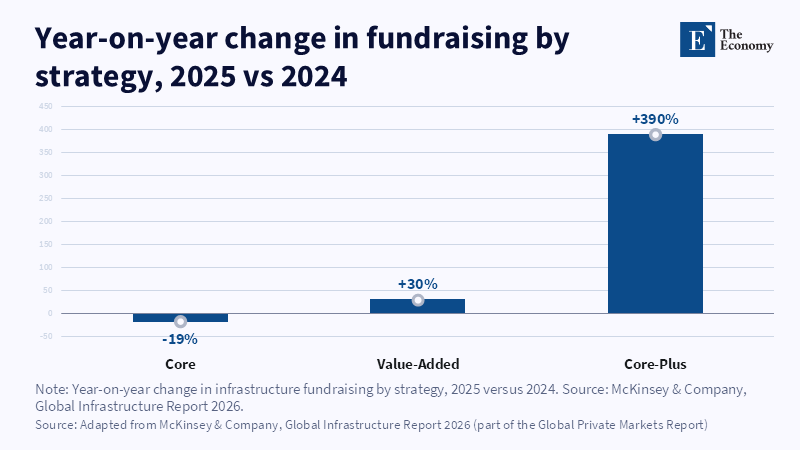
But the return of capital did not occur uniformly. McKinsey finds that most fundraising was directed to value-added and core-plus strategies, which increased about 30% and 390% respectively, while traditional core fell nearly 19%. That shift says more about the market than the headline fundraising total. Investors still want the stability of infrastructure, but they are increasingly asking for returns that a purely low-risk regulated asset cannot easily provide.
At the same time, capital is concentrated in fewer and larger funds. About 44% of total commitments in 2025 was captured by the ten largest managers, according to CBRE Investment Management, while dry powder fell to 23% of AUM. This points to a market where capital is still being deployed, while fundraising is becoming more concentrated among the largest managers.
It is no coincidence that a large part of this activity is around data centers, energy and, more broadly, the infrastructure needed to develop artificial intelligence. This also fits with Macquarie's position: for many investors, the more interesting asset is not the data center itself but the electricity, the connection or the adjacent infrastructure that has become a bottleneck. High yields can occur there without completely abandoning the basic logic of infrastructure, meaning limited supply and inelastic demand.
Germany Shows the Public-Sector Version of the Same Problem
The same distance between the capital that is announced and the infrastructure that is finally created also appears in the public sector. A special fund of up to €500 billion was approved in Germany for infrastructure and climate neutrality, and it was presented as one of the largest investment interventions in decades.
A year later, however, the first assessments were much more uncomfortable. The Institut der deutschen Wirtschaft estimated that around 86% of the relevant 2025 resources did not translate into real additional investment, with the federal government's total investment spending nominally increasing by around €2 billion. The ifo Institute, using a different approach, was even stricter: it calculated that 95% of the additional borrowing was not directed to additional investment and that the real increase was about €1.3 billion compared with 2024.
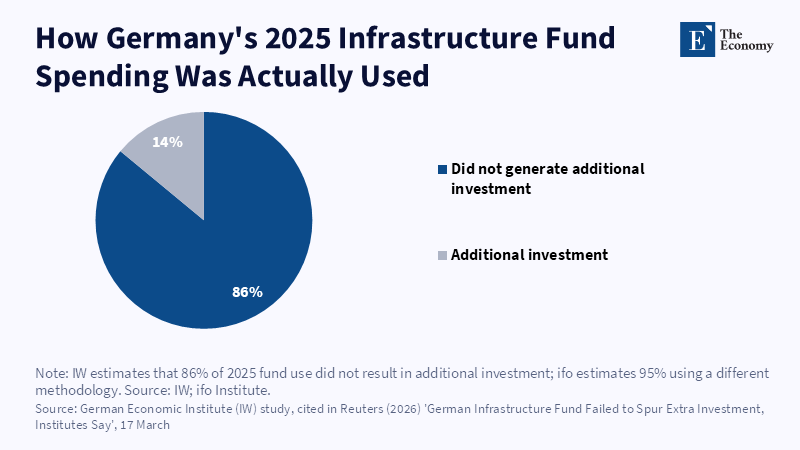
In other words, much of the new budgetary space replaced or freed up expenditure that would otherwise have had to be covered by the normal budget. This does not mean that the money disappeared, but it changes the image of a fund that was supposed to increase investment on a net basis.
The German example thus functions as a mirror of the same problem that exists in private capital. In one case, money moves towards assets with a better risk-reward ratio. In the other, it is absorbed by budgetary and administrative needs. The result can look quite similar, though: huge amounts of capital are available for infrastructure, but this does not automatically mean that the infrastructure with the greatest real need is financed.
Mission Drift and the Risk-Sharing Gap
The basic logic of infrastructure finance has never been just financial. It exists because large projects have very high upfront costs, a duration of decades, and benefits that are often spread across an entire economy. A water supply network, a hospital or an energy connection is not financed because it is simply a good trade. It is financed because without it a large part of economic activity cannot function properly.
However, as infrastructure evolves into a much larger and more competitive category of private investment, return inevitably becomes more important. That is where the original purpose begins to blur. A data-centre power project with strong contracts and a lack of available capacity can be much easier to finance than a new hospital, school network or water project with politically controlled prices. The latter may be more socially important, but this alone is not enough to turn risk into an investable return.
Table 1: Where Infrastructure Capital Is Moving
| Segment | 2025 Signal | Why It Matters |
|---|---|---|
| Core infrastructure | Fundraising down 19% | Defensive strategies lost share |
| Core-plus | Fundraising up 390% | Investors accepted more risk for return |
| Value-added | Fundraising up 30% | Operational and development upside |
| Digital infrastructure | Strong capital interest | AI demand and power scarcity |
| Social infrastructure | Harder to finance privately | Regulatory and political risk |
| German special fund | Low additionality in 2025 | Public capital can be redirected |
The solution is not to limit private capital. Quite the opposite. Some risks that private investors cannot reasonably price will need to be absorbed by the public sector, through guarantees, contingent liability mechanisms, revenue floors or structures similar to the Thames Tideway, where low-probability but very high-impact risks are not left entirely to the investor. Without such structures, the vast capital seeking long-term, protected returns will continue to find its way to infrastructure that is easier to finance. And those are not always the infrastructure projects that are needed the most.
This article reflects the analytical judgment of The Economy Markets Editorial Board and does not constitute business advice or the official position of any affiliated institution.
References
CBRE Investment Management (2026) ‘Infrastructure Quarterly: Q1 2026’.
Department for Environment, Food & Rural Affairs (2015) ‘Thames Tideway Tunnel: government support package contract documents’. Updated 1 July 2026.
Federal Ministry of Finance (2026) ‘Special Fund for Infrastructure and Climate Neutrality’.
ifo Institute (2026) ‘German Government Misappropriated 95 Percent of New Debt for Infrastructure in 2025’, 17 March.
Institut der deutschen Wirtschaft (IW) (2026) ‘86 Prozent des Sondervermögens im Jahr 2025 zweckentfremdet’, 17 March.
Macquarie Asset Management (2026a) ‘A golden age for infrastructure debt?’, 2 July.
Macquarie Asset Management (2026b) ‘Infrastructure debt’s HALO shines bright’.
McKinsey & Company (2026) ‘Infrastructure: Investing to Support Global Growth’, Global Private Markets Report, 23 March.
The Economy (2026a) ‘Artificial Intelligence Transformation’, The Economy Wiki, reviewed 24 August.
The Economy (2026b) ‘Private Captial Markets’, The Economy Wiki, reviewed 24 August.
The Economy (2026c) ‘Private Wealth and Family Office Services’, The Economy Wiki, reviewed 24 August.
With Intelligence (2026) ‘Infrastructure Outlook 2026: Fundraising Momentum Returns’, 24 February.
The Economy Markets Editorial Board is a multidisciplinary group of researchers, analysts and sector specialists covering the structure and evolution of global professional and institutional markets. Its work examines competitive landscapes, market positioning, buyer choice and the forces reshaping industries across advisory services, capital markets, wealth management, healthcare and other specialist sectors.
The Board also contributes to The Economy’s ranking research, where its members assess firms, institutions and market participants using structured research, sector evidence and comparative analysis. This combination of market research and ranking coverage gives the Board a continuing view of how competitive positions develop within individual industries and how firms differentiate themselves as markets evolve.
Through The Economy Markets, the Board translates this research into accessible analysis of market structure, competitive dynamics and institutional change, complementing The Economy’s rankings, Wiki profiles and broader research coverage with a comparative view of the markets in which ranked organisations operate.
Similar Post