Artificial Intelligence Market in Europe: Compute, Adoption and the Scale Gap

Working across research, policy, and data-driven analysis, the Editorial Board ensures that published pieces reflect a consistent institutional perspective grounded in quantitative reasoning and long-term structural assessment.
Authored On
Modified
Europe's AI compute gap remains large despite new investment
Small firms face deeper barriers to meaningful AI adoption
Local demand could reinforce infrastructure, competition and productivity

Three American companies, Amazon, Microsoft and Google, control about 70 percent of the European cloud market, according to data from Synergy Research Group cited by Bruegel and Bruegel's approximate calculations bring their combined revenue from the continent close to €60 billion for 2025. The AI market in Europe is already moving with this money as a base and every time a business buys access to a model, a portion of that spending crosses the Atlantic. Two gaps coexist in the same market. The continent has just 5 percent of the world's computing power and small businesses, which make up the backbone of the economy, remain reluctant to pay the prices of American providers and the cost of local implementation. The two gaps feed each other and interventions targeting only one risk being weakened by the other.
Where the AI Market in Europe Stands Today
The quantities that can be measured clearly show the distance. Based on the Europe2031.ai dataset, Bruegel records for 2026 about two gigawatts of operational computing power for artificial intelligence in the Union, compared with 35 in the U.S. and five in China, while forecasts for 2031 leave the European share at 5.6 percent, with the American share falling from 78 percent to 68 percent and the Chinese share rising to 15 percent. At the model level, Europe has essentially one major developer, Mistral, which in September raised €3 billion at a valuation of more than €21 billion. The Commission's existing network of 19 AI Factories is expected to be supplemented by much larger AI Gigafactories. In terms of funding, U.S. startups in 2024 attracted about 74 percent of global venture capital investment in the sector, while European ones attracted about 12 percent, according to INSEAD, which adds that the U.S. produces about four times as many AI unicorns as Europe.
The public side has also begun to move. In July, the European Commission launched a tender for up to seven AI Gigafactories, with up to €10 billion in EU and national public funding expected to mobilise at least €20 billion in private investment, bringing total expected investment to more than €30 billion. The call closes on November 12, selections are expected in early 2027 and deployment is expected within 18 months of contract signing. AMD, NVIDIA and Qualcomm have also submitted letters of intent concerning hardware supply. Demand is not waiting. Across OECD countries with available data, the share of firms using artificial intelligence rose from 8.7 percent in 2023 to just over 20 percent in 2025.
Europe's Compute and Adoption Gaps Reinforce Each Other
The first problem concerns supply. Without sufficient computing infrastructure on the continent itself, researchers seeking to train large systems may find laboratories, capital and chips elsewhere and Europe risks losing that talent and the associated expertise. Time is increasingly as important as money. From securing permits and power to becoming operational, the average lead time is about 24 months in the U.S. and 42 months in Germany, although Bruegel notes uncertainty around the comparison. The IMF also highlights energy constraints, with data centres already accounting for a growing share of European electricity demand and AI expected to intensify that pressure. In markets where data centres are already concentrated, including Frankfurt, London, Amsterdam, Paris and Dublin, grid connections can take seven to ten years. Bruegel estimated that the original five-gigafactory plan would have added roughly 750 megawatts, around 4 percent of projected European AI compute capacity in 2031. The subsequent July 2026 tender expanded the initiative to up to seven facilities.
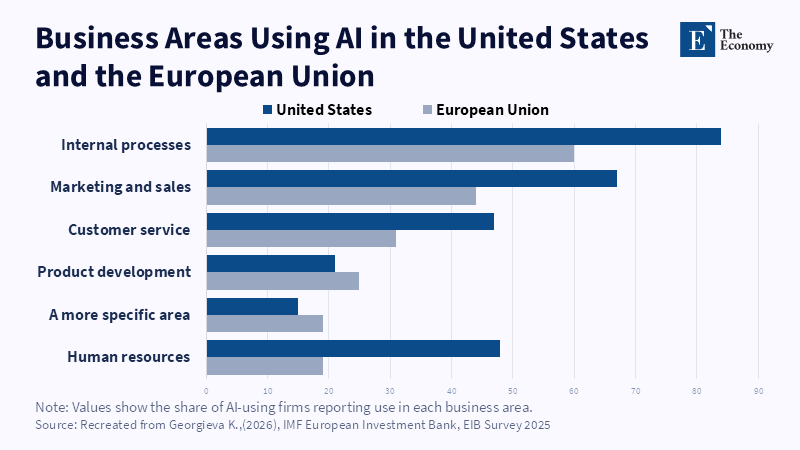
The second problem concerns demand and here the picture is more uneven. A European Investment Bank study covering more than 12,000 EU and U.S. companies estimates that the adoption of artificial intelligence raises labour productivity by about 4 percent, with gains concentrated in medium-sized and large enterprises that also invest in software, data and training. In the short term, the result reflects capital deepening rather than job losses, while the long-term employment effects remain uncertain. Eurostat records that in 2025 20 percent of EU enterprises with at least ten employees used artificial intelligence, but that statistical threshold leaves many microenterprises outside the measurement. European firms also tend to use AI less extensively across business functions than their American counterparts. For a company with five employees, the fixed costs of data preparation, software integration and training must be spread across much less output, while bargaining power with technology vendors is weaker.
What AI Could Deliver for European Productivity
At a private seminar on September 4, the Commission's special envoy for industrial AI, Jim Hagemann Snabe, urged the 27 commissioners to prioritise the use of technology to improve productivity rather than focus primarily on competing with American and Chinese frontier models. Examples presented included simpler testing rules for self-driving cars, secure data spaces for personalised medicine and a digital adviser for farmers. His team is studying the potential of individual sectors, with the first policy plans expected towards the end of the year. The broader discussion reflects an unresolved European tension between accelerating practical adoption and expanding domestic computing capacity.
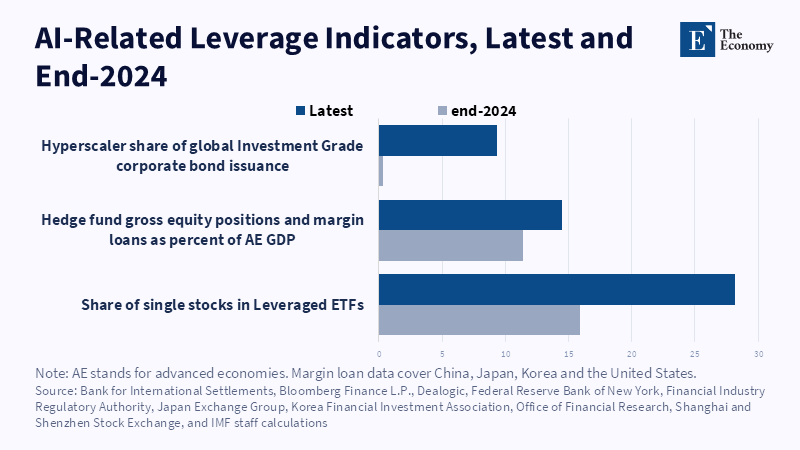
The IMF estimates that artificial intelligence could eventually raise global annual potential growth by 0.1 to 0.8 percentage points, with Europe capable of reaching the upper half of that range. At the informal meeting of EU finance ministers in Dublin, IMF Managing Director Kristalina Georgieva argued that Europe needs to participate both as a builder of infrastructure and models and as a user reorganising economic processes around the technology. The IMF also warns that if expected profits or investment projects disappoint, leverage and cyclical financing could amplify the resulting market correction internationally. The estimate concerns potential growth and does not specify when those gains will become visible in productivity data.
INSEAD places a substantial part of Europe's opportunity in physical AI, including robotics, manufacturing, chemistry and energy systems, where the continent already possesses a large industrial base and operates 219 robots per 10,000 manufacturing workers. Europe employs 2.15 million researchers, spent €403 billion on research and development in 2024 and produces 2.2 million science and engineering graduates every year. INSEAD estimates that the next generation of European companies could capture more than 25 percent of the global next-generation AI market if the region becomes substantially better at turning discoveries into scalable businesses. The conditional estimate highlights the same structural gap: Europe combines a strong research and industrial base with much smaller shares of compute capacity and AI funding.
How Local Demand Could Start the Investment Cycle
The two sides can be connected in a reinforcing cycle. The more companies buy locally implemented applications, the more revenue stays with European companies and those revenues can help justify additional infrastructure investment. More firms in the market mean greater competition and more positions for researchers, potentially improving tools and reducing implementation costs for smaller customers. The mechanism resembles markets with indirect network benefits, but the difficulty is getting the cycle started. A pump in a deep well does not raise water unless a little water is poured into it first. Public procurement and demand from large industrial groups could provide that initial push.
The counterargument also has evidence behind it. Bruegel argues that capital itself is not the main constraint and that subsidies for AI Gigafactories do not clearly address a private financing failure. It also warns that sovereignty requirements under European cloud and AI policy could increase costs. Private developers are already investing heavily: 76 of 101 identified infrastructure projects are entirely privately financed and account for 84 percent of planned capacity. The data still leave open how much of that new capacity will ultimately serve European customers and how much will be used by U.S. providers. Bruegel's forecast of a 5.6 percent European share of global AI compute in 2031 also shows that rapid private investment does not necessarily close the relative gap.
For policymakers, Social Europe suggests that support programmes should measure the participation of small businesses, the use of technology in key processes and continued use twelve months later, rather than simply counting event participants. In candidate countries the issue is more acute. In Montenegro, 95.9 percent of active business entities are microenterprises, while 2022 digitalisation programmes supported 353 SMEs and only just over a third of surveyed companies knew that the programmes existed. Employees often know where information is duplicated and which tasks consume time without adding value, making their early participation useful in identifying worthwhile investments. Industry groups in tourism, retail and agriculture could also share demonstrations, expertise and procurement terms, reducing fixed costs for smaller firms.
The fact that three U.S. companies control about 70 percent of the European cloud market, alongside roughly €60 billion in estimated 2025 revenue, describes where the market stands today, while recent investment announcements describe where Europe wants it to move. The AI Gigafactory tender closes on November 12, selections are expected in early 2027 and deployment is expected within 18 months of contract signing. The first policy plans for industrial AI are also expected toward the end of 2026. Until then, the cost faced by a small business seeking to use AI will still be strongly influenced by the same dominant providers and the available evidence does not yet establish whether the first water in the pump will come primarily from private demand, public procurement or faster permitting and grid access.
This article reflects the analytical judgment of The Economy Editorial Board and does not constitute policy advice or the official position of any affiliated institution.
References
Aldasoro, I., Gambacorta, L., Pál, R., Revoltella, D., Weiss, C. and Wolski, M. (2026) ‘AI adoption, productivity and employment: Evidence from European firms’, EIB Working Paper 2026/02. Luxembourg: European Investment Bank.
European Commission (2026) ‘EU launches AI Gigafactories call to boost Europe’s computing capacity and unlock more than €30 billion in investment’, 30 July.
Eurostat (2026) Digitalisation in Europe: 2026 edition. Luxembourg: Eurostat.
Georgieva, K. (2026) ‘Europe and the Global AI Race’, remarks at the Informal Meeting of Economic and Financial Affairs Ministers, Dublin, 21 September. Washington, DC: International Monetary Fund.
INSEAD (2026) ‘Europe’s Historic Second Chance: Leading AI’s Next Wave’, INSEAD Knowledge.
Martens, B. and Schenk, T. (2026) How Can Europe Address Its Pressing AI Compute Infrastructure Shortfall? Policy Brief 18/2026. Brussels: Bruegel. IDEAS/RePEc
OECD (2026) ‘AI use by individuals surges across the OECD as adoption by firms continues to expand’. Paris: OECD.
Rabrenović, J. (2026) ‘Europe’s AI Divide Is Already an Enlargement Problem’, Social Europe, 28 September.
Sheftalovich, Z. (2026) ‘EU’s top AI adviser urges commissioners to use the technology to fix bloc’s economy’, POLITICO Europe, 24 September. Muck Rack
Thomson, A. and Mackenzie, T. (2026) ‘Mistral AI raises at €21 billion valuation in Samsung-led round’, Bloomberg, 8 September.
Working across research, policy, and data-driven analysis, the Editorial Board ensures that published pieces reflect a consistent institutional perspective grounded in quantitative reasoning and long-term structural assessment.