Minimum Wage Effects: The Hidden Costs Inside Firms

Working across research, policy, and data-driven analysis, the Editorial Board ensures that published pieces reflect a consistent institutional perspective grounded in quantitative reasoning and long-term structural assessment.
Authored On
Modified
Minimum wages reshape firms beyond wages and employment
Firms adjust through training, hierarchy, prices and work intensity
Aggregate figures conceal who ultimately bears adjustment costs

When the real total labour costs of a minimum wage position increased by 3.7 percent in France, companies with an average degree of exposure reduced jobs by 0.9 percent and positions at the production level by 1.8 percent, while revenues per position rose by about 1.1 percent. The figures come from a study by Nicholas Lawson, Claire Lelarge and Grigorios Spanos for the years 2003 to 2006 and the crucial point is that sales and value added did not decline in a statistically significant way. In terms of overall figures, such a minimum wage seems almost painless. Within the company, however, costs have not been lost, they have moved towards fewer production positions, more employer-paid training, narrower wage differentials and flatter hierarchies. The analysis that measures only total jobs and incomes does not see this movement and with it a large part of the real balance sheet of the minimum wage is lost.
What Changes Within the Business When the Minimum Wage Rises
France's transition to the 35-hour week was accompanied by five temporary wage guarantees for minimum wage workers, depending on when each firm adopted the reduced working hours. Their subsequent consolidation generated different increases in minimum labour costs for firms operating under the same legal hours, with actual changes ranging from an increase of 7.9 percent to a decrease of 1.6 percent between 2003 and 2006, after taking into account changes in contributions. The researchers linked these differences to administrative data on employment, occupations, training and business accounts. Because the timing of the timetable was not random, they compared additional firms in the same guarantee group on the basis of the initial proportion of low-paid workers, which amounted to around 13.6 percent of workers.
The changes were concentrated on the basis of organization. The most exposed firms were less likely to add a management level and more likely to abolish one, with no large or purely measurable changes in the number of managers. The participation of production workers in employer-funded training increased by about two percentage points in relatively simple enterprises, while wage rise above the level of production was squeezed, a sign that part of the costs were absorbed by the narrowing of internal wage differentials. Hourly income rose by 0.9 percent, factor revenue productivity by about 0.3 percent and changes in capital were too small to explain the effect.
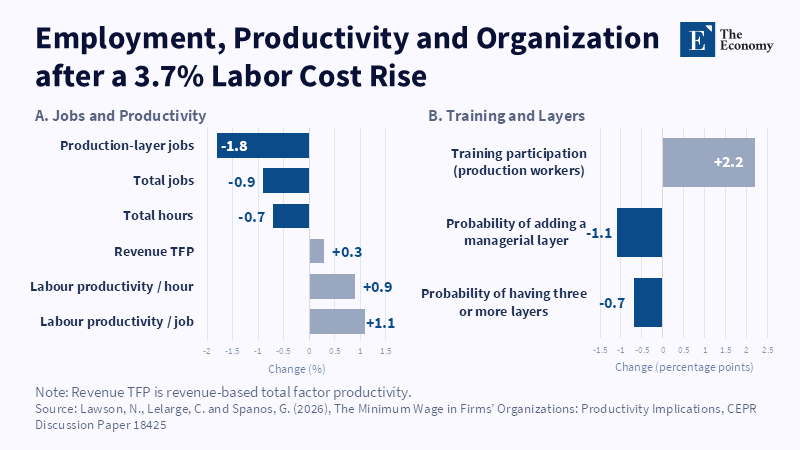
The proposed mechanism is simple. Production workers solve routine problems and pass on the difficult ones to management and any additional management level comes at a cost. When even the most basic position has to be paid more expensively, investing in skills becomes comparatively more advantageous, the best trained solve more problems on their own and supervision is limited. Hence a caveat for interpreting the figures: higher revenues per employee do not demonstrate better technical efficiency, because they can come from changes in prices, staff composition and organization and in any case do not constitute a welfare gain.
The Cost that Ends up in the Employee's Body
A different chunk of the same adjustment was recorded in California. Michael Davies, R. Jisung Park and Anna Stansbury analyzed over 13 million work-related accident compensation claims between 2000 and 2019 and found that a 10 percent increase in the minimum wage increases the injury rate by 7.2 percent in an occupational and regional market that is fully exposed to the increase. In absolute terms, the finding corresponds to about two additional injuries per 1,000 low-paid workers per year and the elasticity of the injury rate to the change in wages caused by the minimum wage was estimated at 2.2. In higher-paid occupations, where exposure to the minimum wage is limited, the phenomenon hardly occurs and this reinforces the interpretation that wage growth is behind injuries rather than some independent trend.
The composition of injuries says more than their magnitude. Cumulative injuries, associated with repeated physical exertion rather than individual accidents, increased at a rate about twice as high as the total, a pattern that is difficult to explain as random variation and indicates an intensification of the pace of work. In a production line or warehouse, the same project with fewer workers means more shift movements for those who stayed and this fits with the French picture of fewer production jobs and higher revenue per position. A second possible explanation, cuts in maintenance, training, or protective equipment, cannot be isolated in the available data. The revised estimate suggests that injury risk offsets about 19 percent of the welfare improvement from higher wages, without in itself reversing the case in favor of the increase.
How the Minimum Wage is Diffused in the rest of the Pay scale
Portuguese experience shows that costs travel upwards as well. In Portugal about 20 percent of workers are paid close to the minimum wage and the increases at the end of 2014 and 2016, which followed two years without change, affected wages by about half of the distribution, up to the median, according to Filipe Bento Caires of the European University Institute. The intensity of the diffusion depends on the internal structure of the company. Where the remuneration is tied to the title of the position, such as in large law firms, consulting firms or the public sector, the phenomenon is about 30 percent stronger. When the salary of the introductory position rises, the additional benefit of promotion narrows and the company raises the next level so as not to lose the motivation that supports its hierarchy.
The direction of internal adjustment is not one. In France, wage rise above the level of production was squeezed, in Portugal's rigid scales it climbed and in Italy Effrosyni Adamopoulou, Francesco Manaresi, Omar Rachedi and Emircan Yurdagul found that wage floors transfer part of the burden of adverse productivity shocks to higher-paid workers. In Hungary, Péter Harasztosi and Attila Lindner recorded that a significant part of the costs were passed on to consumers through higher prices. Each study shows a different recipient of the same cost: the production worker who was not hired, the middle salary level, the manager with a compressed increase, the employee who stayed and was intensified, the customer at the checkout.
Why One Team's Profit Comes With a Loss in Another
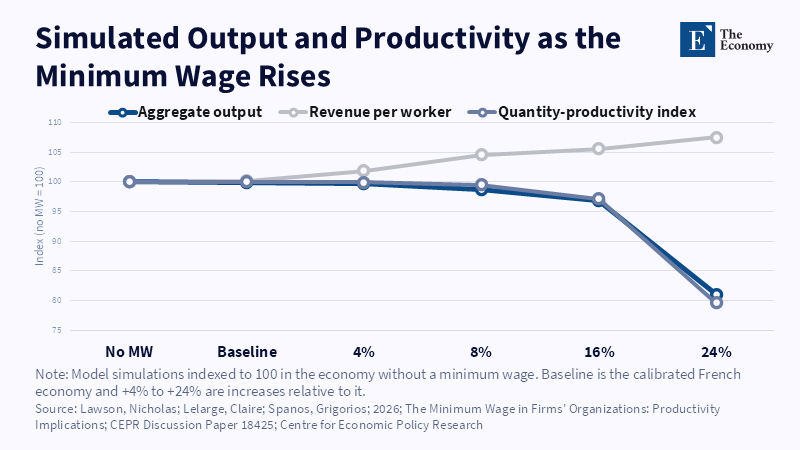
From the above emerges an accounting that the aggregate analysis omits. When the price of labor rises in one segment of the market, the increase in income of the workers in that segment is a transference and someone else finances it: the candidate who did not find a position, the middle-wage earner who saw his scale squeezed or rise disorderly, the customer who paid for a more expensive product, the shareholder with a lower profit, the worker himself with his injury. In the Lawson et al. model, organisational adjustment consumes real resources, so higher revenue per worker does not imply a corresponding welfare gain. In the French model, more effort goes into training instead of current production, profits deteriorate and the quantity-based productivity index decreases, even as income per worker rises.
Two counter-arguments deserve an answer. The first considers that the flexibility of businesses eliminates costs, since sales have not fallen. The model itself limits this: when skills can be adjusted but hierarchy cannot, the simulated cost for the product is about four times higher and at a wage floor 24 percent above the calibrated French baseline, modelled output is about 19 percent below the hypothetical economy without a minimum wage. This is a simulation that shows the limits of adjustment and not a prediction. The second counter-argument considers injuries negligible in the face of income growth and is largely right, since the net result for minimum wage workers remains positive. But this answer is about whether the group benefits and not who bears the rest.
What the Findings Mean for Policymakers
For macroeconomists, models with stable business organization overestimate the product cost of modest increases and at the same time ignore costs that do not show up in wages or jobs. For policymakers, Caires points out that it is first necessary to determine which inequality is being targeted, because the minimum wage narrows the gap between low and high wages, while raising middle wages can leave the gap between low and middle wages almost untouched. For labor inspectorates, the findings for California suggest that safety enforcement is particularly important precisely in industries with many workers close to the minimum wage. For businesses themselves, the choice between training and intensification determines who ultimately pays the bill.
The French 3.7 percent increase in labor costs left sales virtually unchanged, reduced production jobs by 1.8 percent and increased participation in training by about two points, while in California each 10 percent increase was associated with about two additional injuries per 1,000 workers. The two results come from different countries, periods and occupations and do not add up to a single account. The French intervention concerned an initial report of 13.6 percent of workers and the authors themselves note that the adjustment mechanism weakens when the minimum wage approaches the wages of the majority. For such a level there is still no comparable measurement of injuries, training or diffusion in middle wages and the broader welfare balance remains uncertain.
This article reflects the analytical judgment of The Economy Editorial Board and does not constitute policy advice or the official position of any affiliated institution.
References
Adamopoulou, E., Manaresi, F., Rachedi, O. and Yurdagul, E. (2026) ‘Minimum wages and insurance within the firm’, VoxEU, 19 January.
Caires, F.B. (2025) ‘Internal organization of firms and minimum wage spillovers’, working paper, revised March 2026.
Davies, M., Park, R.J. and Stansbury, A. (2026) ‘Minimum wages and workplace injuries’, Upjohn Institute Working Paper, No. 26-428.
Harasztosi, P. and Lindner, A. (2019) ‘Who pays for the minimum wage?’, American Economic Review, 109(8), pp. 2693–2727.
Lawson, N., Lelarge, C. and Spanos, G. (2026) ‘The minimum wage in firms’ organizations: Productivity implications’, CEPR Discussion Paper, No. 18425, revised September 2026.
Working across research, policy, and data-driven analysis, the Editorial Board ensures that published pieces reflect a consistent institutional perspective grounded in quantitative reasoning and long-term structural assessment.