China’s Exchange Rate Policy: Undervaluation, Exports and Supply Chains

Working across research, policy, and data-driven analysis, the Editorial Board ensures that published pieces reflect a consistent institutional perspective grounded in quantitative reasoning and long-term structural assessment.
Authored On
Modified
China’s weak real exchange rate supports export competitiveness
Evidence does not prove continuous deliberate yuan devaluation
Persistent undervaluation can reshape manufacturing and foreign firm survival

China's trade surplus of goods reached record levels of about $1.2 trillion in 2025. A figure large enough to make exchange rate policy look like an obvious explanation. The connection is plausible. A cheaper currency lowers the foreign-currency price of exports, increases the domestic value of foreign revenues and can direct more investment toward manufacturing. Today's debate, however, is more complex than the image of a China that is simply constantly pushing the yuan down. The International Monetary Fund calculated that China's current account surplus reached 3.3 percent of GDP in 2025 and linked the strong export performance in part to the real depreciation of the exchange rate caused by low Chinese inflation. At the same time, the yuan strengthened against the dollar in 2026. The key issue is therefore attribution to the cause: how much of China's export power comes from deliberate currency devaluation, how much from a weak real exchange rate and how much from an industrial structure that had already been created.
What the Devaluation Claim Actually Establishes
Donald Trump accused China and Japan in March 2025 of lowering the value of their currencies and thereby hurting American manufacturers. This position is part of a long tradition of US trade policy. Asian economies have repeatedly been accused of managing their exchange rates, creating an artificial advantage for exports, particularly when large trade surpluses coexist with high foreign exchange reserves, restrictions on capital movements or government intervention in the foreign exchange market. The current case of China offers critics enough real material. The governor of the People's Bank of China, Pan Gongsheng, stated at the G20 meetings in September 2026 that the country will not use the yuan as a tool to boost exports, while arguing that deficit countries also need their own structural reforms. The Chinese government does influence the exchange rate through a controlled range of fluctuation and broader restrictions on the financial system. What remains in question is the degree, intention and actual economic impact of this management.
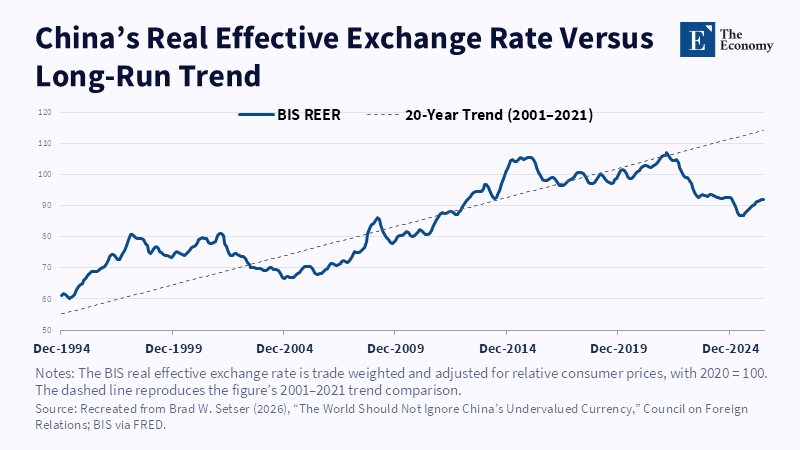
The available data does not equally easily support the more extreme version of the accusation. The US Treasury Department did not label China as a country manipulating its currency in the July 2026 report, although it criticized the lack of transparency around Chinese practices and warned that intervention aimed at preventing appreciation could lead to a different assessment in the future. Distinction matters. A currency can be considered undervalued without a new nominal depreciation, especially when domestic prices rise more slowly than prices in trading partners. The IMF has pointed out just this for China. Weak domestic demand and very low inflation have reduced the real exchange rate even without a sharp drop in the nominal yuan. Brad Setser of the Council on Foreign Relations estimated in August 2026 that the Chinese currency was about 20 percent undervalued based on the IMF's external equilibrium framework. This is an economic model assessment, not proof that Beijing deliberately caused a devaluation of the same magnitude.
Exchange Rate Policy Can Move Factories, Not Just Prices
The strongest argument in favour of the view that exchange rate policy has real industrial consequences comes from evidence showing that its effects can persist for years. Paul Bergin, Woo Jin Choi and Ju Hyun Pyun look at 45 countries, 22 emerging and 23 advanced economies and focus on the combination of foreign exchange accumulation and capital movements, rather than equating any exchange rate change with manipulation. The empirical sample of their structural analysis covers the period 1985 to 2007. In this sample, this policy mix is associated with a higher share of manufacturing in employment, reserve accumulation and capital controls and increased use of domestic intermediate inputs. According to their estimates, an economy with full capital controls that increases its foreign exchange reserves by one percentage point of GDP per year shows about 1.3 percentage points higher growth in manufacturing labor productivity over a five-year horizon. The estimate is policy-specific and is not a direct prediction for today's China, but the mechanism is clearly related to today's debate.
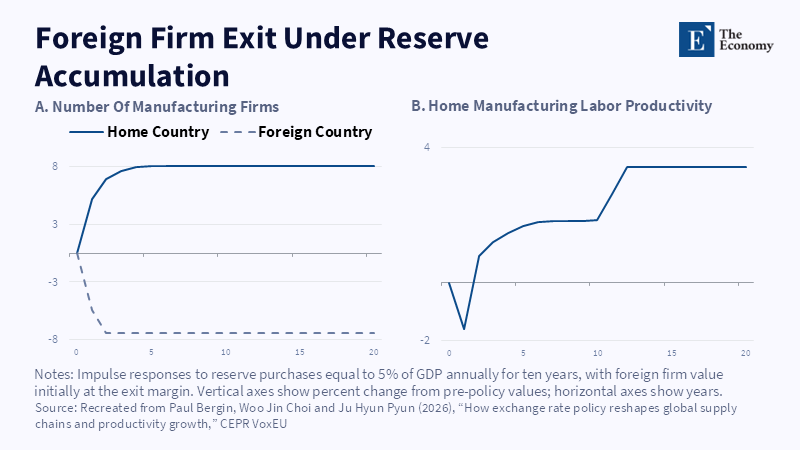
A lasting trade advantage changes more than the price of a product. New businesses enter the market, local suppliers expand around them, production gains more domestic connections and the availability of specialized intermediate products increases. Once this network has been established, the industrial structure does not necessarily return to the previous state when the exchange rate normalizes. This is where the substantial expansion lies beyond the simple thesis that a devalued currency temporarily takes demand away from foreign producers. In the model of Bergin, Choi and Pyun, foreign exchange reserve purchases equal to 5 percent of GDP per year for ten years increase the number of domestic manufacturing enterprises by about 7.5 percent after five years. Labor productivity in manufacturing eventually stabilizes about 3 percent above its original level. These are simulation results, not observed results of the Chinese economy, but they show why exchange rate policy can function as industrial policy when it lasts long enough to change the entry of businesses and supplier networks.
China Fits Part of the Mechanism, Not the Whole Explanation
The Chinese economy possesses several characteristics that make this mechanism plausible. The capital account remains tightly controlled, the central bank sets a daily benchmark for the yuan, state-owned financial institutions have an important role in foreign exchange markets and the country has accumulated very large foreign holdings over time. At the same time, manufacturing occupies an unusually large part of the economy and economic policy continues to boost investment in industrial production capacity. The IMF concluded that low inflation relative to trading partners had caused a significant real depreciation of the exchange rate by the end of 2025, enhancing the competitiveness of Chinese exports. The current account surplus was estimated at 3.3 percent of GDP for 2025, while the surplus in trade in goods exceeded $1 trillion. These data support the more limited thesis that exchange conditions have boosted China's export performance. They do not prove that exchange rate policy created the entire surplus.
Time development also makes it difficult to describe a continued deliberate devaluation. In September 2026, Reuters reported that the yuan had strengthened by 4.3 percent since the beginning of the year and was near a four-year high, to the extent that Chinese authorities encouraged exporters to use more exchange rate hedging tools. A currency can remain cheap in real terms even when it strengthens nominally, especially after a previous weakness and a period of very low inflation or deflation. The distinction, however, changes the conclusion that can be drawn. The safest description is that China maintains a controlled exchange rate regime within an economy where the real exchange rate has remained weak and where policy can limit appreciation. Attributing each period of high exports to a new deliberate devaluation merges different mechanisms into one term and ignores the importance of domestic demand, high savings, industrial subsidies and an already developed productive base.
The Plaza Accord Is Not a Precedent for Competitive Devaluation
The Plaza Agreement often appears in discussions of the Chinese currency because it links exchange rates, trade imbalances and industrial policy to one of the best-known episodes in postwar economic history. However, its direction was the opposite of a competitive Japanese devaluation. On September 22, 1985, Japan, the United States, France, West Germany and the United Kingdom agreed to seek a weakening of the dollar against the yen, the German mark and other major currencies. Japan therefore accepted a stronger yen, not a weaker one. The Japan Bank for International Cooperation records that the exchange rate moved from about 240 yen per dollar before the deal to about 127 yen per dollar three years later. The episode is relevant to today's debate because it shows that governments have for decades treated exchange rates as part of adjusting for large trade imbalances. But it is not an example of Japan devaluing its currency to increase its exports.
This historical difference also explains why the current pressure for a stronger Chinese currency cannot be treated as a repeat of a Plaza-style agreement. The economic structure is different. China has a much larger position in global manufacturing than Japan had in 1985, while today's supply chains include thousands of specialized supplier relationships that are not quickly reversed. A sharp appreciation would also have consequences inside China, particularly at a time of weak demand and problems in the real estate sector. One possible counterargument is that the imposition of a stronger exchange rate could intensify deflation, limit growth and ultimately leave the real exchange rate almost unchanged if domestic prices fell further. This concern has an economic basis, but it does not completely negate the effect of exchange rate policy. Nominal rates can move faster than wages and prices, while recent research on business dynamics shows that even temporary changes in relative prices can affect business entry and supplier choices.
For Supply Chains, Firm Exit Matters More Than the Manipulation Label
The most important result of the relevant research is at the same time that it limits the more generalized political category. Industrial expansion supported by exchange rate policy does not automatically make the trading partner poorer. In the basic model of Bergin, Choi and Pyun, the domestic economy gains from the expansion of its manufacturing base, but prosperity abroad also increases because foreign consumers acquire cheaper imported varieties and foreign businesses can recover when the trade balance is later reversed. The negative effect occurs when foreign businesses are already close to the exit point from the market. In this alternative scenario, the number of foreign enterprises decreases by 6.9 percent by the fifth year and the loss remains permanent, while foreign prosperity decreases by 1.57 percent in terms of equivalent consumption. Policy becomes more detrimental to the outside world when temporary competitive pressure destroys production capacity that is difficult or expensive to rebuild.
For governments, businesses and trade authorities, this changes the practical test. The indication that a currency is undervalued needs to be considered along with evidence of factory closures, loss of suppliers, restriction of new business entry and lower investment in the sectors most exposed to competition. Tariffs aimed solely at correcting a bilateral trade deficit may not take into account this structure, while a stronger yuan alone cannot restore a production chain after businesses and suppliers have already left. But the reverse is also true. If foreign businesses remain viable and supply chains adjust without a permanent exit, a Chinese trade surplus can create intense competitive pressure without necessarily causing permanent deindustrialization. The surplus of goods of about $1.2 trillion is therefore proof of the magnitude of the imbalance, not in itself proof of the mechanism that created it. Exchange rate policy is part of the explanation and the available evidence strongly supports the view that prolonged undervaluation can reshape manufacturing. However, they do not prove that every Chinese export profit comes from deliberate devaluation or that every trading partner suffers permanent industrial damage.
This article reflects the analytical judgment of The Economy Editorial Board and does not constitute policy advice or the official position of any affiliated institution.
References
Anstey, Christopher (2026) ‘US Treasury Calls Out China for Lack of Transparency on Yuan’, Bloomberg News, 23 July.
Bergin, Paul R., Choi, Woo Jin and Pyun, Ju Hyun (2023) ‘Catching Up by “Deglobalizing”: Capital Account Policy and Economic Growth’, Journal of International Money and Finance, 138, 102920.
Bergin, Paul R., Choi, Woo Jin and Pyun, Ju Hyun (2026) Exchange Rates, Structural Change, and Productivity Growth. NBER Working Paper 35609.
Funabashi, Yoichi (1988) Managing the Dollar: From the Plaza to the Louvre. Washington, DC: Institute for International Economics.
Kihara, Leika and Yamazaki, Makiko (2025) ‘Trump says Japan, China cannot keep reducing value of their currencies’, Reuters, 3 March.
Leahy, Joe (2025) ‘IMF calls on China to fix economic “imbalances”’, Financial Times, 10 December.
Reuters Staff (2026) ‘China urges more FX hedging as strong yuan hits exporters, sources say’, Reuters, 14 September.
Setser, Brad W. (2026) ‘The World Should Not Ignore China’s Undervalued Currency’, Council on Foreign Relations, 2 August.
Wu, Xinyi (2026) ‘China rejects G20 trade imbalance claims, says no need to devalue yuan’, South China Morning Post, 3 September.
Working across research, policy, and data-driven analysis, the Editorial Board ensures that published pieces reflect a consistent institutional perspective grounded in quantitative reasoning and long-term structural assessment.