“Trade Imbalances Must Be Broken”: Western Calls for Yuan Appreciation Target China’s Trade Surplus, Raising Concerns Over Fallout for South Korean and Japanese Manufacturers

Aoife Brennan is a contributing writer for The Economy, with a focus on education, youth, and societal change. Based in Limerick, she holds a degree in political communication from Queen’s University Belfast. Aoife’s work draws connections between cultural narratives and public discourse in Europe and Asia.
Authored On
Modified
China’s trade surplus expands as an undervalued yuan boosts price competitiveness
Western pressure for appreciation intensifies; China insists it has “never sought gains through its currency’s value”
Prospect of simultaneous South Korean and Japanese currency appreciation heightens tensions across East Asian markets
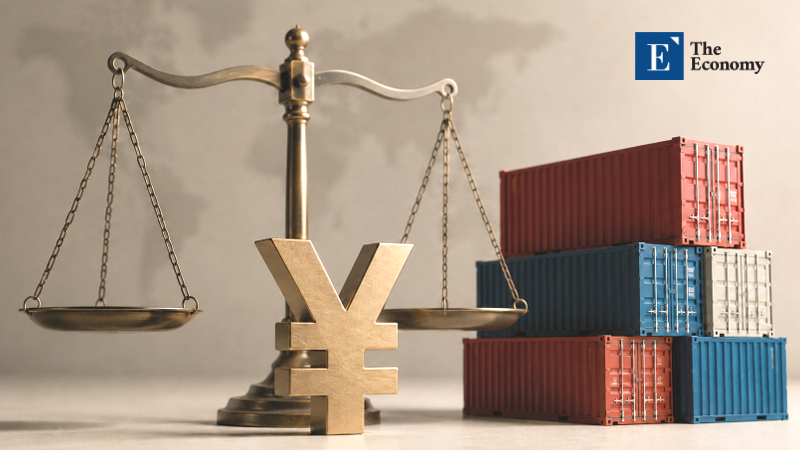
China’s trade surplus is expanding rapidly. The undervalued yuan has kept Chinese products highly competitive on price, driving brisk export growth and further exacerbating global trade imbalances. As the United States, Europe and other Western economies repeatedly call for the yuan to appreciate, markets increasingly expect the pressure to spread to major East Asian exporters such as South Korea and Japan. Analysts warn that if simultaneous appreciation pressure on the South Korean and Japanese currencies materializes, it could substantially erode the price competitiveness and profitability of export-oriented manufacturers in both countries.
China’s Exchange Rate-Driven Export Competitiveness
The Wall Street Journal reported on Aug. 28 (local time) that China’s export offensive, underpinned by an undervalued yuan, is threatening the manufacturing bases of its trading partners. According to global investment bank Goldman Sachs, China’s trade surplus is projected to reach $1.2 trillion this year. Its current-account surplus, encompassing goods, services and investment income, is expected to approach 1% of global gross domestic product. Goldman Sachs noted that there has been virtually no precedent in the postwar era for a single country’s trade surplus to account for such a large share of the global economy.
Exchange-rate policy has been identified as a central pillar supporting China’s export competitiveness. Goldman Sachs estimates that the yuan is undervalued by 19%, while Brad Setser of the Council on Foreign Relations puts the figure at 35%. Against this backdrop, the WSJ argued that China’s major trading partners must act to encourage Beijing to allow the yuan to appreciate voluntarily. Just as major economies jointly intervened in foreign-exchange markets under the 1985 Plaza Accord to bring down an excessively strong dollar, the proposal calls for raising the value of the undervalued yuan to normalize China’s export price competitiveness. Should China refuse, tariffs could be deployed as leverage and then gradually reduced in proportion to the extent of the yuan’s appreciation.
US Takes Aim at Undervalued Yuan
The United States has long taken measures against what it views as trade imbalances caused by China’s undervalued currency. One prominent example is the Trade Facilitation and Trade Enforcement Act enacted in 2015. At the heart of the legislation is a framework for assessing the exchange-rate policies of major trading partners based on criteria including their trade surpluses with the United States, current-account surpluses and intervention in foreign-exchange markets. On this basis, the US Treasury placed China on its currency “monitoring list” in 2016, establishing a system for continuously scrutinizing movements in the yuan and possible government intervention. In 2019, at the height of the US-China trade war, Washington formally designated China a “currency manipulator” for the first time in approximately 25 years. The US Treasury concluded at the time that China had tolerated an undervalued yuan through prolonged, large-scale intervention in foreign-exchange markets, giving the country an unfair competitive advantage in international trade.
Exchange-rate pressure subsequently became a bargaining chip in trade negotiations between the two countries. Ahead of the Phase One US-China trade agreement in January 2020, Washington removed China’s designation as a currency manipulator in exchange for provisions requiring both countries to refrain from competitive currency devaluation and disclose information concerning their exchange-rate policies and foreign-exchange reserves. US demands for yuan appreciation have become increasingly explicit again in recent months. In a report released in January, the US Treasury stated, “Although China has not been designated a currency manipulator, the yuan remains substantially undervalued,” publicly urging Chinese authorities to allow the currency to appreciate in line with market conditions and macroeconomic fundamentals.
Concerns Also Mount in Europe
Europe is likewise intensifying pressure over the yuan’s depreciation. Following a European Union summit in Brussels, Belgium, in June, German Chancellor Friedrich Merz claimed that the Chinese currency was undervalued by as much as 30% relative to its fair value. He cited the exchange-rate distortion, alongside China’s massive industrial subsidies, as a factor undermining the competitiveness of European companies. Merz invoked the Plaza Accord as a historical precedent for correcting such currency imbalances and called for international exchange-rate consultations with China.
French President Emmanuel Macron also addressed the issue during Franco-German consultations held in Germany last month, stating, “The current exchange-rate relationship between the yuan and the euro is unsustainable given China’s enormous trade surplus with Europe,” and adding, “Europe must discuss the exchange-rate issue with China at the EU level.” European Central Bank President Christine Lagarde similarly cited an International Monetary Fund analysis estimating that the yuan is undervalued by approximately 15–16% in real terms after accounting for inflation differentials. She emphasized that China’s exchange-rate policy should be addressed as part of the broader debate over excessive imbalances in the global economy. Lagarde nevertheless drew a line under calls to replicate the Plaza Accord, arguing that the current international financial environment differs markedly from that of 1985.
Table 1. Western Responses to the Undervaluation of the Yuan
| Year | Actor | Key Measure |
|---|---|---|
| 2015 | United States | Enacted the Trade Facilitation and Trade Enforcement Act, establishing a legal basis for evaluating the exchange-rate policies of major trading partners |
| 2016 | United States | Placed China on its currency monitoring list and began monitoring movements in the yuan and intervention in foreign-exchange markets |
| 2019 | United States | Designated China a currency manipulator for the first time in approximately 25 years |
| 2020 | United States | Removed China’s currency-manipulator designation in exchange for provisions in the bilateral trade agreement requiring the prevention of competitive currency devaluation and greater disclosure |
| 2026 | United States | Declared the yuan substantially undervalued and urged Chinese authorities to permit appreciation in line with market conditions |
| 2026 | Germany | Claimed that the yuan was undervalued by as much as 30% and called for international exchange-rate consultations |
| 2026 | France | Argued that the prevailing yuan-euro exchange rate was unsustainable given China’s trade surplus with Europe |
| 2026 | European Central Bank | Raised concerns while citing an analysis that the yuan was undervalued by 15–16% in real terms |
China Pushes Back Forcefully Against the West
China has shown little willingness to accept these demands from Western countries. Last month, China’s Ministry of Foreign Affairs stated, “China is not the source of Europe’s economic and trade problems,” arguing that “China’s industrial competitiveness stems from its comprehensive industrial system, vast market and innovation ecosystem.” Beijing also stressed that it has never manipulated its exchange rate or weakened the value of its currency to secure trade advantages. China’s financial authorities have adopted the same position. People’s Bank of China Governor Pan Gongsheng said in March, “China neither needs nor intends to secure foreign-trade competitiveness through currency depreciation,” adding that the country continues to adhere to its established policy of keeping the yuan broadly stable at a reasonable and balanced level.
Chinese officials and state media have also argued that Europe’s trade deficit with China should not be reduced to an exchange-rate issue. The state-run Global Times asserted, “The growing competitiveness of Chinese companies is not the result of an ‘artificially manipulated’ exchange rate, but of a comprehensive industrial system, sustained technological investment, a vast market and robust market competition.” It added, “Targeting the yuan will neither resolve the challenges confronting German manufacturing nor remedy the deficiencies in Europe’s innovation chain.” The newspaper continued, “Calls for another Plaza Accord are, in essence, political pressure rather than an economic solution,” declaring, “China will not tolerate the exchange rate being used as a pretext for coercion, nor will it return to an era in which great powers dictated the fate of a handful of countries.”
South Korean and Japanese Currencies Enter the Line of Fire
As trade tensions between China and the West intensify, the strategic calculations facing Asian economies are becoming increasingly complex. The IMF has previously noted that Asia’s production and trade networks are tightly interconnected and that correcting global imbalances would therefore require exchange-rate adjustments across major Asian economies, rather than in China alone. This means that if US and European demands prompt an actual appreciation of the yuan, currency appreciation pressure could spread beyond China to other major Asian exporters, including South Korea and Japan. One market expert said, “If China alone strengthens the yuan while the currencies of neighboring economies such as South Korea and Japan remain weak, a substantial portion of the price competitiveness lost by China could shift to competing economies such as South Korea and Japan.” The expert added, “Western countries are highly likely to exert additional pressure on South Korea and Japan if only to address their overall trade imbalances with Asia.”
For South Korea and Japan, currency appreciation is a double-edged sword. A stronger South Korean or Japanese currency would reduce the domestic-currency cost of crude oil, natural gas, raw materials, imported machinery and consumer goods, easing imported inflation and production-cost pressures. For exports, however, the effect would be precisely the opposite, as South Korean and Japanese products would become relatively more expensive for consumers in the United States and Europe. If companies pass the exchange-rate increase on to selling prices, South Korean and Japanese businesses could lose market share in fiercely price-competitive industries such as automobiles, machinery, steel and chemicals. If they instead hold local selling prices unchanged to preserve competitiveness, their revenue and operating profit would decline when converted into their domestic currencies. Either outcome would sharply increase the strain on the price competitiveness and profitability of the two countries’ export-dependent manufacturing sectors.
Aoife Brennan is a contributing writer for The Economy, with a focus on education, youth, and societal change. Based in Limerick, she holds a degree in political communication from Queen’s University Belfast. Aoife’s work draws connections between cultural narratives and public discourse in Europe and Asia.
Similar Post