“$74 Billion Valuation” — China’s DeepSeek Seeks Fresh Funding and Greater Profitability, May Join Global AI Market’s IPO Race

Oliver Griffin is a policy and tech reporter at The Economy, focusing on the intersection of artificial intelligence, government regulation, and macroeconomic strategy. Based in Dublin, Oliver has reported extensively on European Union policy shifts and their ripple effects across global markets. Prior to joining The Economy, he covered technology policy for an international think tank, producing research cited by major institutions, including the OECD and IMF. Oliver studied political economy at Trinity College Dublin and later completed a master’s in data journalism at Columbia University. His reporting blends field interviews with rigorous statistical analysis, offering readers a nuanced understanding of how policy decisions shape industries and everyday lives. Beyond his newsroom work, Oliver contributes op-eds on ethics in AI and has been a guest commentator on BBC World and CNBC Europe.
Authored On
Modified
DeepSeek raises external funding at a valuation of $74 billion
Pricing overhaul aimed at improving profitability fuels listing speculation
Potential to enter public markets alongside OpenAI, Anthropic and Moonshot AI
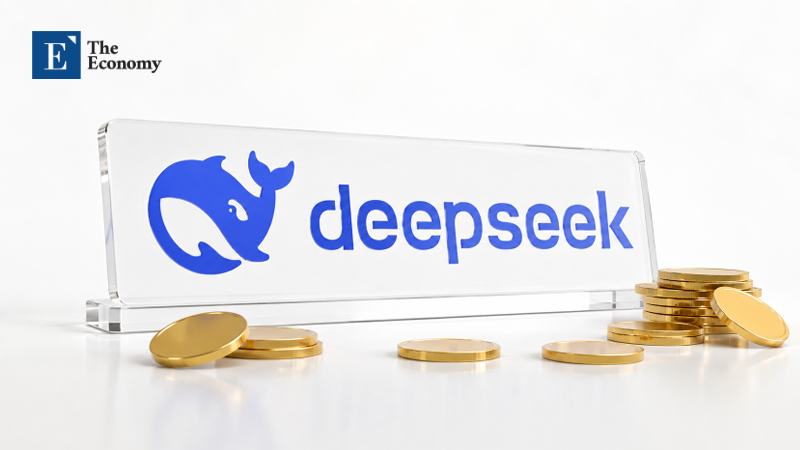
Chinese artificial intelligence (AI) startup DeepSeek is raising fresh capital at a valuation substantially higher than in its previous funding round. Its recent revenue growth has driven the increase in valuation. DeepSeek is also stepping up efforts to improve profitability, including raising application programming interface (API) prices for its flagship models, prompting market observers to interpret the moves as part of a broader strategy geared toward an eventual listing. Analysts say DeepSeek is increasingly likely to join rivals including OpenAI, Anthropic and Moonshot AI in what could become a de facto succession of initial public offerings (IPOs).
DeepSeek Launches Fundraising Round
Citing people familiar with the matter, The Wall Street Journal (WSJ) reported on the 26th (local time) that DeepSeek is seeking to raise $7.4 billion to fund research and development (R&D) and expand its computing infrastructure. The company is expected to be valued at approximately $74 billion in the round, a marked increase from $50 billion in June. The roster of investors is reportedly set to include investment firms Monolith Management and Xishang, as well as Chinese battery manufacturer CATL. Several funds backed by Chinese local government entities are also participating in the investment.
Market analysts say DeepSeek’s latest valuation largely reflects its strong revenue growth. The Information recently reported that DeepSeek generated $66.7 million in revenue between January and July this year, approximately 10 times its total revenue for the entirety of last year. Its overall gross margin during the period stood at 44.6%, while the business selling access to AI models through APIs posted a gross margin of 82.9%. Profitability appears to be improving gradually as infrastructure optimization reduces the computing costs required to run its AI models.
Accelerating the Push for Profitability
DeepSeek, however, has yet to generate a meaningful profit from its AI business. Its net loss between January and July approached $100.4 million. The persistent deficit partly reflects the growth strategy characteristic of China’s AI industry. DeepSeek has long maintained lower API prices than its competitors to expand market share. Under this structure, growth in model usage does not necessarily translate into a commensurate increase in revenue. Investment has also expanded as the company seeks to compete with the United States in AI model development. DeepSeek reportedly spent $1.54 billion on AI infrastructure between January and July, more than nine times the $168.5 million it spent last year.
DeepSeek has now demonstrated its intention to improve profitability by raising usage fees. A notable example came with the official release of V4-Pro on the 13th, when the company replaced its previous single-rate pricing structure with differentiated peak and off-peak rates. Peak hours are from 9 a.m. to noon and from 2 p.m. to 6 p.m. China time, when charges are twice the off-peak rate. Accordingly, V4-Pro’s output price rose from $0.87 per million tokens to $1.98 during off-peak hours and $3.96 during peak hours. The output price of the lightweight V4-Flash model likewise increased from $0.28 to $0.66 during off-peak hours and $1.32 during peak hours.
DeepSeek’s Listing Scenario
Industry observers increasingly view DeepSeek’s latest price increases as preparations for a public listing. Bloomberg reported last month, citing multiple sources, that DeepSeek had begun preparing for a listing on a mainland Chinese stock exchange and could submit an IPO application as early as this year. Accounting firms, investment banks and other advisers had reportedly begun substantive discussions concerning the company’s IPO. The Wall Street Journal subsequently offered a more specific timeline, reporting that DeepSeek could debut on the Shanghai stock market as early as the second quarter of 2027.
The Shanghai Stock Exchange’s Science and Technology Innovation Board, commonly known as the STAR Market and often described as China’s answer to Nasdaq, is widely considered the most likely listing venue. In June, the China Securities Regulatory Commission expanded the scope of the STAR Market’s so-called fifth set of listing standards to include the AI sector, allowing high-quality AI companies that have yet to turn a profit to pursue listings based on their technological capabilities and growth prospects. The listing schedule, however, remains subject to change depending on the progress of regulatory reviews, and DeepSeek has yet to confirm that it has formally filed an IPO application.
US AI Companies Also Knock on the Public Market’s Door
If DeepSeek’s listing scenario materializes, the company will join the “IPO relay” now unfolding across the global AI industry. Leading AI companies in the United States and China have recently begun preparing to enter public markets. Anthropic is the furthest along in the listing process. According to Reuters, Anthropic confidentially filed IPO registration documents with the US Securities and Exchange Commission (SEC) in June. The offering size, listing venue and specific timetable have not yet been disclosed, while the company’s most recently recognized valuation stands at approximately $965 billion.
OpenAI also confidentially submitted a draft IPO registration statement to the SEC that same month. No specific terms or listing timetable have been disclosed, but overseas media outlets increasingly expect the listing process to gain momentum in 2027. Advisers reportedly presented OpenAI with two options: lower its valuation somewhat and proceed with a listing this year, or wait until 2027 and seek a $1 trillion valuation. OpenAI CEO Sam Altman is reportedly maintaining that he will not accept a valuation below $1 trillion. OpenAI’s most recently confirmed valuation is $852 billion, established when it raised $122 billion in March this year.
Table 1. IPO Plans of Major AI Companies
| Company | Listing Market | Status |
|---|---|---|
| DeepSeek | Mainland China | In discussions with advisers; formal application not confirmed |
| Anthropic | US stock market | Confidentially filed registration documents with the US Securities and Exchange Commission |
| OpenAI | US stock market | Confidentially filed registration documents with the US Securities and Exchange Commission; targeting a $1 trillion valuation |
| Moonshot AI | Hong Kong stock market | Dismantling offshore structure and seeking shareholder approval; advised by Goldman Sachs and China International Capital Corporation |
IPO Is Not the “Final Battleground”
Chinese company Moonshot AI, which recently gained prominence with “Kimi K3,” is also preparing for an IPO. Reuters reported last month that Moonshot AI had begun dismantling its existing offshore structure ahead of a Hong Kong listing and was discussing IPO plans with Goldman Sachs and China International Capital Corporation (CICC) serving as financial advisers. A shareholder resolution seeking investors’ approval for the Hong Kong listing was distributed, and an IPO within as little as six months was reportedly among the options under consideration. Around the same time, Moonshot AI also sought fresh funding at a valuation exceeding $30 billion. The company had been valued at approximately $20 billion during a fundraising round in May.
As the AI industry’s “listing race” intensifies, experts say neither the speed of an IPO nor the valuation achieved at listing will necessarily be the decisive factor determining the ultimate winner in the AI market. “AI businesses fundamentally require enormous upfront investment in areas such as infrastructure and highly skilled research personnel, but economies of scale become increasingly powerful as models are deployed on a large scale,” one market expert said. “Over time, the market is likely to evolve into an oligopolistic structure in which a small number of general-purpose model providers capable of absorbing the vast investment costs gain the upper hand, while specialized and open-source models coexist beneath them.”
Oliver Griffin is a policy and tech reporter at The Economy, focusing on the intersection of artificial intelligence, government regulation, and macroeconomic strategy. Based in Dublin, Oliver has reported extensively on European Union policy shifts and their ripple effects across global markets. Prior to joining The Economy, he covered technology policy for an international think tank, producing research cited by major institutions, including the OECD and IMF. Oliver studied political economy at Trinity College Dublin and later completed a master’s in data journalism at Columbia University. His reporting blends field interviews with rigorous statistical analysis, offering readers a nuanced understanding of how policy decisions shape industries and everyday lives. Beyond his newsroom work, Oliver contributes op-eds on ethics in AI and has been a guest commentator on BBC World and CNBC Europe.
- Previous “High Costs, Low Growth, and the Rise of China and Japan” — South Korea’s MMORPG Growth Formula Falters as Game Industry Seeks New Growth Engine in Poland
- Next “Trade Imbalances Must Be Broken”: Western Calls for Yuan Appreciation Target China’s Trade Surplus, Raising Concerns Over Fallout for South Korean and Japanese Manufacturers
Similar Post