Chinese Industrial Policy: Pricing Efficiency and Subsidy Fairly

Working across research, policy, and data-driven analysis, the Editorial Board ensures that published pieces reflect a consistent institutional perspective grounded in quantitative reasoning and long-term structural assessment.
Authored On
Modified
China’s efficiency is real and follows Japan and Korea
State subsidies and rare earth coercion distort fair trade
Policy should target subsidies, not efficiency, with precise tools
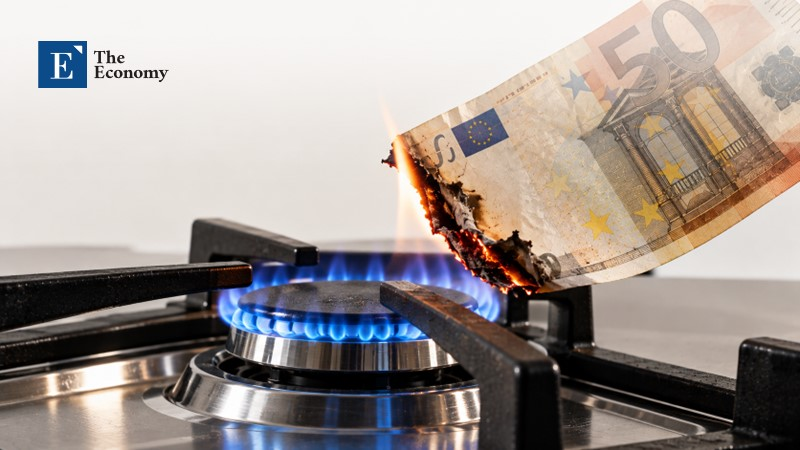
On January 14, 2026, China’s General Administration of Customs announced that the country’s trade surplus for 2025 reached $1.189 trillion, compared to $993 billion in 2024, an amount that exceeded a trillion for the first time and roughly corresponds to Saudi Arabia’s GDP, while exports to the United States had fallen by 20 percent in the year without this slowing down anything, since the cargoes simply changed destination to Southeast Asia, Africa, the European Union and Latin America. Two camps have formed around this number. The first reads in Chinese industrial policy a subsidy machine that flattens the manufacturing of competitors, with rhetoric reminiscent of a pre-election rally, where China is the worst trading partner the planet has ever known. The second sees an economy that has conquered classically, the comparative advantage that once belonged to Germany and Japan. Each of the two holds a piece of the truth and the difficulty lies in exactly where the pieces are divided.
Japan, Korea, China: One Efficiency Story
East Asia has already staged the same play with other protagonists. In the 1970s and 1980s, Japan filled Western markets with cars, televisions and semiconductors, to such an extent that in 1981 Washington pressured Tokyo to accept a voluntary limit on car exports to the United States to 1.68 million vehicles per year, while four years later the Plaza Accord sharply raised the value of the yen. In the 1990s and 2000s, South Korea took over, with Samsung reaching the top of the global DRAM memory market as early as 1992 and Hyundai moving from the position of a cheap assembler to that of a global manufacturer. The pattern had two strands at a time: wages that were low in relation to productivity and factories that learned faster than their competitors.
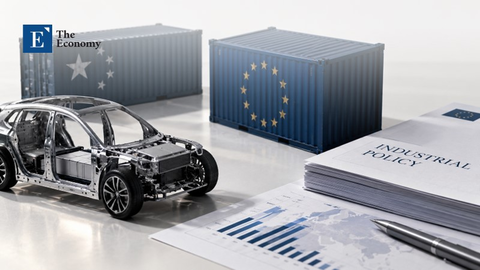
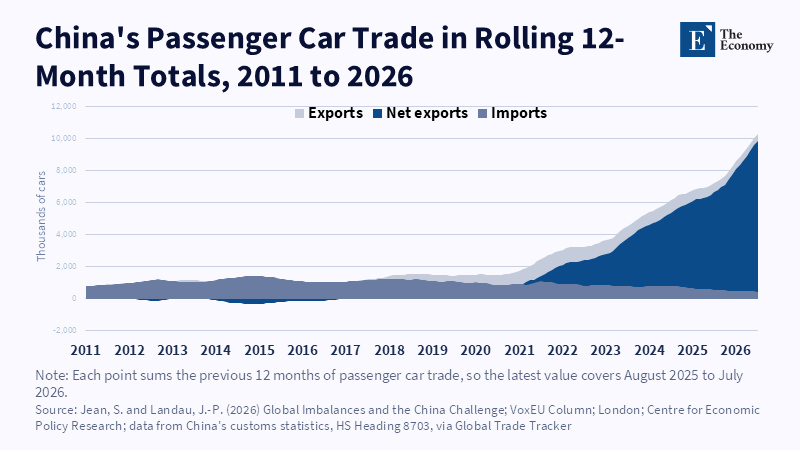
China of the 2010s and 2020s is the third and much larger version of the same recipe and the cleanest example of it is the automotive industry. In 2023 the country overtook Japan as the world’s largest car exporter and maintained its position in 2024 and 2025 as well, which no subsidy alone explains, because behind this are battery supply chains concentrated in a few provinces, engineers coming out of universities in numbers that Europe does not come close to and model development cycles that at BYD or Geely are measured in months where in Wolfsburg they are measured in years. The Kiel Institute estimated that direct government subsidies to BYD in 2022 reached 2.1 billion euros, an amount equal to about 3.5 percent of its revenues. This is a significant amount, but a margin of this magnitude is not enough to explain why a Chinese electric car is reaching the European market at a price that European manufacturers find difficult to approach. Efficiency is real and anyone who denies it is misreading the last fifty years of Asian industrial history.
Chinese Industrial Policy Goes Beyond WTO Limits
The problem begins where efficiency meets the state treasury. The Agreement on Subsidies and Countervailing Measures, which entered into force together with the World Trade Organization in 1995 and which China accepted when it joined in 2001, prohibits export-related subsidies and allows partners to react when domestic aid causes damage. The CSIS, in a 2022 study, calculated with an explicitly conservative methodology that China spent at least 1.73 percent of its GDP on industrial policy in 2019, when South Korea, second in the relevant ranking, spent 0.67 percent and the United States 0.39 percent. The Kiel Institute found in 2024 that more than 99 percent of listed Chinese companies received direct government subsidies in 2022 and concluded that the overall level of aid is three to nine times higher than that of major OECD countries.
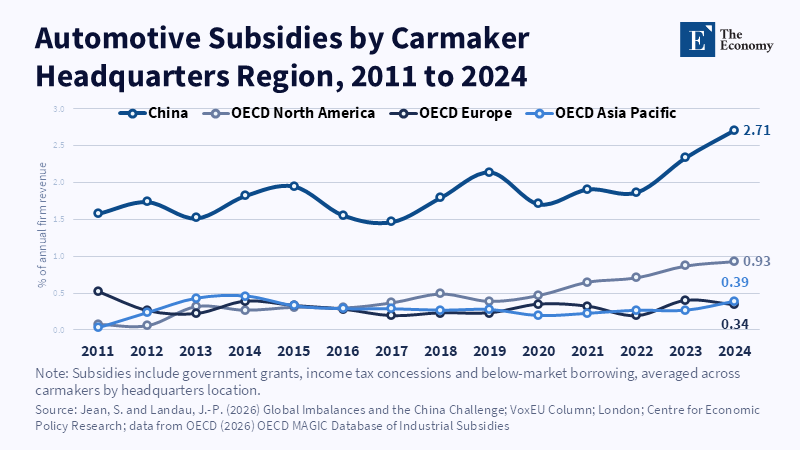
The theory of international trade has an answer for what happens next and it is not pleasant for anyone. A subsidy of this scale transfers resources from Chinese taxpayers and savers to foreign consumers, draws capital into sectors where global demand is not sufficient and provokes retaliation that closes markets, so the end result is less overall prosperity than there would have been without the intervention. The European Commission concluded in October 2024, after a year-long investigation, that the electric car value chain in China benefits from unfair subsidies and imposed for five years countervailing tariffs of 17 percent on BYD, 18.8 percent on Geely and 35.3 percent on the state-owned SAIC, on top of the already existing 10 percent tariff. The United States had already raised the tariff on Chinese electric cars to 100 percent in May of the same year and Canada followed with the same rate. The gap between the 3.5 percent of BYD’s direct aid and the 17 percent estimated by Brussels is not a contradiction, since the Commission also counted cheap batteries, subsidized debt and land below market price and this shows just how deeply rooted support is within the chain, far below where an accountant would look.
Rare Earths as a State Weapon
If the subsidies belong to a gray area where every major economy has something to hide, rare earths do not. In 2010, after a Chinese fishing boat collided with Japanese Coast Guard vessels near the Senkaku Islands, rare earth shipments to Japan were halted for weeks and in 2014 the WTO Appellate Body ruled that Chinese export restrictions on rare earths, tungsten and molybdenum violated the country’s membership commitments. Beijing formally complied in 2015, but kept the tool in a drawer. In April 2025, it imposed a case-by-case licensing requirement for seven medium and heavy rare earths, including dysprosium and terbium, along with the permanent magnets containing them and on October 9, 2025, China’s Ministry of Commerce announced a much broader regime, with extraterritorial provisions that would require Chinese permission even for products made outside China with minimal Chinese content.
The bargaining power behind these decisions is measurable. According to GlobalData, China produced about 69 percent of the world’s rare earth extraction in 2025 and its share of processing is close to 90 percent. Following the Trump and Xi meeting in Busan on October 30, 2025, the October regime was suspended for one year, expiring on November 10, 2026, while the April restrictions remained in place. Global Trade Alert recorded that in the months following the deal, Chinese magnet exports increased, but the supply was unevenly distributed among trading partners, with the United States receiving less. None of this was decided by individual producers in Baotou or Ganzhou, since the regulation of licences, the timing of the announcements and their suspension were planned and announced by the leadership in Beijing and that is precisely why Chinese efficiency, however real, is in the shadow of a state strategy that uses monopoly as a lever of pressure. The November deadline is now a few weeks away and although the US Treasury said on September 24 that the wider truce would run to January 10, 2027, Beijing has not confirmed that date or formally extended the rare earth suspension.
Everyone Subsidizes, but China’s Numbers Stand Apart
The most serious objection to all this comes from those who remind us that the West does not have clean hands. The CHIPS and Science Act of 2022 provided $52.7 billion for the American semiconductor industry, the Inflation Reduction Act of the same year distributed tax credits for electric cars in terms of domestic production and Japan in the 1970s and 1980s used MITI to steer credit and technology toward selected industries. The argument is valid, but the scale weakens it, since even the conservative estimate of the CSIS places China at a level of almost four times the US expenditure as a percentage of GDP, in a year before the IRA and on top of an economy that is the second largest in the world, while Japanese industrial policy worked at a time when WTO rules on subsidies did not yet exist and Washington could impose quotas and currency appreciation on Tokyo without legal process.
A second, more practical objection says that tariffs first punish the very consumers who impose them. The Kiel Institute, in the same study that documented the scope of Chinese subsidies, warned that higher tariffs on Chinese electric cars would make the European Union’s green transition more expensive and slower. The warning is correct and shows why the distinction between the two schools is of practical importance to policymakers. A single tariff on each Chinese product punishes efficiency and subsidy equally, while a countervailing measure calculated per company, such as the Brussels one with the three different rates for BYD, Geely and SAIC, tries to remove only the part of the price due to the state.
For the ministries of finance and trade in Europe, Japan and Korea, the consequence is that they need two tools with different logics. Against the subsidy, the answer is targeted countervailing measures and pressure for stricter rules in the WTO, rules that also catch up with indirect support within the supply chain. In the face of rare earth coercion, the answer is reserves and alternative processing capacity, such as the one being built by Lynas in Australia and MP Materials in the United States and this costs public money precisely because a private investor would not take the risk of Beijing lowering prices as soon as new production enters the market. In the face of pure efficiency, automation, product development rate and supplier density, the only long-term answer is the same efficiency and no government has yet found a way to introduce it by decree.
A Surplus with Two Sources
The $1.189 trillion surplus of 2025 does not belong entirely to either school. Much of it is the result of the same Asian route that made Toyota and Samsung global players and no tariff will wipe it out without making products more expensive for European and American buyers. Another part is Chinese industrial policy in its most aggressive form, with subsidies that the European Commission counted per company as much as 35.3 percent and with a monopoly on rare earths that the government in Beijing has shown it is willing to use, in 2010 against Japan and in 2025 against everyone. The fair valuation goes through the separation of the two and its next test already has a date: November 10, 2026, when the suspension of October controls formally expires and the Ministry of Commerce will decide whether the tool returns to the drawer or to the table.
The views expressed in this article are those of the author(s) and do not necessarily reflect the official position of The Economy or its affiliates.
References
Bickenbach, F., Dohse, D., Langhammer, R.J. and Liu, W.-H. (2024) Foul Play? On the Scale and Scope of Industrial Subsidies in China. Kiel Policy Brief No. 173. Kiel: Kiel Institute for the World Economy.
DiPippo, G., Mazzocco, I. and Kennedy, S. (2022) Red Ink: Estimating Chinese Industrial Policy Spending in Comparative Perspective. Washington, DC: Center for Strategic and International Studies.
European Commission (2024) Commission Implementing Regulation (EU) 2024/2754 of 29 October 2024 imposing a definitive countervailing duty on imports of new battery electric vehicles designed for the transport of persons originating in the People’s Republic of China. Official Journal of the European Union, L 2754.
General Administration of Customs of the People’s Republic of China (2026) Annual Import and Export Statistics, 2025. Beijing: GACC.
Global Trade Alert (2026) Divide and Rule: Chinese Export Management of Rare Earths since the Busan Accord. St. Gallen: St. Gallen Endowment for Prosperity through Trade.
GlobalData (2026) Global Rare Earths Mining: 2026 Review. London: GlobalData.
Ministry of Commerce of the People’s Republic of China and General Administration of Customs (2025) Announcement No. 70 of 2025 on the Suspension of Export Control Measures. Beijing: Ministry of Commerce.
Reuters (2026) ‘China’s trade ends 2025 with record trillion-dollar surplus despite Trump tariffs’, Reuters, 14 January.
ThePrint (2026) ‘US declares two-month trade truce with China as Xi Jinping lands in Washington’, ThePrint, 24 September.
World Trade Organization (2014) China: Measures Related to the Exportation of Rare Earths, Tungsten and Molybdenum. Reports of the Appellate Body, WT/DS431/AB/R, WT/DS432/AB/R, WT/DS433/AB/R. Geneva: WTO.
Working across research, policy, and data-driven analysis, the Editorial Board ensures that published pieces reflect a consistent institutional perspective grounded in quantitative reasoning and long-term structural assessment.