European Car Industry: The Case for Temporary Protection
Published
The Economy Research Editorial*
*The Economy Research, 71 Lower Baggot Street, Dublin 2, Co. Dublin, D02 P593, Ireland

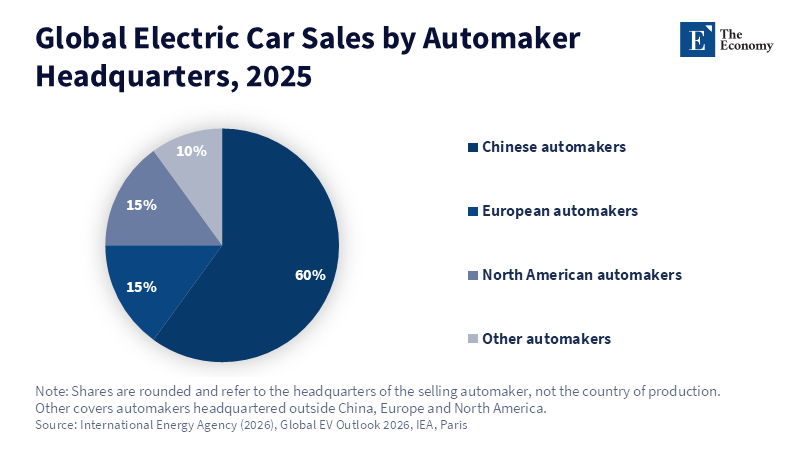
In 2025, Chinese manufacturers supplied 60% of the more than 20 million electric cars sold worldwide, while in August 2026 Chinese brands reached 11.7% of registrations in Europe. The conventional policy recipe, which favours restructuring, cost reduction and minimal protection, treats the Chinese cost advantage as a product of normal competition. The article argues that this advantage was accelerated by industrial policy that lasted more than a decade, with government support estimated by CSIS at $230.8 billion for the period 2009–2023, and that scale, learning through production and supplier density have now turned it into real efficiency, capable of surviving the reduction in subsidies. The 2024 countervailing tariffs measure specific subsidies and leave the scale advantage untouched, while closures among European suppliers and the bankruptcy of Northvolt show that the loss of industrial capacity may prove irreversible. The analysis acknowledges that protection has real costs for consumers, decarbonisation and trade, as shown by Chinese tariffs on brandy, pork and dairy. It concludes that time-bound, tapering protection, contingent on measurable targets that also bind European producers, may secure the time required for restructuring, though it is not certain that it will be enough.
1. Introduction - Europe No Longer Argues From a Position of Strength
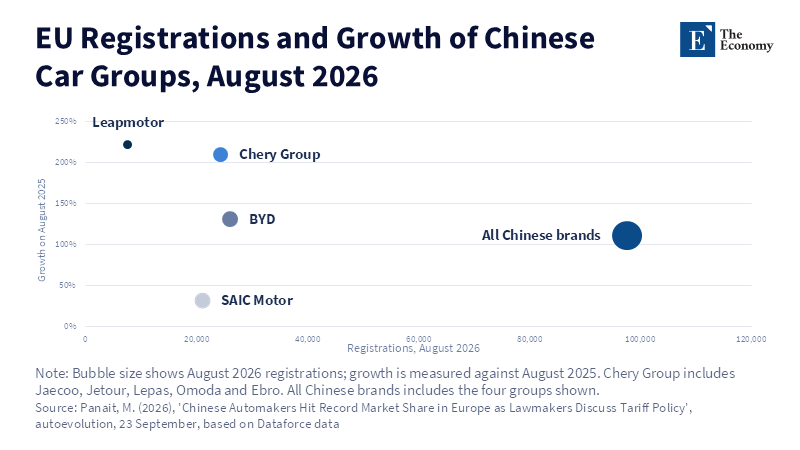
In 2025, more than 20 million electric cars were sold worldwide, and Chinese manufacturers supplied 60% of them, while European and North American ones were each limited to around 15%, in a year in which the European market grew faster than any other major market, with stricter CO2 emission standards bringing the share of electrics to 28% of sales, and in which China, having already overtaken the European Union as the largest car exporter in 2024, doubled its electric car exports to more than 2.5 million units.[1] European demand for electric cars grew, but an increasing part of it was met by production outside Europe. In August 2026, Chinese brands reached 11.7% of passenger car registrations in Europe, the highest share they have recorded.[2] Any serious discussion of European industrial policy now necessarily starts from China's automotive advantage, as already reflected in registrations, production volumes and prices.
The pressure can be seen more clearly in the supply chain than in the balance sheets of large groups. European automotive suppliers announced 54,000 job cuts in 2024 and another 50,000 in 2025, while new jobs announced in 2025 were around 7,000.[3] The conventional diagnosis of the causes is well known and largely correct: high labor and energy costs, insufficient scale in batteries, weak software capabilities, slow model development cycles and electric cars that do not compete on price. Bruegel sums it up by observing that European manufacturers, with high production costs and limited battery capacity, are unable to offer affordable electric cars for the mass market on a scale, a gap filled by Chinese manufacturers.[4] From this diagnosis emerges the typical policy recipe, i.e. restructuring and reducing costs with as little protection as possible.
This recipe has an economic logic that should not be underestimated. Tariffs raise domestic prices, soften competitive discipline and allow incumbent producers to survive longer than the market would allow. The Kiel Institute for the World Economy's simulations of a 20% tariff concluded that consumers would pay significantly more for electric cars because production within the EU costs significantly more due to energy, materials and, above all, labor.[5] The weakness of the recipe lies in an implicit hypothesis. It treats the current Chinese cost advantage as if it arose mainly from ordinary market competition, while the Chinese electric vehicle ecosystem developed within a broad industrial policy framework, with direct and indirect government support that lasted more than a decade. When a competitive advantage has been substantially accelerated by long-standing industrial policy, it is not self-evident that its competitors can respond effectively under conditions of unrestricted market exposure, and this is precisely the question that the conventional position leaves unanswered.
This study argues that Europe may now need temporary protection for reasons that differ from the classic infant industry argument. The European car industry is mature and established, but it is going through a technological transition that erodes much of its accumulated advantage in internal combustion engines, and faces that transition against a competitive ecosystem that has already accumulated scale with state aid. The issue is considered here as a problem of industrial economics, dynamic comparative advantage and second-best trade policy, outside the political confrontation between Europe and China. Restructuring, productivity growth and technological upgrading are considered necessary, and disagreement with the conventional position concerns the order of steps: whether the restructuring can be completed without temporary protection, or whether the protection creates the economic conditions that restructuring itself requires. Protection comes at a cost, including more expensive vehicles, weaker competitive pressure, the risk of retaliation, disruptions in supply chains and the possibility that incumbents will use it to maintain profit margins rather than improve productivity. The policy question is whether these costs fall short of the long-term economic and strategic costs of a loss of European automotive capabilities.
2. China's Automotive Advantage Is Partly a Policy Creation
Chinese competitiveness in cars is usually attributed to cheaper labor and the flexibility of private enterprises. Both matter, but neither explains the speed at which an industry that currently dominates global electric car production was formed. According to an estimate by the Center for Strategic and International Studies, government support for the Chinese electric vehicle sector from 2009 to 2023 amounted to $230.8 billion, equivalent to 18.8% of the total value of electric car sales in the period. Just over half was for purchase tax exemption, while the rest came from national buyer subsidies, financing of charging infrastructure, public procurement of electric vehicles, and research and development programs. The same analysis characterizes the estimate as particularly conservative, leaving out local subsidy programs in cities such as Shanghai and Shenzhen, cheap land, electricity and credit that some manufacturers had access to, as well as support for battery producers and the rest of the supply chain.[6]
A different method results in a related picture. The Kiel Institute, looking at business data, found that more than 99% of listed Chinese companies received direct government subsidies in 2022. For BYD, direct subsidies increased from about 220 million euros in 2020 to 2.1 billion euros in 2022, i.e. from 1.1% to 3.5% of its revenues, while the company also received significantly more purchase subsidies than other domestic manufacturers or foreign companies that produce locally. At the level of the economy, industrial subsidies were estimated, with a very conservative estimate, at about €221 billion, or 1.73% of GDP in 2019, a level three to four times higher and in some measurements up to nine times higher than that of the major OECD countries, with additional tools such as privileged access to critical raw materials and favourable treatment in public procurement and administrative procedures.[7]
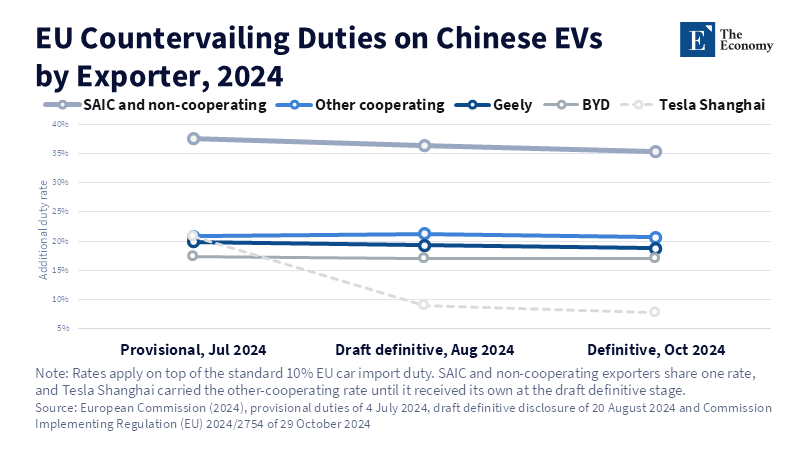
These figures are not the same as the legal concept of subsidy in commercial law, and the distinction is of practical importance. In October 2024, the European Commission imposed definitive five-year countervailing duties on Chinese pure electric cars, in addition to the usual 10% duty: 17.0% for BYD, 18.8% for Geely, 35.3% for SAIC, 7.8% for Tesla Shanghai, 20.7% for other cooperating companies and 35.3% for non-cooperating companies, after concluding that the electric vehicle value chain in China benefits from unfair subsidies that pose a threat of injury to European producers.[8] A countervailing duty measures specific, identifiable subsidies in a specific investigation period and for specific exporters. It does not measure the accumulation of suppliers in industrial zones organized by local governments, nor the charging infrastructure that reduced the cost of use, nor the demand created by buyer subsidies in years when no private investor would bet on such a scale. The legal measurement therefore acts as a floor of the broader economic concept of state-supported industrial development. This does not mean that every element of the support constitutes an illegal subsidy, and several of them, starting with charging networks and market incentives, have corresponding counterparts in the policies of European states.
The exact value of Chinese support remains difficult to estimate and is politically disputed. The CSIS analysis sums up fiscal expenditure specific to electric vehicles, while the Kiel Institute relies on declared subsidies from listed companies and industry-wide estimates, and neither approach fully captures cheap financing by state-owned banks, the value of which depends on which interest rate is considered marketable. The discrepancies between the estimates come from the scope and the method, and in no way call into question the direction of the phenomenon. For the argument developed here, accuracy is of secondary importance, because it is not required that every euro of the Chinese cost advantage comes from a subsidy; suffice it to accept that the current industrial structure was not formed independently of long-term government intervention.
The support was not limited to money. For a time China made the use of batteries from approved domestic suppliers a condition for purchase subsidies, and a study published by the National Bureau of Economic Research in 2025 estimates that this local content requirement has helped Chinese suppliers gain a competitive advantage, at a cost to consumers and foreign suppliers.[9] The effect is visible today in the centralization of the supply chain. China accounted for more than 80% of global battery cell production in 2025 and even higher shares in their active materials, while Chinese producers' share of the EU cell market has almost doubled since 2023.[10]
The importance of all this for trade policy is concrete. International competition in electric cars does not take place between companies developed under equivalent institutional conditions. Through tax exemptions, demand subsidies and supply preferences, the Chinese state absorbed some of the financial risk involved in creating an electric vehicle industry on a huge scale, and even before this industry became profitable. European producers are now competing with the accumulated result of this process. This finding does not contain an ethical judgment about the Chinese choices, which from the point of view of Chinese economic policy have proved to be largely successful, but it does change what can reasonably be demanded of a competitor who did not have such risk coverage.
3. Past Subsidies Can Become Permanent Competitive Advantages
The simple version of the subsidy argument assumes a direct relationship, in which the subsidy lowers the selling price and its abolition would restore it. If this were the case, the problem would be solved by a countervailing duty equal to the subsidy, and European policy could simply wait for the gradual withdrawal of Chinese support. The mechanism that matters most works differently and lasts longer. Industrial support finances expansion, expansion creates scale, scale accelerates learning through production and attracts supplier investment, and the resulting lower unit cost gains market shares that in turn create additional scale. When this cycle has been in place for several years, the cost advantage it generates can survive the reduction or even elimination of the subsidies that set it in motion.
Learning through production is the best-documented link in this chain in the battery industry. The cost of electric vehicle batteries has fallen by more than 90% within a decade, and the NBER study of the global industry estimates a learning rate of 9.2% after isolating the industry's technological progress, economies of scale, input costs, and manufacturers' assembly experience. The same study shows that learning multiplies the effectiveness of subsidies to consumers and transfers some of their benefits to other countries through common battery suppliers.[11] A learning rate of 9.2% means that each doubling of cumulative production reduces unit costs by about this percentage. For competition, the consequence is that a subsidy that bought early volume also bought a place in the learning curve, which a downstream competitor has to go through from the beginning, with its own funds and without the volume that would finance the route.
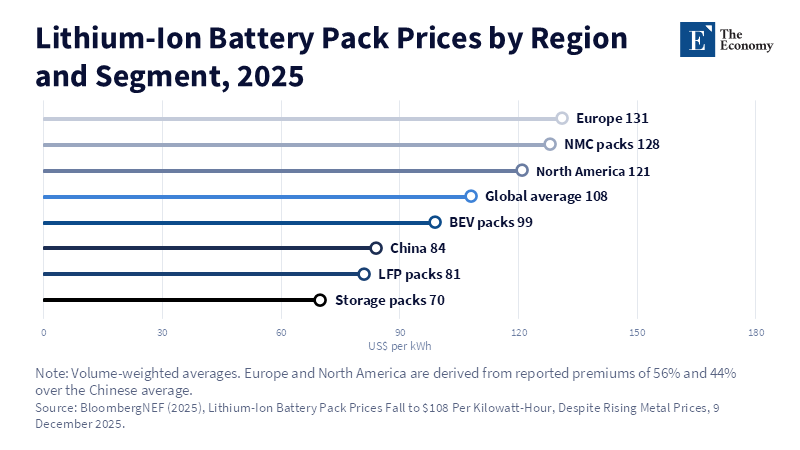
This position is visible in prices. BloombergNEF's 2025 price research found an average lithium-ion battery pack price of $108 per kilowatt-hour, the lowest on record. In China, the average was $84, while in Europe prices were 56% higher, a discrepancy that BloombergNEF attributes to higher local production costs and reliance on imported batteries, which are typically priced higher than Chinese-made ones. The same research records that many Chinese companies redirected exports to Europe with more aggressive pricing to maintain their global volumes after changes in the US tariff regime, and that China's dominance in the production of lithium iron phosphate batteries allowed its producers to meet almost all of the global demand for this chemistry.[12]
Economies of scale work in a similar way in vehicle assembly, where platforms, battery factories and electronics require high fixed investments that are spread over more units as production increases. According to the International Energy Agency, China accounted for nearly 75% of the approximately 22 million electric cars produced globally in 2025, while 70% of all-electric cars sold in China were already cheaper than the average conventional car. Intense domestic competition is squeezing profit margins and pushing manufacturers to seek higher returns abroad, to the extent that 2025 exports are estimated to have exceeded actual sales in foreign markets by more than 25%.[13] Suppliers are investing where they expect large and stable volumes, and growing Chinese production has therefore drawn capital towards the Chinese supply chain, which in turn has made each subsequent vehicle cheaper. In such a cluster, where cell manufacturers, electronics suppliers, logistics companies and assemblers operate in geographical and commercial proximity, the ecosystem itself becomes a source of efficiency, regardless of whether each individual business is the best of its kind.
The most revealing clue to the durability of this advantage is its time course. The ratio of government support to electric vehicle sales fell, according to CSIS, from over 40% before 2017 to just over 11% in 2023.[14] Support intensity was declining precisely at a time when the industry's international competitiveness was rising faster than ever, and the price difference in batteries recorded by BloombergNEF is observed in a phase of low and declining support per vehicle. Such a reverse trajectory is difficult to explain if the cost advantage is identical to the current subsidy, and easy to explain if the advantage has already been passed on to scale, learning, and supplier density.
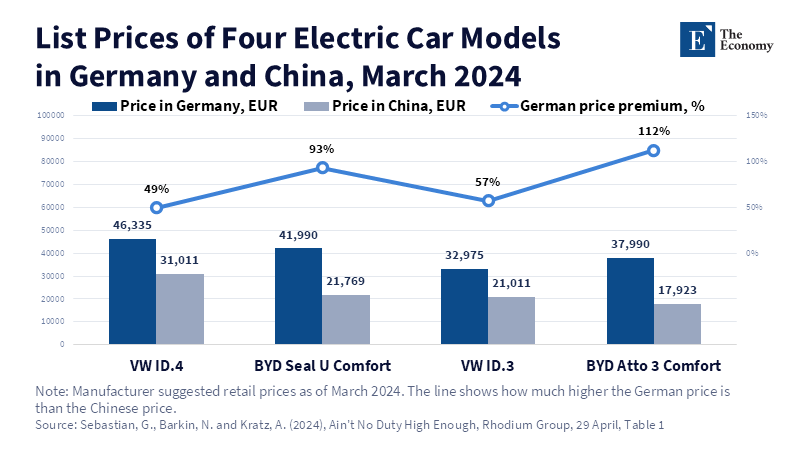
The same logic explains why countervailing duties, as designed, could not neutralize the advantage. Rhodium Group estimated in April 2024 that even a 30% tariff would leave BYD a profit on the Seal U in Europe higher by about 15%, or about 4,700 euros, compared to its profit in China, and that tariffs of 45% to 55% would be needed for highly competitive producers like BYD for exports to Europe to cease to be commercially attractive.[15] The definitive duty finally imposed on BYD was 17%. The margin offered by the European market reflects the cost gap combined with the European price level, and an instrument calibrated on the basis of the measurable subsidies of a reference year is designed, by its very legal nature, not to touch a scale advantage.
None of this means that Chinese manufacturers are technologically lagging behind or that they are competitive only thanks to subsidies. When scale exists, cash flow and engineering capacity are reinvested in battery chemistry, production techniques, software, vehicle design, and faster model refresh cycles, and the product initially supported becomes genuinely better. Industrial policy can in this way turn an initially subsidized industry into a truly efficient industrial ecosystem, and the path dependence thus created means that today's comparative advantage partly reflects yesterday's industrial policy. A static reading of comparative advantage, treating it as a given feature of an economy, misses precisely this element.
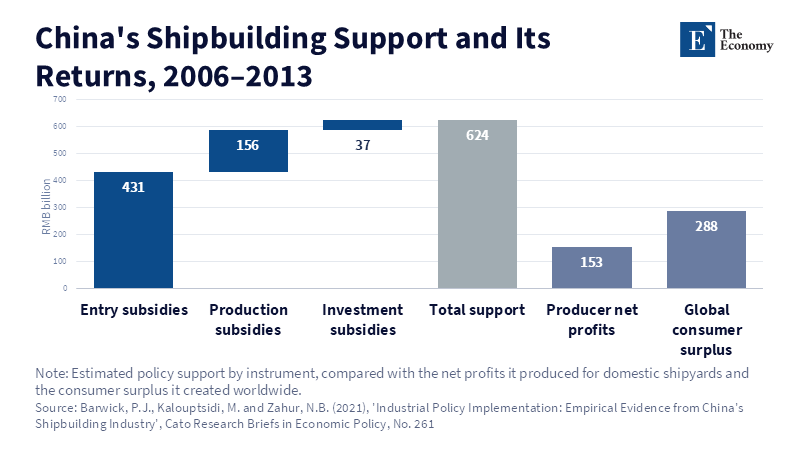
But the conversion is not automatic, and the Chinese experience in shipbuilding shows this. A study published in the Review of Economic Studies found that China's policy of supporting shipbuilding dramatically increased domestic investment, new business entries and global market share, but yielded low returns and led to fragmentation, idle capacity and depressed global ship prices, with entry subsidies proving wasteful while production and investment subsidies could be justified in terms of market share.[16] A plausible interpretation of the difference with electric vehicles is that in batteries the learning curve was steep and domestic competition, as suggested by the margin squeeze described by the International Energy Agency, put selection pressure on the less efficient. This interpretation, if true, leads to a conclusion that is not very comforting for Europe: the advantage it faces is largely real efficiency and will not disappear on its own when the support that created it fades further.
4. The European Car Industry's Exit Could Prove Irreversible
The typical adaptation argument says that inefficient production should be shrunk and resources shifted to higher-value uses. The argument assumes that factories are distinct, replaceable units that can be shut down and, if necessary, reopened. The automotive industry operates as an ecosystem that includes specialized suppliers, machine tools and molds, engineering teams, testing facilities, research institutions, logistics networks, battery and electronics chains, and funds with a long payback horizon, and much of its value lies in the relationships between these elements, built over decades and not bought ready-made.
The geography of employment makes the problem more acute. According to the EU Labour Force Survey, 3.12 million people were employed in the manufacture of motor vehicles in the third quarter of 2024, and the sector's share of total national employment was highest in Slovakia, Czechia, Romania and Hungary, followed by Germany.[17] The shrinkage of an industry so geographically concentrated is not smoothly distributed across the Union's economy. It weighs heavily on specific regions of Central and Eastern Europe where alternative employers at a similar level of skills and pay are scarce, and pushes engineers and skilled technicians either to other sectors, where their knowledge is partially exploited, or to other countries.
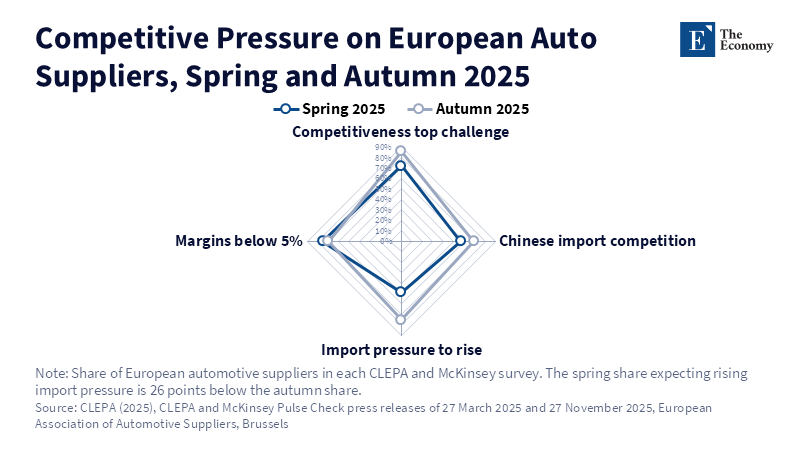
Suppliers break first, because they operate with tighter margins and more dependence on their customers' volumes. In a survey by CLEPA, the European Automotive Suppliers Association, published in May 2025, 62% of businesses reported excess capacity and rising fixed costs, one in four said that at current levels of demand it does not cover fixed costs at most of their facilities, and at the beginning of 2025, 57% of announced job losses were due to bankruptcies or plant closures, compared to an average of 22.5% from 2020.[18] The shift from internal restructuring to closure is qualitatively important. A business that restructures retains capabilities on a smaller scale, while a business that closes loses them, along with its relationships with customers and sub-suppliers. In January 2026, the same association recorded that 70% of suppliers expect margins below 5% for 2026, a threshold it considers necessary to sustain investments in technology, skills and production.[19]
This results in a negative feedback mechanism that is the inverse of the Chinese cycle. Loss of market share reduces expected volumes, lower expected volumes curtail investments, truncated investments increase associated costs, and higher costs lead to new loss of share. The case of Northvolt illustrates how this mechanism works at the most sensitive point of the transition. The company, one of the most prominent European efforts in cell production, filed for bankruptcy in Sweden on March 12, 2025, citing rising capital costs, geopolitical instability, supply chain disruptions and changes in demand, but also significant internal difficulties in scaling production.[20] Scaling is the phase where the learning curve begins, with scrap rates falling and processes stabilizing, and a business that cannot finance this phase never reaches the part of the curve where costs recede, so initial failures turn from a temporary handicap to a permanent foreclosure.
The European Commission has already incorporated this dynamic logic into its legal reasoning, perhaps more than is recognised in the public debate. In the final findings of the investigation, the threat of material injury was based on a projected increase in low-priced imports that would capture a significant market share and prevent the high and sustained rate of investment needed by European industry to fully switch to the production of all-electric vehicles.[21]The damage described is less about current sales and more about future investment capacity.
Economic history gives reason to believe that industrial jobs, once formed, are persistent. A study of the Napoleonic blockade showed that areas of the French Empire that were most protected from British trade for reasons unrelated to industry increased capacity in mechanized cotton spinning more than exposed areas, and that in the long run areas with greater capacity maintained higher activity in the sector.[22]The same persistence works in the opposite direction. If an industrial ecosystem breaks up, its reconstruction does not simply require reversing the decline, because the suppliers, engineering teams and relationships that will be needed must be rebuilt, and in the face of competitors who in the meantime will have moved even further down the learning curve. In other words, there is an asymmetry between the cost of maintaining a capability and the cost of recovering it, and the standard adjustment analysis, which assumes that resources are reallocated without loss, overlooks it.
The extent of the risk is now being discussed openly and at the institutional level. The Commission's Executive Vice-President for Industrial Strategy warned in November 2025 that, without intervention, the number of cars produced and sold in Europe could fall from 13 million to 9 million within ten years.[23] This is a political warning and not the result of an econometric model, but it shows that the question has ceased to be about the survival of individual companies and is now about whether Europe will maintain enough industrial scale for an economically viable automotive ecosystem. Europe is trying to replace one production architecture with another, while at the same time receiving strong external competition, and this is radically different from protecting a mature technology with no intention of change. The policy objective is to maintain sufficient industrial capacity during a disruptive transition, which is why the term infant industry is inappropriate for European cars. The terms protection of industry in transition, protection of strategic capabilities or temporary restructuring protection describe the problem more precisely.
5. Static Consumer-Welfare Analysis Is Incomplete
The argument in favor of free trade deserves to be presented in its strongest form. If Chinese electric cars are significantly cheaper, European consumers profit from importing them, tariffs raise prices, consumers bear some of the costs of protection and competition forces domestic producers to become more efficient. The simulations of the Kiel Institute gave concrete form to this logic: a 20% tariff would reduce imports of electric cars from China by 25%, i.e. by about 125,000 vehicles worth about $3.8 billion based on 2023 volumes, and sales of domestically produced electric cars would increase by about $3.3 billion. Only part of the increase would come from new production, with the rest shifted from exports. The Institute's researchers also noted that it was not at all certain that European manufacturers would fill the gap, since Chinese companies could serve demand from new factories in Europe, and that the simulation did not involve Chinese retaliation, which they considered to be expected.[24]
Added to the cost to the consumer is the cost of Europe's own transition to decarbonisation. Bruegel points out that cost-competitive Chinese models now account for around a quarter of electric car sales in the EU, and that Chinese companies have become major investors in the European battery and electric vehicle chain, proposing a conditional strategy of accepting Chinese investment that uses access to the European market as a bargaining chip.[25] A tariff that delays the adoption of electric cars also has an environmental cost, which is not offset by the employment it may preserve. These benefits are real, and an analysis that ignores them cannot support any policy proposal.
Consumer prices, however, do not reflect the whole welfare bill. Automotive production creates clusters of employment, mechanical skills transferred to related industries, R&D spillovers, supplier networks, capital formation, regional economic activity, export capacity and strategic industrial capacity. When production is lost, these effects are also lost, the cost of which is not included in the price difference between an imported and a domestic vehicle. The distinction between static and dynamic welfare makes it possible to formulate the problem precisely. Static analysis asks which vehicle the consumer can buy cheaper today. Dynamic analysis asks what will happen to European productivity, investment, industrial capacity and technological development in the next ten or twenty years if local production shrinks sharply.
The NBER study on batteries offers a specific reason why the two analyses diverge. It finds that battery suppliers retain only a small portion of the economic benefits of learning through production, that subsidies to consumers correct inadequate learning provision and improve social welfare, and that China's local content requirement, if it had been delayed by five years, would have harmed domestic well-being.[26] When the benefits of learning are not reaped by the business that produces, the market produces very little in the early stages, and the price that the consumer sees today does not contain the value of learning on which tomorrow's price will depend. This is a classic market failure, which justifies some form of intervention regardless of what competitors do. The timing finding is less favourable for Europe, however, because it suggests that protection pays off mainly when applied early in a phase of technological convergence, and Europe is starting its own in a market where the learning curve has already been largely crossed by others. This point limits the expected benefit of any protection and supports the argument for strict limits on its duration.
Neither perspective automatically determines the right policy. Consumer well-being does not become irrelevant because there are dynamic outcomes, and dynamic outcomes do not become imaginary because they are harder to measure. A path-dependent industrial transition, learning externalities and foreign competition that has been shaped by government support cannot be assessed in terms of short-term prices alone, and policymakers need to weigh both dimensions, knowing that the weighting will be done under uncertainty and that the costs of one are visible today while the costs of the other will appear later in other regions.
6. Protection Must Be Temporary and Conditional on Restructuring
The main criticism of the opponents of tariffs must be accepted without reservation. Protection can allow inefficient firms to avoid the necessary restructuring, and the empirical literature contains many such examples. A classic examination of Turkish industry in the 1960s did not find a systematic tendency for protected industries to increase their productivity faster than less protected ones.[27] Closer to the industry, the voluntary restriction of Japanese automobile exports to the United States from 1981 was evaluated in the American Economic Review as a strategic trade policy, and the analysis recorded a significant increase in Japanese automobile prices.[28] The economic logic of the measure explains why this result is not surprising: an unconditional quantitative restriction leaves the price difference as revenue to the exporter and demands nothing from the domestic producer. If European manufacturers respond to tariffs by raising prices, maintaining margins and postponing investment, protection will weaken rather than restore their competitiveness.
Even successful temporary protection has finite results. In the case of the Napoleonic blockade, areas with greater spinning capacity had higher added value per capita in industry until the second half of the 19th century, but not later.[29] The historical example concerns an economy that was behind the technological frontier and had to adopt a new technology, and this limits its application in Europe. In conventional cars, Europe is at the frontier, and there an argument for protection would be weak. In battery cells and in much of the electric vehicle chain, Europe is a follower, as shown by China's share of world cell production, and it is only in this part of the chain that the argument for temporary protection gains ground.
The sound policy argument is therefore that protection should create room for restructuring rather than replace it. This translates into a time-bound window of protection linked to measurable industrial targets. Indicators can include the increase in European production of pure electric vehicles, cell capacity actually working rather than just being announced, labour productivity per vehicle, capital expenditure and research expenditure as a percentage of revenues, length of development cycles, software capabilities, supply chain diversification and cost convergence with international competitors. An accurate list is less important than the principle that the continuation of protection depends on proven progress. Protection should follow a descending path: initial protection, investment period, productivity improvement, gradual reduction of tariffs and re-exposure to international competition. The study on Chinese shipbuilding offers a useful reverse lesson here, since it found that countercyclical policies, targeting specific firms and shortening the intervention horizon significantly reduce distortions.[30] The 2024 definitive tariffs expire in principle in 2029, and this date can act as a natural checkpoint: any extension should depend on published progress indicators rather than on the overall intensity of imports.
The experience of the first two years also shows that the protection defined around a single powertrain technology is leaking. According to the Bank of Finland's Institute for Emerging Economies, the countervailing tariffs only briefly slowed the growth of Chinese car exports, which soon returned to pre-tariff levels as manufacturers switched to plug-in hybrids and internal combustion vehicles, which are exempt from countervailing duties, and the Commission is considering extending the measures to plug-in hybrids.[31] According to Dataforce data, Chinese brands accounted for 28.3% of European sales of plug-in hybrids in the first half of 2026.[32] At a time when the technological direction of the market remains fluid, a measure that only covers pure electric shifts competition to neighboring segments, without giving European producers the certainty of volumes that would justify investment.
Some of the elements of a conditional framework already exist, although they are mainly aimed at foreign producers. The Commission issued guidance on price undertaking offers in January 2026 and on 10 February confirmed the acceptance of the first undertaking by a Chinese exporter, which includes a minimum import price for a specific model, a cap on import volumes and an obligation to invest in a major plan related to electric vehicles within the EU with clearly defined milestones.[33] The December 2025 Automotive Package proposed reducing the 2035 target from zero emissions to a 90% reduction, a €1.8 billion programme for the European battery chain and a new category of small, affordable cars.[34] The proposed Industrial Accelerator Act of March 2026 would subject foreign direct investment of more than €100 million in batteries, electric vehicles, photovoltaics and critical raw materials, when the investor's country holds more than 40% of the world's capacity, to conditional approval that includes a foreign participation cap of 49%, joint ventures with European partners, know-how licensing, research expenditure in the Union of at least 1% of revenues, at least 50% workers from the Union and a European value chain strategy.[35] All these tools impose conditions on the incoming investors. The missing half is the conditions for European incumbent producers, who currently benefit from protection without any corresponding published commitments of investment, volumes or cost convergence.
The division of responsibilities must be clear. The Commission, as responsible for trade defence, can link each mid-term review and any extension decision to a public scoreboard that is updated annually. The Commission and the Member States, as financiers through the Battery Programme and national State aid, can structure the support as loans disbursed in instalments against achieved production milestones, with recovery clauses in case of failure. Businesses are responsible for what no state can design better, i.e. vehicle architectures, software, chemistry options and production organisation, and should publish their investment plans as a condition for continued protection. National governments have a role to play in retraining and regional adaptation where shrinkage is inevitable, because there is a real failure of coordination: no single firm has an incentive to finance skills that its competitors will use.
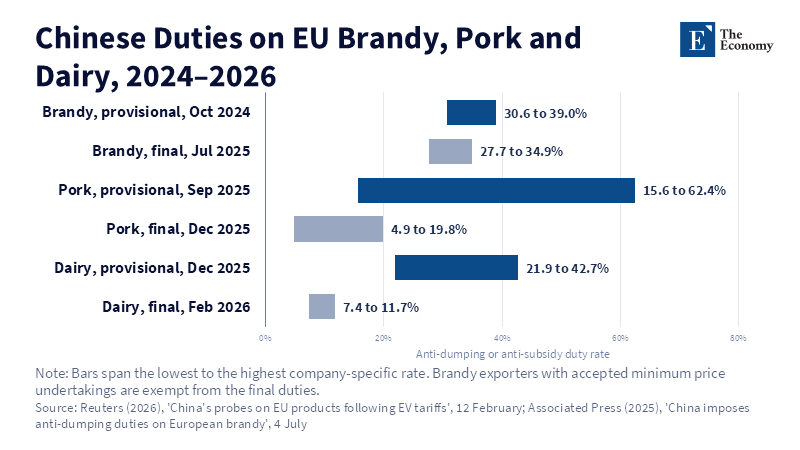
The risks must be presented explicitly and not as secondary objections. Retaliation has already occurred. China imposed tariffs of up to 34.9% on European brandy from July 5, 2025 and for five years, with exceptions for 34 companies that committed to minimum prices, definitive tariffs of 4.9% to 19.8% on European pork from December 2025, and definitive tariffs of 7.4% to 11.7% on dairy in February 2026.[36]The sectors that pay the retaliatory tariffs are different from those that benefit from protection, which turns trade policy into an internal distribution problem. Reliance on Chinese inputs is perhaps the most serious risk. When China restricted exports of rare earths and magnets in the spring of 2025, several production lines and supplier factories in Europe were halted, while only about a quarter of the hundreds of export licence applications appeared to have been approved.[37] That restriction was not directed against Europe, but it showed how quickly a disruption in inputs carries over to assembly lines. Added to these are inflationary effects, higher costs for industries using Chinese intermediate goods, restrictions in World Trade Organization law, and pressure from incumbents to extend protection indefinitely. If competitiveness does not improve after a reasonable period of restructuring, the continuation of protection becomes increasingly difficult to justify economically, because it will have turned into a transfer from consumers to the shareholders of protected undertakings.
7. Conclusion - Protection as a Choice Between Two Sets of Costs
Europe is not faced with a simple choice between free trade, which is by definition efficient and protection that is by definition inefficient. The existing competitive environment reflects already extensive government intervention, combined with scale, learning and private innovation. European manufacturers are competing less on the subsidies paid today and more on the industrial capacities that the previous intervention helped to accumulate.
The conventional recommendation for restructuring and innovation is correct in principle, but incomplete. Restructuring requires capital, production volumes, supplier confidence and sufficient expectations of future market share, and if unrestricted competition erodes these conditions before the restructuring is complete, the requirement for European producers to become competitive ends up internally contradictory. The question that remains open is whether European producers can realistically restructure while losing the scale that would finance and support restructuring.
Temporary protection is a possible response, provided that it does not become a right for incumbents. Its economic justification depends on whether it produces measurable investment, productivity improvements and technological convergence, and on whether it is limited to where Europe is actually a follower. Europe faces two sets of risks. One is visible and involves higher prices, weaker competition, retaliation and possible inefficiency. The other is less visible and much more difficult to reverse, and concerns the loss of capacities accumulated over generations. Maintaining the current regime does not exempt from choice, since accepting the market effect in today's international industrial policy environment is also a policy decision. The practical question is what total costs Europe will accept, and whether a strictly delimited protection window, with conditions also for domestic producers, can ensure enough time for its car industry to become internationally competitive again.
References
[1, 10, 13] International Energy Agency (2026) Global EV Outlook 2026. Paris: IEA.
[2] Autoevolution (2026) 'Chinese automakers hit record market share in Europe as lawmakers discuss tariff policy', autoevolution, September.
[3, 19] CLEPA (2026) Structural pressures on Europe's suppliers: policy delivery is key. Data Digest 24. Brussels: European Association of Automotive Suppliers.
[4, 25] Tagliapietra, S., Trasi, C. and Sebastian, G. (2025) A smart European strategy for electric vehicle investment from China. Policy Brief 21/2025. Brussels: Bruegel.
[5, 24] Kiel Institute for the World Economy (2024) EU tariffs against China redirect trade of EVs worth almost USD 4 billion. Press release, 31 May. Kiel: IfW Kiel.
[6, 14] Kennedy, S. (2024) The Chinese EV dilemma: subsidized yet striking. Trustee China Hand, 20 June. Washington, DC: Center for Strategic and International Studies.
[7] Bickenbach, F., Dohse, D., Langhammer, R.J. and Liu, W.-H. (2024) Foul play? On the scale and scope of industrial subsidies in China. Kiel Policy Brief. Kiel: Kiel Institute for the World Economy.
[8] European Commission (2024) Commission Implementing Regulation (EU) 2024/2754 of 29 October 2024 imposing a definitive countervailing duty on imports of new battery electric vehicles designed for the transport of persons originating in the People's Republic of China. Official Journal of the European Union, L series, 29 October.
[9, 11, 26] Barwick, P.J., Kwon, H.-S., Li, S. and Zahur, N.B. (2025) Drive down the cost: learning by doing and government policies in the global EV battery industry. NBER Working Paper 33378. Cambridge, MA: National Bureau of Economic Research.
[12] BloombergNEF (2025) Lithium-ion battery pack prices fall to $108 per kilowatt-hour, despite rising metal prices. Press release, 9 December. New York: BloombergNEF.
[15] Sebastian, G., Barkin, N. and Kratz, A. (2024) Ain't no duty high enough. Rhodium Group Note, 29 April. New York: Rhodium Group.
[16, 30] Barwick, P.J., Kalouptsidi, M. and Zahur, N.B. (2025) 'Industrial policy implementation: empirical evidence from China's shipbuilding industry', Review of Economic Studies, 92(6), pp. 3611-3648.
[17] Eurofound (2025) Employment in the EU's automotive sector. Dublin: European Foundation for the Improvement of Living and Working Conditions.
[18] CLEPA (2025a) Factory closures overshadow EU's mobility transition. Data Digest 20, May. Brussels: European Association of Automotive Suppliers.
[20] Northvolt (2025) Northvolt files for bankruptcy in Sweden. Press release, 12 March. Stockholm: Northvolt AB.
[21] Cleary Gottlieb Steen & Hamilton (2024) 'Definitive duties adopted by the EU on Chinese battery electric vehicles to counteract subsidies to apply by October 30', Cleary Trade Watch, October.
[22, 29] Juhász, R. (2018) 'Temporary protection and technology adoption: evidence from the Napoleonic blockade', American Economic Review, 108(11), pp. 3339-3376.
[23] Reuters (2025) 'EU must protect car industry from Chinese rivals, commissioner says', Reuters, 7 November.
[27] Krueger, A.O. and Tuncer, B. (1982) 'An empirical test of the infant industry argument', American Economic Review, 72(5), pp. 1142-1152.
[28] Berry, S., Levinsohn, J. and Pakes, A. (1999) 'Voluntary export restraints on automobiles: evaluating a trade policy', American Economic Review, 89(3), pp. 400-430.
[31] Bank of Finland Institute for Emerging Economies (2026) BOFIT Weekly Review 30/2026. Helsinki: Bank of Finland.
[32] The Next Web (2026) 'Volkswagen wants tariff protection after Chinese brands grab 28% of Europe's PHEV market', The Next Web.
[33] CMS (2026) Battery electric vehicles from China: a timely update on the EU Commission's new guidance on price undertakings. CMS Automotive Outlook 2026, 9 March.
[34] DieselNet (2025) 'EU Commission releases Automotive Package proposals', DieselNet, 17 December.
[35] Greenberg Traurig (2026) EU Industrial Accelerator Act introduces new conditions for strategic foreign investments. GT Insights, March.
[36] Reuters (2026) 'China's probes on EU products following EV tariffs', Reuters, 12 February.
[37] CLEPA (2025b) Urgent action needed as China's export restrictions on rare earths disrupt European automotive supply chains. Press release, 4 June. Brussels: European Association of Automotive Suppliers.