In-House Training in the AI Era: Upskilling Beats Hiring

Working across research, policy, and data-driven analysis, the Editorial Board ensures that published pieces reflect a consistent institutional perspective grounded in quantitative reasoning and long-term structural assessment.
Authored On
Modified
AI raises productivity bars, leaving mid-ranked workers behind
External hires cost more and underperform for two years
In-house training of middle ranks beats hiring externally

In a five-month experiment with 640 entrepreneurs in Kenya, a portion of the participants were given access, via WhatsApp, to a GPT-4-based business advisory assistant and the average results did not differ statistically significantly from those of the control group. The zero average covered two opposite paths. Entrepreneurs who were already doing well before the intervention gained more than 15 percent, while those who were doing worse recorded a performance almost 10 percent lower, according to the study by Berkeley Haas and Harvard Business School researchers published in 2026 in Management Science. The finding foreshadows something that businesses are beginning to perceive in practice. When AI grows the work of the most skilled, in-house training of the middle ranks becomes a cheaper solution than looking for ready-made people in the market, where every miscalculation now costs more.
In-House Training when the Bar Rises for Everyone
In a group of ten professionals, sorted from the first to the tenth level of competence, the two or three at the top will likely remain very productive with minimal institutional help. They have strong judgment, knowledge of the subject, the ability to adapt and the confidence needed to try out a new tool without waiting for instructions and the AI adds speed to them on an already solid foundation. The data from Kenya shows how this mechanism works. The researchers identified the difference in the selection and application of the advice, as the questions to the assistant and their answers were similar between the two groups. The ability to distinguish a useful suggestion from a persuasive but misguided one is what the top of the scale already has and the middle of the scale has not yet shown.
The bar, after all, does not stay the same. When an employee with AI tools delivers significantly more work, the manager counts the others based on that project and the minimum acceptable level per position goes up with him. A fourth or fifth-level worker, who two years ago adequately filled his position, is now below the requirement without having forgotten anything he knew. The company has two paths in front of it, replacement or growth and the choice depends on who reaches the same productivity target more cheaply, a comparison that changes in favor of growth with the higher bar.
What a Failed External Hire Costs
The most systematic recording of the price of external hiring comes from a study by the Wharton School of the University of Pennsylvania, which analysed six years of personnel data from an investment bank. Those hired from outside were paid about 18 percent to 20 percent more than colleagues who had been promoted internally to similar positions, received lower performance ratings in the first two years and left more often, voluntarily or involuntarily. Outsiders proved to be capable, since after two years they were promoted faster than internal ones, but first it took time to set up relationships and understand how the organization works. The greater the work expected from each position, the more expensive this two-year adjustment is paid, because each month of underperformance corresponds to more lost results.
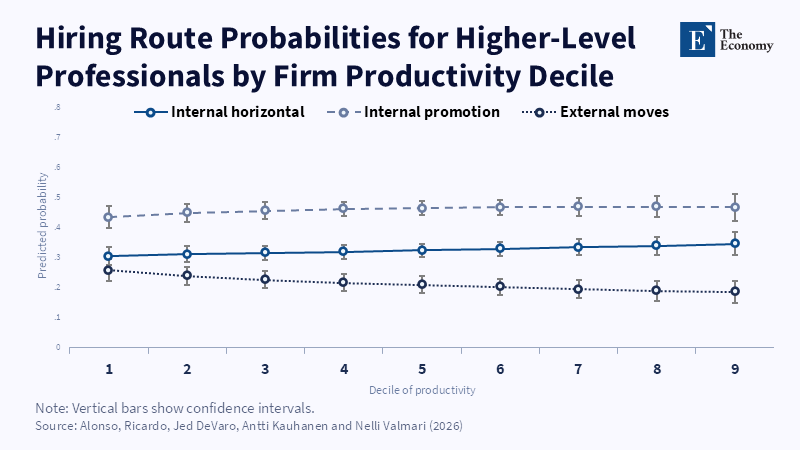
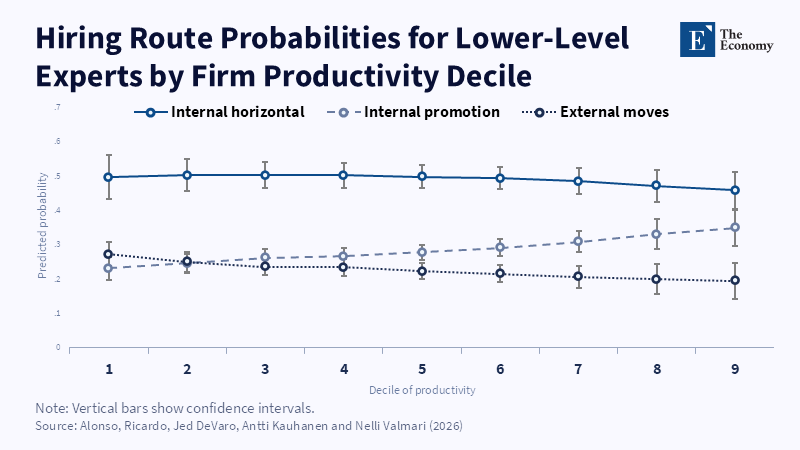
The second source of cost is uncertainty about where the new employee really belongs on the scale. A resume, degrees, references and one or two interviews leave enough room for someone who looks like an eighth to turn out to be fifth and the real rank is only known after months of close cooperation. In an environment where the typical work per person has grown, hiring someone who performs at a fifth-tier level while being paid at an eighth-tier level causes more damage than in the past, because the gap between expected and actual production has widened. Internal candidates have years of evaluations, assignments and appraisals from supervisors behind them, so the company knows where they are, while for the external one there is also learning the internal style of the company, from the form of reports to the way decisions are made, which is also paid by the employer. Finnish employer-employee records, analysed in a CEPR discussion paper by researchers at the London School of Economics, California State University East Bay and Aalto University, show the same pattern at firm level. A one-standard-deviation rise in firm productivity is associated with a 2.9-percentage-point lower probability that a higher-level professional vacancy is filled externally and a 4-percentage-point lower probability for lower-level expert vacancies.
The Leveling Argument and its Limits
The strongest counterargument comes from studies that find that AI benefits the less experienced the most. In a Stanford and MIT study of 5,179 customer service agents, productivity increased by 14 percent on average and by 34 percent for the more inexperienced and lower-skilled workers, while the benefit for the more experienced was minimal. The system had even been trained on the conversations of the best agents, so it transferred to the younger ones some of the practice of the top. If this is the general course, it can be argued that the tool will flatten out the differences on its own and that a special program for the middle of the scale would be an unnecessary expense.
The circumstances of that research were, however, special, with repeated conversations, clear measures of success and a system tailored to the job. In the Harvard Business School experiment with 758 consultants from the Boston Consulting Group, those who had access to GPT-4 completed 12.2 percent more tasks, 25.1 percent faster and with more than 40 percent higher quality, as long as the tasks stayed within the limits of the tool's capabilities. Participants in the bottom half of the scoring group improved by 43 percent and those in the upper half by 17 percent, which strengthens the counterargument. In a task that went beyond these limits, the probability of a correct solution was 19 percentage points lower for those who used the tool than for those who did not.
These boundaries are not marked anywhere on the screen and the judgment that identifies them is cultivated by practicing real problems. The open problems of Kenya, where the management of a business does not have a predetermined correct answer, have shown that in such a terrain the sign can be reversed for the weak. The fourth and fifth-level worker works daily in both types of work, the structured and the open and the mix changes from week to week.
Planning a Program for the Fourth and Fifth Tiers
For an HR manager, the first material is already inside the company, in the evaluations, assignment history and supervisors' assessments, which allow them to identify those who are a short distance from the new bar. Companies that keep systematic evaluations and make them accessible to recruiters have a clear advantage here, because they know internal candidates with an accuracy that no interview gives for an external one. For the financial manager, the comparison concerns the external recruitment account, with the pay premium recorded in the investment-bank study and the two years of lower performance, against the cost of a program that includes working hours, trainers and licenses to use tools.
The content of such a program must be based on the real work of the company, with its own publications, its own customers and its own quality criteria, so that the training is identical to the job. Of particular importance is the exercise in identifying errors in the tool, i.e. in identifying the point where a flawless answer ceases to be reliable, with checks by supervisors and with measuring the work against the initial performance of the same person. External recruitment is not abolished, since there are skills that are missing from the company and are not developed in a reasonable time, but the initial assumption for each vacancy changes and the external candidate must now justify his preference over a person the company already knows.
Retention and the Social Legitimacy of AI
The loss of employees in the fourth and fifth tiers has a cost that is not reflected in the recruitment budget. With them goes knowledge about the processes, customers and informal contracts of the company, exactly the knowledge that an external candidate will need two years to acquire. There is also a message to those who stay, because a department that sees its colleagues replaced every time the bar is raised may learn to hide difficulties. Technological progress needs the consent of the people who work for it and this consensus is difficult to maintain when the benefits are concentrated at the top and the rest are offered as costs to be replaced.
The Kenyan experiment lasted five months and the gap between the best and the weakest emerged during that time, with a tool given to everyone on the same terms. The project tested access to advice rather than a training program, so the data do not answer whether organized in-house training changes the sign for those in difficulty. The data on the cost of external recruitment, with the 18 percent to 20 percent pay premium and two years of lower ratings recorded in the Wharton study of an investment bank, show where the benchmark lies for each development program to be tested in businesses.
This article reflects the analytical judgment of The Economy Editorial Board and does not constitute policy advice or the official position of any affiliated institution.
References
Alonso, Ricardo, DeVaro, Jed, Kauhanen, Antti and Valmari, Nelli (2026) 'Firm productivity and the internal-versus-external hiring decision', CEPR Discussion Paper, DP21871.
Bidwell, Matthew (2011) 'Paying more to get less: the effects of external hiring versus internal mobility', Administrative Science Quarterly, 56(3), pp. 369-407.
Brynjolfsson, Erik, Li, Danielle and Raymond, Lindsey R. (2025) 'Generative AI at work', The Quarterly Journal of Economics, 140(2), pp. 889-942.
Dell'Acqua, Fabrizio, McFowland III, Edward, Mollick, Ethan R., Lifshitz-Assaf, Hila, Kellogg, Katherine, Rajendran, Saran, Krayer, Lisa, Candelon, François and Lakhani, Karim R. (2026) 'Navigating the jagged technological frontier: field experimental evidence of the effects of artificial intelligence on knowledge worker productivity and quality', Organization Science, 37(2), pp. 403-423.
Otis, Nicholas G., Clarke, Rowan, Delecourt, Solène, Holtz, David and Koning, Rembrand (2026) 'The uneven impact of generative artificial intelligence on entrepreneurial performance: evidence from a field experiment in Kenya', Management Science.
Working across research, policy, and data-driven analysis, the Editorial Board ensures that published pieces reflect a consistent institutional perspective grounded in quantitative reasoning and long-term structural assessment.