Making Teenagers Read Newspapers Takes More Than Free Access

Working across research, policy, and data-driven analysis, the Editorial Board ensures that published pieces reflect a consistent institutional perspective grounded in quantitative reasoning and long-term structural assessment.
Authored On
Modified
Free access raises use, but school context matters
Digital visits do not prove sustained reading habits
Knowledge gains were strongest in disadvantaged schools

A French school experiment produced a striking finding: 70.3 percent of pupils offered free digital access to Le Monde turned on the subscription. In the initial survey, only 19 percent said they had used newspapers in the previous week, while 81 percent had used social media for information. This difference makes the intervention seem like a simple answer to an old problem. The cost is removed, a recognised newspaper is offered to teenagers and reading increases. But teenagers using a newspaper is not exactly the same as getting into the habit of reading, especially when school, teachers, classmates and an unusual free offer are working in the same direction at the same time. The experiment convincingly shows that access can change behavior. It does not fully answer the most difficult question: whether this behavior persists when school support disappears and a long article has to compete with the mobile screen again.
Free Access Also Captures the School Effect
One of the strongest elements of the French experiment is also one of the main sources of uncertainty in its interpretation. Schools and not just individual volunteers, were included in the study, which reduces the risk that mainly students who were already interested in current affairs will participate. More than 9,600 students in 243 high schools participated, with schools of general, technological and vocational direction. This is an unusually large sample. The intervention, however, took place within an institution where students are used to following instructions, performing tasks and meeting teachers' expectations. The free subscription did not present itself like an ordinary commercial offer that a teenager encounters alone at home. It arrived through the school and thus acquired a level of institutional legitimacy that does not exist in the normal information market.
Usage data makes this reservation more meaningful. Students in the same class were 8.34 times more likely to read the same news content than students in different classes. About 19 percent of visits took place on weekends, which weakens the idea that all use was solely due to attendance at school. Nevertheless, the vast majority of activity remained concentrated during the school week. Similarity between students in a class can arise from discussions, assignments, teacher suggestions, or simple imitation between peers. All of these mechanisms can be useful, but they don't answer the same question as a free subscription. For an organization considering funding access to news for teenagers, it matters whether the demand is created by the abolition of costs or whether the school is necessary to give the student a reason to open the article in the first place.
A Visit Is Not the Same as Reading
A common objection to questionnaire-based interventions is that participants can declare a behavior that they consider socially desirable. In this case, the objection is much weaker. The French experiment was not limited to the students' statements. It recorded the activation of accounts and the use of the digital platform by those who received free access. Of the students who activated a subscription, 87.7 percent made at least ten visits and 63.8 percent at least fifty. These figures cannot be easily attributed to students who simply stated that they read because the answer sounded better. The intervention measurably changed the behavior and for several students the use was repeated several times during the school year.
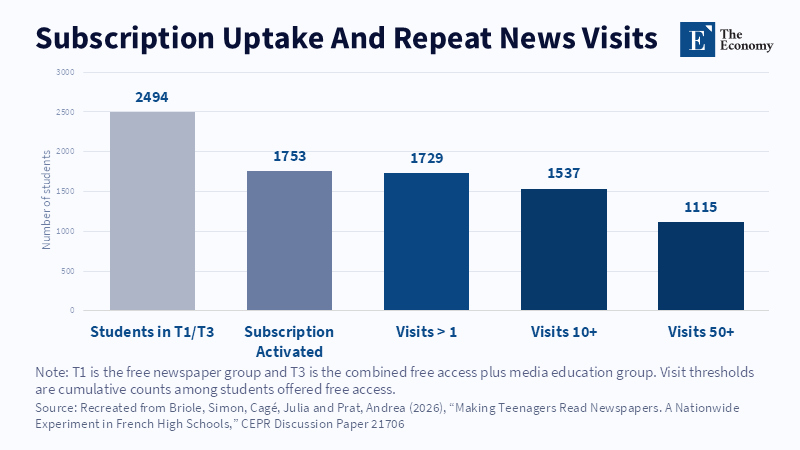
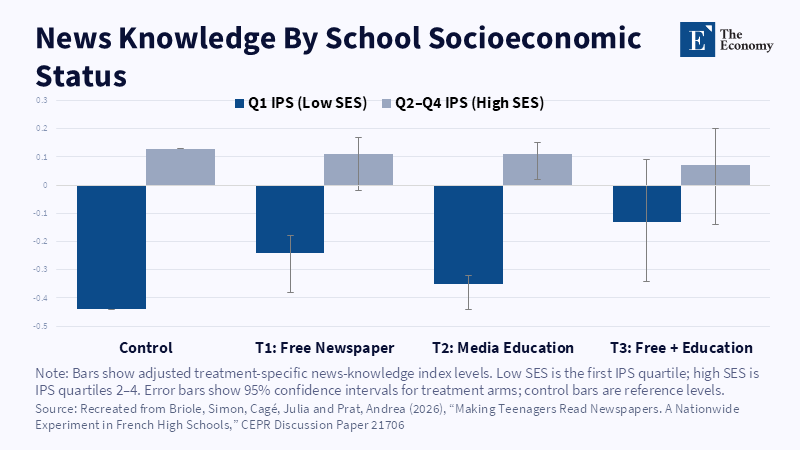
The open question is what exactly these digital traces mean. A visit records exposure to the content. Meaningful reading requires attention, understanding and some ability to retain or utilize the information. The study also looked at a news knowledge index, so the issue was not ignored. The overall treatment effect on news knowledge, however, was not statistically significant. The greatest benefits occurred in schools at lower socioeconomic levels, where free access increased the knowledge index by 0.20 standard deviations and the combination of free access and media education by 0.31. This is an important finding, especially since inequalities in access to quality information remain large. At the same time, it limits a general interpretation of success. The same policy seems to have different effects depending on the starting point.
Making Teenagers Read Newspapers Means Competing With Another Habit
The biggest obstacle isn't just whether a teenager can be persuaded to visit a news website; it's the environment in which that visit takes place. The Reuters Institute's Digital News Report 2025 showed that 44 percent of 18- to 24-year-olds in 48 markets considered social media and video platforms to be the main source of news. In a separate analysis by the same institute, just 35 percent of the same age group indicated a lot or extremely much interest in the news, compared to 52 percent among those aged 55 and over. About 64 percent of younger people were updated daily, compared to 87 percent of people aged 55 and over. These numbers do not exactly refer to high school students, but describe the environment in which today's teenagers enter. Information is increasingly found among entertainment content, personalities and algorithmic suggestions.
There is a second issue, which concerns the ability to read for a long time itself. The results of PISA 2025 showed a 25-point decrease in average reading performance between 2018 and 2025 in the 35 OECD countries for which comparable data were available, with a greater drop in tasks based on longer texts. The finding does not prove that social media caused the decline. But it does show that a policy based on reading long journalistic texts is being implemented in a more difficult environment than the one in which newspapers have traditionally operated. Lidia Altamura, Cristina Vargas and Ladislao Salmerón analyzed 40 effect sizes from 469,564 participants and found only a small average relationship between digital leisure reading and reading comprehension, significantly weaker than the relationship usually observed with printed reading. The relationship improved at older educational ages, which does not allow for easy condemnations of digital reading. However, the distribution of passwords is not enough when the habit of prolonged reading itself is weakened.
Free Access Does Not Solve the Content Problem
Price matters, especially for students who have little or no income of their own. The relevance of the content, however, is what determines whether someone will return when the initial curiosity passes. In France, the Reuters Institute reported in 2025 that just 11 percent of respondents had received some training on how to use or evaluate news. The same report recorded that Hugo Travers, known as HugoDécrypte, reached 22 percent of people under the age of 35 with news content within a week. This success matters because it shows that younger audiences have not necessarily abandoned current affairs. They often choose a different mode of access, a different duration and a different language of presentation. A free subscription removes the financial barrier, not the attention cost of a 1,500-word article nor the distance a student might feel from the conventional format of a newspaper.
Avoiding news reinforces this caveat. In the 48 markets of the Digital News Report 2025, 40 percent of respondents said they sometimes or often avoid being informed. Younger participants were more likely to find that news is not directly related to their lives, is difficult to understand, or leads to toxic disagreements. The school can temporarily change this relationship by linking an article to a lesson, a class discussion, or an assessment. This is precisely why access to content should be separated. Reading an article because it helps with a history paper is helpful, but it doesn't automatically create the same behavior as volunteering to read a long analysis of a state budget, an international conflict, or a crime on a Saturday afternoon. For newspapers and policymakers, the problem isn't just how to fund access; it's also what will make the reader think it's worth staying on the page.
The Strongest Test Begins After School Support Ends
There is a strong counter-argument to this reservation. Some of the behaviour was maintained. Almost 20 percent of the pupils who had used Le Monde during the intervention returned between November and December 2025, several months after the end of the programme. The combined intervention also increased by 8 percentage points the probability that someone would be a Le Monde subscriber about a year later. These results are more difficult to explain solely as compliance with the school. They show that an organized acquaintance with journalism can indeed create sustained demand among a substantial percentage of students. In the United States, by contrast, Daniel Hopkins and Tori Gorton offered free online subscriptions to local newspapers to 2,529 adults in Pennsylvania and only 44 accepted. The huge difference between the two experiments shows how dangerous a simple generalization is. The age, institutional framework, prestige of the medium, content and the way in which the offer is presented all affect the outcome.
A stronger subsequent test would have to separate these mechanisms rather than only counting whether free access works overall. Schools could randomize whether articles are given as homework, simply suggested, or left entirely to students' free choice. Usage data can distinguish simple page opening from active reading time and completion of an article, while short comprehension tests for randomly selected texts would give a clearer picture of what was actually retained. An additional group could compare full articles with short explanations designed for social networks that lead to the same journalistic coverage. This would be seen if the smaller formats replace the large texts or act as an entrance to them. Follow-up should continue after students leave class and after the free subscription expires.
The activation rate of 70.3 percent deserves attention because it shows that teenagers can use a serious newspaper when access is free and the environment reinforces this behavior. It does not prove that a subscription alone can restore the habit of reading long news texts. The most interesting facts are next to the impressive percentage: the strong similarity in article choices within the same classes, the absence of a significant overall effect on knowledge, the greatest improvement in socioeconomically weaker schools and the much smaller percentage of students who returned months later. It seems possible for teenagers to read newspapers. The mechanism, however, is more complex than the price. The next step for schools, publishers and governments is to sort out how much of the result came from free access, how much from teachers and peers, what content held attention and what was left when the school stopped providing a reason for the first click.
This article reflects the analytical judgment of The Economy Editorial Board and does not constitute policy advice or the official position of any affiliated institution.
References
Altamura, Lidia, Vargas, Cristina and Salmerón, Ladislao (2025) ‘Do New Forms of Reading Pay Off? A Meta-Analysis on the Relationship Between Leisure Digital Reading Habits and Text Comprehension’, Review of Educational Research, 95(1), pp. 53-88.
Briole, Simon, Cagé, Julia and Prat, Andrea (2026a) Making Teenagers Read Newspapers. A Nationwide Experiment in French High Schools. CEPR Discussion Paper No. 21706. Paris and London: CEPR Press.
Briole, Simon, Cagé, Julia and Prat, Andrea (2026b) ‘Mission possible: Making teenagers read newspapers’, VoxEU, 15 September.
Hopkins, Daniel J. and Gorton, Tori (2024) ‘Unsubscribed and undemanding: Partisanship and the minimal effects of a field experiment encouraging local news consumption’, American Journal of Political Science, 68(4), pp. 1217-1233.
Newman, Nic, Ross Arguedas, Amy, Robertson, Craig T., Nielsen, Rasmus Kleis and Fletcher, Richard (2025) Reuters Institute Digital News Report 2025. Oxford: Reuters Institute for the Study of Journalism.
Organisation for Economic Co-operation and Development (2026) PISA 2025 Results, Volume I: Future-Ready Students. Paris: OECD Publishing.
Robertson, Craig T., Ross Arguedas, Amy, Mukherjee, Mitali and Fletcher, Richard (2026) Understanding Young News Audiences at a Time of Rapid Change. Oxford: Reuters Institute for the Study of Journalism.
Working across research, policy, and data-driven analysis, the Editorial Board ensures that published pieces reflect a consistent institutional perspective grounded in quantitative reasoning and long-term structural assessment.