[Arctic Maritime Strategy] Alaska Air Defense After Eareckson: What Two F-16s Proved and What Remains Untested

Working across research, policy, and data-driven analysis, the Editorial Board ensures that published pieces reflect a consistent institutional perspective grounded in quantitative reasoning and long-term structural assessment.
Authored On
Modified
Eareckson proved rapid fighter deployment and binational integration
Fuel, warning and support limit sustained operations
Winter endurance remains untested in public evidence

Two F-16s covered the southern end of the Alaska theater on October 25, flying from a runway on Shemya, an island of less than six square miles about 1,600 miles from their home at Eielson Air Force Base. Around them, NORAD assembled F-35s, more F-16s, Canadian CF-18s from Cold Lake, an E-3, KC-135 tankers, a CC-150 Polaris and an HC-130 rescue aircraft. The F-16s had held alert at Eareckson Air Station since October 18, the first such posture there in many years. NORAD offered the result as evidence that Alaska air defense can be generated from an austere field. The deployment supports that limited claim, but the larger question is whether arriving quickly can substitute for a sustained presence across Alaska’s remote approaches. The public record cannot yet answer it. Fighters proved they can move. The tankers, radar aircraft, fuel and sensors that make them useful are scarcer and none of them got any easier to find in October.
Eareckson’s Geography and Permanent Infrastructure
Shemya sits at the western end of the Aleutian chain, about 1,000 miles from mainland Alaska and roughly 500 miles from Russia’s Kamchatka Peninsula. Coverage of this vast area normally comes from Joint Base Elmendorf-Richardson, with Eielson in support, so a jet on alert at Eareckson starts its intercept far to the west of either. The Air Force understood this during the Cold War, when F-4s and F-15s deployed to the island against Soviet aircraft, and RC-135 Cobra Ball jets flew from it to watch Soviet missile tests. The routine fighter mission ended in the early 1990s and the station passed to contractor operation in 1995. What returned in October was a posture that had been absent for more than three decades and it came back for nine days.
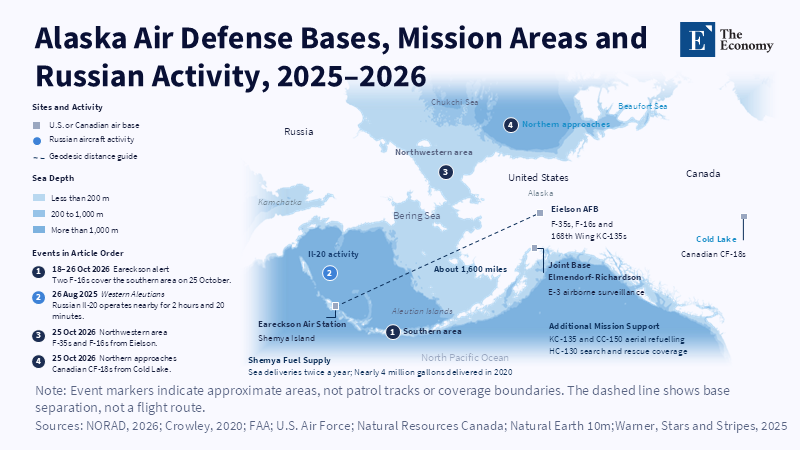
Cobra Dane adds to the island’s strategic value. The radar can track ballistic launches from up to 2,000 miles away, according to Air & Space Forces Magazine, yet it sits on an isolated rock exposed to cruise missiles and one-way attack drones, a growing force protection problem. Fighters at Eareckson could, in principle, screen that site as well as reach outward, although NORAD did not identify Cobra Dane as a participant in this mission. The approach itself is no abstraction, since a Russian Il-20 spent two hours and 20 minutes near the western Aleutians on August 26, 2025, by NORAD’s account to Stars and Stripes. The most durable result of the deployment may be its dullest one. NORAD says the F-16s certified the arresting system, which stays on the island after the jets leave and shortens the next deployment. Its published account names only the F-16, so the same cannot be assumed for the F-35.
Alaska Air Defense Depends on the Aircraft Behind the Fighters
NORAD split the theater three ways. Eareckson’s F-16s took the south, F-35s and additional F-16s from Eielson took the northwest and CF-18s from Cold Lake, which NORAD placed about 2,600 miles from Shemya, covered the northern approaches. The Eielson F-16s belong to the 18th Fighter Interceptor Squadron, redesignated in 2024 from an aggressor unit. Its Block 30 jets are specialized for this mission but are still single-engine aircraft working over very cold water. The HC-130J provided contingency search and rescue coverage, but no recovery was reported, so that capability was not tested in a reported incident. The F-35s, the newest fighters in the package, operated from Eielson throughout, which means the mission showed integration with them and said nothing about operating them from Shemya.
The Canadian contribution deserves similar care because the integration on display involved an aircraft approaching retirement. Canada plans to retire the CF-18 in 2032. Its first CF-35As are due at Luke Air Force Base in 2026 for training and in Canada in 2028. Only the first 16 of the planned 88 are firmly committed while the remainder is under review. The Auditor General of Canada reported in 2025 that the pilot shortage found in 2018 had persisted and new squadron facilities at Cold Lake and Bagotville are not expected before 2031. What NORAD validated in October was a binational procedure and Ottawa has yet to settle which aircraft will carry it out in the 2030s, or how many.
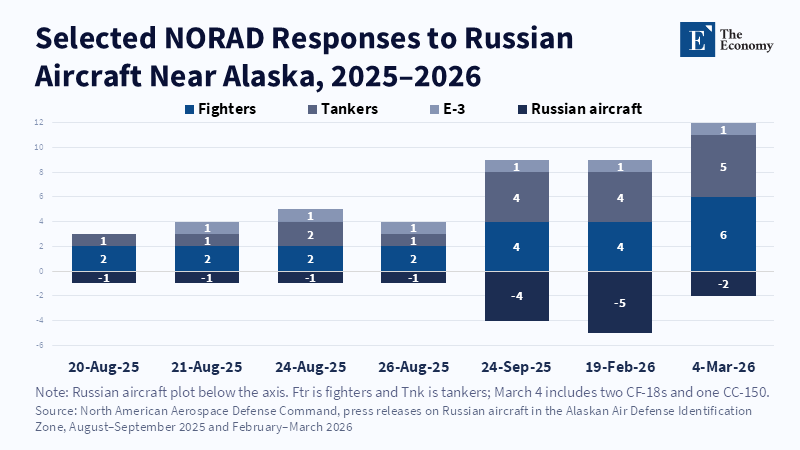
The tighter bottleneck sits further back in the formation, in a fleet that was thin before any of this began. One E-3 participated on October 25. Its radar reaches beyond 250 miles against low flyers, according to the Air Force, which is a long way until it is set against the distance from Eielson to Shemya. The Air Force had 16 E-3s at the start of 2026, with a fiscal 2024 mission capable rate of 55.7%. The Alaska Air National Guard’s 168th Wing, described by the Air Force as the country’s only Arctic air refueling unit, reached 12 KC-135s in April 2026. Set those numbers beside routine demand. On March 4, NORAD launched 12 aircraft against two Russian Tu-142s and in September 2025 it sent one E-3, four F-16s and four KC-135s after four Russian aircraft. Another fighter location adds no tankers.
Nine Days on Shemya Cannot Settle the Sustainment Question
Fuel is the easiest constraint to measure and the one most easily overlooked, since jets arrive by air and their fuel does not. Crowley described twice-yearly sea deliveries to Shemya in 2020, hauling products from more than 1,200 miles away to a dock its own team leader described as often swamped by 28-foot seas. Crews can wait 30 to 40 days for the right wind. In 2020 a winter storm destroyed the dock, pushed the delivery past its best weather window and forced ship-to-shore lightering of nearly four million gallons, with anchoring ruled out because the military warned of unexploded ordnance in the bay. None of this stops a two-ship. It starts to matter as the number of jets grows.
An illustrative calculation shows the potential scale of demand. Luke Air Force Base puts an F-16 refuel at 1,000 to 1,400 gallons. Assuming a full 1,400-gallon refuel after each sortie, a hypothetical 12-jet squadron flying two sorties per aircraft per day would require about 33,600 gallons daily for the fighters alone. At that assumed rate, nearly four million gallons would cover roughly four months of fighter refueling. This is not an estimate of Eareckson’s operational endurance: actual fuel uplift per sortie, usable storage, delivery schedules and consumption are not publicly established, and the calculation excludes tankers, transports, ground equipment and reserves. Fuel is also only the visible part of the bill. Munitions, maintenance and force protection add further demands to any extended stay and photographs released by the Air Force show 176th Wing airmen setting up communications equipment outdoors. NORAD has released no sortie rate, alert launch time, aircraft availability figure or count of support personnel for the deployment. King Salmon offers the only recent comparison and four F-16s spent five days there in September 2025 with a C-17 moving people and equipment. Both events were short and planned in advance, conditions that differ from an unanticipated contingency. The public record does not establish how the same force would perform under those circumstances.
Russian and Chinese Activity Raises the Readiness Question
NORAD has not linked the mission to any specific aircraft or threat and nothing in the public record supports reading it as a response to a Russian or Chinese incursion. Noble Defender is a recurring operation. NORAD calls the October 25 event a homeland defense mission under Noble Eagle, while Task & Purpose described it as an exercise. Neither account establishes a response to a specific incursion. The wider context is plain enough. NORAD recorded 12 Russian flights into the Alaskan zone in 2024 and two Russian and two Chinese bombers entered it together that July, a first. On February 19 this year, five Russian aircraft, including an A-50, operated there. The U.S. Coast Guard told Reuters that four Chinese research vessels had worked off the U.S. Arctic by September, against five in all of 2025. NORAD routinely says such flights stay in international airspace and are not seen as a threat.
That pattern may support a rotational approach, but it cannot establish the optimal basing model by itself. A NORAD spokesperson told Stars and Stripes that annual Russian aircraft activity in the Alaskan identification zone has ranged from zero to 15 flights since 2007. Such figures describe the frequency of observed activity, not the full requirements of deterrence, warning time or wartime readiness. The harder case for Eareckson is wartime dispersal and there the model’s weak point is warning. Lt. Gen. Robert Davis, who commands the Alaskan NORAD Region, told High North News that the reach and coordination of activity near Alaska are reducing warning time. A force that relies on moving late needs to see early. The Pentagon’s inspector general evaluated the Alaska Radar System in January 2024, but its findings remain classified. The public record therefore does not establish how well that network could support a prolonged alert.
Rotation Can Replace a Garrison Only if the Base Stays Ready
The obvious reply to all this is that NORAD should simply base fighters on Shemya and the evidence runs against it. Gen. Gregory Guillot, NORAD’s commander, argued in 2024 that too many forces can end up as capability sitting on alert, pulling readiness away from the services and he sought a better balance between forces held just in case and those called just in time. A permanent squadron on an island of less than six square miles, near the radar it might help protect, could concentrate assets that dispersal is intended to distribute. The opposite reading, that October made permanent investment unnecessary, fails on the same evidence, since every element of the mission rested on something permanent, from the Crowley contract to the runway to Elmendorf’s E-3. Davis himself said homeland defense in the Arctic “cannot be seasonal or episodic.” Rotating fighters answer that only if what they rotate into never stops working.
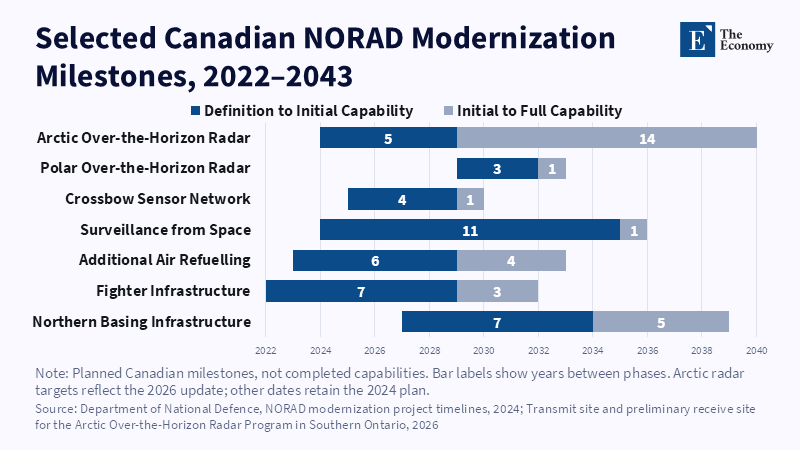
One possible next test would be a longer winter deployment, potentially lasting 30 days, to examine sustainment under more demanding conditions. Whether that duration, a no-notice format or the public release of sortie and alert-time data would be operationally appropriate is a decision for the responsible commands, not something established by the October exercise. Pre-positioned spares and munitions and added fuel storage at Eareckson could reduce the lift required for each rotation; the costs are not public. Ottawa’s planners should fly the CF-35A into this scheme early and settle the fate of the remaining 72 aircraft, because procedures developed around the CF-18 will need to remain effective through the transition. Congress has the least glamorous job in Alaska air defense, which is to treat E-7 delivery, tanker numbers, radar sustainment and over-the-horizon sensors as the actual price of the Aleutian alert line, whatever the fighter count says. Whether that bundle is affordable alongside everything else the Air Force is buying, nobody has yet shown.
Two F-16s proved something specific on October 25. NORAD can deploy to Eareckson, hold alerts, launch and fit into a binational mission across thousands of miles and that is more than it had shown publicly from the island in decades. Its operational effectiveness is a separate claim. The only detailed account of the mission comes from NORAD, whose word for the integration was “seamlessly,” and no independent assessment of the deployment has been identified in the public materials reviewed for this article. Nothing is known about how the force would hold up in January, against a second simultaneous event, or under attack. When the fighters left, Shemya kept its certified arresting gear, its 10,000-foot runway and reliance on difficult sea fuel deliveries.
The views expressed in this article are those of the author and do not necessarily reflect the views of The Economy, its Editorial Board, or any affiliated institution.
References
Air & Space Forces Magazine (2024) “NORAD Boss Calls for Better Arctic Awareness”.
Air & Space Forces Magazine (2026) “What Options Does the Air Force Have for E-3 Taken Out by Iran?”.
Auditor General of Canada (2025) Report 2: Delivering Canada’s Future Fighter Jet Capability. Ottawa: Office of the Auditor General.
Crowley (2020) “Crowley Completes Challenging Over-the-Shore Fuel Delivery to U.S. Military in Remote Shemya”, 16 September.
Department of Defense Office of Inspector General (2024) Evaluation of the Alaska Radar System, DODIG-2024-048. Alexandria, VA: DoD OIG.
Department of National Defence (2026) Future Fighter Capability Project. Ottawa: Government of Canada.
High North News (2026) “Top Alaska Military Officer: Homeland Defense in the Arctic Cannot be Seasonal or Episodic”.
Newdick, T. (2026) “USAF F-16s Back on Alert Duty in Aleutian Islands for First Time in Decades”, The War Zone, 30 October.
North American Aerospace Defense Command (2024) “NORAD Detects, Tracks and Intercepts Russian and PRC Aircraft Operating in the Alaskan ADIZ”, 24 July.
North American Aerospace Defense Command (2025a) “NORAD Detects and Tracks Russian Aircraft Operating in the Alaskan Air Defense Identification Zone”, press releases, 20, 21, 24 and 26 August and 25 September.
North American Aerospace Defense Command (2025b) “Alaskan NORAD Region Conducts Agile Combat Employment from King Salmon”, 25 September.
North American Aerospace Defense Command (2026a) “NORAD Detects and Tracks Russian Aircraft Operating in the Alaskan Air Defense Identification Zone”, 19 February and 4 March.
North American Aerospace Defense Command (2026b) “NORAD Fighter Aircraft Execute Homeland Defense Mission from Austere Eareckson Air Station”, 30 October.
Reuters (2026) “US Watching Chinese Marine Presence off Alaska, Arctic Coast Guard Chief Says”, 21 September.
The Economy Editorial Board (2026) “Bering Strait Military Competition: The U.S. Answers China and Russia on a 2033 Timeline”, The Economy, 22 October.
U.S. Air Force (2015) “E-3 Sentry (AWACS)”. Washington, DC: U.S. Air Force.
U.S. Air Force (2019) “A Day in the Life of POL”, Luke Air Force Base, 21 August.
U.S. Air Force, 168th Wing (2026) “168th Wing Receives Four New KC-135 Stratotankers”, 6 April.
Warner, G. (2025) “US Aircraft Intercept Fourth Russian Surveillance Mission near Alaska in the Past Week”, Stars and Stripes, 27 August.
Working across research, policy, and data-driven analysis, the Editorial Board ensures that published pieces reflect a consistent institutional perspective grounded in quantitative reasoning and long-term structural assessment.