Tariff Evasion and the Hidden Welfare Cost of the US-China Trade War

Working across research, policy, and data-driven analysis, the Editorial Board ensures that published pieces reflect a consistent institutional perspective grounded in quantitative reasoning and long-term structural assessment.
Authored On
Modified
A third of China’s recorded import fall was paperwork
Tariff evasion burns resources the textbook welfare diagram ignores
Tariffs redirect market incentives instead of removing them
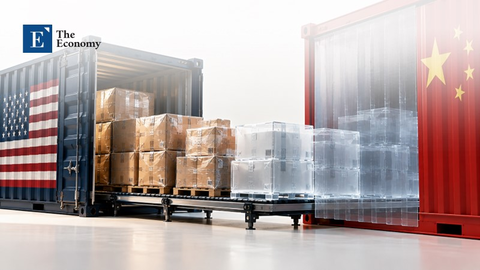
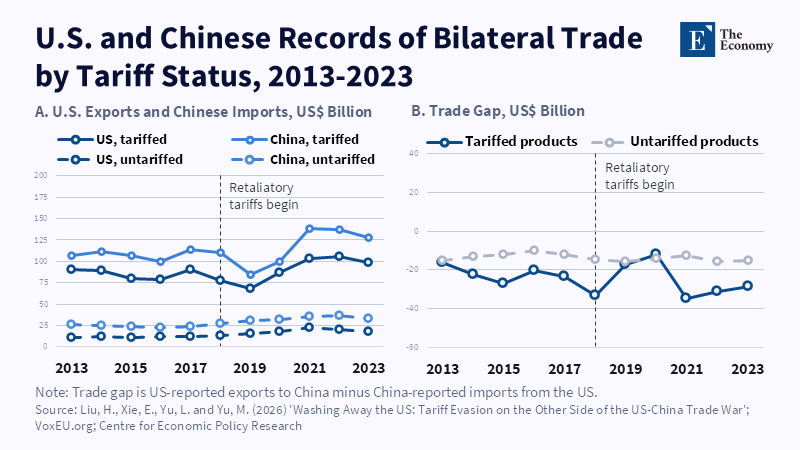
When China imposed tariffs on U.S. goods in 2018, they went from paying an average tariff of about 8 percent to about 20 percent on average. Most other countries that sent goods to China continued to pay less than 10 percent on average. For every $1 million import, that is a $120,000 difference. That is enough to motivate people to play games with customs declarations. Import and export numbers started to diverge between China and the U.S. China reported a 16.3 percent drop in imports from the U.S. between 2018 and 2019, while the U.S. only saw a 7.4 percent decline in exports to China. The divergence was highest for the lines that China decided to impose higher tariffs on.
Underreporting Explains a Third of China’s Missing U.S. Imports
Research published by the Centre for Economic Policy Research in October 2026 quantifies that divergence. It looks at six-digit product lines and compares those that China targeted with those that it did not. It finds that from 2018 to 2023, China reported $477.5 billion less in imports from the U.S. than it would have without the tariffs. $310.4 billion of that was due to trade that did not happen and $167.1 billion was from underreporting of goods that did enter the country so a third of the decline was just on paper.
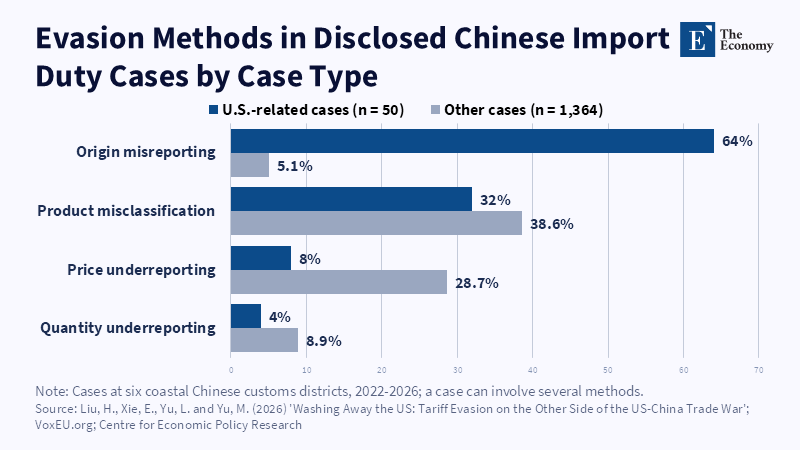
The methods used to evade tariffs were not particularly sophisticated. They reported lower quantities of goods, used product lines with similar classifications but lower tariffs and misreported countries of origin. Underreporting unit price was uncommon, which is usually the channel customs look at the most. When they did misreport country of origin, it tended to be for countries that are plausible transshipment points and already had some exports to China of the goods in question. From 2022 to 2026, six large coastal customs districts in China detected 5,179 trade violations, including 1,414 import duty evasion cases. 50 of those cases were linked to the trade war or hiding the U.S. as a country of origin. 64 percent of these falsely reported the country of origin versus 5.1 percent in other tariff evasion cases. Product exclusions where China simply exempted certain lines from tariffs reduced evasion. Product exclusions that had to be applied for by the importer did not.
An earlier piece on U.S. tariffs in the economy looked at how tariffs from the U.S. caused Chinese exports to be rerouted through Vietnam and Malaysia, creating a false appearance of decoupling and showing how some countries benefit more than others due to manufacturing capacity. The results from China add to this story. The same behavior is happening in a different country with different customs officials and laws and various products. This supports the idea that it is caused by the tariff differential, which is exactly what would be expected from textbooks.
The Textbook Tariff Diagram Assumes Every Duty Is Paid
Any undergraduate trade course teaches that there are 4 areas under the supply and demand curve that describe what happens when a tariff is imposed on a small country. When a tariff is imposed, the domestic price increases by the amount of the tariff. Consumers lose on the goods they continue to buy as well as those that they no longer consume. Some of that is gained by domestic producers who can now sell more goods at a higher price and some of that goes to the government in the form of tax revenue. Once the areas that are just transfers are set aside, there are two triangles that represent the welfare loss from the tariff. One is due to domestic production of goods that could have been produced more cheaply abroad and the other is from goods that consumers no longer buy that would have been valued above the world price.
Large countries can extract some of the tariff from foreign producers who may reduce their prices prior to the tariff. This did not really happen with the U.S. tariff in 2018. A paper in the Journal of Economic Perspectives from 2019 found that tariffs were passed through almost one-for-one into import prices and estimated that tariffs were costing consumers and importers $3.2bn a month in additional taxes and $1.4bn a month in deadweight loss as of December 2018. After accounting for the gains to the government and producers from the tariff, a paper in the QJE from 2020 estimated that the tariff was costing the U.S. economy $7.2bn a year in real income. Reciprocal tariffs are bad for the economy because of these triangles and there is nothing about this added information that changes that.
What does change is the rectangle that is labelled as revenue. That area is assumed to be a transfer from consumers to the government. The first assumption is that all imports pay the tariff and the second is that the only thing that will happen is that people consume fewer imports or switch to domestic goods. Both of those seem to break down quickly when looking at the U.S.-China tariff war. There is also another issue when trying to estimate these areas using customs data. If a third of the fall in imports is from misreporting, then the elasticity of import demand used to estimate the triangle includes goods that did not stop being imported.
Tariff Evasion Turns Lost Revenue into Wasted Resources
It is possible to measure how much trade will try to avoid a tariff. A paper in the Journal of Political Economy from 2004 looked at exports from HK to China and reported imports into China and found that for every one-percentage-point increase in the Chinese tariff, the difference between reported exports and imports increased by about 3 percent. They did this by reporting similar goods under product lines that had a lower tariff. Twenty years later, this CEPR paper uses the same method to look at the U.S.-China tariff war. Trade will still try to dodge tariffs.
For every dollar that a tariff charges an importer, they have an incentive to pay close to that dollar to avoid paying it. Where that money goes is where a welfare loss appears. Port stops in Malaysia or Thailand, warehouses, insignificant amounts of production to meet rules of origin, brokers and lawyers that can help navigate tariff schedules. All these cost money and resources that are not being used to produce anything that consumers want. Rent seeking has been around as long as tariffs. A paper in the AER from 1974 estimated that countries that used import licensing were wasting 7.3 percent of national income in India and 15 percent in Turkey on people trying to get the licenses. Tariffs are slightly better than import licensing because the government gets some of that rent but not all of it.
Some of these are perfectly legal and some are almost funny. Ford used to import its Transit Connect vans from Turkey with seats in the back so they could be classified as a passenger vehicle and pay a 2.5 percent tariff instead of 25 percent as a cargo van. They would then remove the seats in Baltimore and throw them away. These seats were imported just to be removed from a vehicle. The courts ruled that the vehicles were cargo vans anyway. Converse put a thin layer of fabric on the soles of some sneakers so they could pay a lower tariff. The de minimis threshold in the U.S. allowed Shein and Temu to import small parcels of clothing duty-free until the U.S. ended that in 2025. This allowed them to ship single parcels by air rather than in shipping containers, which cost more, but they could avoid paying tariffs.
If it costs less than the tariff to evade it, then the firm will keep that money and the government will not get the tariff. The welfare loss is only the cost of avoiding the tariff. Fraudulent methods of avoiding tariffs will be remarkably close to just a transfer from the government to the importer, which means that some legal ways of avoiding tariffs are worse for the economy than illegal ways. There is also the cost of enforcing the tariff. Finding out if goods are misreporting their country of origin takes time and money as well.
Avoiding tariffs also reduces the price effect that creates the triangle in the standard diagram. If a third of the goods are not paying the tariff, then the domestic price will rise by less than the tariff, which means the size of the triangles will be lower. If avoiding tariffs is less costly than the size of the triangle, then it could be better to have a tariff that people can avoid than one that they cannot. Customs data do not show how much money people are spending to avoid tariffs.
Diversion, Rerouting and Misreporting Look Identical in Trade Data
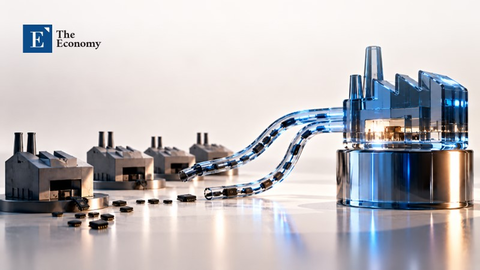
There are a few different ways that goods can avoid a tariff. They can all be seen in the same way in trade data as a decline in imports from the U.S. Some of these have different welfare effects. Trade diversion is when China buys goods from another country. China bought more Brazilian soybeans after it imposed tariffs on U.S. soybeans. The welfare loss here is that China is paying more for those soybeans and China is not collecting the tariff revenue it would have from those imports. Rerouting goods through another country is when U.S. goods go through a third country and are reported as coming from that country. The U.S. is still selling to China; it is just going through a port in Korea or Malaysia. There is a welfare loss here because those goods are taking longer to get to China and probably cost more to ship. Misreporting goods at the border is when they just lie on the customs declaration. There is probably less of a welfare loss here because they are not taking longer to get to China or costing more to ship but it makes it hard to know what is happening with trade.
Firms will do all these things because it will allow them to reduce the cost of their landed goods. Whether they are buying from a different country, sending goods through another country or just misreporting their imports, they can tell their CFO that they are saving money. Only the first reflects a real change in sourcing, and even that leaves the economy poorer than open trade would. The other two allow firms to save money but that is matched by a loss of revenue that the government must collect somewhere else and more money spent on enforcement. $167.1 billion of goods were still imported into China; they were just reported differently. How much did it cost to report them differently? That is where the welfare loss is.
There is also a welfare loss from the things that firms are not doing while they try to avoid tariffs. If management is spending time figuring out how to meet rules of origin or find product lines with lower tariffs, they are not trying to reduce the cost of their goods or improve the product. They may be building factories in countries that allow them to avoid tariffs, but those factories may not be there if there were no tariffs. Some of these will become permanent, as Vietnam has shown but it is not known how many will.
Every Artificial Price Gap Invites Firms to Close It
This is not limited to tariffs. China has an export rebate program that has caused exporters to report higher amounts of goods to get more in rebates. There is smuggling of goods that have different prices in different countries. When the G7 capped the price of Russian oil at $60 per barrel, there were a lot of old tankers that moved oil around the world. They all had something in common: they were all created to take advantage of the price difference.
Tariffs do not stop people from trying to avoid them. They just change what people are incentivized to do. Instead of producing goods more cheaply, they are trying to move their factories, change the product they are making, or just lie. All of these will cost the economy money that is not accounted for when the welfare effects of tariffs are discussed. There may be some welfare gain from having trade diversion if the goal is to not rely on one country for imports but the 35 percent estimate covers only the misreporting that leaves a gap in the data, and customs records cannot show how much of the remaining decline is genuine diversion.
The views expressed in this article are those of the author(s) and do not necessarily reflect the official position of The Economy or its affiliates.
References
Amiti, M., Redding, S.J. and Weinstein, D.E. (2019) ‘The impact of the 2018 tariffs on prices and welfare’, Journal of Economic Perspectives, 33(4), pp. 187-210.
Fajgelbaum, P.D., Goldberg, P.K., Kennedy, P.J. and Khandelwal, A.K. (2020) ‘The return to protectionism’, Quarterly Journal of Economics, 135(1), pp. 1-55.
Fisman, R. and Wei, S.-J. (2004) ‘Tax rates and tax evasion: Evidence from “missing imports” in China’, Journal of Political Economy, 112(2), pp. 471-496.
Krueger, A.O. (1974) ‘The political economy of the rent-seeking society’, American Economic Review, 64(3), pp. 291-303.
Lee, K. (2025) ‘China tariff transshipment and the illusion of decoupling’, The Economy, 22 November.
Liu, H., Xie, E., Yu, L. and Yu, M. (2026) ‘Washing away the US: Tariff evasion on the other side of the US-China trade war’, VoxEU Column, Centre for Economic Policy Research, 26 October.
The Economy Editorial Board (2026) ‘US-China tariff war: Why third-country gains are uneven’, The Economy, 24 June.
Working across research, policy, and data-driven analysis, the Editorial Board ensures that published pieces reflect a consistent institutional perspective grounded in quantitative reasoning and long-term structural assessment.