[Arctic Maritime Strategy] Who Controls the Northwest Passage? Canada, the U.S. and Arctic Navigation Rights

Working across research, policy, and data-driven analysis, the Editorial Board ensures that published pieces reflect a consistent institutional perspective grounded in quantitative reasoning and long-term structural assessment.
Authored On
Modified
Canada claims the Northwest Passage as historic internal waters
Washington treats it as an international strait for transit
The 1988 icebreaker deal manages, but never settles, the dispute
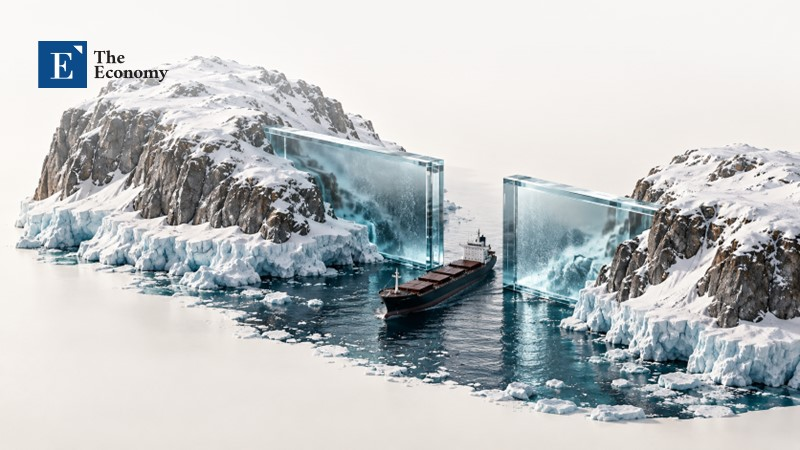
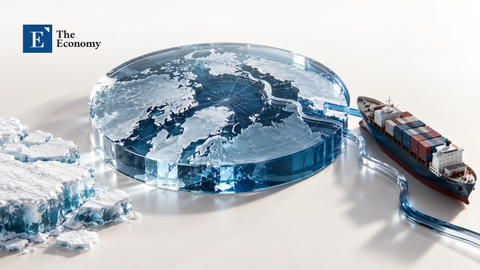
Captain Lawson Brigham later commanded the U.S. Coast Guard icebreaker Polar Sea, which in 1985 transited the Canadian Arctic Archipelago. This transit is what prompted the Canadian government to establish straight baselines around all of the Canadian Arctic. At the time, the United States informed Canada of this transit but did not ask for permission. In an article published in Proceedings in September of 2025, he tallied the number of vessels that have transited the Northwest Passage from Amundsen's first transit in 1903 to the end of the 2024 season. There were 430. Of those 430, only 63 were cargo vessels and 44 of those transited in the last six seasons. These numbers support both arguments. Since two-thirds of cargo ships that have transited the passage have done so in the last six seasons, it can be seen as becoming a trade route which would support the U.S. position that it is an international strait. But the fact that only 63 cargo vessels have transited the passage in its existence can support Canada's position that it is made up of internal waters.
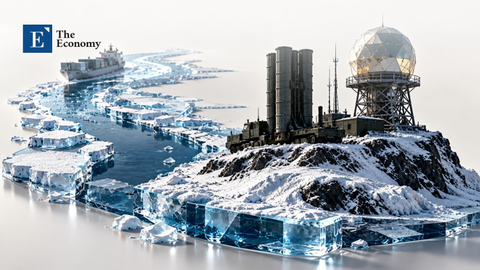
Canada and the United States are among the world’s closest military allies and share the binational NORAD command. As of July 2024, Canada has joined forces with the United States and Finland to build icebreakers as part of the ICE Pact. Canada's foreign policy for the Arctic lists the United States as its closest partner and ally. The one area of contention that has been discussed openly is that of the legal status of the Northwest Passage. Since the 1960s, Canada and the United States have had conflicting views on how the Northwest Passage should be classified. They reached an agreement in January 1988 that allowed for neither country to give up on its position. Canada believes that the Northwest Passage consists of internal waters that are under historical title. The United States believes that it is a strait that is used for international navigation. No court has ruled on the question, and other states have not settled it. With sea ice in the archipelago retreating, this will be the test to see if this agreement will stand.
History Precedes Law: Canada’s Claim and the U.S. Strait Argument
Canada has always held that the waters of the Arctic Archipelago are Canadian Internal Waters. According to Global Affairs Canada, the Canadian Arctic is "joined, not divided, by the waters between them." Canada views these internal waters as its own, much as it views its land. The country can limit traffic or request permission for entry to the waters. Canada uses their straight baselines, which were established on January 1, 1986, as proof that the waters were internal to it. This is the theory behind the straight baselines being put into place. The U.S. transiting the passage through the use of icebreakers prompted the Canadian government to claim the waters. After the tanker SS Manhattan passed through the Northwest Passage, the Canadian government passed the Arctic Waters Pollution Prevention Act. This act declared a pollution zone that extended 100 nautical miles from any part of the Canadian Arctic. This also sparked conflict with the United States.
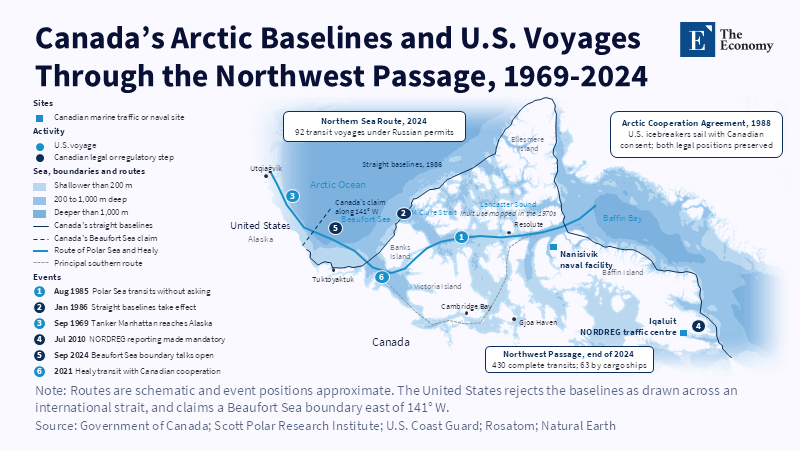
This history can be seen as one of the weaknesses. Article 8 of the UN Convention on the Law of the Sea, UNCLOS, states that waters newly enclosed by straight baselines keep a right of innocent passage, meaning Canada cannot simply claim the waters are theirs by using its baselines. They have to prove that these waters were always internal waters to Canada. This is where historical title comes in. For Canada to hold historical title over the Northwest Passage, they must have had long-lasting use of these waters, and other countries have to have acquiesced to Canada having them. The U.S. and other countries have never shown acquiescence to Canada's position. Historical records by J. Ashley Roach and Robert W. Smith have shown statements from the U.S. protesting the straight baselines on January 10th and February 26th, 1986.
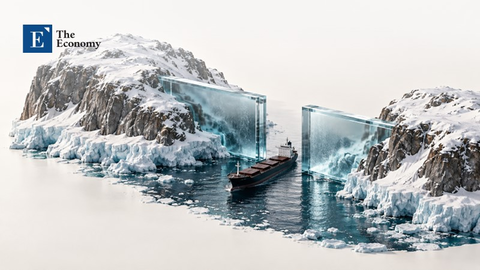
If Canada's position is correct that the waters are internal, then it can shut them off whenever it pleases. But if the Northwest Passage is considered a strait used for international navigation, then they have the right of transit passage. This means no country can restrict or bar entry to the strait. Not only that, but submarines can travel under the surface of the water and planes can fly over the area. The United States has never ratified UNCLOS but has treated it as customary law. Under Article 3 of UNCLOS, a coastal state has a 12 nautical mile territorial sea where it can temporarily suspend innocent passage. If the passage is viewed as a strait, Canada loses even this ability. They have listed many baseline claims by other countries as excessive in their report Limits in the Seas No. 112. This includes Canada's. Secretary of State Mike Pompeo stated at an Arctic Council meeting in May 2019 that the claim was illegitimate, just like Russia's.
Traffic, Consent and the Corfu Channel Test
In the 1949 Corfu Channel decision, the International Court of Justice gave criteria for something to be considered a strait used for international navigation. It must connect two areas of high seas, and it must be used for international navigation. It did not specify that it must have large quantities of vessels that pass through it. This has sparked much debate as to what qualifies as enough vessels passing through the strait. The United States believes that just enough ships sailing through it qualify. Canada would argue that you need a history of foreign vessels traversing the passage. There are many foreign ships that traverse the passage, but most are private yachts and cruise liners. Some government ships also travel the passage with the help of Canadian forces. As of July 2010, all ships that are 300 GT or more must report to Canada’s NORDREG system. This again allows Canada to further their argument.
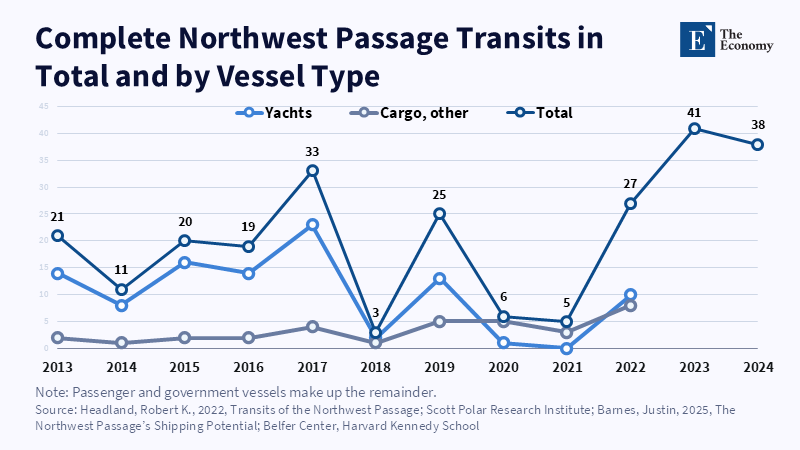
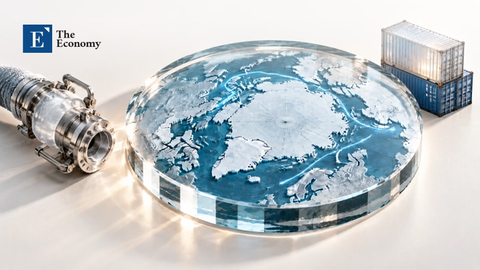
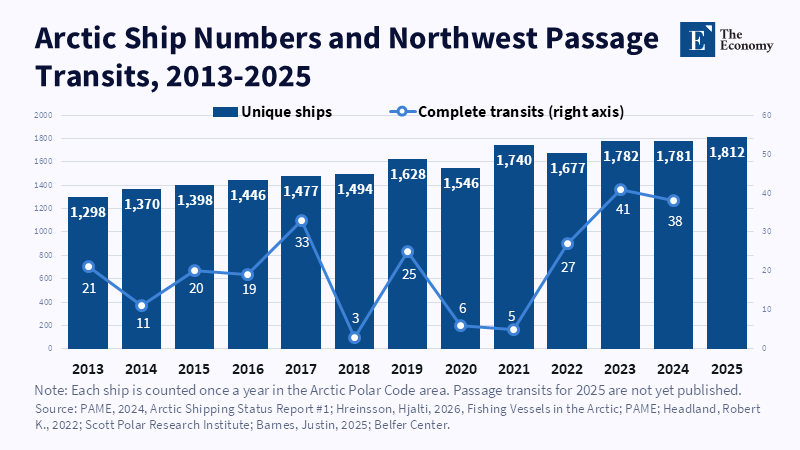
As ice continues to melt, people believe that this will cause the passage to become open to shipping, which would then prove the U.S. position. However, ice is not melting as fast as we believe. The Arctic Council published its number of vessels in the Polar Code area in 2023. It showed there were 1782 unique ships in the Polar Code area. This was a 37% increase from 2013, with fishing vessels making up 41% of that number. We still see little ship traffic going through the Northwest Passage. Ice has also been fluctuating. In September of 2025, Arctic sea ice fell to 4.60 million square kilometers, which tied for the 10th lowest on record. The National Snow and Ice Data Center stated that September has had no significant trend in the last 19 years, although those 19 years were the lowest on record. There will be more ships traversing the passage, but will it be enough to prove the U.S. position?
Inuit Use and Occupancy as Legal Evidence
By ignoring the Inuit, we lose an aspect of Canada's argument. Article 15 of the Nunavut Land Claims Agreement states as a principle that "Canada's sovereignty over the waters of the Arctic archipelago is supported by Inuit use and occupancy." The Inuit use and occupy many of these waters. By stating that the Canadian Arctic is internal waters, Canada is stating that it has sovereignty, which, as mentioned above, needs to be backed by usage. Many of these waters did not have Canadians in them until recent times. The Inuit spent many years traveling through these waters. Many sources, such as the Inuit Land Use and Occupancy Project that was sponsored by the federal government, showed that the Inuit occupied many of these areas. Some experts, such as Terry Fenge, formerly of ICC Canada, have stated that the Nunavut Land Claims Agreement is the only modern treaty that specifically mentions Arctic sovereignty. Without it, our argument is weaker.
This not only impacts our argument, but it will also impact our position in the future. If we are to decide how the Northwest Passage is dealt with, we must know that our indigenous peoples will play a role. Global Affairs Canada states that "Sovereignty and sovereign rights in the Arctic are inextricably linked to issues of Indigenous self-government." The Inuit Nunangat Policy also allows for our Indigenous Treaty organizations to speak on our behalf on the international stage. If a treaty were to be made with the U.S. about the Northwest Passage, or Canada decided to create more restrictions, we would have to take our treaty into consideration. After Mike Pompeo's speech, Monica Ell-Kanayuk from ICC Canada responded, saying that it is part of the Inuit homeland. The Inuit Circumpolar Council made a similar declaration on Arctic sovereignty in 2009. There has never been a court that has ruled on whether you can occupy land that is frozen. Canada and the United States opened talks on their Beaufort Sea boundary in 2024, but these do not address this issue.
What the 1988 Arctic Cooperation Agreement Did Not Settle
On January 11th, 1988, Joe Clark and George Shultz came to an agreement about the Canadian Arctic, two and a half years after the Polar Sea. They both agreed that each country would allow its icebreakers to traverse its Arctic waters and that they would help each other with research. U.S. icebreakers would only traverse the Canadian Arctic with permission from the Canadian government. They then stated that no agreement or action taken under this agreement would alter each country’s position on the Law of the Sea. This includes their positions toward third parties. They also stated that either party can terminate the agreement with three months’ notice. By using the phrase "claimed by Canada to be internal," they allowed Canada to have their position without acknowledging it.
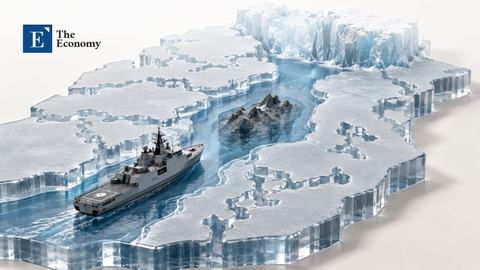
This has allowed both parties to traverse the Arctic using their icebreakers. The United States will traverse the Canadian Arctic with permission. But it does not include military ships or other foreign ships. What could cause an issue in the future? We have allowed the United States to traverse our waters with their icebreakers, including the Healy’s transit in 2021. By allowing them this permission, we are strengthening our argument that the passage is internal. As we are showing, these ships have permission to be there. If the United States were to decide to traverse the passage with military ships, they would have to go against the agreement. They would not be traversing it with our permission. So, the Canadian argument that we have allowed these ships to be there would not apply. But this is only an agreement between the U.S. and Canada. If China or Russia were to travel through the passage, we would not have allowed them. Such voyages would count as foreign use without Canadian consent, which would weaken our argument. This could also cause tensions with the United States, whose position, restated by Mike Pompeo in 2019, would open up the passage to other foreign ships. In a February 2026 report, Vincent Rigby and Lawrence Herman said that sending the U.S. Navy or Coast Guard through the passage would be an easy solution for a U.S. President who wanted to threaten Canada.
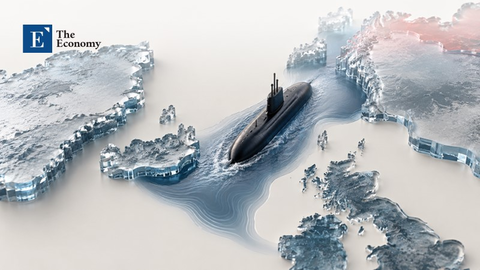
With all the military power the United States holds, and the size of Canada’s Arctic, it makes sense that we would cooperate. Canada has put $38.6 billion into modernizing NORAD. We have also announced that we will be getting up to 12 conventionally powered submarines. These will be able to travel under the Arctic ice, allowing us to defend our internal waters. The U.S. will also benefit from having Canada help patrol our northern waters. The more we can control our Arctic, the safer our northern region will be. If we can control the Northwest Passage as internal waters, we can also stop the Chinese or Russians from sending ships or submarines through, which will strengthen our position with the US.
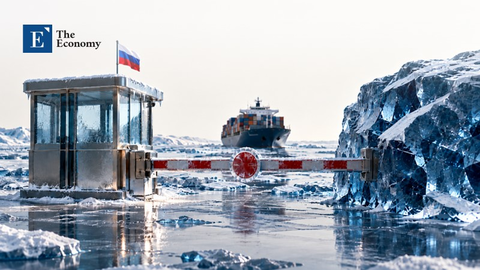
Russia is the closest country to have the same argument as Canada. They consider their Arctic straits internal waters. They also use Article 234 of UNCLOS to regulate shipping in their ice-covered waters. But they go even further, applying their permit rules out to the edge of their EEZ. They require that all ships traveling through their route apply. They then allow all ships that apply to travel. In 2024, the route carried 37.9 million tons of cargo and 92 transit voyages. Russia has had this route since the 1930s. All these years, the United States has protested Russia’s claims. The Soviet Union refused U.S. icebreakers in 1967, when they were trying to circumnavigate the Arctic. If the United States were to agree that the Northwest Passage was internal, it would weaken its stance on Russia.
The Case For and Against U.S. Recognition
Because it makes us safer as a nation, if Russia or China were able to send ships through our waters, they could disrupt trade or take advantage of our weaker military. Allowing us to control the passage as internal waters allows us to defend our north. But if we acknowledge Canada's position, we open ourselves to Russia. They would be able to use our objection to help them. They would ask why Canada can have it but they cannot, and, as we know, they would not let the U.S. through.
A possible solution would be for the United States to create a treaty with Canada, similar to the one that is in place, allowing the U.S. military to traverse the passage while Canada maintains its historic title claim. By doing this we allow both sides to have what they want. If Canada adds its Coast Guard icebreakers to the Arctic, it will have more of a presence in the area, which will further its argument that these are internal waters. This would satisfy both countries and allow us to continue our objections to Russia. If we can allow our military to traverse the passage, we could continue our stance on the Arctic and strengthen our relationship with Canada.
As Captain Lawson Brigham stated, there have been many ships that have traversed the passage, but only 63 cargo ships. This could show that it is being used as a trade route, but could also show that only a few cargo ships have traveled the passage. This agreement has been in place since 1988, allowing us to traverse each other's Arctic. But, as stated above, it does not apply to military vessels or other countries, which will be the deciding factor if this becomes an issue. In 2024 alone, more transit voyages used Russia's route than cargo ships have ever traveled the Northwest Passage. This shows that if the ice continues to melt, Russia will have more of an advantage by controlling its waters.
The views expressed in this article are those of the author(s) and do not necessarily reflect the official position of The Economy or its affiliates.
References
Brigham, Lawson W. (2025) ‘The Northwest Passage: Transit realities’, Proceedings, 151(9). Annapolis: United States Naval Institute.
Fenge, Terry (2007) ‘Inuit and the Nunavut Land Claims Agreement: Supporting Canada’s Arctic sovereignty’, Policy Options, December 2007 to January 2008.
George, Jane (2019) ‘Canadian Inuit challenge U.S. stance on Northwest Passage’, Nunatsiaq News, 15 May.
Global Affairs Canada (2024) Canada’s Arctic Foreign Policy. Ottawa: Government of Canada.
Government of Canada and Government of the United States of America (1988) Agreement Between the Government of Canada and the Government of the United States of America on Arctic Cooperation, Canada Treaty Series 1988 No. 29. Ottawa, 11 January.
Government of Canada and the Inuit of the Nunavut Settlement Area (1993) Agreement Between the Inuit of the Nunavut Settlement Area and Her Majesty the Queen in Right of Canada. Ottawa: Indian and Northern Affairs Canada and Tunngavik Federation of Nunavut.
International Court of Justice (1949) Corfu Channel Case, United Kingdom v. Albania, Merits, Judgment of 9 April 1949. ICJ Reports 1949, p. 4.
National Snow and Ice Data Center (2025) ‘2025 Arctic sea ice minimum squeezes into the ten lowest minimums’, Sea Ice Today, September. Boulder: University of Colorado Boulder.
Protection of the Arctic Marine Environment Working Group (2024) The Increase in Arctic Shipping 2013 to 2023: Arctic Shipping Status Report #1. Akureyri: PAME Secretariat.
Rigby, Vincent and Herman, Lawrence (2026) Trump, Greenland and the Arctic: Is Canada Next on the Menu? Ottawa: Canada-US Experts Group, Norman Paterson School of International Affairs, Carleton University.
Roach, J. Ashley and Smith, Robert W. (2012) Excessive Maritime Claims. 3rd edn. Leiden: Martinus Nijhoff.
The Moscow Times (2025) ‘Northern Sea Route shipping falls short of Russia’s 2024 target’, The Moscow Times, 10 January.
United Nations (1982) United Nations Convention on the Law of the Sea. Montego Bay, 10 December.
United States Department of State, Office of Ocean Affairs (1992) Limits in the Seas No. 112: United States Responses to Excessive National Maritime Claims. Washington, DC, 9 March.
Working across research, policy, and data-driven analysis, the Editorial Board ensures that published pieces reflect a consistent institutional perspective grounded in quantitative reasoning and long-term structural assessment.