[Arctic Maritime Strategy] Control of the Northern Sea Route: Russia, China and Freedom of Navigation

Working across research, policy, and data-driven analysis, the Editorial Board ensures that published pieces reflect a consistent institutional perspective grounded in quantitative reasoning and long-term structural assessment.
Authored On
Modified
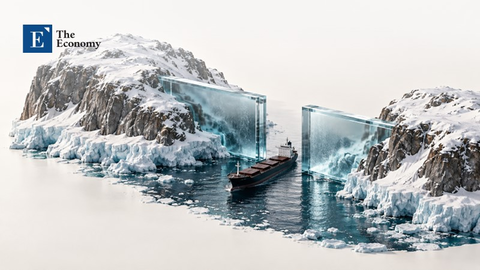
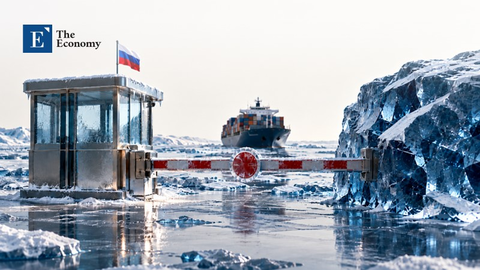
Russia controls Northern Sea Route permits despite weak legal footing
The Article 234 ice clause underpins rules but excludes warships
Sanctions leave China as the route’s only real partner
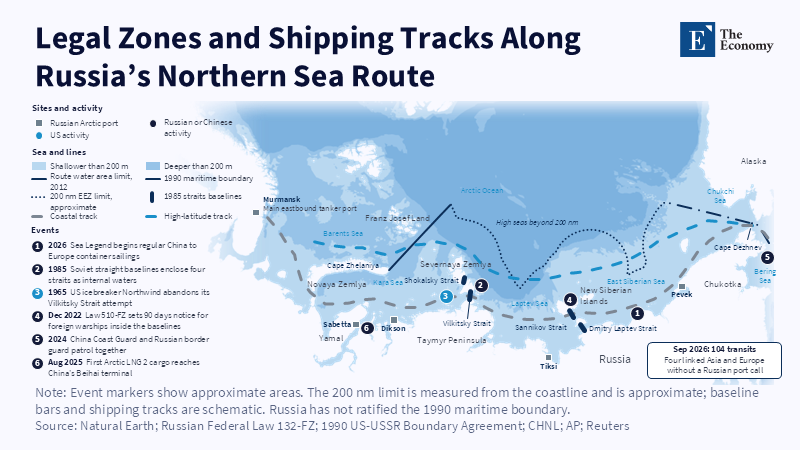
As of 30 September 2026, there have been 104 transits of the Northern Sea Route. That is one more than was completed last year and there are still 2 months left in the year. Four of these were from Asia to Europe and did not visit Russia. Last year there was only one. Chinese shipping company Sea Legend has started its first regular transit of the route from China to Europe, with eight voyages scheduled from Ningbo to Felixstowe, Rotterdam, Hamburg and Gdynia. These all have a permit to navigate the Northern Sea Route from the administration of Rosatom. The Russian Nuclear Corporation runs the Northern Sea Route. Each year, the number of different countries and destinations increases but the ability to decide who gets to navigate there remains with one Russian organisation and their legal argument is not as robust as you would think.
Russia considers it its historical waterway and has created law that reflects that, although this does have some merit in its own law. There are different jurisdictions that run along the length of Russia's Arctic coast. Some areas they have more control over than others. They have full sovereignty over the Taymyr Peninsula and Chukotka, which allows them full control of their internal waters. Then a territorial sea, where they have less control. Then an Exclusive Economic Zone (EEZ), where they have even less control. Whether the Northern Sea Route becomes an internationally recognised waterway will depend on how its users, Russia and its biggest client China, classify these areas.
Russia’s Northern Sea Route Claim Spans Waters That Are Not Legally Alike
Federal Law Number 132-FZ from the 28th July 2012 states that the waters of the Northern Sea Route consist of the sea next to the Northern Coast of Russia. Starting from Nova Zemlya and going east to the parallel of the Dezhnev Cape in the Bering Strait. This law incorporates internal waters, territorial sea, contiguous zone and the EEZ. All of which are subject to the permit system under the Russian Merchant Shipping Code. They have gone further to create rules of navigation which were laid out by government order in 2020. These rules determine if a ship can sail under its own power or needs to hire an icebreaker. This depends on the ice class and area they wish to navigate. Russia's Foreign Ministry has stated on its website that they consider the Northern Sea Route to be a national transport communication, which, on paper, would be true, but International law doesn't agree.
There is no mention of national transport communications in UNCLOS. In internal waters, you can restrict entry as you please. Foreign vessels have the right of innocent passage through your territorial sea and there is freedom of navigation in your EEZ. There has been some debate around the straits. In 1985, the USSR decided to draw baselines around the Vilcksky, Shokalsky, Dmitry Laptev and Sannikov straits. Making them internal waters. The U.S. has contested this since it doesn't meet the criteria of Article 7 of UNCLOS.
The debate actually began in 1965 when the U.S. Coast Guard icebreaker Northwind attempted to transit through the Vilcksky Strait. The USSR objected and they turned back. Russia has also failed to address the fact that it is a signatory to UNCLOS. When they baselined these straits, they violated Article 8, which states that if there was a right of innocent passage through these areas prior to baselining them, you maintain that right. There is a breakdown into three camps. Russia thinks they have a waterway that can be regulated as a nation. The U.S. believes these straits are international waterways and that the EEZ is free to navigate and some legal scholars believe that Russia is using Article 234 of the UNCLOS to allow them to do what they are doing which can be true.
Article 234 Depends on Ice That Russia Cannot Legislate
Article 234 allows coastal states to establish laws regarding pollution from ships in ice-covered areas within the limits of the EEZ. This applies as long as there are severe climatic conditions and ice that can impede or be a hazard to navigation. These laws must have due consideration for navigation and use the best scientific data. This was something Canada wanted included in the UNCLOS. Russia however, has used this article to its advantage. When writing their law on foreign warships travelling through their Northern Sea Route, they made it clear that they were using Article 234 to allow this which was pointed out by the Belfer Center in March 2023. So if there is no ice, then they can't control who travels through their Northern Sea Route.
There is still plenty of ice around the Northern Sea Route. According to NASA and the NSIDC, there were 4.60 million square kilometres of ice on the 12th September 2026, making it the joint 10th lowest since 1979, along with 2008, 2010 and 2025. All 20 of the lowest readings on record have come in the last 20 years. However, the Met Office ranks this September as the 5th highest since 2007. So in the last 10 years there hasn't been much change. Rosatom will only allow navigation of the Northern Sea Route from 1st July to 30th November which is the information they provided to Reuters in 2025. So yes, there is ice for most of the year that will block or be a hazard to ships navigating the coast.
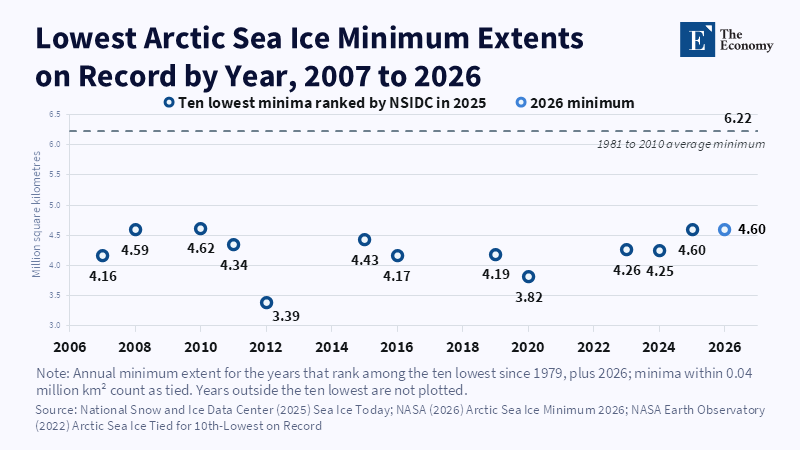
In time, it will probably be ice that allows more ships to use more northerly routes. This would reduce Russia's legal argument. One Russian researcher stated this in 2020 when writing for the journal Arctic and North that if more ships began to travel the more northerly route. Russia would not have any legal argument to stop them. As they would be navigating through the EEZ and outside the 200 NM line, they would be in International waters. NASA has stated that the ice we have is getting younger each year. This will allow more ships to take advantage of the Northern route. For ships that have the ability to navigate these northern areas they will have to decide if they want to apply for a permit or just not ask.
Permits Bind Merchant Ships While Warships Sit Outside the Ice Clause
So far, there have been a lot of permits issued to merchant ships that wish to travel the Northern Sea Route. The Bellona Foundation has counted that there were 1312 permits given out to 975 ships last year. 100 of which had foreign flags on them and a third of those foreign-flag ships had no ice class which is worrying, as this is what Russia is using to justify their laws. You must provide your ice class information and your Polar Ship Certificate. If they deem your ship doesn't meet their requirements, you will need to hire an icebreaker. Or they can deny you passage. Foreign companies have complied with these rules. But researchers at Clingendael believe that it's starting to have political ramifications. Every ship that complies without objection makes Russia’s rules look more settled, even if their legal basis is weak.
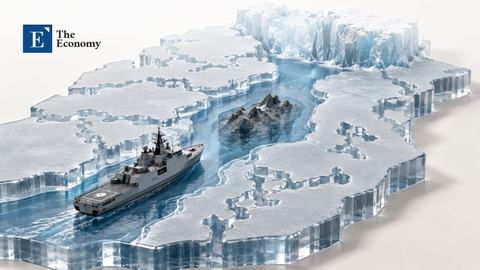
When it comes to warships, Russia's own diplomats have admitted that these laws do not apply. Article 236 of the UNCLOS exempts warships and government ships from environmental laws, including Article 234. Russia's Foreign Ministry has stated that its laws on the Northern Sea Route do not apply to warships. The Norwegian Centre for the Law of the Sea said in June 2026 that Russia has corrected its position. Russia has also created a law to stop foreign warships from entering its internal waters. This law was passed on 5th December 2022. Federal Law Number 510-FZ requires a country to ask permission 90 days before they want to enter the Northern Sea Route. Only one foreign ship can be in this area at any time. Submarines must be surfaced and flying their national flag and they can stop foreign ships from passing at any time.
This only applies to the area between the baselines that Russia created. They cannot control any ships in the territorial sea or the EEZ. There hasn't been a U.S. warship that has traveled from Asia to Europe through the Northern Sea Route. The Clingendael Institute has also stated that if an ally decided to travel this route. They would have to use Russian services. So it would be hard to pull off a Freedom of Navigation Operation here.
China Backs Freedom of Navigation on Paper and Russian Permits at Sea
In 2018, China published its Arctic Policy white paper. It stated that China is a near-Arctic country and wants to develop the Arctic through the creation of a Polar Silk Road and they will respect the laws of Arctic Countries when it comes to their jurisdiction. That these routes should be governed by UNCLOS and international law. Allowing all countries to navigate these routes. They also stated that any disputes should be solved under International Law. This leaves the question of whether they believe there is a dispute. They did not state that they support Russia's view of the Northern Sea Route being a national waterway. If you read between the lines, they are saying that Russia can control these waterways to the extent that UNCLOS allows.
China has allowed its ships to apply for permits to travel through the Northern Sea Route. All 7 Sea Legend ships that will be travelling the China Europe Arctic Express have received a permit from Rosatom. There were 15 Container ships that transited the Northern Sea Route last year. Most went to and from China and Western Russia. 1 went to Felixstowe. Trade between Chinese and Russian ports was 5.4 million tonnes last year which is close to 15% of all cargo that travelled the Northern Sea Route. Rosatom’s chief executive told the Russian outlet Expert in September 2026. China and Russia have created a subcommittee to help develop the Northern Sea Route. They met for the second time in Harbin in October 2025 and have already begun working together on security. Chinese Coast Guard vessels travelled to the Arctic in 2024 and were tracked by the U.S. Coast Guard through the Bering Sea.
China may not be as supportive of freedom of navigation in the Arctic as is thought to be. They have created their own law that states that foreign military ships must receive permission from their government before entering their territorial sea. The U.S. has been protesting this since it was created. They also consider the Qiongzhou Strait off the coast of Hainan to be their internal waters. A researcher looked at Chinese and Russian laws that control the movement of foreign ships in 2022. Specifically looking at Warships. How far can China influence the governance of the Northern Sea Route? From what is stated in Chinese law, they want their merchant ships to be able to travel freely. But not sure about military ships. They would not want to see a U.S. ship transit through the Vilcksky strait, as this would undermine their own laws.
Sanctions Have Narrowed the Northern Sea Route to a Two-Country Arrangement
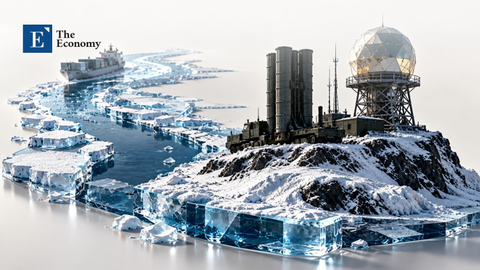
Russia has been proud to announce that the number of ships transiting the Northern Sea Route is growing and Rosatom has predicted that cargo will increase by 14% this year. But looking at the data, down from the 2024 record of 37.9 million tonnes, nowhere near the 80 million tonnes that President Putin wanted in 2018. Transit cargo was only 3.2 million tonnes. A CNN analysis found that all eight oil tankers making full transits directly to China in 2025 had been blacklisted by the United States. It is becoming more of an international route for sanctioned Russian Oil to get to China.
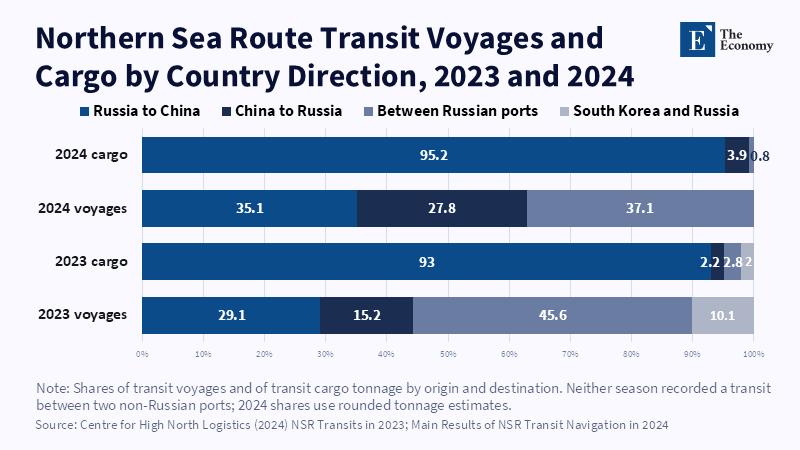
Sanctions have stopped many Western companies from using the Northern Sea Route. MSC, Maersk, CMA CGM and Hapag-Lloyd have all signed the pledge to not use the Northern Sea Route. Many European companies are also on the list of Russia's Shadow Fleet which could make companies wary of doing business with any Russia-related ships. Arctic LNG 2 has been selling to China. They received their first shipment in August 2025 and by June 2026, it had sold 41 cargoes to Beihai in China. According to Reuters, they have lowered prices by 30-40% to try to attract Chinese Buyers.
As of now, it seems like this will continue to happen as long as the Northern Sea Route is not being used by other countries. If Sea Legend were to expand their voyages or if Chinese shipyards build more ice-class ships. China may then take a more active role in the governance of the Northern Sea Route. Russia needs China more than it did in 2018 which gives China more influence. Ship owners and Insurance Companies should know that they will need permission from Russia to navigate the Northern Sea Route and if a country decides not to allow Russia to control this route. It will probably be China.
The views expressed in this article are those of the author(s) and do not necessarily reflect the official position of The Economy or its affiliates.
References
Associated Press (2024) ‘Chinese and Russian coast guard ships sail through the Bering Sea together, US says’, Associated Press, 1 October.
Centre for High North Logistics (2026) Overview of NSR Transit Voyages as of September 30, 2026. Bodø: Nord University.
CNN (2026) ‘How the Northern Sea Route is bringing China and Russia together’, CNN, 14 August.
Council of the European Union (2025) Council Sanctions 41 Vessels of the Russian Shadow Fleet. Press release, 18 December. Brussels: Council of the European Union.
Gudev, Pavel A. (2020) ‘The Northern Sea Route: problems of national status legitimization under international law. Part II’, Arctic and North, December.
Interfax (2026) ‘Rosatom expects cargo traffic along Northern Sea Route to rise 14% in 2026’, Interfax, 1 September.
Liu, Nengye and Solski, Jan Jakub (2022) ‘The Polar Silk Road and the future governance of the Northern Sea Route’, Leiden Journal of International Law, 35(4), pp. 853-866.
National Aeronautics and Space Administration (2026) Arctic Sea Ice Minimum 2026. Greenbelt, MD: NASA Scientific Visualization Studio.
Reuters (2026) ‘China lines up second LNG terminal for sanctioned Russian cargoes’, Reuters, June.
Solski, Jan Jakub (2026) ‘Charting the future of Arctic shipping: why navigational rights in the Northern Sea Route matter?’, NCLOS Blog. Tromsø: UiT The Arctic University of Norway.
State Council Information Office of the People’s Republic of China (2018) China’s Arctic Policy. Beijing: State Council Information Office.
Todorov, Andrey (2023) New Russian Law on Northern Sea Route Navigation: Gathering Arctic Storm or Tempest in a Teapot? Cambridge, MA: Belfer Center for Science and International Affairs.
Vakhrusheva, Ksenia (2025) Vessels on the Northern Sea Route. Vilnius: Bellona Foundation.
van Loon, Karen, Verschoor, Youri, Bekkering, Ben and Valkenet, Chloé (2026) Cold Passage: The Northern Sea Route between Legal Ambiguity and Strategic Competition. The Hague: Clingendael Institute.
Working across research, policy, and data-driven analysis, the Editorial Board ensures that published pieces reflect a consistent institutional perspective grounded in quantitative reasoning and long-term structural assessment.