The AI Bubble Must Be Contained Before It Becomes a Bet on Hegemony

Working across research, policy, and data-driven analysis, the Editorial Board ensures that published pieces reflect a consistent institutional perspective grounded in quantitative reasoning and long-term structural assessment.
Authored On
Modified
Hidden AI lease debt now exceeds Big Tech’s reported debt
Strategic value protects data centers, not their bondholders
Regulators must map who owes what before any bailout
On July 21, 2026, Nikkei Asia published a figure that does not appear on any balance sheet. Alphabet, Microsoft, Amazon, Meta and Oracle have accumulated about $1.65 trillion in off-balance sheet liabilities, mostly data center leases that have not yet been commissioned and contracts for processors that have not been delivered, an amount eight times that four years ago and more than the roughly $1.35 trillion in debt that the same companies officially display. The public debate about the AI bubble usually revolves around valuations, earnings multiples and whether models will ever bring in enough revenue to amortize their costs. The Nikkei finding shifts the burden to another point. The value of technology remains an open issue, while the allocation of the bill, in case expectations are disappointed, has already begun to be decided in footnotes of quarterly statements that few read and even fewer add up.
Two Schools of Thought on Who Pays for the AI Bubble
The first school considers a bailout with public money almost a foregone conclusion. The Political Economy Research Institute at the University of Massachusetts at Amherst argues that the investment boom has already transferred much of the risk to bond markets and private credit and that a government with such close ties to companies in the sector will come under severe pressure to absorb losses as soon as they occur. The argument rests on a Bain & Company account from 2025: to justify investments of about $500 billion a year, annual AI revenues must reach $2 trillion by 2030 and even with generous cost savings, Bain estimated that about $800 billion would be missing. On October 7, at the Forbes Global CEO Conference in Singapore, Ray Dalio added the monetary dimension, warning that rising interest rates and the volume of borrowing for infrastructure could pierce the bubble and that strong technology is not necessarily a good investment at current prices.
The second school rejects the very analogy with the financial bubbles of the past. In its view, artificial intelligence has become a field of power competition between Washington and Beijing and funding will continue for strategic reasons regardless of whether yields confirm valuations, so a 2008-style collapse that would require a bailout will never happen, since neither government is going to let the flow of capital dry up. The most honest version of the same school accepts that public money may be needed and considers the cost acceptable. OpenAI’s chief financial officer said this almost openly in November 2025, when she spoke of a federal guarantee on chip loans and described AI as something very close to a national strategic asset. The statement was retracted within a day and the White House AI adviser responded that there would be no federal bailout, without that response changing anything about why the issue was raised in the first place.
Why the Hegemony Argument Cannot Be Dismissed
Bubble rhetoric often overlooks that the companies at the center of the boom are already making money. Microsoft announced on April 29, 2026 that its AI business exceeded an annual revenue rate of $37 billion, an increase of 123% within a year, while Azure was growing at a rate of 40% and the quarter’s net profit reached $31.8 billion. In the labor market the impact is also measurable. Stanford’s Digital Economy Lab, leveraging data from the largest payroll software provider in the United States, found that the employment of 22- to 25-year-olds in the occupations with the greatest exposure to generative AI fell by 13% in relative terms since the end of 2022, while their more experienced colleagues in the same positions remained stable or increased. A technology that is already changing the way companies hire new graduates is hardly considered a mirage, even if its economic viability at today’s scale remains unconfirmed.
The geopolitical side reinforces the same conclusion. In July 2025, the White House released the action plan titled “Winning the Race,” and the following month the U.S. government acquired a stake of about 10% in Intel. In August 2025, China’s State Council set a goal for the penetration of intelligent agents and devices to reach 70% by 2027. Moody’s noted in August 2026 that Tencent’s capital expenditures in the quarter to June increased by 176% to 52.8 billion yuan and that the financing of Chinese infrastructure is increasingly coming from government debt, sovereign investment vehicles and bank lending. When both governments define the field as a struggle to be won, a voluntary retreat by either side seems unlikely and in this narrow sense the school of hegemony is right that the bubble will hardly burst from an abrupt cessation of state support.
The weakness of the argument lies in what exactly strategic value protects. When the telecommunications bubble collapsed, Global Crossing filed for bankruptcy in January 2002, while its submarine cables continued to carry traffic for years under new owners, who acquired them at a fraction of the cost of building them. The infrastructure survived and the damage was paid for by creditors. Strategic logic justifies keeping data centers running and not losing the computing power already installed. From there to protecting the bondholders of a special purpose vehicle in Louisiana is a long way and a government that confuses the two ends up insuring private leverage with a national security label, without ever having seen the entire bill it signs.
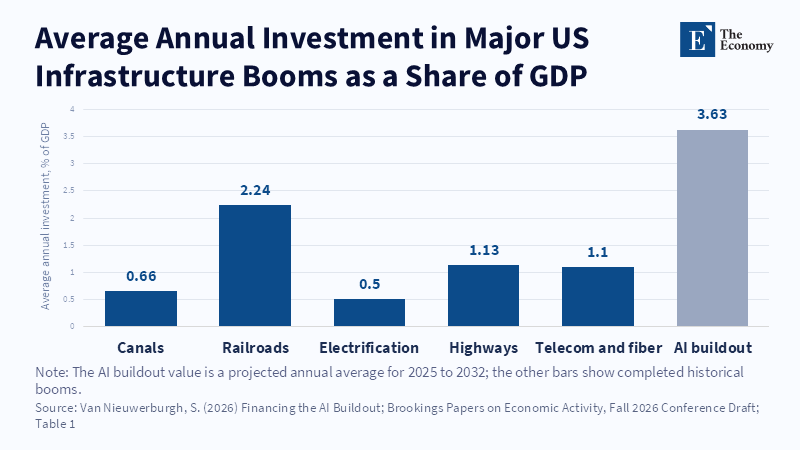
Hidden Debt Would Deepen the Blow
In March 2026, the Bank for International Settlements gave a name to the phenomenon. In its Quarterly Review, it described them as “shadow borrowing” consortia and special purpose vehicles that build or purchase data centers, borrow from private credit funds and institutional investors, service debt from large tenant rents and often carry guarantees from investment-grade rated companies. Banks participate through credit lines to the same vehicles, which according to the BIS opens up new channels of shock transmission, such as refinancing pressures or the activation of guarantees at the worst possible time. An accompanying bulletin from the BIS itself records that private credit funds granted over $40 billion in loans to AI-linked companies in 2025, compared to about $3 billion in 2010.
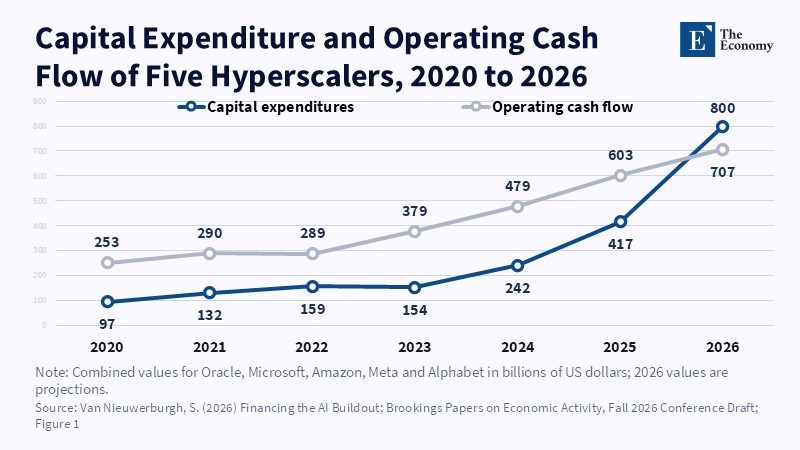
Meta’s case shows how the scheme works in practice. In Louisiana, the company owns just 20% of a joint venture with Blue Owl Capital for a data center campus now estimated to cost more than $50 billion, while, according to the Nikkei, it has guaranteed to cover investor losses if the installation is deemed unnecessary and the lease is terminated. Meta’s total off-balance sheet liabilities are estimated at $420 billion, almost three times its recorded debt. Oracle’s stood at $273.3 billion at the end of May 2026, about thirty times more than four years ago, largely tied to the Stargate project that the company is developing alongside OpenAI and on July 9 S&P Global Ratings downgraded its rating to BBB-, one notch above the speculative category. Accounting rules keep leases on data centers not yet in operation in the footnotes and transfer them to the balance sheet as soon as operations begin, meaning that leverage appears smaller at the exact interval when the bet is placed and inflates sharply at the interval when it should start to pay off.
Nor is the visible debt negligible. According to a Reuters analysis of London Stock Exchange Group data, Alphabet, Amazon, Meta and Oracle had issued nearly $194 billion in bonds by July 7, 2026, 79% more than the entire previous year’s $108 billion and Goldman Sachs expects the same four companies, along with Microsoft, to reach $250 billion this year and $400 billion in 2027. Of the 91 comparable bonds they issued this year, 78 traded in July at yields above those of the issue and Goldman is now linking that corporate debt offering to upward pressure on long-term U.S. Treasury yields. SpaceX is looking for $40 billion to buy Nvidia chips, while its thirty-year bonds have fallen to about 85% of their face value. A blow to this system would not stay with shareholders. It would pass to insurance companies and pension funds that hold investment-grade papers and from there to the borrowing costs of the U.S. Treasury itself.
Regulators Need to Know Who Owes Whom
In September 2008, the Federal Reserve granted AIG an $85 billion line of credit in a matter of days, without knowing exactly which counterparties depended on the company’s credit default swaps and much of the political outrage that followed stemmed from this very ignorance, since where the money ended up became known months later, when the damage to public trust had already been done. For today’s boom, this experience is of practical importance. The speed and cost of an intervention, if ever needed, depend on whether regulators know in advance who owns the facilities, who owes the debt and how much capital each has to absorb losses before the problem is transferred elsewhere. Today no authority publishes a single map of these exposures and the Nikkei has had to reconstruct the 1.65 trillion from footnotes in documents filed with the U.S. Securities and Exchange Commission, a task that should be regularly performed by a supervisory mechanism rather than a newspaper.
The Securities and Exchange Commission may ask each listed company for a single table of leases not yet commenced, residual value guarantees, equipment purchase commitments, refinancing schedules and concentration in individual tenants, so the data can be compared across companies without private research. The Financial Stability Oversight Council can map banks’ credit lines to special purpose vehicles and bonds that end up in insurance companies’ portfolios. For those who manage pension funds and insurance reserves, the issue is simpler and more inconvenient, because a bond secured by a data center gets its rating from the tenant’s solvency. At the same time, much of the collateral consists of processors that may have lost value long before the bond matures, if the architecture of the models changes or cheaper generations of chips appear.
Rules for Support Must Come Before the Hegemony Bet
None of this requires construction to be stopped. Containing the AI bubble means defining from now, while the market is still willing to finance, what form government support can take if it is ever needed. Walter Bagehot’s principle of lending freely only to solvent institutions, against good collateral and at a high interest rate, translates here into something concrete, namely a rule that any federal guarantee, loan or participation in AI infrastructure is accompanied by full disclosure of off-balance sheet exposures and by equity that absorbs losses first. A post on a social network that there will be no bailout carries much less weight than a law that sets out under what conditions there can be and as long as the U.S. government owns shares in Intel and describes the industry as a matter of national security, the markets will price an implied guarantee whether it is written somewhere or not.
The Nikkei number was for the last quarter before the July earnings releases and the results coming up at the end of October are likely to push it up. The 1.65 trillion won’t stay in the footnotes forever. Every time one of Stargate’s centers in Texas, New Mexico, Michigan or Wisconsin goes live, the corresponding lease goes to the balance sheet of Oracle, a company that S&P already places one notch above the speculative category. If competition with China keeps funding open, that debt will be recycled for years. If it doesn’t keep it, the decision on who will pay it will be made within hours, by people who currently don’t have a single table to see where it stands.
The views expressed in this article are those of the author(s) and do not necessarily reflect the official position of The Economy or its affiliates.
References
Aldasoro, I., Doerr, S. and Rees, D. (2026) ‘Financing the AI boom: from cash flows to debt’, BIS Bulletin, no. 120. Basel: Bank for International Settlements.
Bain & Company (2025) Bain’s Technology Report 2025. Boston: Bain & Company.
Board of Governors of the Federal Reserve System (2008) Press release on American International Group, 16 September. Washington, DC: Federal Reserve.
Brennan, A. (2026) ‘“Debt Burden Overshadows Growth Prospects”: U.S. Big Tech Credit Risk Surges Amid AI Investment Race, OpenAI IPO Stalls as Uncertainty Mounts’, The Economy, 29 July.
Brynjolfsson, E., Chandar, B. and Chen, R. (2025) Canaries in the Coal Mine? Six Facts about the Recent Employment Effects of Artificial Intelligence. Stanford, CA: Stanford Digital Economy Lab.
Duffy, C. (2025) ‘Why OpenAI went into crisis PR mode Thursday’, CNN Business, 6 November.
Eren, E., Krohn, I. and Todorov, K. (2026) ‘Financing the AI infrastructure boom: on- and off-balance sheet borrowing’, BIS Quarterly Review, March. Basel: Bank for International Settlements.
Hansbrough, T. (2026) ‘“Borrowing to Fund AI Investment”: U.S. Big Tech’s Debt Buildup Puts Upward Pressure on Corporate Bond and Treasury Yields’, The Economy, 8 October.
Intel Corporation (2025) Intel and Trump Administration Reach Historic Agreement to Accelerate American Technology and Manufacturing Leadership. Press release, 22 August. Santa Clara, CA: Intel Corporation.
Microsoft Corporation (2026) Earnings Release FY26 Q3, 29 April. Redmond, WA: Microsoft Corporation.
Murugaboopathy, P. (2026) ‘Hyperscaler debt binge pushes yields up as investor demand cools’, Reuters, 29 July.
Polychroniou, C.J. (2026) ‘Taxpayers Must Not Be on the Hook for Bailing Out the AI Industry’, Truthout, 2 September.
Proactive Investors (2026) ‘Ray Dalio warns AI bubble is nearing a breaking point as debt and rates rise’, Proactive, 7 October.
State Council of the People’s Republic of China (2025) Opinions on Deepening the Implementation of the “Artificial Intelligence+” Action. Beijing: State Council.
TechNode Global (2026) ‘Chinese hyperscalers ramp up AI spending but trail US rivals: Moody’s’, TechNode Global, 28 August.
The White House (2025) Winning the Race: America’s AI Action Plan. Washington, DC: Executive Office of the President.
Van Nieuwerburgh, S. (2026) Financing the AI Buildout. Brookings Papers on Economic Activity, Fall 2026 Conference Draft.
Yamada, K. (2026) ‘Five US tech giants’ hidden debts soar to $1.65tn on opaque AI funding’, Nikkei Asia, 21 July.
Working across research, policy, and data-driven analysis, the Editorial Board ensures that published pieces reflect a consistent institutional perspective grounded in quantitative reasoning and long-term structural assessment.
Similar Post