“Profiting Even on Borrowed Money”: Big Tech Rushes Into Corporate Bond Market, Betting on Data Center Profitability

Anne-Marie Nicholson is a fearless reporter covering international markets and global economic shifts. With a background in international relations, she provides a nuanced perspective on trade policies, foreign investments, and macroeconomic developments. Quick-witted and always on the move, she delivers hard-hitting stories that connect the dots in an ever-changing global economy.
Authored On
Modified
Big Tech pours into the corporate bond market to finance AI infrastructure
AI-related investment-grade bond issuance nears USD 400 billion
Data center profitability expected to remain strong amid persistent supply shortages
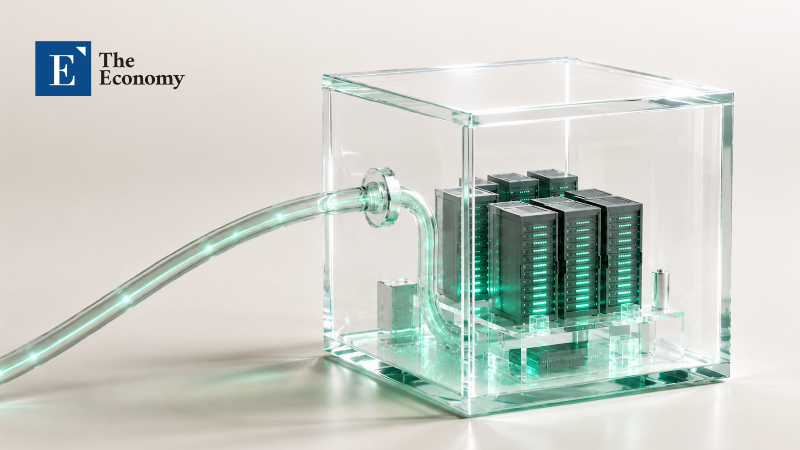
Global Big Tech companies led by Amazon are ramping up corporate bond issuance to finance artificial intelligence (AI) data center construction. As competition in AI intensifies, companies are facing enormous capital requirements to secure data centers, power infrastructure, and semiconductors. With demand for AI computing expected to outpace supply for the foreseeable future, the strong profitability of data centers is widely expected to offset the burden of massive borrowing and support continued investment expansion by major technology firms.
Amazon Issues Another Round of Data Center Bonds
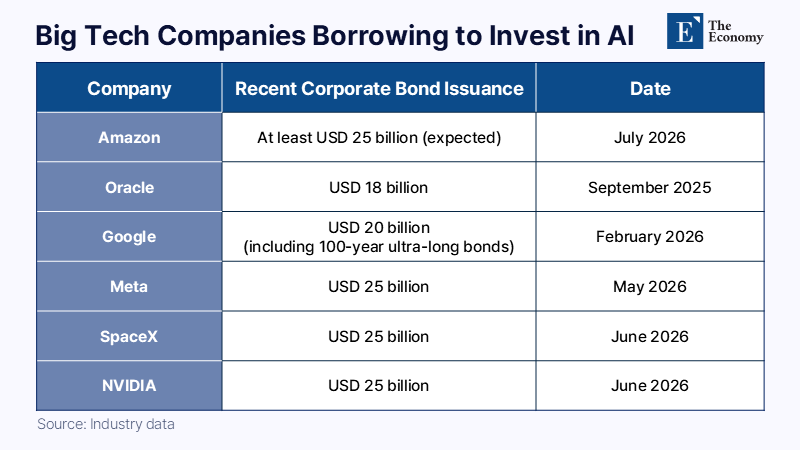
According to Bloomberg and other foreign media outlets on July 9 (local time), Amazon recently disclosed its fundraising plans in documents filed with the U.S. Securities and Exchange Commission (SEC). The offering is expected to total at least USD 25 billion. Initial price discussions for the longest-dated bonds, maturing in 2066, reportedly indicated a premium of approximately 1.45 percentage points over comparable U.S. Treasury securities.
Although Amazon stated in its filing that the proceeds would be used for general corporate purposes—including debt repayment, acquisitions, investments, and capital expenditures (CapEx)—industry observers believe much of the funding will ultimately support AI infrastructure expansion and related investments. Scaling generative AI services requires massive spending on data centers, power infrastructure, servers, graphics processing units (GPUs), and proprietary AI chips. Amazon is not only an e-commerce giant but also the owner of Amazon Web Services (AWS), one of the world's largest cloud providers. As demand for AI model training and inference continues to rise, so too does the need to expand cloud infrastructure.
The latest debt sale follows a series of major bond offerings by Amazon. Since last year, the company has actively embraced a debt-financed investment strategy by tapping the bond market. While Amazon has traditionally been regarded as a company with exceptional cash-generating capabilities, the AI race has pushed capital expenditure requirements to unprecedented levels. Securing data center sites, electricity contracts, cooling systems, server equipment, and semiconductor supplies now requires enormous investment.
Including funds raised this year, Amazon's cumulative corporate bond issuance has reached approximately USD 89 billion. In March alone, the company issued USD 37 billion in U.S. dollar-denominated bonds—the fourth-largest corporate bond sale in U.S. history—and an additional USD 17 billion equivalent in euro-denominated bonds. It followed that with approximately USD 3.4 billion equivalent in Swiss franc bonds in May and roughly USD 15 billion equivalent in Canadian dollar bonds in June. In addition, on June 8, Amazon secured USD 17.5 billion in loans from Citibank, Bank of America (BofA), JPMorgan, HSBC, Wells Fargo, and other financial institutions.
From Hyperscalers to Nvidia and SpaceX, Debt-Financed Investment Gains Momentum
Amazon is far from alone in issuing large volumes of corporate bonds to finance AI data centers. Most major technology companies are aggressively entering the bond market to avoid falling behind in the AI race. This year, Meta and Oracle each issued approximately USD 25 billion in bonds to fund AI-related investments—amounts exceeding what they had previously raised in single equity offerings. Alphabet, Google's parent company, raised USD 20 billion in the U.S. market before issuing additional Swiss franc-denominated bonds just days later. Alphabet's U.S. dollar bond offering consisted of seven maturities, with the longest 40-year tranche due in 2066 initially discussed at a spread of 1.2 percentage points over U.S. Treasury yields. Strong investor demand subsequently compressed the spread to 0.95 percentage points.
Only days later, Alphabet expanded its fundraising by issuing bonds denominated in Swiss francs and British pounds. In the United Kingdom, it drew particular attention by issuing GBP 1 billion equivalent in 100-year corporate bonds. Although century bonds have occasionally been issued by sovereign borrowers during periods of ultra-low interest rates, they remain extremely rare in the technology sector. Previous issuers of 100-year bonds in the U.K. market include the University of Oxford, Electricité de France (EDF), and the Wellcome Trust. Among technology companies, IBM issued 100-year U.S. dollar bonds in 1996, roughly three decades ago.
Beyond hyperscalers, Nvidia—the world's most valuable publicly traded company by market capitalization—also sold USD 25 billion in bonds on June 15. It marked Nvidia's first bond issuance since 2021. The company had initially planned to issue USD 20 billion in bonds with maturities ranging from two to 30 years but reportedly increased the offering to USD 25 billion after investor demand surged. SpaceX, Elon Musk's aerospace company, also entered the corporate bond market on June 23 by selling USD 25 billion in bonds, just 10 days after raising USD 85.7 billion through what became the largest initial public offering (IPO) in history and debuting on the Nasdaq on June 12.
Morgan Stanley estimates that AI-related investment-grade bond issuance in the United States will total between USD 350 billion and USD 400 billion this year. That would represent more than double last year's AI-related corporate bond issuance and account for over 15% of the projected USD 2.3 trillion in total U.S. investment-grade bond issuance for the year.
Indeed, on Feb. 5, Amazon projected AI-related CapEx of USD 200 billion this year, the highest among hyperscalers. Google initially guided for between USD 175 billion and USD 185 billion before raising its forecast to between USD 180 billion and USD 190 billion. Microsoft likewise increased its spending plan from USD 185 billion to USD 190 billion. Meta also raised its projected capital expenditures from USD 115 billion–USD 135 billion to USD 125 billion–USD 145 billion, while Oracle set annual AI-related investment at approximately USD 50 billion.
AI Infrastructure Generates Stable Returns That Offset Borrowing Costs
The willingness of Big Tech companies to shoulder enormous debt burdens reflects the strong profitability of AI data centers and the structural shortage of computing infrastructure. GPU server rental services can recover investment costs rapidly as long as utilization rates remain consistently high. According to industry simulations, a server equipped with eight GPUs requires an investment of approximately USD 300,000. Assuming an annual utilization rate of 70% and an hourly rental fee of USD 70, such a server could generate roughly USD 400,000 in annual revenue and USD 250,000 in EBITDA, implying a payback period of only about 1.36 years.
Current market conditions also favor data center operators. According to global real estate services firm CBRE, while data center capacity across major North American markets expanded 33% year over year in the first quarter, vacancy rates fell to record lows. Vacancy stood at just 0.3% in Northern Virginia—the world's largest data center hub—1% in Atlanta, and 1.8% in Dallas-Fort Worth. In Dallas-Fort Worth, 88% of the 716.7 megawatts (MW) of capacity currently under construction had already been pre-leased before completion. The figures suggest that much of the new capacity is effectively absorbed before entering the market, despite the rapid pace of supply growth.
Demand for AI computing also continues to outstrip supply growth. Moody's projects that capital expenditures by six major U.S. hyperscalers will reach USD 700 billion this year. However, the credit rating agency also expects AI computing supply to remain unable to satisfy demand until at least 2027, given the lengthy timelines required to secure power infrastructure and construct new data centers.
Longer-term demand projections further reinforce the case for massive investment. McKinsey estimates that global data center capacity demand will triple by 2030, with AI computing accounting for approximately 70% of total demand. The consulting firm projects cumulative investment requirements of USD 6.7 trillion, including USD 5.2 trillion dedicated specifically to AI data centers. Even under a more conservative scenario in which demand growth slows more than expected, AI-related investment requirements would still total approximately USD 3.7 trillion. As enterprise AI adoption accelerates and computing demand shifts from model training toward inference and AI agent deployment, overall consumption of computing resources is expected to continue rising.
Anne-Marie Nicholson is a fearless reporter covering international markets and global economic shifts. With a background in international relations, she provides a nuanced perspective on trade policies, foreign investments, and macroeconomic developments. Quick-witted and always on the move, she delivers hard-hitting stories that connect the dots in an ever-changing global economy.
- Previous French Fighter Jet Rafale Exposes Technological Gap in Next-Generation Race, While South Korea’s KF-21 Also Faces Daunting Challenges Despite Expected Spillover Benefits
- Next “Cooperation Endures Despite Merger Collapse” Honda and Nissan Double Down on SDV Strategy by Bringing Parts Affiliates Into the Fold
Similar Post