Japan Rural Depopulation Is No Longer a Rescue Mission

Working across research, policy, and data-driven analysis, the Editorial Board ensures that published pieces reflect a consistent institutional perspective grounded in quantitative reasoning and long-term structural assessment.
Authored On
Modified
Japan rural depopulation is now an infrastructure problem
Tokyo’s efficiency gains come with rural service loss
Policy needs planned concentration, not symbolic revival

Japan currently faces around 9 million abandoned homes. This isn’t a consequence of misguided housing policy. This is a snapshot of a nation that continued to build, pave, subsidize and overpromise well after the local population began to thin. Approximately one in every fourteen inhabitants has an unoccupied house. More than just an issue of real estate, this is evidence that the depopulation of Japan’s rural areas has shifted from a warning to a matter of infrastructure. The old bargain is beginning to crumble. Much as some previous generations of Japanese have moved to the larger urban centers where employment, healthcare, education and the availability of choice are much more abundant, young people are doing the reverse by moving to the major hubs, such as Tokyo, Osaka and Nagoya. The obvious reasons are that they can get jobs and grow up in schools with friends, while for the older generations, the considerations include the range of shops, the proximity to graves, their memories and the lack of transportation options. The fact that most leave, die, or rent out their homes is becoming secondary; the policy question today is no longer: how can we arrest the decline everywhere? But can we feel honored about respecting the dignity of people who have adapted before us and a lesson to be learned from life's unavoidable tuition.
Japan's rural depopulation is an urban planning decision
Japan's rural depopulation is too often discussed as a birth-rate story, when the real issue is place. Japan didn't simply age-it aged unevenly. By the end of 2024, people aged 65 and over constituted 29.3 percent of the total population, while those aged 14 and under (vitality sources) constituted 11.2 percent. That is more than two and a half times as many older people as young people. Not very cheerful news nationwide, but local maps look worse. Population declined in 45 of Japan's 47 prefectures in 2024. Tokyo still grew. Saitama still grew. And all the many "core" rural and outer suburban municipalities saw their age structures age out so that the age groups needed to sustain births, shops, schools, clinics and tax revenue had vanished.
Therefore, the debate should not be: "How to restore the countryside," but "what type of settlement system Japan can no longer afford and, implicitly, should fight for." Japan's net domestic inflow in 2024 was almost 80,000 persons, showing that location still influences economic choices. They are not abandoning their hometowns; they are following orders within a system that values density. Dense cities have higher-quality labor markets and more extensive public service. But the same unavoidable tide empties out the centers that raised those workers. A village cannot keep the school open on history books. A clinic cannot stay in business on views. A bus can only break even with festival audiences. Rural Japan depopulation has become an urban planning option because the country must choose where real public guarantees still exist.
The clock is also running ahead of the many public strategies still working on false assumptions. The full year 2024 saw Japan record only 686,061 births while suffering over 1.6 million deaths. And the natural-difference clock was almost 920,000 in less than 12 months. National projections forecast the population to slump toward 87m by 2070, with nearly 39% aged 65 or more. They do not imply every part of the country will decline so uniformly; they tell us the old model of covering the landscape with the same basic promises is an impossible proposition. A declining country can be rich, safe and just, but it cannot sustain abundant-to-dayservices settlement systems originally designed for a large, young population. The genuine dilemma is between planned reduction today and a much more painful shutdown tomorrow.
The efficiency case cannot remove the duty of care
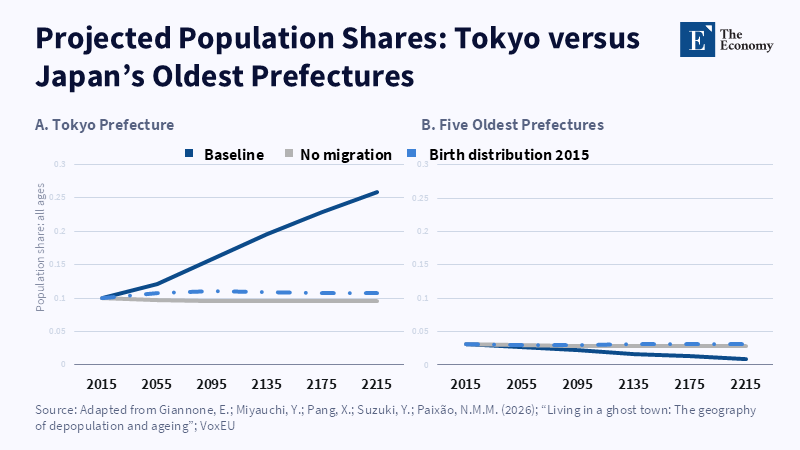
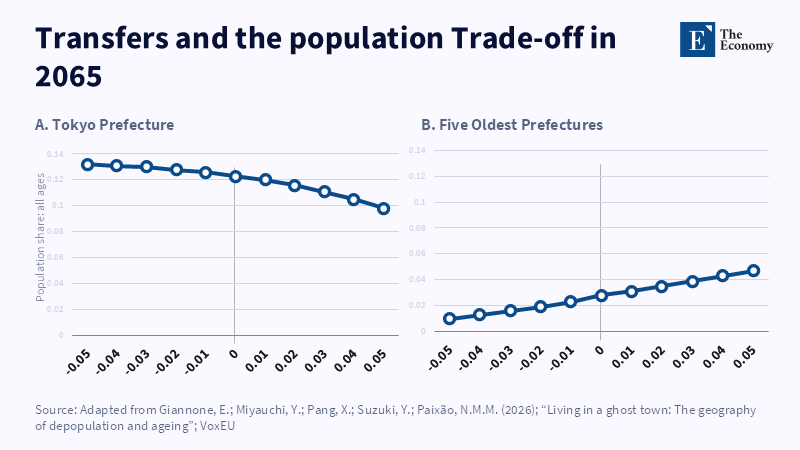
The hard efficiency case is real. Small areas cost more per person. Roads, water, snow plows, emergency shelters, city hall -these don’t get proportionately smaller as populations dim. Many services have fixed costs. When young families depart, local tax bases decline; when shopping malls shut down, everyday life gets more difficult. When care workers follow, older ones pay the price, traveling more for their daily needs. These dire economic simulations of aging Japan have long shown that moving more people to places with high productivity can raise averages and reduce some costs of nationwide services. Those same models also show that directing large cumulative resources-over decades-to aging prefectures can slow local decline, at a measurable national cost. It is entirely feasible to bribe citizens to hang on. It is simply expensive.
But efficiency for efficiency's sake is not policy. It is a spreadsheet with no funeral, no winter road, no fragile person waiting for a nurse. The depopulation of rural Japan leaves behind work. Abandoned homes decay. Neglected fields turn to bushes. Forest boundary lines creep inward. Incidents involving bears have increased as farms are left untended and the experienced hunters who shot them grow older. This is not a wildlife problem. It signals that retreat without support generates new dangers. It also undermines ad hoc caregiving networks. The neighbor who would visit an infirm octogenarian may have drifted off. The corner shop that would have kept an eye on missed visits may have shut down. A care-willing nation cannot tell an old lady who has never been anywhere else to simply go to Tokyo. It must design a secure transition from scattered settlements to supported settlements.
Cost-consciousness requires that the path also be honest about who pays. That keeping a clinic open in a few hundred old people’s village is economically sensible in one hillside of a valley and inconceivable in another where the next best clinic is at twenty minutes and cannot be very different, depends in part on whether snow and floods and fire risk are high in the former places where the road is owned and not in the latter, where it could be side-stepped. A cost-conscious approach is not to rank lives by cost. It is to rank public promises with regard to future life by outcome. Japan's rural depopulation needs a new obligation-of-care test: use first where money is spent to secure safety, ease of access, security of other services and preserve assets; not where it is spent to secure life-extension, or to reduce the feels-like-fate or the time-horizon of what is inevitable.
Japan's rural depopulation is crying out for triage, not nostalgia
The overarching policy position is triage, not rescue. Triage sounds a bit unfeeling, but is more honest than today’s bizarre mishmash of symbolic handouts, 'one shot' tourism schemes and half-baked revival plans. Japan needs to rapidly categorize declining places into three typologies. There are still towns with station connections, hospitals, schools, existing housing supplies and access to good employment. These can be prime candidate places to receive brute environmental and economic investment. There are villages that should be able to stay populated and provide simple needs-directed services by shared infrastructure, scheduled public services, remote services and mobile health and care workers. There are places that need managed retreat, land banking, demolition support services, forest-edge management systems and incentives for people to leave. The point is not to wipe out communities. The point is to say not to spread small amounts of public money across places with increasingly divergent life chances.
This test is important as Japan already possesses many 'revival' mechanisms; however, they lack discipline. The example of closed schools illustrates both the potential and the danger. When approximately 450 schools are abandoned annually and thousands of closed school facilities have been repurposed since 2002, projects can work. They allow decent buildings to remain active; they can bring visitors and provide space for small firms in places with limited cash flow. However, a repurposed school alone does not constitute a population strategy. It can only be part of a population strategy within an integrated services map. An isolated school entrance doesn't substitute a maternity ward, or existing care staff, or a regular transport operation for seniors.
All of this will have a direct impact on teachers and local capital too–but not because school can rescue towns. In many shrinking areas, the school is the last joint amenity. Closure can feel like signing the death warrant for the village. Keeping it open, with too few kids, can trap those children in narrower peer groups and draw teachers into fragile local systems. The key solution is to take regional learning design seriously. Better anchor schools will need to be linked to smaller communities through transport, digital infrastructure, after-school provision, adult learning and cultural reuse of the old school site. An abandoned campus can be a retiree's day center, a skills laboratory, a work-from-homeplex, or an emergency planning center. It should not be a shrine to population loss. Education assets have to be a living map.
A just compact future for Japan's rural depopulation
A fair compact policy would start with a national promise of minimum access, not maximum settlement. Every local community would have access to emergency provisions, nourishment, mobility, heat, digital access and social contact. That would not mean every hamlet would have every service; it would mean the government would have clarity over the time, distance, cost and quality thresholds that every resident of Japan should face. Once those are established, resources can be allocated to those places that can meet them most efficiently. Anchor towns would get funding for housing repair, GP integration, care training, child services and transport links. Fragile settlements would get mobile teams, home adaptations and clear voluntary movement offers. Derelict buildings would get inheritance costs, demolition support, reconversion screening and value intake conversion. Letting buildings decompose is not respecting the past.
The most likely argument is that this sacrifices rural Japan. It doesn't. It sacrifices false hopes. Culture is not committed to aging alone in dangerous houses. Local communities are not committed to using up money on dead roads while the care system is left in the dirt. A second argument is that Tokyo is not an answer to age because high urban densities bring falling fertility and unaffordable homes. Yes, but that underlines the need for planning over drift. If Japan is to accept more urbanization, it must make its cities more family-friendly. More homes by jobs; less half-hour commutes; childcare in step with the working day; open space within reach of children and retirees. An efficient city without a family policy merely takes the decline to a higher level of concentration.
Rural policy must also stop implying that all places are a lifestyle choice. Lifestyle moots from tourism, remote working and foreign newcomers will support a few townscapes, but they cannot prop up a national habitation matrix. Youth will not inhabit a pretty hamlet where jobs, schools, clinics, shops and peers are not certain. Elderly seasoned people do not require image-making. They want transportation, heating, pharmaceuticals, food proximity and community. The criterion for Japan's rural non-belonging policy should be simple. Does the attempt still increase the daily uptake of those residing there? Does it diminish an existential service hazard? Does it bolster a strengthenable anchor? Does it rule land that has bungled constant human nurture? If not, the policy is just yearning for a budget line. These 9 million empty homes are the warning and they are also the bookkeeping. Each represents a private tragedy, but together they represent a public indecision– a postponement on a grand scale. The answer to Japan's rural exodus cannot be execution by neglect, nor can it be an indefinite cycle of Re-Esturian spectacle. Instead, the country needs a spatial contract toward a geriatric, diminished society. The plan must specify a limited number of towns that will be the focal points of regional life. It must provide secure access to those towns for all outsiders. It must facilitate moves of existing populations before they are compelled by a crisis to so move themselves. It must allow for the adaptive reuse of well-placed state structures only in the context of a clear strategy. And it must provide for the dignified, caring natural expiration of some communities. The objective must be yet another balanced, reasoned concentration of populations before it becomes a default of silence. The alternative is not between a city and a village; it is between an administered aggregation and a unmanaged disappearance.
The views expressed in this article are those of the author(s) and do not necessarily reflect the official position of The Economy or its affiliates.
References
BBC Travel (2025) ‘How school-stays are saving Japan’s dying villages’, BBC Travel, 26 June.
Giannone, E., Miyauchi, Y., Pang, X., Suzuki, Y. and Paixão, N.M.M. (2026) ‘Living in a ghost town: The geography of depopulation and ageing’, VoxEU, Centre for Economic Policy Research, 2 July.
Healthcare - Hospital Desk (2026) ‘Hospitals, Clinics & Care Providers Outlook 2026: Care Model Redesign, Margin Pressure, and the Institutionalization of Patient-Centered Delivery’, Healthcare Ranking, 31 January.
McBride, R. (2024) ‘In Japan’s ageing countryside, some villages face extinction’, Al Jazeera, 15 August.
Ministry of Education, Culture, Sports, Science and Technology (2021) Casebook on the Utilization of Closed Schools. Tokyo: MEXT.
Ministry of Health, Labour and Welfare (2025) Vital Statistics of Japan 2024. Tokyo: MHLW.
Murakami, S., Arranz, A. and Huang, H. (2024) ‘Bear attacks are rising in Japan. Aging hunters are on the front line’, Reuters, 3 December.
National Institute of Population and Social Security Research (2023) Population Projections for Japan: 2021 to 2070. Tokyo: IPSS.
Statistics Bureau of Japan (2024) 2023 Housing and Land Survey: Summary of Results. Tokyo: Ministry of Internal Affairs and Communications.
Statistics Bureau of Japan (2025) Current Population Estimates as of October 1, 2024. Tokyo: Ministry of Internal Affairs and Communications.
Statistics Bureau of Japan (2025) Report on Internal Migration in Japan: Annual Report 2024. Tokyo: Ministry of Internal Affairs and Communications.
Working across research, policy, and data-driven analysis, the Editorial Board ensures that published pieces reflect a consistent institutional perspective grounded in quantitative reasoning and long-term structural assessment.