Managed Interdependence Is the Price of Sovereign AI

Working across research, policy, and data-driven analysis, the Editorial Board ensures that published pieces reflect a consistent institutional perspective grounded in quantitative reasoning and long-term structural assessment.
Authored On
Modified
Managed Interdependence is the realistic path for middle powers
Local data centers do not equal sovereign AI
Real sovereignty needs leverage, exits and supplier choice

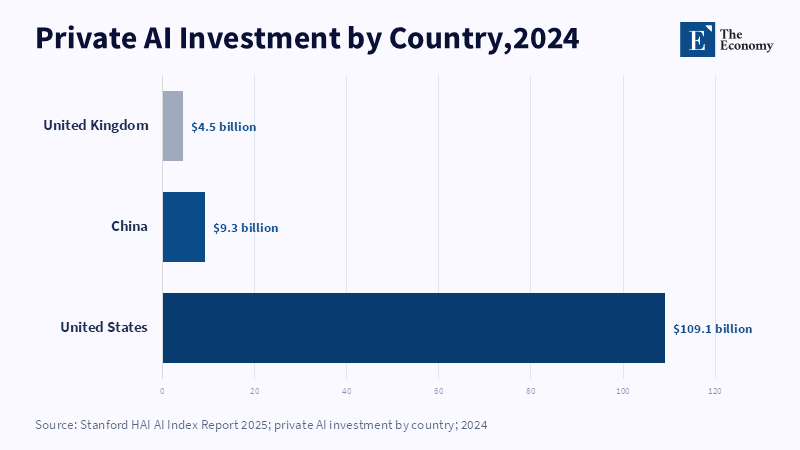
The clearest warning in the sovereign AI debate is not a slogan. It is a gap. In 2024, private AI investment in the United States totaled $109.1 billion; China attracted $9.3 billion and Britain $4.5 billion. In the same year, US institutions produced 40 notable AI models; Chinese institutions produced 15 and European institutions produced only three. That distribution should not suggest other states give up trying. It should suggest that the older promise of sovereign AI has become too tidy in the world that it describes. Managed Interdependence is the more honest framing. It recognizes that most states cannot own all layers from chips and cloud to models and data. It also turns away from passive dependence. The difficult question is not "Can a country do it alone?" It is "Can a country depend on others without being dominated by them?"
Managed Interdependence Starts Where Sovereign AI Myths End
The first policy shift is mental. Sovereign AI should not be a badge to be earned by hosting a national model or building a local data center. It should be a bundle of powers. A state needs the power to choose sources of supply, to defend data against hackers, to audit its systems, to switch vendors, to steer local uses, to grow its talent pool and to keep critical public services alive when diplomacy fails. Managed Interdependence hinges on that broader question set. It asks less dramatic but more pressing questions: which segment of the AI stack needs to be owned, which can be shared with trusted partners and which creates a chokepoint?
This reorientation is important because nowadays the economics of AI hit middle powers hardest-and hit them hardest for trying to imitate the giants. A frontier model requires rare people, rare data, the latest chips, abominable amounts of electricity and years of cash that can be burned in the interim. Building a data center takes half as long as wiring a national electricity grid. A frontier model requires software that people can get out of town faster than public-sector hiring processes can wrap up. Your model costs can be split in one nation while skyrocketing in another. A national program of heroic self-sufficiency can turn into a gaudy piece of scenery. It might appear sovereign from afar, once key controls are found to be held offstage. A wiser approach is limited reliance. If Managed Interdependence is to work, reliance should be identifiable, assessable, transfer-proof and constrained. This is a less ambitious promise, but a better one.
The pattern in UAE-India demonstrates this more than any abstract theory. One partner provides the capital and the worldwide AI agenda. The other provides the Atlantic level of market size, bright minds, rules and local data access. American-associated equipment and niche companies remain part of the package. That is not pure sovereignty. That is a tradeoff. India has the compute in India, under Indian rules. The UAE has a new role as an offshore infrastructure power. The United States still maintains many of its controls over chips, cloud connections and security standards. This is not severance from reliance. It is a new attempt at it. This is why it is significant. It transforms sovereignty from a statement of entitlement to a term of negotiations.
Managed Interdependence Is a Supply-Chain Contract, Not a Flag
The second policy change is to stop conflating location and control. A data center located within national borders may mitigate some elements of the risk. It can mitigate latency, reduce some privacy regulation issues, give greater comfort to the public and allow continuity. That said, it does not make the country sovereign if it imports the chips, rents the trained model, sets the updates, deployment and safety filters remotely and the cloud terms are subject to an alternate legal system. Local storage is not a crown. A country that stores under its own roof but rents the model, the toolchain and the accelerator supply has merely shifted one layer. This distinction should be at the heart of every sovereign AI initiative.
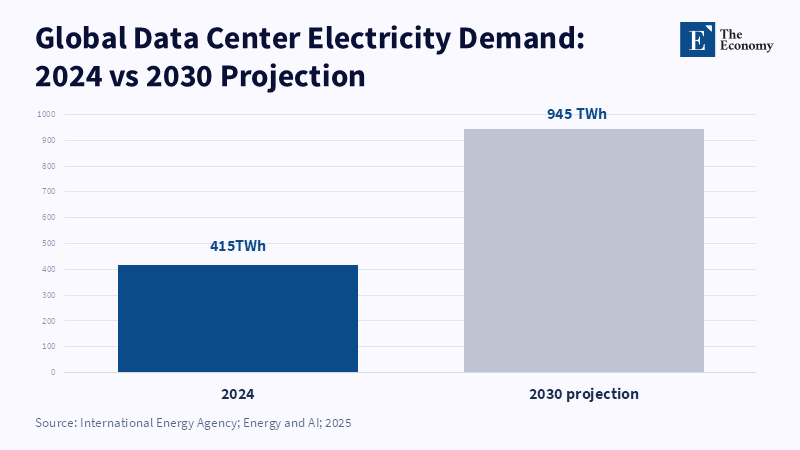
The figures speak for themselves. It has been reported that Nvidia commands nearly 80 percent of the high-spec AI chip market. Worldwide data center power consumption is forecast to more than double by 2030 to around 945 terawatt-hours. Accelerated servers, which are the machines most directly connected to AI, are expected to be responsible for much of that growth. The data isn't a sovereignty score. It is a warning sign. They reveal why a middle power cannot treat computing as an ordinary public procurement issue. Buying chips is not the same as securing sustainable access to them. Instigating rack installations is not the same as owning the software layer. Entering into a cloud agreement doesn't convert to geopolitical influence. The danger is in the relationship between these four scales.
The UAE offers both the promise and peril of this pattern. It has invested, whether from the sovereign, the energy state capacity, or through its state-linked firms, billions into AI both domestically and globally, including, allegedly, USD 148 billion since the start of 2024. It has used its state coffers, its energy state capacity and its state-linked firms to buy influence in a game where most nations remain price-takers. Its most decisive steps reveal, however, the speed with which sovereign plans can become the subject of intersectional trade-offs. Microsoft's investment in G42, the diminution of some symbiosis with China and the effort to conform to Washington's rules all reflect the same truth. Money can buy access, but it's powerless against gatekeepers. Managed Interdependence is credible only where leaders acknowledge that they remain. If they deny their limits, the pact will be weaker.
Managed Interdependence Needs Exit Rights, Not Just Local Data
The third policy shift is legal. Governments should negotiate AI arrangements as if they might always have to walk away. That means exit rights, portability rights, audit rights, source-of-supply disclosure, model performance reporting, escrow plans for critical services and clear rules for public-sector data. It means testing whether a government is capable of migrating workloads from one provider to the next without months of inevitable failure. This is not anti-American or anti-Chinese. It is core risk management. A nation must not act in bad faith to plan for poor incentives. Export controls, sanctions, trade battles, merger decisions and price shocks can all alter the terms of access-even a friendly partner may encounter political pressure to curtail supply. A robust contract regards this as routine, not as an insult.
The most apparent criticism is that this plan will slow the rate of uptake. Public agencies are already struggling to purchase and implement AI. Carpeting everything in rules of contract, interoperability tests and audits may be a recipe for further delay. The criticism is well-founded but misses the fundamental cost parabola. Affordable reliance is often affordably minimal only initially. Once public service is enveloped by one firm, one cloud spec, one data format, it is costly to switch. The provider is then selling nothing but performance, but possible relief from instability. This is how lock-in becomes a normative goal. Managed Interdependence should have an easy uptake for lower-risk uses; it should set more robust exit conditions for justice, health care, tax, defense and data-nationality systems. Speed should not be bought at the expense of future choice.
Canada and South Korea show why this matters outside the Gulf and India. At about C$200 billion, Canada's grand AI plan aims for about two-thirds of that in extra growth, 250,000 additional jobs and AI adoption going from just over 12 percent to 60 percent by 2034. It also centers issues of trust, privacy and sovereignty. South Korea has opted for a different approach, leaning heavily on its chip backbone, Korean-language models, a national AI computing center (of up to KRW 2 trillion) and envisaged private investment in AI of KRW 65 trillion from 2024 to 2027. Neither is seeking to own the global AI stack; instead, each is seeking to make clear choices on where they need to be strong. That is the challenge for middle powers.
Managed Interdependence Should Build Bargaining Power Before Crisis
The fourth policy shift is to assess sovereignty through bargaining power. The more AI sovereignty a country has, the more it can refuse, veto, switch, inspect, localize and co-develop without destroying its economy. This is not accessed through speeches, but through mundane assets. In-country technical teams. Public procurement capability. National test beds. Power commissioning. Data trusts. Shared compute pools. Open standards. Regional partnerships. Native language capacity. Trusted connections to multiple suppliers. These are not sexy projects, but they determine the tone of the negotiations. A country that is aware of its own workloads and possesses its own key datasets approaches a deal very differently from a country that only comes with a demand. It is able to ask sharper questions. It is able to refuse unfavorable terms. It is able to identify false hope early.
This also bodes well for the division of labor between middle powers. Not all countries should contract to build a frontier model. Several shouldn't bother. A few should aim at making a benign form of power to compute with. Others at state data governance, natural language varieties, safety testing, chips, cooling, evaluation, advantage-adding tools, regional cloud infrastructure. When is shared sovereignty feasible? When each partner has something hard to replace. When it looks precarious-when everyone else is in a race to reduce the number of other states-or when it looks stable, when the middle powers are holding and everyone else is ramping up to beat this country, it can't be quite so fragile. Managed Interdependence should be a layer-precise industrial policy. Find the one where you can keep building a difficult-to-replace crutch. Then leverage this strength to access what is hard to build alone. That is how small states exploit constraints.
The biggest hazard is the political one. Managed Interdependence seems sedate until an ally turns unreliable. The free-trade deal has already survived export controls, tariffs, sanctions, energy shocks and quick security-policy reversals. An administration might charge suddenly for AI access. China might, as well, with its hardware or algorithms. A platform might change terms because regulators, investors, or security agencies do so. In that instant, the state with purely domestic data centers will discover how little sovereignty is stored. The data center. The state that has the exit ability, many suppliers, many cultivars and regional partners will take a hit. But it will have options. Policy should be designed for that day, rather than the end state.
That's the point. Managed Interdependence is not a euphemism for capitulation. And it's not the rays of the secret AI future shining through. It is certainly not a set of skills that will empower a new kind of master. It is a practice of how to live in a world when control is halting and blind reliance is suicidal. Middle powers can at last stop promising the electorate a stack of machines they cannot make. What they can and should promise is something sharper and proven more effective: that they can rule out any foreign country, company, or power bloc from turning their national capacities into a tool of coercion. The investment gap will not be filled any time soon. America and China will remain in the lead in chips, interfaces, models and capital. The answer is not imitation. Instead, leverage. Go ahead and build those elements that generate leverage. Share those elements that cannot be built single-handedly. No state should assume that a platform in your capital city equals sovereignty.
The views expressed in this article are those of the author(s) and do not necessarily reflect the official position of The Economy or its affiliates.
References
Associated Press / Gillies, R. (2026) ‘Canadian Prime Minister Mark Carney warns foreign AI platforms can be used against Canadians’, AP News, 4 June.
Cherney, M.A. and Nellis, S. (2024) ‘Nvidia pursues $30 billion custom chip opportunity with new unit’, Reuters, 9 February.
International Energy Agency (2025) Energy and AI. Paris: International Energy Agency.
Joshi, S. (2026) ‘Early Lessons in the Pursuit of Sovereign AI’, Carnegie Endowment for International Peace, 17 June.
Low, T. and Low, H. (2025) ‘Singapore’s AI Strategy and the Limits of Digital Sovereignty’, Cambrian, 11 August.
Maslej, N., Fattorini, L., Perrault, R., Gil, Y., Parli, V., Kariuki, N., Capstick, E., Reuel, A., Brynjolfsson, E., Etchemendy, J., Ligett, K., Lyons, T., Manyika, J., Niebles, J.C., Shoham, Y., Wald, R., Walsh, T., Hamrah, A., Santarlasci, L., Betts Lotufo, J., Rome, A., Shi, A. and Oak, S. (2025) Artificial Intelligence Index Report 2025. Stanford, CA: Stanford Institute for Human-Centered Artificial Intelligence.
Sergie, M. (2025) ‘UAE touts $148B investment in AI’, Semafor, 7 November.
Varela Sandoval, F.J., Wilkinson, I., Krasodomski, A. and Wilkinson, R. (2026) How Middle Powers Can Weather US and Chinese AI Dominance: The Case for Sovereign AI Strategies. London: Chatham House.
Working across research, policy, and data-driven analysis, the Editorial Board ensures that published pieces reflect a consistent institutional perspective grounded in quantitative reasoning and long-term structural assessment.
Similar Post