The Free-Trade Coalition Can Survive America’s Retreat

Working across research, policy, and data-driven analysis, the Editorial Board ensures that published pieces reflect a consistent institutional perspective grounded in quantitative reasoning and long-term structural assessment.
Authored On
Modified
U.S. withdrawal would not end trade cooperation
The Zollverein shows why accession can beat isolation
A free-trade coalition needs open rules and domestic support

U.S. demand for imports, which constitutes about 14% of world imports, is substantial, but far from decisive. That simple reality should alter the discussion of the future of the international trading order. For American withdrawal would penalize its exporters, increase instability and diminish the norms Washington fought hard to establish. But withdrawal would not undo the economic benefits that other nations currently enjoy from their own trading and investment relationships. The only viable alternative to a global system dominated by an absent Washington is not toward protectionism on a major scale; it's toward a proactive free-trade coalition that makes accession more valuable than detachment. That network would be unable and unwise to seek at once to match U.S. access for every country in the system and to produce an authoritarian bloc opposed to the US. It should focus instead on fortifying markets, broadening access and preventing Washington’s withdrawal from becoming a contagious example of isolation. A movement may lose its leader, but it cannot survive a copycat rush into isolation.
The coalition forming around free trade is bigger than any one market
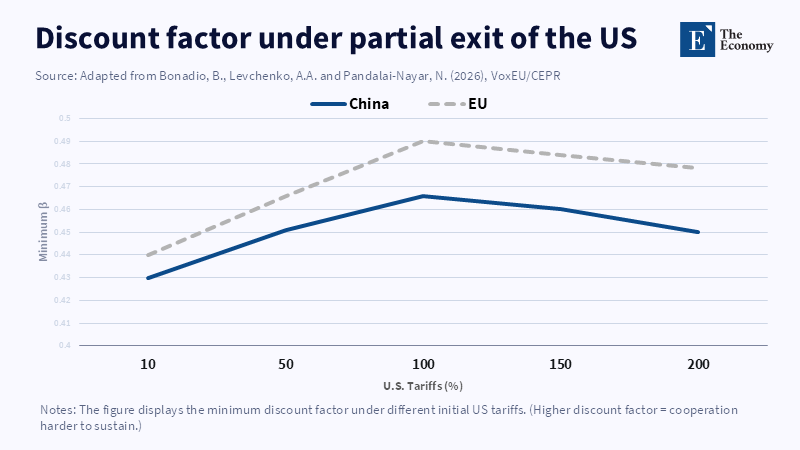
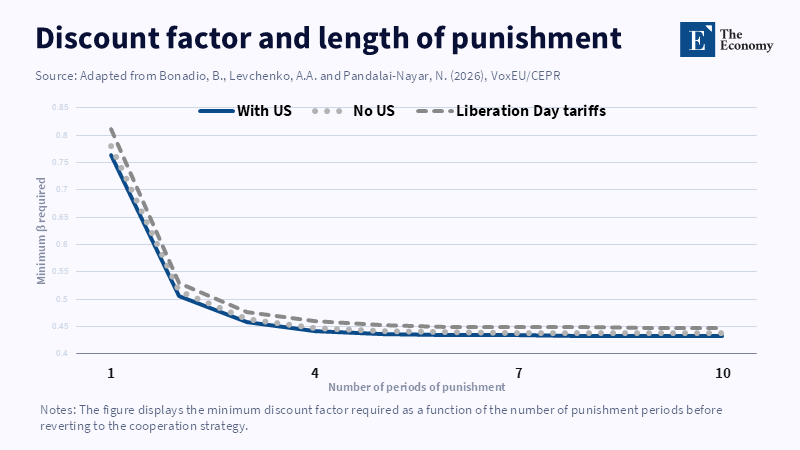
Trade cooperation is sometimes described as a falling row of dominoes: one significant power imposes tariffs, leading to counteraction by others, resulting in the collapse of the system. This explanation, though appealing, suffers from several problems. Trade is a web, not a simple linear order. Each nation has multiple trading partners, causing product-specific responses in bargaining. A model applied to forty-two economies shows that, if the United States were to exit the cooperative free-trade regime, the predicted optimal tariffs of China and the EU would only go up by about one-half of one percent. Moreover, it would influence the level of patience needed to sustain trade cooperation with only a minimal effect on the power of markets in the remaining major economies. It's primarily in the self-interest of the remaining nations to obtain market access for trade cooperation to be sustained; the benefits available to them from free trade institutions remain evident.
Trends in world trade affirm this broader view. Total world trade reached about $33 trillion in 2024, representing a 3.7% growth over the previous year with services trade growing by 9%. While trade in goods grew by 2%, exports and imports in developing countries grew by 5%. All this happened in a difficult period of a pandemic, a war in Europe, shipping disruptions and trade restrictions growing, an event which proves the world system's capacity to handle shocks. Although the slowing growth at the end of last year and high costs still show continued fragility of trade, the fact that it nonetheless managed to handle the crisis demonstrates that what the free-trade camp can do is to make use of this strength. It should regard the world as a dynamic, changing economic system rather than an audience hungry for Washington's return.
More granular evidence deepens the argument. In both trade and investment, it seems the trend is blurring borders. For instance, following Russia's invasion of Ukraine, the International Monetary Fund observed that intra-bloc trade had declined about 12% more than intra-bloc trade; for FDI, the margin was nearly 20%. China’s share of U.S. imports fell by eight percentage points between 2017 and 2023. But this new focus didn't eliminate trade activity, much of it simply transited through intermediary countries such as Mexico and Vietnam. Although these countries may be unable to conceal former dependencies behind new routes, it appears that they diligently preserved the integrity of the global supply chain. A key policy take-away should not be to laud rerouting, but to preserve enough open links so firms are better able to reconfigure with less compulsion to form cut-off regimes. Ultimately, the free-trade coalition requires and supports intermediary states, with clear origin measures, accessible customs information and actual capacity buildup, as opposed to superficial rebranding of borders.
The lesson from the Zollverein is not about destiny but accession
A brief history of the Zollverein, established by 18 German states in 1834, is instructive-but only when viewed from the correct perspective. It abolished customs between members, mainly allocated customs revenue on the basis of population, invested heavily in transport infrastructure to improve interstate commerce and, as an important technological advance, imposed tariffs on external regimes. It was not, despite the rhetoric of the age, an overt expression of universal 19th-century free trade by all European states; it was a pragmatic negotiation arrangement, largely dominated by Prussia. The fact that membership slowly grew over time indicates a network effect: markets increased in value as more links were integrated. For smaller parties seeking access, the benefits outweighed the costs: in terms of the requisite relationship, the prospect of access to neighbors, ports and routes simply proved more valuable than the prospect of isolation. That is the key lesson in terms of constructing a modern free-trade coalition: accession must be worth more than nonaccession.
Economics offers confirmation of this. A study of wheat prices in 14 German states showed that the beneficial economic effects of the formation of the Zollverein were much more significant when the choice of accession dates, rather than their being seen as determined by history, was taken into account. The sequenced way in which the member states joined altered the value of membership for subsequent applicants, just as the current negotiations threaten to do. While increasing the size of a market, streamlining customs procedures, establishing a universal standard product and introducing an impartial commission on disputes will make membership naturally more attractive and the incentive to join much more powerful, this analogy also serves as a reminder that a broad trade zone could turn into a fortress. Just as the Zollverein maintained an external wall even as it removed internal barriers, the present coalition must therefore focus on keeping accession open tather than building a new external barrier.
The Austrian exclusion example, by contrast, is still being viewed rather too simplistically. Austrian protectionism meant that Austria was neither part of the development of the emerging German customs union nor of the consequential reallocation of economic power among the new states. It was, but one more reason why the Habsburg Empire's turn of fortune post-1815 was the more precipitous: political instability, war, nationalism and fiscal burdens mattered far more than economics. Thus, the customs union is also a cautionary tale about the importance of rules and access; nations emanating from a common sphere of exchange suffer a loss of market access and, perhaps more profoundly, the ability to influence future standards, trade patterns and commercial relationships. The United States may yet continue to enjoy the economic muscle, have a larger financial role, be a focal point for worldwide security and technological regimes and be indispensable. But size in itself does not relieve the pressures of a dominant position not being used to help determine the next set of rules of the road.
A New Free-Trade Coalition Must Move Beyond Tariff Cutting
The blueprints for a comprehensive open free-trade coalition are already in place: over 380 regional trade deals are operational now, WTO figures note, as of June 2024. While these agreements show an almost ubiquitous desire to work together, they also indicate the inherent flaw. With so many overlapping, conflicting bargains agreed on such a complex set of product standards, customs processes and paperwork, the resulting maze of standards and paperwork can be especially difficult for smaller firms to navigate. Further steps will be needed for the next stage to be as mainstream as it is symbolic, to deliver effective access, not just a signature.
Members should reduce digital customs declaration obstacles, recognize mutually accepted inspections and scrap overlapping tests; simplify origin rules so firms can give proof of origin through shared, tamper-resistant data-sharing networks. They should liberalize public procurement piece by piece where possible, establish a swift panel to deal immediately with border-level conflicts. To make such policy moves as significant in actual business terms as the dramatic term tariff-cut announcements requires time to make a difference in daily lives. This is already more than enough movement in this direction. The EU and India have reached an agreement on a treaty covering two billion people and almost one-fourth of world output that will reduce or eliminate duties on more than 90% of trade goods and speed customs procedures.
Even with the somewhat wobbly progress between EU and Mercosur and the addition of Costa Rica to the CPTPP, even if these agreements are not unambiguously profound and legally binding and cannot be declared final until ratification and consummation, they are enough to suggest that large economies are not waiting for a grand accord but are instead developing a latticework of overlapping markets. This would seem to be still a role for a Global Free-Trade alliance in bringing about these linkages, which could be achieved by encouraging similar digital trade measures, standardizing norms for environmental standards reporting and aligning origin rules. In the longer term, deepening some of the existing linkages would be much more rewarding than simply retaliating with tit-for-tat tariffs. One report showed that the imposition of higher U.S. tariffs would dampen world real incomes by as little as 0.16%; an improvement in tariffs would have offset most of this effect.
A package of reforms that reduces non-tariff barriers and simplifies the current web of some 1500 rules would increase world real incomes by 0.45%; East Asian gains would reach almost 2% and 1.4% if the EU works more as a single market. These are model-based projections that place many assumptions and dependencies in the system, but they very convincingly signal that appearing to only copy protectionist measures will not restore lost market access, while reducing non-tariff barriers holds large potential. Instead of building walls in response to someone else's act of exclusion, the goal should be to find ways to enlarge the common territory for the export of goods, services, capital and data according to mutually agreed rules.
Domestic approval of the free trade coalition
And perhaps most damaging, the main Objection to continued free trade is the uneven distribution of its costs and benefits: Free trade's gains will be shared by consumers and corporations far and wide, while its harms will be localized and intensely concentrated-sweeping whole towns, companies, or industries. Any free-trade coalition must sincerely embrace this stark contrast in order to be durable. Governments can no longer treat domestic adjustment as a peripheral concern; free-trade agreements must always include immediate and adequate investment in the communities and workers affected, flexible skills-retraining programs, targeted regional investments and comprehensive income-insurance initiatives that kick in before any plant closures occur. Likewise, anti-trust policy must step in to prevent dominant firms from reaping the upside of cheaper imported inputs without passing those savings to their consumers or supporting the displaced domestic workers.
Those are not anti-trade measures, but the costs of genuine free trade. It's also worth noting that a 2024 WTO study found that tariffs target poorer households and small firms disproportionately. Protectionism can therefore target precisely those it claims to help and direct individual support is superior to a permanent increase in the cost of everything. The concern for security must be handled with as much care, if not more. Justified trade restrictions will have to be in respect of narrow restrictions on military hardware, strategic components and critical infrastructure parts, or a handful of applications of frontier technologies where security risks are clear and direct. Again, taking everything too broadly may lead to the flat-out destruction of the trading system. In whatever passing time, each such provision would have to be strong on detail, establishing the actual security concern, with a clear definition of which goods were affected, before setting a timetable for reassessment and establishing why alternate measures weren't effective. When justified, trade sanctions as temporary safeguard measures to combat an import surge should be subject to scrutiny.
Climate and labor standards are vital, but should not be sui generis trade barriers only conventionally admissible by the advanced economies. Widening levels of accepted standards will require some financial and technical help for these to be reached on the part of the least developed. First, a global free-trade coalition must be open to the U.S. and China and must not evolve into a masked political grouping. A union effect can be reaped without imposing a customs union, a single external tariff, or a super force if a common set of rules for access to the market, customs and resolution of disputes is adopted while keeping divergent views on foreign policies intact. The WTO can serve as the minimum common denominator while smaller groups of countries can afford to pursue more ambitious agreements at their own pace. Further, existing platforms can be kept active even during episodes of political tension, while new agreements must be open for accession on the terms of their entry without exploiting any "political" clause to exclude would-be partners. This preserves leeway and rules out another potential obstacle to the U.S. regaining entry on equal footing with the EU and Japan after decades of cooperation.
Meanwhile, 14% of U.S. demand must be on the table. So must the 86% demand elsewhere, which cannot be just cast aside. Whether the shape of the future trading order becomes steep protectionist slopes leading towards an avalanche of trade collapse, or a coalition of easily reached, coercion-resistant and open countries able to sustain lasting loyalty, depends entirely on how that 86% share of demand behaves. Will they follow U.S. protectionism towards the ledge, causing a free fall for the age-old world trading system, or work together to create an easily reached, coercion-proof, open partnership, committed on pain of future disintegration? That will require joint-compliance agreements, standardized custom procedures, effective dispute-resolving mechanisms, sound through-the-cycle adjustment programs and a firm commitment to mutual benefit. The goal is not to pass judgment on the United States or foretelling its impending demise; if free trade is to remain in existence, no one nation must be able to force all others to remain behind.
The views expressed in this article are those of the author(s) and do not necessarily reflect the official position of The Economy or its affiliates.
References
Bonadio, B., Levchenko, A.A. and Pandalai-Nayar, N. (2026a) ‘Falling dominoes? The impact of the US exit from free trade on the sustainability of trade cooperation’, NBER Macroeconomics Annual, forthcoming.
Bonadio, B., Levchenko, A.A. and Pandalai-Nayar, N. (2026b) ‘The impact of the US exit from free trade on trade cooperation elsewhere in the world’, VoxEU, 26 June.
Electric Prism, Inc. (n.d.) ‘A majority of states of the loose, ineffectual German Confederation form the commercially powerful Zollverein’, History Atlas.
Gopinath, G. (2024) ‘Geopolitics and its impact on global trade and the dollar’, speech delivered at the Stanford Institute for Economic Policy Research, 7 May. Washington, DC: International Monetary Fund.
Gordon, N.M. (2023) ‘German Customs Union’, EBSCO Research Starters: History. Ipswich, MA: EBSCO Information Services.
Hinz, J., Head, K., Mejean, I., Ornelas, E. and Schularick, M. (2025) An Alliance for Open Trade: How to Counter Trump’s Tariffs. Kiel Policy Brief No. 194. Kiel: Kiel Institute for the World Economy.
Keller, W. and Shiue, C.H. (2014) ‘Endogenous formation of free trade agreements: Evidence from the Zollverein’s impact on market integration’, The Journal of Economic History, 74(4), pp. 1168–1204.
Kumar, M. and Acharya, S. (2026) ‘Details of EU–India trade deal’, Reuters, 27 January.
Ploeckl, F. (2010) ‘The Zollverein and the formation of a customs union’, Oxford Economic and Social History Working Papers, No. 84. Oxford: University of Oxford.
Reuters (2026) ‘EU–Mercosur trade accord to apply provisionally from May 1’, Reuters, 23 March.
United Nations Conference on Trade and Development (2025) Global Trade Update: The Role of Tariffs in International Trade. Geneva: United Nations.
Wealth – Legal and Arbitration Desk (2026) ‘Top 20 sovereign dispute law firms 2026’, Wealth Ranking, 1 February.
World Trade Organization (2024) World Trade Report 2024: Trade and Inclusiveness—How to Make Trade Work for All. Geneva: World Trade Organization.
World Trade Organization (n.d.) Regional Trade Agreements Database. Geneva: World Trade Organization.
Working across research, policy, and data-driven analysis, the Editorial Board ensures that published pieces reflect a consistent institutional perspective grounded in quantitative reasoning and long-term structural assessment.