Hear It Enough, and It Becomes Real: Rethinking How Inflation Expectations Actually Form

Working across research, policy, and data-driven analysis, the Editorial Board ensures that published pieces reflect a consistent institutional perspective grounded in quantitative reasoning and long-term structural assessment.
Authored On
Modified
Media coverage volume shapes inflation expectations, mainly among politically neutral viewers
Partisan viewers barely shift; their channels already discuss inflation nonstop
Repetition matters most once personal experience stops predicting prices

Turkish inflation opened 2024 near 65 percent, climbed toward 75 percent by May and eased back to roughly 44 percent by December. Numbers like that translate into real behavior. They move minds and a recent household panel study out of Turkey shows exactly how: viewers whose favorite news channel talked about inflation more one month expected higher inflation the next, even after stripping out politics, location and personal experience. On its face, that's not shocking. Talk about rising prices often enough and people brace for more of them. What is surprising is who actually moved. It wasn't the audiences glued to partisan channels that mention inflation nightly. It was people watching politically neutral news, the ones with the least fixed opinion to defend. Repetition alone didn't do the work. Repetition landing on an open mind did. That distinction matters for anyone trying to manage what people believe. Think about the old theory that saying something enough times makes it true.
Repetition Explains Less Than It Seems To
The instinct that repeated exposure breeds belief is old and mostly right. Advertisers and propagandists have leaned on it for a century. Applied to inflation, the logic looks airtight: households don't read central bank statements. They watch the news and if the news keeps saying prices are climbing, viewers will keep expecting them to climb. For a long stretch, this barely mattered, because inflation itself hardly moved. Economists spent those years defending a narrower idea: hold inflation near 2 percent for long enough, hit that target consistently and public expectations settle into a groove that fits reality. Anchor the expectation and the loop closes on itself, stable beliefs supporting stable prices, which in turn sustain stable beliefs. Brookings researchers describe that anchoring logic plainly: once the public trusts inflation will average close to target, short-term spikes barely register in behavior and a central bank's job gets much easier. That equilibrium held for roughly two decades. Then 2020 through 2024 broke it.
Once inflation moved outside its normal range, the old shortcut for forming expectations stopped working too and people had to look elsewhere for a read on where prices were headed. Daily news was the obvious place. The Reserve Bank of Australia presented research in 2024 estimating that roughly three-quarters of households and trade unions form expectations mainly by extrapolating from their own recent experience of prices, adjusting only slowly whenever reality surprises them. The remaining quarter leans more on forward-looking information and that share grew sharply during the high-inflation years, rising among unions from about a quarter to more than two-thirds. People did not passively soak up whatever the news told them. They updated the way a careful forecaster updates: slowly, unevenly and more so once the old rules of thumb stopped delivering.
This matters for the "lie a hundred times" analogy the whole idea gets compared to outside economics. That analogy assumes a captive audience with no competing signal, which is roughly true for propaganda but not for household budgeting. A person watching their own grocery bill has a running, independent check on whatever the anchor on television is saying and that check doesn't disappear just because a story runs every night. So the honest version of the claim isn't that repetition manufactures belief out of nothing. It's that repetition fills a gap left open once personal experience alone can no longer answer the question of where prices are going, which is exactly the gap that opened once the old 2 percent anchor came loose. The Turkish data confirm the same instinct from a different angle. Coverage swayed expectations but mainly among audiences whose beliefs weren't already locked down by partisanship and mainly on the question of the future rather than the past.
What the Numbers Actually Show
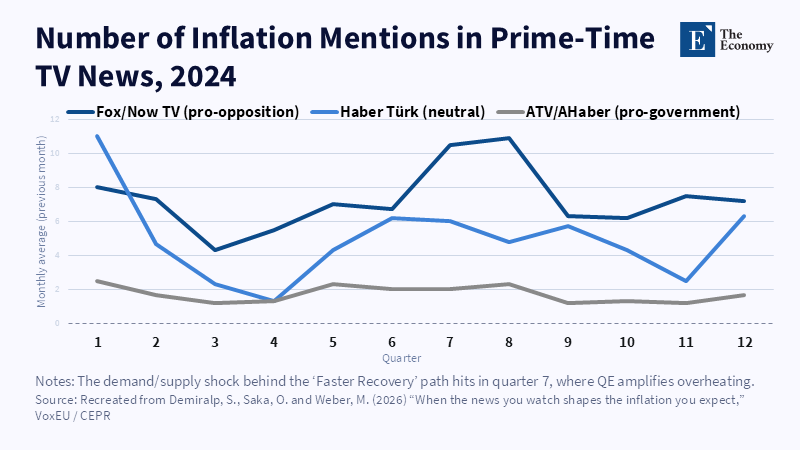
Turkey gave researchers an unusually clean setting to test this.. Annual inflation opened 2024 near 65 percent, spiked to about 75 percent in May and eased to roughly 44 percent by year's end, against a media field split cleanly along political lines. A 2026 study combined a monthly household panel from Koç University, text analysis of prime-time news transcripts and a randomized information experiment. Tracking the same people over time, the researchers found that a one-standard-deviation rise in how often a viewer's preferred channel mentioned inflation raised that viewer's own inflation expectations by roughly a tenth of a standard deviation. Modest but real and the effect held up even after controlling for what people already believed inflation had been doing. The effect showed up in forward-looking expectations, not in backward-looking perceptions of past inflation, which stayed anchored to what people actually experienced at the till rather than what they watched on television. Media shifted the forecast, not people's memory of past prices
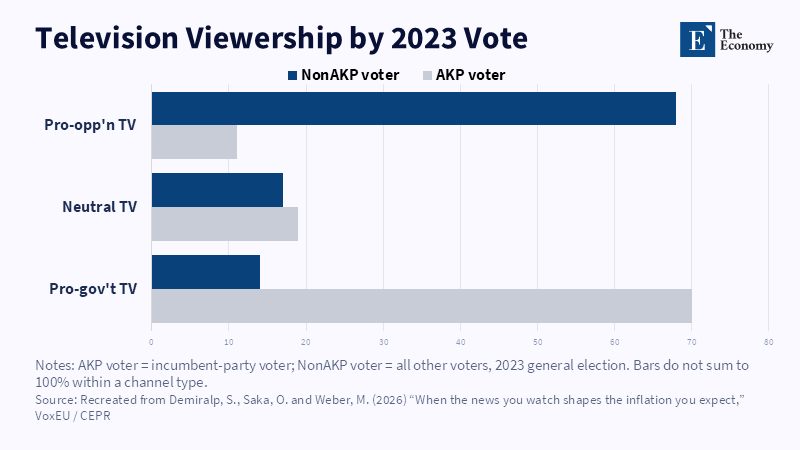
The sharpest finding split the sample by audience type. Viewers of politically neutral channels responded to coverage more than three times as strongly as the average viewer. Viewers of partisan channels, on either side, barely responded at all. A follow-up experiment explains why. Neutral-channel viewers updated their beliefs regardless of which outlet a story came from, consistent with weaker prior commitments and genuine openness to new information. Viewers of channels aligned with the governing party updated mainly when a story was credited to a source they already trusted politically. Opposition-aligned viewers barely updated at all, likely because their preferred channels already talk about inflation constantly, leaving little new ground left to cover. None of this maps perfectly onto other economies but the same pattern shows up elsewhere: the University of Michigan's Surveys of Consumers showed year-ahead inflation expectations climbing from about 3.3 percent in January 2025 to 4.5 percent within a few months, easing only gradually after that, alongside a news cycle heavy with tariff and conflict-driven price stories.
The Volume Problem, Not Pitch Problem
One detail complicates the simple "say it enough and it becomes true" version of this story: it was mostly the amount of coverage that mattered, not whether that coverage was upbeat or alarming. Once inflation gets mentioned at all, reassuring framing does little to cancel out the mention itself. That's an uncomfortable finding for anyone hoping a "good news, prices are cooling" segment might offset a news cycle otherwise full of grocery-bill complaints. It also suggests the Turkish channels that avoided the topic entirely, rather than trying to spin it, came out ahead, since raising the subject at all seems to plant the expectation regardless of framing. A skeptic might object that this whole picture just restates confirmation bias with extra steps or that a result from a high-inflation, profoundly polarized economy says little about calmer places like the United States or the eurozone. That objection has some force. The Reserve Bank of Australia's research points in the same direction using an entirely different dataset: households and unions extrapolate more slowly than older models predicted specifically when they suspect a shock is temporary, which is itself a form of paying closer attention rather than reflexively echoing headlines.
A second objection carries more weight. If only the least partisan, least locked-in viewers respond to coverage, does media exposure move aggregate expectations at all or just a shrinking sliver of a polarized public? The Turkish study offers a partial answer. Even a modest shift among politically neutral viewers translated into a measurable political cost: a one-percentage-point rise in expected inflation cut the likelihood of expressing support for the governing party by roughly 5 percent within that group. If beliefs held by even a fifth of an electorate can move outcomes at that rate, the same mechanism, in any economy where a meaningful share of the public still watches non-partisan news, isn't a rounding error. It may be the last channel left through which a shared economic reality can reach a divided public at all.
What This Means for the People Setting Policy
Central banks built their communications approach on the assumption of a roughly unified information environment: announce the target clearly, meet it consistently, trust that households absorb the same basic signal over time, however imperfectly. That assumption gets shakier every year that television and social media sort audiences into separate new diets. A policy statement written for a generic, attentive household does little for a viewer whose entire news diet comes from a channel that either drowns out inflation coverage or never lets the subject go. Central banks may need to treat communication less as a single broadcast and more as several parallel messages, delivered through the specific, trusted sources each audience segment actually watches. Credibility, on the evidence from both Turkey and Australia, travels with the messenger nearly as much as with the message itself, which is an uncomfortable adjustment for institutions built around one official voice.
For households, the practical lesson runs the other direction: it helps to notice when a belief about prices was formed by exposure rather than by evidence. Somebody expecting sharp inflation because their preferred channel keeps saying so isn't wrong to feel uneasy but that expectation may say more about a media diet than about a receipt. Awareness like that won't fix a fractured information environment on its own. It might blunt one of its worst effects, though: the quiet way what people watch becomes, almost indistinguishably, what they believe is coming next. For newsrooms themselves, there's a smaller but real obligation buried in these outcomes too. If mere mention moves expectations more than tone does, then treating inflation coverage as a routine, low-drama beat, worth a steady drumbeat of accurate updates rather than either alarm or silence, is not just good journalism. It's a form of monetary policy support that costs nothing and asks nothing of anyone's politics.
Turkey's own inflation rate has already fallen by more than 30 percentage points since its 2024 peak and household expectations are, unevenly, following it down. That is the real test of this whole mechanism, not whether repeated coverage can manufacture belief, since it plainly can but whether belief can still find its way back down once coverage dies down and attention moves elsewhere. Anchoring was never a permanent state that governments earn once and keep forever. It is closer to a habit, built through years of boring, consistent, low-coverage inflation and broken in a matter of months once prices stop cooperating. Rebuilding it will take the same two ingredients this whole episode surfaced: a central bank willing to keep meeting its target and a media environment that still leaves at least some of its audience open enough to notice when it does.
This article reflects the analytical judgment of The Economy Editorial Board and does not constitute policy advice or the official position of any affiliated institution.
References
Brassil, A., Haidari, Y., Hambur, J., Nolan, G. and Ryan, C. (2024) How Do Households Form Inflation and Wage Expectations? RBA Research Discussion Paper No. 2024-07. Sydney: Reserve Bank of Australia.
Demiralp, S., Saka, O. and Weber, M. (2026) 'When the news you watch shapes the inflation you expect', VoxEU Column, Centre for Economic Policy Research, 1 August.
Hunter, S. (2024) Inflation Expectations – Why They Matter and How They Are Formed. Speech to the Citi Australia and New Zealand Investment Conference, Sydney, 16 October. Sydney: Reserve Bank of Australia.
Lee, J., Powell, T. and Wessel, D. (2020) 'What are inflation expectations? Why do they matter?', Brookings Institution Commentary, 30 November (updated 27 June 2022).
University of Michigan Survey Research Center (2025) Surveys of Consumers: Inflation Expectations. Ann Arbor: University of Michigan.
Working across research, policy, and data-driven analysis, the Editorial Board ensures that published pieces reflect a consistent institutional perspective grounded in quantitative reasoning and long-term structural assessment.