The Expansion Premium: Why Startups Are Priced for US Growth

Working across research, policy, and data-driven analysis, the Editorial Board ensures that published pieces reflect a consistent institutional perspective grounded in quantitative reasoning and long-term structural assessment.
Authored On
Modified
Markets already price a startup's future U.S. expansion, rewarding CEOs with multinational track records
European founders now treat U.S. entry as a day-one strategy, not a later reward
Corporate tax design shapes which firms expand globally and who leads them

A founder who has never sold a product outside Berlin can still watch investors mark up the company's valuation the moment New York appears on a slide. That is measurable, not hype. New research on multinational firms found that companies destined to expand abroad already carry higher stock returns and higher market risk premiums years before they open a single foreign office and that the CEO's own résumé is one of the strongest predictors of whether the leap happens at all. Markets do not wait for the expansion. They price the option to expand. For founders and investors, that idea changes how ambition gets priced and it explains a pattern showing up constantly in early-stage rounds on both sides of the Atlantic.
The Expansion Premium Starts With the Person, Not the Product
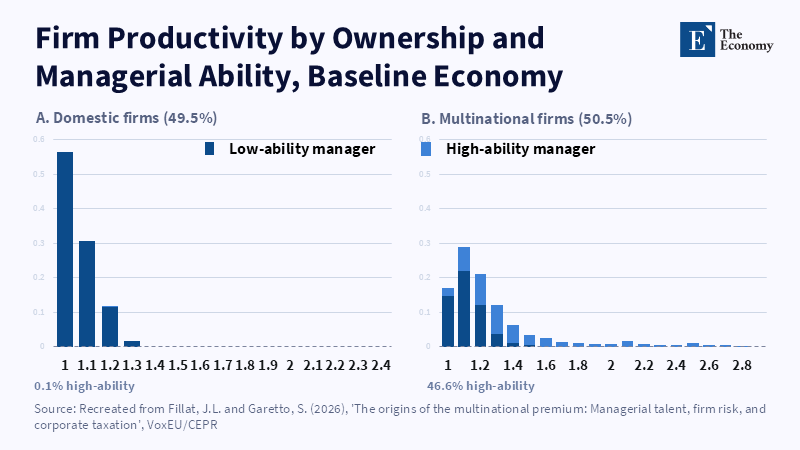
The instinct is to assume valuation follows revenue or at least a credible go-to-market plan. Often it follows the manager instead. In the corporate finance research behind this idea, a domestic firm run by a CEO who has previously guided another company from domestic to multinational status is about 5.2 percentage points more likely to make that same jump itself. Each additional country where that CEO has opened operations in a past role adds roughly 0.6 percentage points to the odds and since the average internationally experienced CEO has worked across some ten countries, the cumulative effect is not small. The mechanism is fairly mundane: expansion is expensive and a manager who has already solved the regulatory maze, the hiring problem and the distribution puzzle lowers the fixed cost of doing it again. Investors, who read résumés as closely as they read revenue lines, price that lowered cost in advance.
This is why a founder with an Ivy League undergraduate degree and a stated intention to enter the U.S. can command an unusual valuation before a single American customer signs a contract. It is not credentialism for its own sake. It is a proxy for the same thing the research measures directly: a lower expected cost of crossing the ocean and a market that opens up ten to twenty times over. A product that has only ever had to solve for one country's regulations, one language, one payment culture, carries a hidden tax when investors think about scale. A founder who looks capable of shedding that tax gets rewarded immediately, whether or not the expansion has actually started. Skeptics might call this noise, not signal. The same research shows the pattern holds even when the eventual multinational is, for now, operationally identical to a firm that never leaves home. The premium is forward-looking by construction.
Why European Founders Are Pricing in America From Day Zero
Nowhere is this dynamic sharper than in the transatlantic startup market, where the raw arithmetic makes the option value almost impossible to ignore. Early-stage American companies raise more than seven times the capital of European peers building comparable products, a gap that alone can stretch a valuation multiple three to seven times over depending on timing. PwC counted more than 3,000 unicorns worldwide by the end of 2023, worth roughly $27 trillion combined and found that more than half sit in the United States while fewer than one in ten sit in Europe, even after adjusting for the size of each economy. The reasons are structural rather than cultural. American venture capital is deeper both in absolute dollars and as a share of GDP, the U.S. operates as one coherent consumer and enterprise market instead of twenty-seven fragmented national ones and the country pours something like 3.5 percent of GDP into research and development, well ahead of European levels.
European founders have stopped treating U.S. entry as a reward for later-stage success and started treating it as a starting condition. Index Ventures' research, distilled through interviews with partner Martin Mignot, found that 64 percent of European startups now say they expanded into the U.S. at seed or even pre-seed stage, up from just 33 percent five years earlier.
Personio moved toward a U.S. strategy on the strength of investor and customer pull well before it had built out American operations; Pleo kept its engineering in Copenhagen while shifting commercial weight toward the U.S. after a $150 million-plus Series C; Algolia relocated its headquarters to San Francisco outright, rebuilding itself around the American developer ecosystem it wanted to serve. Spotify waited a decade to enter the U.S. and treated the delay as discipline; Klarna sprinted in and treated speed as the strategy. Both bets paid off, which says less about which approach is correct and more about how much latitude the market gives founders who at least have a credible transatlantic story.
None of this is really about market size in the naive sense, though size matters enormously. It is about the same option-value logic sitting underneath the CEO research. A startup that has proven product-market fit in Stockholm has not proven it will work in Ohio but the market has learned to treat that unproven leap as a real possibility worth paying for, provided the founder and the team look capable of making it. About 10 percent of EU startups relocate their headquarters abroad and roughly 85 percent of those choose the United States specifically, often through a partial corporate flip that keeps engineering in Europe while sales and leadership move west. That structure exists because the option to expand has become worth protecting even when the full commitment has not been made.
What this What This Means for How Investors and Founders Should Actually Behavefor how investors and founders, should actually behave
If the premium is priced on the option rather than the outcome, then investors evaluating early-stage companies are underwriting management quality and market-entry credibility as much as they are underwriting current traction. That has consequences worth taking seriously. U.S. venture firms already supply something like 42 percent of funding for high-growth European tech startups, according to venture capitalist Francesco Perticarari and that capital increasingly arrives with an implicit expectation that the company will build the operational muscle to eventually justify the premium it was granted. A founder who raises on the strength of a transatlantic story and then never builds the sales infrastructure, the compliance readiness or the local hiring needed to execute it is not just missing a growth opportunity. They are failing to deliver on the thing investors actually paid for.
For founders, the honest reading of the evidence isn’t to fake a U.S. presence before it exists; it’s to recognize that the market is already grading their optionality, so they should build toward it deliberately. That means auditing whether a product can function for an American buyer without a rebuild, since research shows enterprise customers there expect speed, compliance readiness and reference customers before they will engage seriously. It means being honest that the U.S. buyer's psychology is not the European buyer's psychology transplanted; sales cycles compress, procurement expects urgency and the pitch has to change shape, not just language. And it means recognizing that the premium a founder enjoys today, before any American revenue exists, is essentially a loan against a plausible future. Loans get called in.
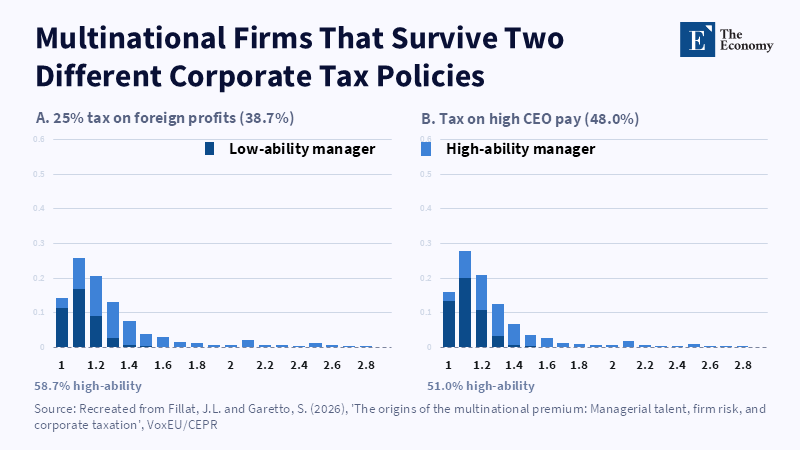
There’s a policy angle too, tied to the same research. If managerial talent is what actually unlocks the option value that markets reward, then policies aimed at large multinationals do not just tax profits. They reshape who gets hired to run companies and which firms even attempt the jump in the first place. Modeling a 25 percent tax on foreign profits showed the share of multinationals in an economy falling sharply, while a tax pegged to high CEO pay produced a much smaller contraction, because firms could simply hire less expensive managers to dodge the threshold. Whatever one thinks of either policy, the lesson for founders and allocators is the same: the price of ambition is not fixed and it moves with decisions made in Brussels and Washington as much as with decisions made in a founder's own office.
That is the real argument here. A valuation is never just a bet on what a company has built. It is also a bet on what a company's leadership has already proven, elsewhere, that it can build again. Investors evaluating the next transatlantic hopeful should ask less about the size of the American market the founder is chasing and more about whether the team in front of them has actually earned the option they are being paid for.
This article reflects the analytical judgment of The Economy Editorial Board and does not constitute policy advice or the official position of any affiliated institution.
References
Angela (2026) European Startups Building Transatlantic Growth Strategies. The European Business Review.
Baarsma, B. (2025) PwC Research: Why does the US have more unicorns than Europe? PricewaterhouseCoopers.
Clawson, T. (2025) Selling In America. How European Startups Can Bridge The Atlantic. Forbes.
Dominguez, R. (2025) Europe to America: The Startup Playbook for US Expansion. The VC Corner.
Fillat, J.L. and Garetto, S. (2026) The origins of the multinational premium: Managerial talent, firm risk, and corporate taxation. CEPR.
Working across research, policy, and data-driven analysis, the Editorial Board ensures that published pieces reflect a consistent institutional perspective grounded in quantitative reasoning and long-term structural assessment.