Labor Supply During Downturns: The Missing Causality Test in Monetary Transmission

Working across research, policy, and data-driven analysis, the Editorial Board ensures that published pieces reflect a consistent institutional perspective grounded in quantitative reasoning and long-term structural assessment.
Authored On
Modified
Downturns can push households to work more as income and security weaken
Monetary tightening may trigger the shock without uniquely causing the labor response
Policy should separate rate effects from broader household self-insurance during recessions

A married woman in the United States is about 60 percent more likely to enter the labor force in a month when her husband loses his job. A 2024 study found that pattern in decades of Current Population Survey data. The number points to a basic fact that when income becomes less secure, families often reconsider how much work they can take on. The trigger can be a lost job, weaker pay, higher debt bills or a lower chance of finding work. A wider frame may be more useful for understanding labor supply during downturns. Recent studies show that labor supply can rise for some groups after interest-rate increases. That finding matters. The label attached to it matters too. A rate hike may start the chain. The household response often comes after the loss of income or job security that follows. Describing the whole response as a monetary-policy effect can make the mechanism look cleaner than it really is. It can also hide a much older form of family self-insurance: when money gets tight, someone tries to work more. That pattern is older than modern central banking and wider than any one policy tool.
Labor Supply During Downturns Starts With Household Income
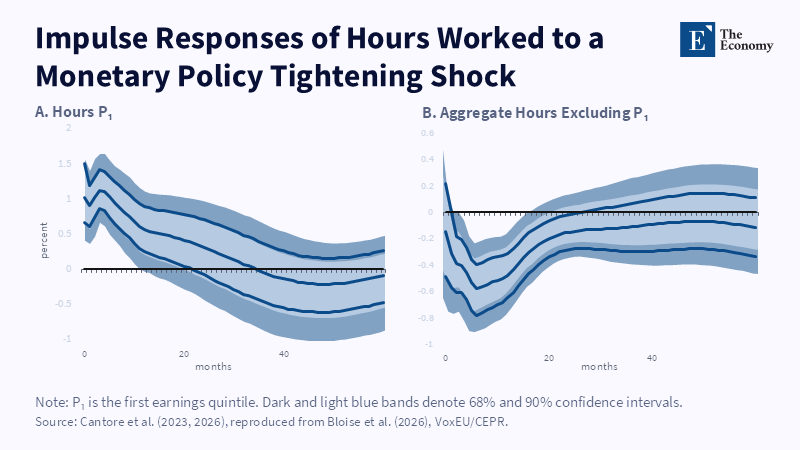
The new evidence breaks with a simple macro view of labor supply. In one U.S. study, lower-paid workers raised their hours after a monetary tightening even as total hours and earnings fell. An earlier version put the rise at about 0.5 percent one year after a 100-basis-point rate increase for workers near the lower end of the pay scale. The household logic is fairly simple. A low-paid worker has less room to absorb a loss of income. Savings are often thinner. Credit can be costly or hard to get. Spending may already be cut close to basic needs. More work can become one of the few ways to protect cash flow. The extra hours are a labor-supply response, although the immediate reason may be the loss of income or security. The rate decision matters because it can weaken pay, demand, hiring and household finances. The wish to work more grows out of that squeeze. Household budgets therefore deserve more attention when these results are interpreted alongside movements in the policy rate.
Family employment decisions make the same issue easier to see. The 2024 added-worker study found that the monthly chance of a non-working wife entering the labor force rose by 6 percentage points when her husband lost his job. The baseline rate was 9.8 percent. The same study estimated that the added-worker effect lifted married women’s labor-force participation by about 0.93 percentage points during recessions. None of this requires a central-bank shock. A household loses one source of work. Another possible earner becomes more active in the labor market. The path looks much like the one seen after monetary tightening. Lower expected income raises the value of another hour of paid work. The same response can follow many shocks that hurt family income. A rate hike can cause the first loss, yet the next step reflects a broad household reaction to stress. That is the key reason to widen the frame beyond monetary policy alone. It is a response to lost income, whatever event caused the loss.
The Causality Problem Is More Than a Technical Detail
The main empirical problem is simultaneity. A drop in demand can cut hiring, slow wage growth, lower job-finding rates and raise the risk of unemployment. At the same time, families hit by those changes may offer more labor. They may search harder. They may delay leaving a job. Labor demand is falling while desired labor supply for some workers is rising. The wage, hours and jobs seen in the data reflect both forces. The result is a fairly awkward identification problem. A central-bank tightening can sit at the start of the sequence. The rise in labor supply may still be a response to the weak economy that comes next. In industrial organization, price and quantity are jointly set by supply and demand. The same logic applies here. It is even harder in labor markets because supply is inferred from hours, search, entry and quits. A fall in quits may mean a stronger wish to keep working. It may also mean that outside jobs look scarce. In actual labour markets, the two explanations can easily overlap.
High-frequency studies help with this problem, though they do not close it. U.S. research using rate changes around Federal Reserve announcements finds that tighter monetary shocks raise search among people without jobs. They also reduce quits into non-work and pull some people toward the labor force. The effect is large. If those supply-side flows were held fixed, the fall in employment after a contractionary shock would be about twice as large. That is strong evidence that an unexpected rate move can start a causal chain. Yet the same research finds that a lower job-finding rate is a key reason people cling more closely to work. A lower job-finding rate is also a normal feature of weak labor demand. So an important question remains. The causal design can show where the shock began. It does not by itself show that the later household response belongs only to monetary policy. There is already some evidence that this behavior extends beyond monetary shocks. Graves, Huckfeldt and Swanson find similar movements in labor-supply flows following a broader demand-like business-cycle shock. That result makes it harder to treat the response as something unique to monetary tightening.
The Same Response Appears Outside Monetary Tightening
Family job-loss studies give a useful comparison because the original shock does not come from monetary policy. Research across 24 European Union countries and the United Kingdom found that women raised labor supply after a male partner became unemployed, though the average effect was fairly weak. Tax rates changed the size of the response. That finding matters because the shock was family unemployment, not a surprise change in interest rates. Research summarized by Nature Index reaches a similar broad view. Downturns, financial crises and other shocks can push secondary earners into the labor force to replace lost income. At the same time, poor job prospects can make other people stop looking for work. These forces run in opposite directions. Labor supply during downturns can rise for one group and fall for another. A single national figure can hide both stories. That makes the household budget more useful than a single macro label. It asks who lost income, who can add work and what rules shape that choice.
The Great Recession literature gives the same warning from another angle. Deep slumps change much more than the policy rate. They change unemployment duration, job ladders, wage setting, firm entry, worker moves and the value of search. Work on the Great Recession found severe damage across many of these margins. The 2024 added-worker study adds a family-level piece to that picture. Only 1.5 percent to 3.5 percent of married women entering the labor force in a typical month were added workers linked to a spouse’s job loss. Even so, the effect on married women’s participation and employment was meaningful in the aggregate. Small family responses can matter when they happen at the same stage of the cycle. This supports a wider name for the mechanism: household self-insurance under income stress. Interest rates can create that stress. Layoffs can create it too. So can a credit squeeze, a local industry slump, a cut in hours or a partner’s pay loss. What these cases share is pressure on expected household income.
Institutions Decide Who Can Work More
A household-insurance view also explains why the same macro shock leads to different labor responses across countries. Euro-area evidence finds that tighter monetary policy can increase moves from inactivity into unemployment and reduce moves back into inactivity. Both signs point to stronger attachment to the labor market. Yet the size of the effect differs a lot by country. The study also finds no clear pattern across income groups. The differences across countries matter because households do not face the same constraints. Labor supply during downturns depends on the rules and limits around each family. Taxes change the payoff from extra work. Childcare affects whether more hours are possible. Jobless benefits change how fast a second earner needs to look for work. Mortgage rules change how quickly a rate rise hits the monthly budget. One central bank can set one rate, while families feel very different shocks. A single “monetary labor-supply channel” can hide those gaps and make a conditional response sound general. Better policy analysis has to keep the household setting in view.
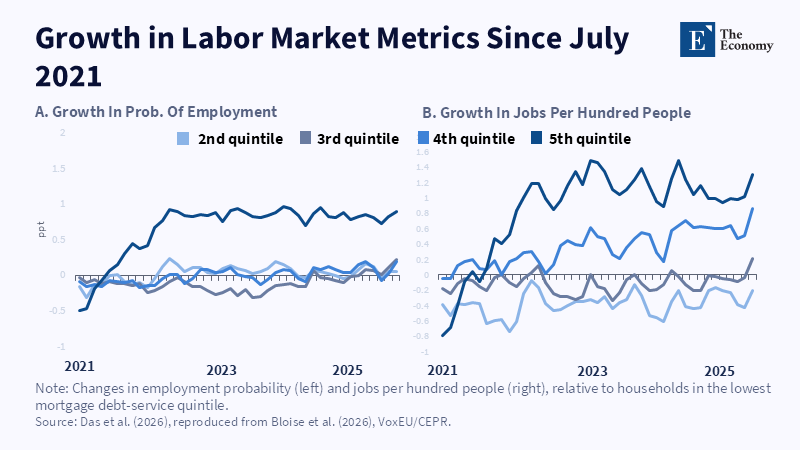
Australia offers the strongest challenge to a pure wage-loss account. It also strengthens the wider thesis. During the tightening cycle that began in May 2022, the policy cash rate rose by 4.25 percentage points. Researchers linked census data on 3.3 million mortgage-holding households with monthly work and income records. Families with heavier mortgage debt-service exposure were more likely to raise employment and take extra jobs after rates went up. The Australian evidence complicates a wage-only explanation. Higher mortgage payments can push households toward more work before any wage loss becomes the main issue.. The common mechanism is still a hit to cash flow. Higher required payments leave less money for other needs and raise the value of extra earnings. This also gives clear predictions. The effect should be weaker where long fixed-rate mortgages are common. It should also be weaker for outright owners and families with large savings buffers. Monetary policy can trigger the stress, but balance sheets decide how hard it lands.
A Better Policy Test for Labor Supply During Downturns
Recent OECD data show why the distinction matters in practice. In the first quarter of 2024, labor-force participation across the OECD was 1.3 percentage points above its level at the end of 2019. Participation had risen since early 2022 in 32 of 38 member countries. Yet real wages were still below their late-2019 level in 16 of 35 countries with wage data. These facts do not prove an added-worker effect. They do show that high labor-market attachment can sit next to a long squeeze on real pay. Central banks and finance ministries should take care when they read high participation or low quitting as simple signs of strength. Some workers may stay in jobs longer because family finances feel less safe. Some may add hours or a second job for the same reason. A labor market can look resilient while part of that resilience comes from lost leisure and tighter family budgets. That is useful policy information, not a statistical footnote.
The next step is to separate causes more carefully. Monetary-policy analysis should track pay losses, job-finding rates, debt bills, spouse employment, savings and childcare along with headline employment. Models should also test the same labor-supply response after fiscal cuts, credit shocks, sector layoffs and other slowdowns. If the pattern appears across those shocks, it belongs in a broad theory of household insurance during bad times. If it appears only after rate moves, the narrow monetary label is earned. This test would also make policy fairer. Low-income families, renters, mortgage borrowers and parents do not have the same room to add work. The opening 60 percent figure makes the central point clear. People often enter the labor market when a family income source disappears. A rate hike can make such losses more likely. It can also raise debt bills directly. The full sequence matters for policy. Higher rates may begin the process, but the decision to work more can emerge several steps later, after household income, employment prospects or debt payments have changed. Treating all of those responses as one monetary-policy channel risks giving the initial shock too much explanatory weight.
This article reflects the analytical judgment of The Economy Editorial Board and does not constitute policy advice or the official position of any affiliated institution.
References
Acemoglu, D., Koster, H.R.A. and Ozgen, C. (2023) ‘Robots and Workers: Evidence from the Netherlands’, NBER Working Paper No. 31009. Cambridge, MA: National Bureau of Economic Research.
Bárány, Z.L., Patel, A. and Siegel, C. (2026a) ‘Automation does not lower the labour share’, VoxEU, 5 August.
Bárány, Z.L., Patel, A. and Siegel, C. (2026b) ‘Does Automation Lower the Labor Share?’, CEPR Discussion Paper No. 21700. Paris and London: Centre for Economic Policy Research.
Brynjolfsson, E., Chandar, B. and Chen, R. (2025) ‘Canaries in the Coal Mine? Six Facts about the Recent Employment Effects of Artificial Intelligence’, Stanford Institute for Economic Policy Research Working Paper. Stanford, CA: Stanford University.
Brynjolfsson, E., Li, D. and Raymond, L. (2025) ‘Generative AI at Work’, The Quarterly Journal of Economics, 140(2), pp. 889–942.
Corselli-Nordblad, L. (2025) ‘Productivity trends using key national accounts indicators’, Eurostat Statistics Explained. Luxembourg: European Commission.
Dell’Acqua, F., McFowland III, E., Mollick, E., Lifshitz-Assaf, H., Kellogg, K.C., Rajendran, S., Krayer, L., Candelon, F. and Lakhani, K.R. (2023) ‘Navigating the Jagged Technological Frontier: Field Experimental Evidence of the Effects of Artificial Intelligence on Knowledge Worker Productivity and Quality’, Harvard Business School Working Paper No. 24-013. Boston, MA: Harvard Business School.
Filippucci, F., Gal, P. and Schief, M. (2024) ‘Miracle or Myth? Assessing the Macroeconomic Productivity Gains from Artificial Intelligence’, OECD Artificial Intelligence Papers, No. 29. Paris: OECD Publishing.
Hampole, M., Papanikolaou, D., Schmidt, L.D.W. and Seegmiller, B. (2025) ‘Artificial Intelligence and the Labor Market’, NBER Working Paper No. 33509. Cambridge, MA: National Bureau of Economic Research.
Noy, S. and Zhang, W. (2023) ‘Experimental evidence on the productivity effects of generative artificial intelligence’, Science, 381(6654), pp. 187–192.
OECD (2026) OECD Insights on Productivity: France. Paris: OECD Publishing.
Pluyaud, B. and Kergozou, N. (2024) ‘Boosting productivity growth and employment’, in OECD Economic Surveys: France 2024. Paris: OECD Publishing.
Working across research, policy, and data-driven analysis, the Editorial Board ensures that published pieces reflect a consistent institutional perspective grounded in quantitative reasoning and long-term structural assessment.