[Europe as a Middle Power] What Brussels Could Still Learn From Tokyo

Working across research, policy, and data-driven analysis, the Editorial Board ensures that published pieces reflect a consistent institutional perspective grounded in quantitative reasoning and long-term structural assessment.
Authored On
Modified
Japan doubled defense spending in three years; Europe still argues over percentages
Germany faces the same China shock Japan absorbed decades ago, only slower
Japan's soft power now outpaces France's, a shift Europe has barely noticed
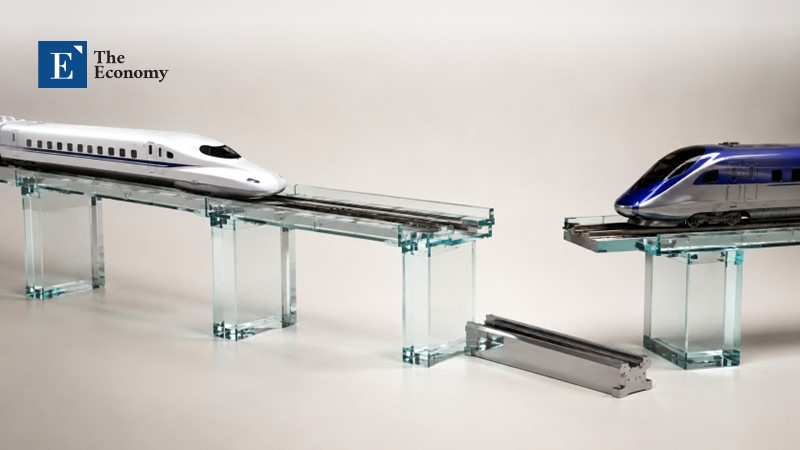
Japan doubled its defense budget's share of GDP in three years and nobody in Washington calls it reckless. Europe is still arguing about whether 3.5 percent by 2035 is realistic. That gap isn't really about money. It's about who decided to stop waiting for permission to adjust and who is still negotiating with itself. The first piece in this series argued that Europe has slid into the same second-tier bracket Japan has occupied for forty years, ranked by both Washington and Beijing as a capable market to be managed rather than a power to be consulted. This piece asks the harder question: given that position, what is Japan actually doing about it and how much of that playbook could Europe realistically run. The comparison isn't flattering to either side in equal measure. Japan has real advantages Europe lacks, chiefly a single government that can move fast once it decides to move. Europe has advantages Japan doesn't have either, a larger combined economy and a currency that trades as a genuine reserve asset. But strip away the structural differences and look at behavior instead of assets and Tokyo has spent the last three years doing something Brussels has mostly just discussed doing.
Germany's Mirror: The Same Shock, One Generation Later
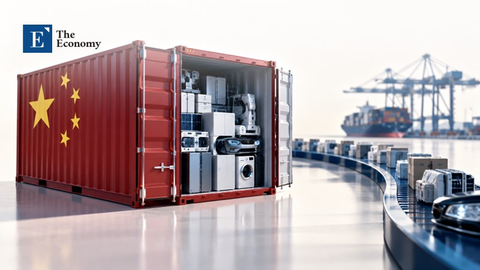
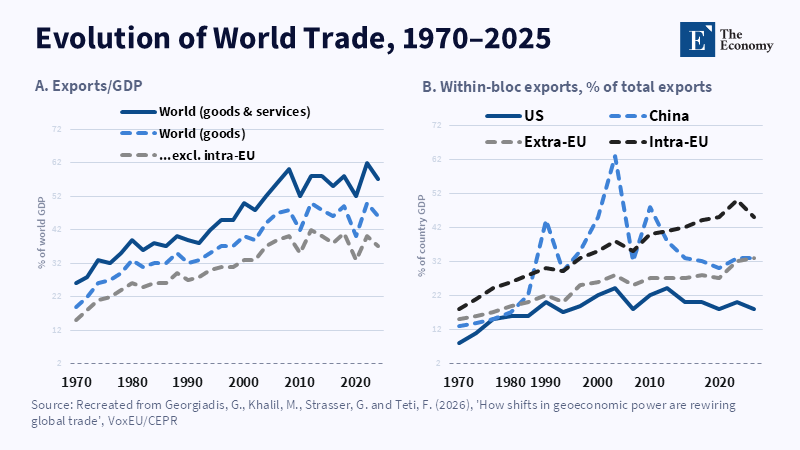
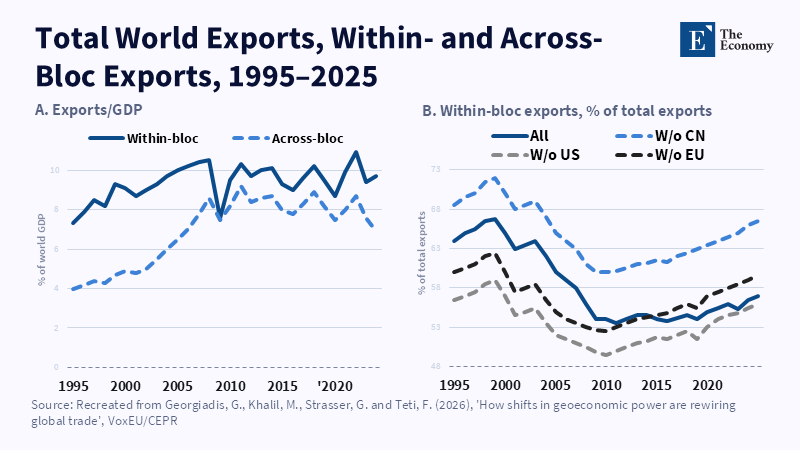
The industrial story is the clearest parallel and the most painful one for Germany specifically. China's Ministry of Commerce published a lengthy position paper in July 2026 rejecting the idea that it has an overcapacity problem at all, arguing that its manufacturing growth simply reflects innovation and market competition rather than subsidy and weak domestic demand. Global Times and other outlets close to Beijing framed it as a rebuttal to what Western commentators have started calling China Shock 2.0. Nikkei Asia's coverage was blunter, describing the same document as an attempt to rebrand a genuine shock as an opportunity. Whatever the label, the numbers behind the dispute are not really contestable. China's trade surplus hit a record $1.2 trillion in 2025. The European Commission's own estimate has China producing roughly 30 percent of global manufactured goods while consuming only 13 percent of them, an imbalance that Piotr Arak's Atlantic Council research ties directly to a projected 721 million tonnes of global steel overcapacity by 2027.
Germany is absorbing this the way Japan absorbed a version of the same shock in the 1980s and 1990s, except slower and with fewer good options. German auto exports to China fell a third in 2025. Industrial output posted its steepest monthly drop in three years in August of that year, driven by an 18.5 percent collapse in automotive production alone. Sander Tordoir and Brad Setser's research for the Centre for European Reform makes the comparison explicit: this is a second China shock and unlike the first one two decades ago, it's hitting the capital-intensive, high-wage sectors, cars, machinery, chemicals, that Germany assumed were permanently safe. Japan went through its own version of this reckoning after the 1985 Plaza Accord forced a yen revaluation that Washington judged necessary and Tokyo had little power to resist. Japanese manufacturers spent the following fifteen years hollowing out, moving production offshore and rebuilding around higher-value niches rather than raw manufacturing volume. It was not a comfortable adjustment and it didn't restore Japan's manufacturing dominance. But it happened, deliberately, with state backing, rather than being managed as a series of denials and partial tariffs the way Germany's version currently is.
The difference in Germany's case is that nobody in Berlin or Brussels has said out loud that the old export model is not coming back. Tordoir and Setser's brief is notable precisely because it says this plainly when almost no elected German official will: the country needs to rethink its trade and industrial policy rather than wait for Chinese demand to normalize, because it won't. Japan's equivalent moment came with genuine political cost, three lost decades of growth is not a small price but it came with a clear-eyed acceptance of new terms. Germany is still negotiating with a version of reality that no longer exists, hoping tariffs calibrated by brand and by battery subsidy will hold back a trade imbalance measured in hundreds of billions of dollars.
Hugging Washington Instead of Hedging Against It
The second parallel runs through defense and alliance strategy and here the contrast in decisiveness is sharper. Hal Brands' recent account of Japanese grand strategy, drawing on meetings with Tokyo's national security establishment, describes something close to a formal three-part doctrine. First, build Japan's own military capability fast: defense spending has doubled from roughly 1 percent of GDP to 2 percent since 2022 and officials now talk seriously about 3 percent or higher by the early 2030s, which would give Japan the world's third-largest military budget after the United States and China. Second, widen the circle of partners beyond the U.S. alone, deepening ties with Australia, the Philippines, India and others so Japan is not solely dependent on one patron's attention span. Analysts at the Hudson Institute have gone further still, arguing that Washington and Tokyo are quietly building the alliance China fears most, a partnership deep enough to shape regional order rather than merely respond to it. Third and this is the part that seems to unsettle some Europeans who favor "strategic autonomy" language, keep Washington close rather than distant, because no alternative security guarantee currently exists that can substitute for it.
Tokyo has made this look undramatic in public even as it represents, in Brands' words, a sharp break from past Japanese foreign policy. Prime Minister Sanae Takaichi accelerated the 2 percent GDP defense target by two full years specifically because of doubts about how durable American commitments will prove to be, doubts that are rarely spoken aloud but that shape budget decisions anyway. That's the posture of a country that has decided uncertainty about its protector is a planning input, not a diplomatic crisis to be managed through statements. Compare that with the pattern in Europe, where NATO's European members did raise collective defense spending by nearly 20 percent in real terms in 2025, a genuine and overdue shift, but where the public conversation still runs through disputes over whether 3.5 percent or 5 percent is the right number, whether Spain's exemption sets a bad precedent and whether the whole framework represents capitulation to American pressure rather than a sober read of the threat environment. Japan had roughly the same argument with itself a decade ago. It appears to have finished having it.
There's a specific reason Japan can move faster on this than a 27-member bloc can and it isn't just political will. It's structural: one government, one budget, one chain of command from the Prime Minister's office to the Self-Defense Forces. The EU has none of that for defense and every attempt to build something closer to it runs into the same wall of national vetoes that slowed the EV tariff response and continues to slow a unified answer to Chinese industrial policy. That doesn’t excuse European fragmentation. It does mean closing the gap with Japan's decisiveness requires institutional change Brussels has so far been unwilling to force through, not just bigger budget lines.
The Soft Power Gap Nobody in Paris Wants to Discuss
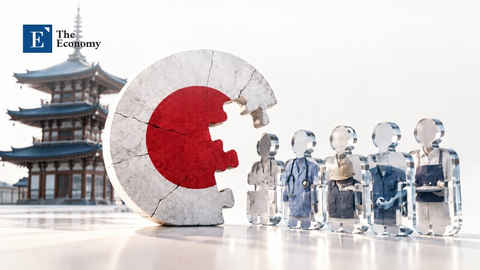
The comparison that gets talked about least is cultural. For most of the twentieth century, France was the undisputed reference point for taste, style and cultural export in a way no single European country is today. That position is eroding and Japan is the country visibly taking its place in the popular imagination, especially among younger audiences. Brand Finance's Global Soft Power Index put Japan third globally in its 2026 ranking, driven by what the index's own authors describe as the pull of anime, manga, cuisine and design rather than economic or military weight. Japan topped Condé Nast Traveler's Readers' Choice rankings for the second year running, drawing 31.65 million international visitors in the first nine months of 2025 alone, a 17.7 percent jump on the previous year. A Fortune feature published in early 2026 put the shift in blunter terms than most policy journals would dare: Japan has replaced France as the country that young Americans romanticize obsessively, a role France held for generations through cinema, fashion and food.
Soft power is not a decorative add-on to hard power calculations, it's a force multiplier that determines how much benefit of the doubt a country gets when it asks for cooperation on harder issues. Japan's cultural reach gives it leverage in exactly the rooms where its GDP or military spending alone would not: trade negotiations, technology partnerships and the diplomatic goodwill that makes other countries willing to align with Tokyo's position on China rather than stay neutral. France and Europe more broadly still have real, underused cultural capital but it has been managed as a heritage asset rather than an active instrument of strategy, something to be protected rather than deployed. Japan, by contrast, has folded cultural exports into an explicit national strategy for decades, treating anime and gaming exports with the same seriousness Germany once reserved for automotive engineering. The result is a country whose global image keeps growing even as its population shrinks and its fiscal position worsens, while France's image, for all its residual strength, is visibly ceding ground to a country a fraction of its former economic weight.
Borrowing the Playbook Without Copying the Politics
None of this argues that Europe should become Japan and the differences matter as much as the similarities. Japan's adjustment came out of a demographic and fiscal position considerably worse than most of Europe's, a fertility rate of 1.1 births per woman that guarantees decades of economic strain regardless of any trade policy. Its social cohesion around rapid rearmament also rests on a specific, decades-old security anxiety about China that doesn't map cleanly onto every European capital's threat perception, particularly those further from Russia's border. Copying Tokyo's playbook wholesale would mean importing its constraints along with its clarity.
What's transferable is narrower but still substantial. First, treat industrial dependency on China as a solved question rather than an ongoing negotiation: Japan's manufacturers made peace with a shrunken export role decades ago and rebuilt around what remained, while Germany is still hoping for a version of the old relationship to return. Second, decouple the debate over defense spending from the debate over whether American protection is reliable, because Japan's experience suggests the first can be raised without resolving the second and waiting for certainty about Washington before committing to a budget number guarantees perpetual delay. Third, treat cultural and diplomatic capital as something to actively deploy rather than passively enjoy, because Japan's soft-power gains did not happen by accident. They were the product of deliberate cultural-export policy running in parallel with defense policy, not instead of it.
The same pattern runs across trade, defense and culture that opened with: Europe keeps waiting for a moment of clarity, a settled answer about American reliability or Chinese intentions, before committing to a strategy. Japan stopped waiting for that clarity roughly a decade ago and started building toward the world it expects rather than the one it would prefer. Whether that record makes Japan a genuine model middle power worth studying or simply the best example available is a fair question but it is the only serving example Europe currently has. That is what middle-power status actually requires in practice, not a change in rhetoric about strategic autonomy but a willingness to make decisions before the ambiguity resolves itself, because for a power of Europe's rank, it may never fully resolve.
This article reflects the analytical judgment of The Economy Editorial Board and does not constitute policy advice or the official position of any affiliated institution.
References
Arak, P. (2026) 'Europe has had enough of China's export surge', Atlantic Council, 3 June.
Brands, H. (2026) 'Japan Is Becoming the Superpower of the Middle Powers', Bloomberg Opinion, republished by American Enterprise Institute, 8 June.
Brand Finance (2026) Global Soft Power Index 2026. London: Brand Finance plc.
Georgiadis, G., Khalil, M., Strasser, G. and Teti, F. (2026) 'How shifts in geoeconomic power are rewiring global trade', VoxEU.org, CEPR, 2 August.
Klebanov, S. (2026) 'How Japan replaced France as the country young Americans obsessively romanticize', Fortune, 5 February.
Nicholson-Messmer, E. (2025) 'Germany's Auto Industry Is Facing Decline. Here's Why', Autoblog, 15 October.
Nikkei Asia (2026) 'China rejects "overcapacity" claims in sweeping rebuttal against US, EU', late July.
North Atlantic Treaty Organization (2026) Funding NATO. Brussels: NATO.
South China Morning Post (2026) 'China pushes back against Western overcapacity claims in new document', late July.
Snyder, N. (2026) 'Rule Japanica: America and Japan Are Building the Alliance China Fears', Hudson Institute, 2026.
The Diplomat (2026) 'Is Japan a Model Middle Power?', July. [Byline author could not be independently confirmed at time of writing.]
Tordoir, S. and Setser, B. (2025) 'How German industry can survive the second China shock', Centre for European Reform Policy Brief, January.
Travel And Tour World (2025) 'Japan Dominates 2025 Tourism Rankings As The World's Most Popular Travel Destination Yet Again', 8 November.
USNI News Staff (2025) 'Japan Poised to Increase Defense Spending to $70 Billion, 2% of its GDP', USNI News, 3 December.
Working across research, policy, and data-driven analysis, the Editorial Board ensures that published pieces reflect a consistent institutional perspective grounded in quantitative reasoning and long-term structural assessment.