"From Political Taboo to Strategic Fault Line" China's 3T Recast Amid Great-Power Rivalry, With U.S. Containment and Structural Constraints Eroding Momentum for a New Global Order

Aoife Brennan is a contributing writer for The Economy, with a focus on education, youth, and societal change. Based in Limerick, she holds a degree in political communication from Queen’s University Belfast. Aoife’s work draws connections between cultural narratives and public discourse in Europe and Asia.
Authored On
Modified
China's "3T" shifts from political taboo to the focal point of diplomatic and trade tensions
Trump administration maintains pressure on all three fronts from before taking office through its second term
China's premature bid for great-power status meets U.S. resistance and credibility challenges, slowing its rise
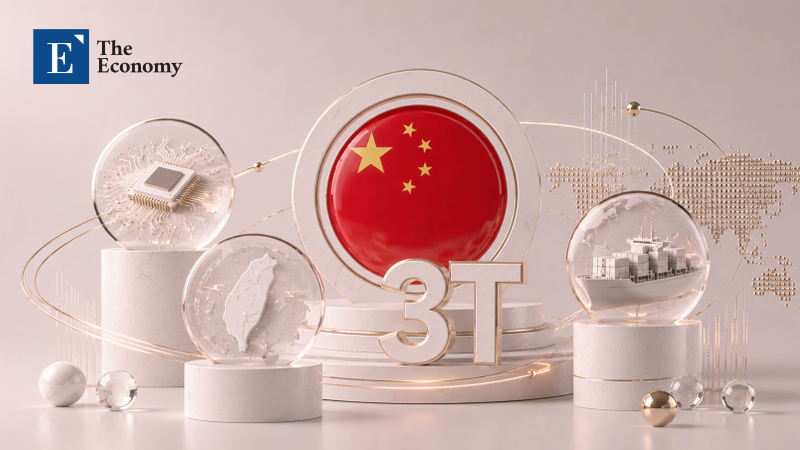
The meaning of China's defining "3T" is undergoing a profound transformation. What once symbolized political taboos has evolved into a framework representing the principal fault lines between China and the international community. Donald Trump, who targeted these vulnerabilities even before securing a second term, continues to pursue an aggressive China-containment strategy, while the prospect of China emerging as the world's dominant power remains far from certain.
The Transformation of China's 3T
According to diplomatic sources on June 18, the traditional "3T" associated with China referred to Taiwan, Tibet, and Tiananmen. These three terms have long represented some of the most politically sensitive issues under Chinese Communist Party rule. Taiwan is tied to sovereignty concerns, Tibet to ethnic, religious, and human rights issues, and Tiananmen to the 1989 military crackdown on pro-democracy demonstrations. This is why foreign nationals working in or dealing with China have repeatedly been advised to avoid discussing the "3T."
Today, however, China's 3T is increasingly being redefined as Taiwan, Technology, and Trade. Rather than taboos within the Communist Party system, these represent three major fronts on which China is colliding with the existing global order. Taiwan remains the sole common denominator linking the old and new versions of the 3T, yet its significance has changed markedly. Taiwan is now viewed not merely as a political red line but as a tangible security flashpoint where Chinese military pressure intersects with Taiwan's defense preparations. Beijing has expanded its campaign from military coercion to diplomatic pressure, including efforts to block Taiwan's participation in international forums, while Taipei has responded by intensifying tactical training and military readiness.
Technology constitutes the second pillar of the new 3T. Whereas China's technology-related controversies once centered on censorship, surveillance, and internet controls, today's technology battlefield is defined by competition over semiconductors, artificial intelligence (AI), and supply-chain self-sufficiency. Central questions now revolve around how effectively China can circumvent U.S. restrictions and how successfully the United States and its allies can delay China's technological ascent. The third pillar, trade, lies at the heart of China's tensions with the United States and other Western nations. Facing sweeping trade restrictions, China has pushed excess industrial output into global markets through low-cost exports, generating significant disruption across major Western economies. Europe, in particular, has seen China's influence expand across high-value manufacturing sectors such as electric vehicles, batteries, and advanced machinery, contributing to a visible erosion of industrial competitiveness.
Trump's Continued Pressure Campaign Against China
The United States recognized these shifts years ago and has steadily expanded efforts to counter China's 3T. During his 2024 reelection campaign, Trump pledged to raise the United States' average tariff rate from roughly 3% to as high as 20%, while imposing tariffs of up to 60% on Chinese imports. He also proposed revoking China's Most Favored Nation status, reducing imports of strategic goods, and reshoring critical supply chains to the United States, signaling broader pressure on Chinese technology and manufacturing industries. On Taiwan, Trump maintained that military intervention should remain an available option while continuing to support the longstanding policy of strategic ambiguity rather than explicitly guaranteeing Taiwan's defense.
Soon after taking office, the second Trump administration launched a new phase of tariff confrontation. The opening move came in February of last year, when Trump signed an executive order imposing an additional 10% tariff on Chinese imports under the justification of combating fentanyl inflows. The measure took effect the same month, prompting China to retaliate with tariffs of 15% on U.S. coal and liquefied natural gas (LNG), and 10% on crude oil, automobiles, and agricultural machinery. Washington subsequently raised additional China tariffs to 20% in March and announced its so-called "Liberation Day" tariffs in April, imposing a universal 10% baseline tariff on imports and an additional 34% reciprocal tariff on Chinese goods. The two countries then engaged in successive rounds of retaliation, with U.S. tariffs on Chinese imports peaking at 145% and Chinese tariffs on American goods reaching 125%. Although subsequent truce agreements and extensions led to partial reductions, Chinese products remain subject to overlapping measures, including Section 301 tariffs and global baseline duties.
Semiconductor export controls have also tightened steadily. Following the so-called "DeepSeek shock" last year, Trump pressured allies such as Japan and the Netherlands to further restrict China's access to semiconductor manufacturing equipment. This year, Washington expanded restrictions on exports of advanced AI chips to China and Macau, increasingly treating cutting-edge semiconductors as instruments of both national security and tariff policy. Taiwan, however, has not seen major policy shifts. The second Trump administration continues to prioritize deterrence against a potential Chinese invasion within its national security strategy and maintains existing partnerships and military deterrence frameworks, while still declining to provide a definitive answer on whether U.S. forces would intervene directly in the event of a conflict.
The Limits of China's Great-Power Strategy
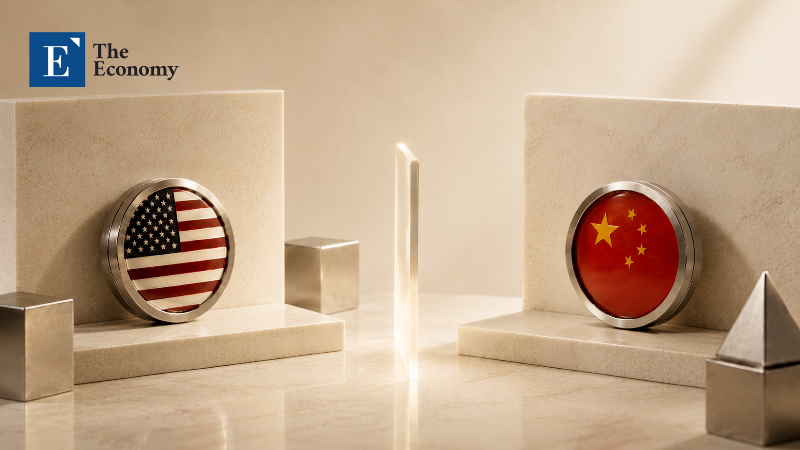
Whether China can overcome U.S. pressure and ultimately achieve superpower status remains an open question. Military power is the most visible foundation of hegemony, yet sustaining such power requires overwhelming economic strength. When Xi Jinping assumed power in 2012, China's economy had already surpassed half the size of the U.S. economy. By the time the first Trump administration took office in 2017, China's GDP had reached roughly 63% of America's. At the time, some analysts projected that China could overtake the United States around 2027 or 2028. However, the subsequent acceleration of U.S. decoupling efforts, supply-chain controls, and tariff pressure reversed that trajectory. China's GDP relative to that of the United States peaked in 2021 and has been declining since.
This reflects the consequences of China revealing its ambitions for global leadership too early. Former Chinese leader Deng Xiaoping emphasized the principle of "hide your strength and bide your time," while Mao Zedong also warned against openly pursuing hegemony. Under Xi, however, Beijing effectively formalized its aspirations for great-power status before its economic and military capabilities had fully matured, accelerating the onset of U.S. containment efforts. Compounding the challenge, several of China's strategic footholds around the world have come under pressure. Recent developments in Panama, Venezuela, and Iran have tested China's influence, yet Beijing has struggled to demonstrate a meaningful presence, whether through military support or diplomatic mediation. This has fueled deeper questions about whether China is prepared to shoulder the burdens associated with maintaining a global order.
Weaknesses in soft power also remain a significant vulnerability in China's hegemonic ambitions. Global leadership cannot be sustained through economic and military strength alone; it also requires international confidence in a country's rules, institutions, governance model, and political commitments. China, however, has faced persistent criticism over the Hong Kong National Security Law, suppression of pro-democracy movements, human rights concerns in Xinjiang and Tibet, and military pressure on Taiwan. Beijing's flagship Belt and Road Initiative, presented as a national-level strategic framework for expanding westward, has likewise become associated with concerns over debt dependency and political influence rather than serving as a universally embraced symbol of development cooperation. As one diplomatic expert noted, "China possesses immense manufacturing capacity and is modernizing its military at a remarkable pace, but it has yet to establish the normative appeal and trust necessary for the world to follow its lead voluntarily."
Aoife Brennan is a contributing writer for The Economy, with a focus on education, youth, and societal change. Based in Limerick, she holds a degree in political communication from Queen’s University Belfast. Aoife’s work draws connections between cultural narratives and public discourse in Europe and Asia.
Similar Post