The License to Overcharge: Why Occupational Licensing Protects Insiders, Not the Public

Working across research, policy, and data-driven analysis, the Editorial Board ensures that published pieces reflect a consistent institutional perspective grounded in quantitative reasoning and long-term structural assessment.
Authored On
Modified
Occupational licensing has expanded far beyond high-risk professions
Entry barriers can raise incumbent income while restricting competition
Reform should preserve necessary licences but remove rules that no longer protect the public

More than one in five employed Americans now needs a government permit just to earn a living. In 2024, 21.6 percent of employed workers held an occupational license, according to the Bureau of Labor Statistics. Back in the 1950s, that share was close to 5 percent. In seventy years, the license went from a rare mark of elite trades like medicine and law to a routine gatekeeper for florists, interior designers and hair braiders. This growth was sold to the public as a safety measure. The real story is simpler and less flattering. Licensing has become a tool that lets insiders raise prices, block rivals and dodge the pressure of open competition. That is not a side effect. For many trades, it is the entire point.
Occupational Licensing Has Become a Global Habit, Not Just an American One
For years, occupational licensing looked like a mostly American puzzle. Reformers pointed at state boards and asked why a florist in Louisiana needed a license to arrange flowers. New cross-country research now shows the pattern is far bigger than one country's quirky rules. A 2026 study covering 44 nations found that occupational licensing touches roughly a quarter of the global workforce on average. India and South Africa license more than 40 percent of their workers, higher rates than the United States or most of Europe. Australia, Germany, Japan and Chile also license over 30 percent of their labor force.
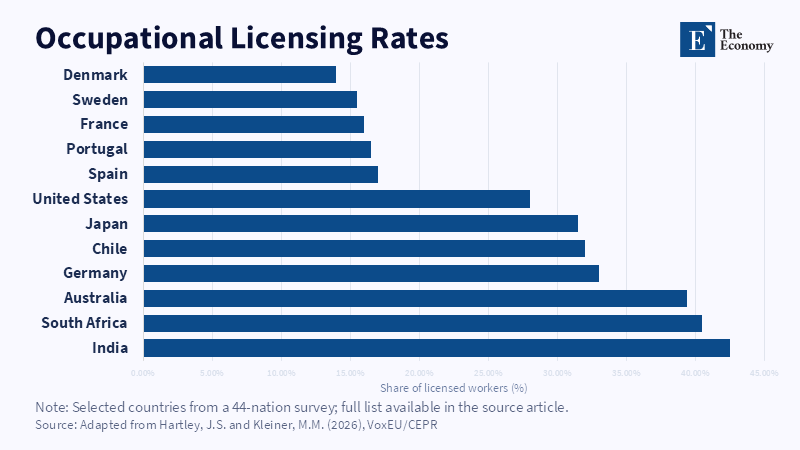
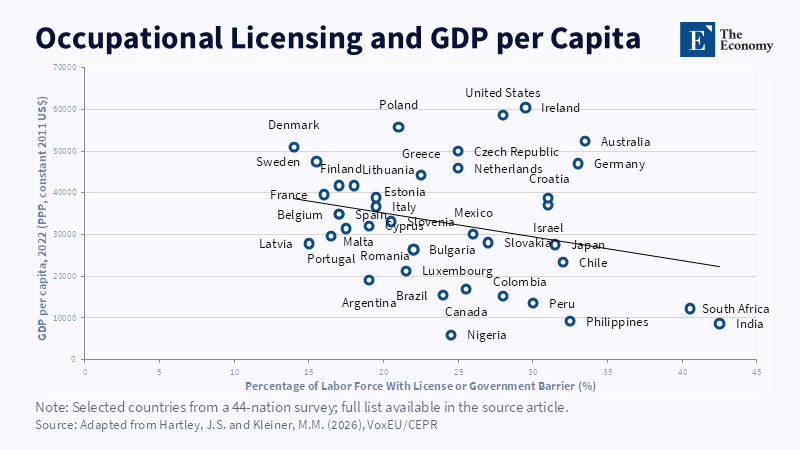
This spread matters because it kills a comforting excuse. Advocates often argue that licensing only grows where economies are rich enough to afford it and that poorer nations simply have not caught up yet. The cross-country data says the opposite. Higher licensing rates track with lower income per person, not higher. Countries with more licensing also tend to have larger informal sectors, where workers skip the rules entirely because the formal path costs too much. In other words, heavy licensing does not signal a mature, careful economy. It often signals a labor market where the price of entry has been set by insiders rather than by need. When a government requires a license to braid hair, cut hedges or manage a shop's books, it is not always solving a safety problem. Frequently, it is answering the request of an industry group that wants fewer competitors.
The wage evidence from this global research points the same direction. Licensed workers across the 44 countries studied earn between roughly 6 and 19 percent more than similar unlicensed workers, a range that lines up closely with older estimates from the United States and Europe. A premium that size, repeated across so many different legal systems and cultures, is hard to explain purely as a reward for extra safety training. If licensing mainly reflected genuine skill gaps, the wage gap would shrink wherever training quality is already high. Instead, it holds up almost everywhere licensing exists, which suggests the premium comes less from added competence and more from the simple fact that competitors were kept out.
The Economics Behind the Badge
Economists have a plain word for the extra income a license generates once it restricts entry: rent. A rent is the money a worker or business collects above what open competition would allow. Licensing creates rent by making it harder, slower and costlier for new people to enter a trade. The evidence on this point is consistent and clear. Research summarized by the Brookings Institution found that licensed workers earn about 4 percent more than unlicensed peers with similar education and experience, once analysts control for other factors. In fields like healthcare, construction and transportation, the wage gap runs even higher. Licensed workers also face lower unemployment and are more likely to hold onto a job than unlicensed counterparts doing similar work. None of that is an accident of the market. It is the direct result of a barrier that keeps the labor supply smaller than it would otherwise be.
Pacific Legal Foundation's review of the same government data made the underlying motive explicit. Existing practitioners often tell lawmakers that new licenses will protect the public. Yet the data shows the strongest and clearest effect of a license is higher pay for the people who already hold one. Over the past four decades, states have fully repealed licensing rules in only a handful of cases nationwide. Once a badge exists, the people who hold it fight hard to keep it, because losing it means losing income they never had to earn through better service or lower prices. This is the textbook definition of rent seeking. Groups spend time and money securing a legal advantage instead of competing on quality. The public pays for that advantage through higher prices, fewer choices and slower entry of new talent into badly needed trades.
The Institute for Justice's most recent national review found that the 102 lower income occupations it tracks now carry 2,749 separate state licenses. On average, earning one of these licenses requires 362 days of training, at least one exam and nearly 300 dollars in fees. Between 2017 and 2022, states created 16 new licenses in this group while removing only 26 and much of that removal simply reversed prior expansions rather than shrinking the system overall. A worker with no criminal record, no health risk to the public and no complaint history can still be barred from a job for months over paperwork that has nothing to do with skill.
Stale Rules Cannot Keep Pace With a Fast Moving Market
The deepest cost of occupational licensing is not just the money it extracts. It is the way licensing freezes a trade in the shape it had when the rule was written. Licensing boards are usually run by people who already hold the license, which gives them every reason to protect the version of the job they learned years ago. New tools, new business models and new ways of serving customers often clash with rules built for an older market. A worker who wants to use updated equipment, digital platforms or leaner service models can find that the license itself blocks the very efficiency that would benefit customers most.
This creates a market increasingly stocked with practitioners who have strong legal standing but weaker incentive to modernize. When entry is hard, the people already inside face less pressure to adopt better methods, lower prices or faster service, because fewer challengers can undercut them. Meanwhile, workers who might bring fresh skills, often younger, more mobile or trained outside the traditional path, face months of unpaid training and hundreds of dollars in fees before they can even test their ideas in the market. The result tends to favor outdated practice over useful innovation, not because customers prefer it but because the rules make the alternative too expensive to attempt. Licensing boards rarely update requirements at the speed technology moves, so the gap between what a license certifies and what a modern job actually demands keeps widening.
Supporters of licensing raise a fair concern here. Some trades genuinely involve risks that untrained workers cannot judge for themselves and doctors, electricians and pilots are the clearest examples. That concern deserves respect, not dismissal. But the honest reply is that most licensed trades today are nothing like those high stakes fields. Florists, interior designers and shampoo assistants do not put lives at risk the way an unlicensed surgeon would. Cross country evidence backs this up too. Nations with lower licensing rates, largely in Northern Europe, do not show worse consumer outcomes than more heavily licensed peers. If licensing genuinely protected consumers first, the safest countries should be the most licensed ones and they are not.
Age and turnover inside licensed trades reinforce this pattern. When a license is hard to earn, fewer young or career changing workers bother trying, so the trade slowly fills with people who entered decades ago and see little reason to change how they operate. Call this the boomer effect on a licensed market. The workforce ages in place, protected from the churn that normally forces any industry to adapt. Newer competitors, who might bring lower prices, digital tools or simply a different way of doing the job, are priced out before they can prove themselves. Consumers are left choosing among a shrinking, aging pool of providers instead of a wide, competitive one.
Toward Licensing Rules That Serve the Public, Not the Profession
None of this argues for eliminating licenses in medicine, law or aviation, where the case for oversight is strong and well tested. It argues for treating licensing as a policy tool that must earn its cost, not a default response to every occupation someone wants to protect. Lawmakers reviewing licensing rules should ask a simple question before adding or renewing any requirement. Does this rule reduce real, demonstrated harm to the public or does it mainly reduce competition for people who already hold the credential? Lighter tools exist and already work well in many markets. Private certification, public reviews, bonding requirements and insurance can flag bad actors without locking out an entire pool of willing, capable workers.
Policymakers can also build sunset clauses into licensing statutes, forcing a fresh justification every few years rather than letting a rule sit unchanged for decades. Reciprocity between states, so that a license earned in one place counts elsewhere, would cut one of the sharpest costs of the current system, worker immobility. None of these reforms require abandoning consumer protection. They require separating the legitimate cases from the ones built mainly to keep prices high and rivals out.
The numbers at the start of this piece are not an accident of history. They are the record of decades in which industries learned that a license is worth more than almost any other form of protection a lobbyist can secure. A quarter of the world's workforce now needs government permission to work and the strongest predictor of that permission is not risk to the public but the negotiating power of the people already inside the trade. Reversing this trend will not happen through one law or one court case. It requires lawmakers willing to ask, occupation by occupation, whether a rule protects people or simply protects a paycheck. The data is now available across dozens of countries and hundreds of occupations. What remains is the political will to use it.
The views expressed in this article are those of the author(s) and do not necessarily reflect the official position of The Economy or its affiliates.
References
Hartley, J.S. and Kleiner, M.M. (2026) 'Occupational licensing across countries: New evidence from 44 nations', VoxEU/CEPR, 20 July.
Institute for Justice (2022) License to Work: A National Study of Burdens from Occupational Licensing. 3rd edn. Arlington, VA: Institute for Justice.
Kleiner, M.M. and Krueger, A.B. (2013) 'Analyzing the extent and influence of occupational licensing on the labor market', Journal of Labor Economics, 31(S1), pp. S173-S202.
Koumenta, M. and Pagliero, M. (2019) 'Occupational regulation in the European Union: coverage and wage effects', British Journal of Industrial Relations, 57(4), pp. 818-849.
Nunn, R. (2016) Occupational Licensing and American Workers. Washington, DC: Brookings Institution, The Hamilton Project.
Trotter, C. (2016) 'New data on occupational licensing confirms existence of rent-seeking incentives', Pacific Legal Foundation, 27 April.
U.S. Bureau of Labor Statistics (2025) Certification and Licensing Status of the Civilian Noninstitutional Population 16 Years and Over by Employment Status, 2024 Annual Averages. Washington, DC: U.S. Department of Labor.
Working across research, policy, and data-driven analysis, the Editorial Board ensures that published pieces reflect a consistent institutional perspective grounded in quantitative reasoning and long-term structural assessment.