Civil Service Independence: The Overlooked Shield Against Populist Economic Damage

Working across research, policy, and data-driven analysis, the Editorial Board ensures that published pieces reflect a consistent institutional perspective grounded in quantitative reasoning and long-term structural assessment.
Authored On
Modified
Professional civil services limit the economic damage linked to populist rule
Patronage replaces expertise with loyalty and weakens public performance
Merit-based hiring protects growth, contracts and institutional stability

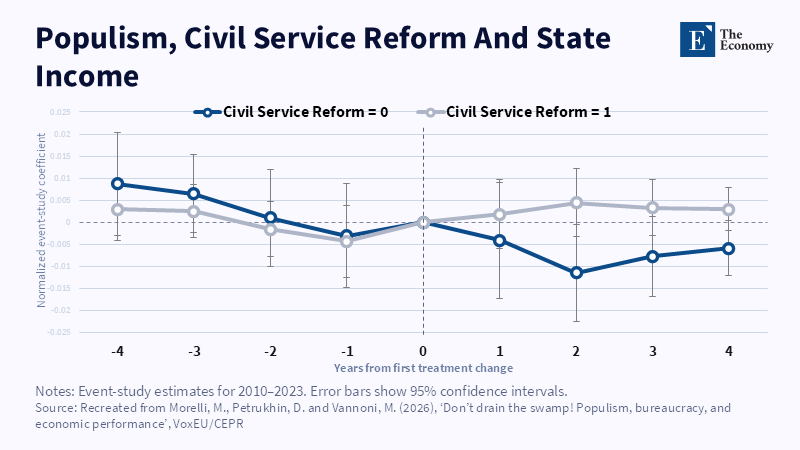
Some governors campaign against unelected bureaucrats. They win applause. They win votes. Voters like the message. It sounds like common sense. But one number tells a different story: 3.8 percent. That is how much lower a state's income falls, on average, when a populist governor takes office without civil service protections. When those protections exist, the drop disappears. This pattern comes from decades of state data. It points to something bigger than one election. Civil service independence, not political loyalty, may be the wall that holds an economy up. Populist leaders often call career officials an obstacle. The evidence says the opposite. Professional staff who are shielded from political pressure act like shock absorbers. Remove that shield and you do not just change who holds power. You remove a buffer. That buffer protects investors, workers and taxpayers from the chaos that comes with rule by loyalty instead of skill.
The Hidden Cost of Politicizing Public Jobs
Most debates about populism focus on tariffs, courts, or speeches. Few focus on the clerk who processes a permit. Few focus on the auditor who flags a bad contract. This piece looks there instead. New research on U.S. governors, Brazilian towns and European contracts points to one idea. The line between loyalty and skill in public hiring shapes the economy almost as much as ideology does. This matters now. Several governments have moved to weaken job protections. They have swapped career staff for political picks. They have shrunk watchdog agencies. If civil service independence really limits the damage from shaky governance, cutting it is not a small choice. It is an economic decision. It has real costs, whether voters see them or not.
This shift in focus matters for a simple reason. Most people treat bureaucratic independence as a question of fairness. Fairness is real, but it is not the strongest case here. The stronger case is economic. It rests on data, not on sentiment. Three separate bodies of research back this up. They come from different countries and different decades. They use different methods. Yet they reach the same place. When hiring inside government rewards loyalty over skill, harm follows. Growth slows. Programs run worse. Corruption rises. None of this research says elected leaders should lose control of policy. The claim is narrower. The machinery that carries out policy works better when it sits apart from election cycles. Populist rhetoric tends to blur that line. This piece tries to draw it back in.
The Hidden Cost of Politicizing Public Jobs
A recent study of American states shows this pattern clearly. Researchers read more than three thousand governor speeches. They scored each one for populist language. Then they matched the scores against decades of state income data. States with populist governors and no civil service rules saw income fall by about 3.8%. States with those rules in place saw no drop at all. The same research found a wider pattern across countries. Fifteen years under populist rule tracks with roughly 10% lower income per person, compared with a likely non-populist path. These two findings fit together. Populist rule alone does not guarantee economic harm. Populist rule paired with a weak, loyalty-based bureaucracy does.
A second study explains why this happens. It looked at U.S. federal programs. It compared results under career managers with results under political appointees, using a standard government scorecard. Programs run by appointees scored five to six points lower on a hundred-point scale. This held true even after accounting for budget size and program type. Programs run by managers promoted from within scored four to five points higher. Programs shielded from routine political reshuffling by fixed terms scored eleven to twelve points higher still. None of these stronger managers were picked for loyalty. They were picked, in effect, for time on the job and knowledge of the system. That difference explained most of the performance gap. Education and private-sector polish barely mattered.
When Loyalty Replaces Expertise: Evidence from Brazil
Brazil offers a clear test case. Economists tracked about two million political supporters across Brazilian towns from 1997 to 2014. They compared supporters of candidates who barely won with supporters of candidates who barely lost. Being a known supporter of the winning side raised a person's odds of a public job by about ten and a half points. That is close to a fifty percent jump over the normal hiring rate. Supporters of the losing side saw their odds fall instead. This was not limited to top officials. It also showed up among clerks, inspectors and other frontline workers, the people who deal with citizens every day.
The deeper problem was not just that connections helped people get hired. It was who got hired because of them. Workers hired through political ties tended to be less qualified than workers hired through normal channels for similar jobs. Once loyalty paid off more than skill did, skill stopped being the deciding factor. It stopped deciding who ran local schools. It stopped deciding who ran clinics and permit offices. This matches what the CEPR research describes: populist governments turning agencies into tools of political control. Brazil shows what that tool looks like once it runs. Workers get picked for loyalty, not ability, across every level of local government.
Why Civil Service Independence Curbs Corruption
Patronage does more than lower average skill. It also changes what people are rewarded for. One study covered more than two hundred European regions and over a million public contracts. It asked whether career structure inside the civil service predicted corruption risk in those contracts. Regions where officials built careers inside professional, merit-based systems saw lower corruption risk. This held even though these officials answered mainly to their own institutions, not to sitting politicians. The logic is simple. When a contract officer's career depends on political favor, favor gets cheap to buy. When that officer's career depends on peer review and civil service rules instead, the same favor gets harder to buy and easier to catch.
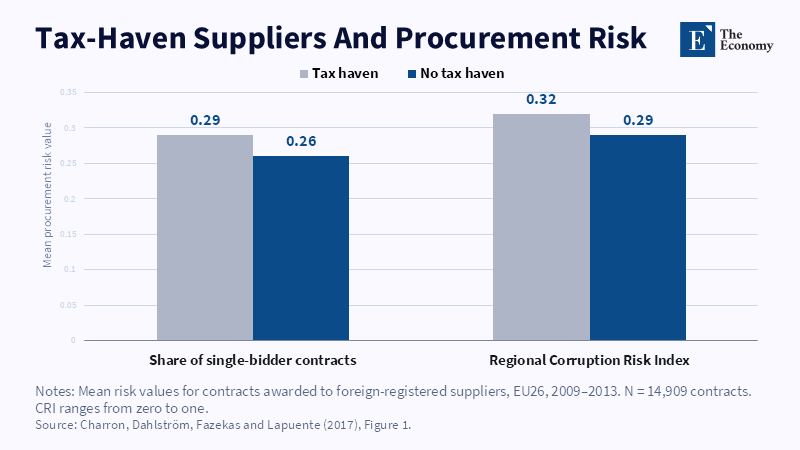
This is the piece missing from populist attacks on the so-called deep state. Independent officials get called unaccountable. In practice, they answer to a different system. That system runs on professional standards, not election timing. Remove that system and government does not become more accountable. It becomes accountable only to whoever holds office right now, with no check in between elections. Corruption risk rises as a result. This is not because career staff are naturally more honest than political picks. It is because the system around them rewards different behavior.
What This Means for Policymakers
None of this evidence argues that every current civil servant is a model employee, or that every political appointee is a liability. Some career staff grow rigid over time. Some appointees bring real energy and fresh thinking to stale agencies. The point is about averages, not individuals. Across thousands of programs and millions of workers, systems built on merit and tenure outperform systems built on loyalty. That average holds even when specific cases point the other way. Policymakers designing reform should keep this distinction in mind. The goal is not to protect every incumbent bureaucrat from scrutiny. The goal is to protect the hiring and promotion rules that, on balance, select for competence over connections.
For administrators and policymakers, the lesson is narrow and testable. Civil service independence is not just a value to defend on principle. It works like economic infrastructure, similar to a stable currency or a working court system. Reforms that back merit-based hiring, protect jobs from routine political sweeps and keep watchdog bodies independent are not only about fairness to workers. They limit the swings that follow sudden shifts in leadership. For those who train future civil servants, the same evidence argues for teaching tenure and technical skill as core values, not red tape. States weighing reform should treat these protections as insurance against policy shocks, not as roadblocks to democracy.
One fair objection follows closely. Elected leaders need some power to direct government. A bureaucracy that is too shielded from political control can become its own unaccountable elite. That risk is real. But the evidence does not support treating it as the main risk. Career officials in the Brazilian and European studies were not unusually powerful. They were simply less politically connected and that tracked with better results for citizens, not worse ones. The American state data shows no sign that civil service rules stopped governors from governing. What they stopped was the turning of executive power into patronage networks. Shielding staff from patronage is not the same as shielding them from accountability. Mixing up the two has made it easier to cut safeguards that were never really the problem.
A second objection is worth a look too. Critics sometimes claim career staff simply resist change, good or bad. Cases from the underlying CEPR research push back on this claim. Career-staffed bodies did not stop governors from setting policy direction. They slowed the fastest, least reviewed decisions. They pushed some choices through normal legal and technical checks. Slower is not the same as blocked. For citizens and investors, a steady pace of policy change usually beats sudden swings driven by a single election. That steadiness is itself an economic good. Patronage systems rarely deliver it.
The 3.8 percent is a small figure next to slogans about draining swamps or dismantling deep states. But it stands for real income lost by real households when bureaucratic independence disappears under populist rule. The Brazilian and European evidence shows why that number holds up. Patronage systematically picks loyalty over skill and that trade carries a cost. It shows up in service delivery, in corruption risk and in long-run growth. Governments do not have to choose between responding to voters and running a professional administration. The evidence says they need both, working as separate systems with separate jobs to do. Protecting civil service independence, then, is not a defense of unelected power. It is a defense of the ordinary tools, competitive hiring, job security, technical accountability, that keep public institutions working no matter who wins the next election. Reformers who want better government should strengthen those tools before they cut them.
The views expressed in this article are those of the author(s) and do not necessarily reflect the official position of The Economy or its affiliates.
References
Charron, N., Dahlström, C., Fazekas, M. and Lapuente, V. (2017) ‘Careers, connections, and corruption risks: Investigating the impact of bureaucratic meritocracy on public procurement processes’, The Journal of Politics, 79(1), pp. 89–104.
Colonnelli, E., Prem, M. and Teso, E. (2020) ‘Patronage and selection in public sector organizations’, American Economic Review, 110(10), pp. 3071–3099.
Funke, M., Schularick, M. and Trebesch, C. (2023) ‘Populist leaders and the economy’, American Economic Review, 113(12), pp. 3249–3288.
Lewis, D.E. (2007) ‘Testing Pendleton’s premise: Do political appointees make worse bureaucrats?’, The Journal of Politics, 69(4), pp. 1073–1088.
Morelli, M., Petrukhin, D. and Vannoni, M. (2026a) ‘Do not drain the swamp! Populism, bureaucracy and economic performance’, CEPR Discussion Paper, No. 21671. Paris and London: CEPR Press.
Morelli, M., Petrukhin, D. and Vannoni, M. (2026b) ‘Don’t drain the swamp! Populism, bureaucracy, and economic performance’, VoxEU, 24 July.
Working across research, policy, and data-driven analysis, the Editorial Board ensures that published pieces reflect a consistent institutional perspective grounded in quantitative reasoning and long-term structural assessment.