The Shift to Defined Contributions Is Changing Demand for Bonds

Working across research, policy, and data-driven analysis, the Editorial Board ensures that published pieces reflect a consistent institutional perspective grounded in quantitative reasoning and long-term structural assessment.
Authored On
Modified
Pension funds are shifting fast from defined benefit to defined contribution
Netherlands offers the clearest real-time test of the transition
Falling long-term bond demand may be pushing US Treasury yields up

In the United States, in 2023, defined contribution plans had 93.4 million active participants, while traditional defined benefit plans had just 11.1 million, according to data from the Congressional Research Service. Until 1984, the ratio was reversed. This gap is not just demographic. It reflects a shift in the way trillions of dollars of pension capital are directed into stocks, bonds, and alternative assets, with implications that reach as far as sovereign debt markets. The transition from defined benefits to defined contributions is not a new story, but its scale in recent years has changed the nature of the debate, from a theoretical issue of insurance policy to a variable that directly affects demand for long-term debt.
The Scale of the Global Shift to Defined Contributions
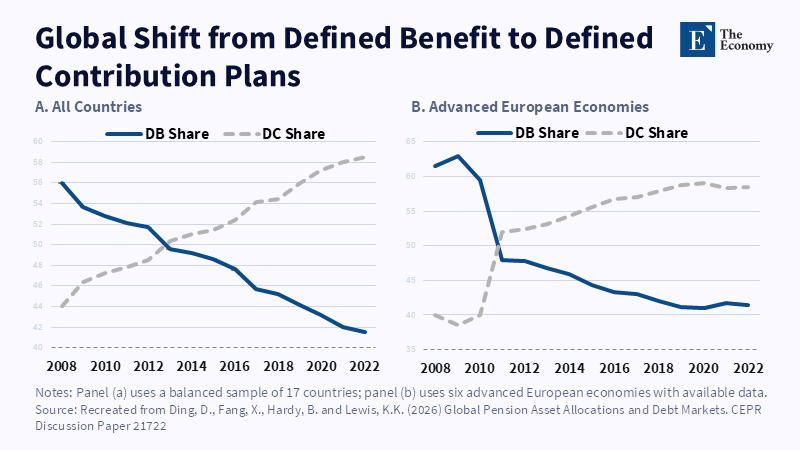
The trend is not limited to the United States. Ding, Fang, Hardy, and Lewis, in recent work presented through CEPR, document a global shift in pension fund portfolios, with the structure of defined benefit programs steadily shrinking while defined contribution programs expand, in a sample of countries spanning from advanced European economies to emerging markets such as Chile and Colombia. In the U.S., access to a defined benefit program in the private sector declined from 20 percent in 2010 to 14 percent in 2025, while access to defined contribution programs rose from 59 percent to 70 percent over the same period, according to Bureau of Labor Statistics data processed by the Congressional Research Service.
The finding that stands out in the work of Ding and associates is that the transition away from defined benefits does not in itself explain the decline in bond placements. Both kinds of programs have limited direct fixed-income placements while enhancing their participation in mutual funds. The expansion of defined contributions accelerates this trend but does not cause it entirely. It is rather a combination of institutional change and a broader search for returns, particularly intense in defined benefit programs, which still carry binding obligations to their beneficiaries.
The New Investment Map of Pension Funds
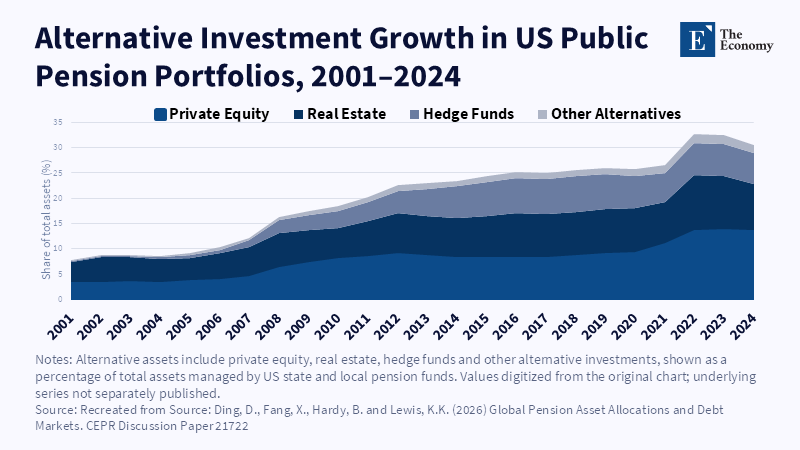
In defined contribution plans, the risk of performance is transferred to the employee himself, who manages his own account instead of receiving a predetermined monthly pension. This changes the logic of asset allocation. In US state and local pension funds, alternative investment products, such as private equity, real estate, infrastructure and hedge funds, increased from less than 10 percent of total assets in the early 2000s to over 30 percent by 2024, according to the US Public Plans Database used by the same team of researchers.
This shift is not accidental, nor is it purely a result of the change in the type of programs. The low interest rates of the last twenty years have played a decisive role, prompting funds to seek yields outside of traditional fixed income. The same researchers, looking at data from 87 countries from 1980 to 2023, found that a one-percentage-point decrease in the ten-year government bond yield is associated with about a one-percentage-point decrease in the share of bonds in the portfolio, a 1.5 percentage point increase in mutual funds and a three-percentage-point increase in foreign assets. In fact, defined benefit programs appear more sensitive to this dynamic than defined contribution programs, which contradicts the intuitive assumption that the transition to defined contributions is the only driving force behind the aversion to bonds.
The Netherlands as a Real-Time Test of the Transition
No system offers as clear a picture of the transition as the Dutch one. The Wet toekomst pensioenen law came into force on 1 July 2023, obliging the eurozone's largest occupational pension system to switch from defined benefits to defined contributions by 1 January 2028. By the end of the second quarter of 2026, according to data from De Nederlandsche Bank, 34 funds had completed the transition, with €589 billion of assets now managed under the new framework, out of a total of €1.72 trillion across the Dutch pension system. As early as January 1, 2026, more than half of the participants in the Dutch funds had been transferred to the new system, with Social Affairs and Employment Minister Eddy van Hijum estimating that around 95 percent of participants will have completed the transition within the next year and a half.
The path is not entirely linear. Aon Netherlands executives, such as investment wealth manager Frank Driessen, have noted that several funds have been forced to postpone their transition date due to technical difficulties in management systems, with the result that the peak of the process is now expected in 2027 instead of 2026. This delay does not negate the direction; it simply lengthens the timeline. In a system with €1.7 trillion under management, even a partial transition is enough to noticeably change demand for long-term bonds and interest rate swaps, given that Dutch funds have historically held a disproportionately large share of the longer-term segments of the European sovereign debt market.
What the Shift Means for Sovereign Bond Demand
The link between the transition to defined contributions and the demand for bonds is not just an empirical observation. It also has a mechanistic explanation. Linda Fache Rousová, Angelica Ghiselli, Maddalena Ghio and Benjamin Mosk, in an analysis by the European Central Bank, explain that defined benefit funds carry a negative maturity gap, as their liabilities are more sensitive to interest rate changes than their assets. This pushes them to buy long-term bonds and enter into interest rate swaps to close the gap, resulting in them holding up to two-thirds of the long-term European government bonds held by institutional investors. Defined contribution funds have no corresponding obligation, so this maturity incentive weakens significantly as the transition progresses.
The same analysis warns that a shift towards defined contributions could structurally reduce demand for long-term bonds and swaps, potentially resulting in a steepening of the yield curve. The work of Ding, Fang, Hardy, and Lewis goes a step further, calculating that when long-term investors' share of the market falls from half to one-third, a major volatility shock can double the response of bond yields. Pension funds have traditionally acted as steady buyers that absorbed government debt even in times of stress. As they leave, their place is taken by more price-sensitive investors, such as mutual funds, who facilitate debt issuance during calm periods but tend to sell more sharply when the market is turbulent.
The Case for US Treasury Bonds
One question that remains open concerns the relationship between this transition and the recent trajectory of yields on long-term U.S. Treasuries. In the May 2026 ten-year U.S. Treasury Bond auction, the final yield stood at 4.468 percent, up from 4.217 percent in March of the same year, with the bid coverage ratio falling from 2.45 to 2.13 and the deviation margin from the expected yield widening from 0.7 to 5.5 basis points, according to data compiled by Dukascopy Bank. The percentage of indirect bidding, an indicator of demand from foreign institutional investors and central banks, fell from 74.5 percent to 64 percent over the same period.
There is no direct, documented causal link between the contraction in pension funds' demand for long-term debt and the specific pressure seen in recent US bond auctions. However, based on the mechanism described by both the ECB and the work of Ding and colleagues, it would be a reasonable assumption that the gradual shift of defined benefit programs away from long-term bonds, as defined contribution programs replace them with less need for duration matching, is among the factors that have exerted upward pressure on long-term U.S. bond yields in recent months. This assumption needs further substantiation before it can be considered more than a likely factor among many others, such as the budget deficit and inflation expectations.
The path towards defined contributions shows no signs of reversing, either in the United States or in Europe. The 93.4 million Americans currently participating in defined contribution programs represent a generation that now bears the investment risk of its own pension, with all that this entails for the portfolio choices of millions of households. On the other side of the Atlantic, the Dutch transition of 1.7 trillion euros will provide over the next two years the clearest, real-time example of how a sovereign debt market reacts when the largest buyer of long-term bonds in history gradually changes role. If the relationship between this institutional transition and long-term bond yields is confirmed by more systematic data. The path towards defined contributions shows no signs of reversing.
This article reflects the analytical judgment of The Economy Editorial Board and does not constitute policy advice or the official position of any affiliated institution.
References
Congressional Research Service (2026a) A Visual Depiction of the Shift from Defined Benefit (DB) to Defined Contribution (DC) Pension Plans in the Private Sector, IF12007, Washington DC.
Congressional Research Service (2026b) Access to Retirement Benefits in the Private Sector: 2010–2025, IF13274, Washington DC.
De Nederlandsche Bank (2026) Statistics on Wtp Pension Fund Transition, Amsterdam.
Ding, D., Fang, X., Hardy, B. and Lewis, K.K. (2026) 'Global Pension Asset Allocations and Debt Markets', CEPR Discussion Paper 21722.
Fache Rousová, L., Ghiselli, A., Ghio, M. and Mosk, B. (2021) 'The Structural Impact of the Shift from Defined Benefits to Defined Contributions', ECB Economic Bulletin, Issue 5/2021.
Working across research, policy, and data-driven analysis, the Editorial Board ensures that published pieces reflect a consistent institutional perspective grounded in quantitative reasoning and long-term structural assessment.