[Russian Sanctions] A Larger Package Addresses a Long-Standing Problem

Working across research, policy, and data-driven analysis, the Editorial Board ensures that published pieces reflect a consistent institutional perspective grounded in quantitative reasoning and long-term structural assessment.
Authored On
Modified
EU plans 1,600 new sanctions targets by October
Shadow fleet sanctions grew, Baltic oil flows barely dropped
Gas-price spike pulled more Russian LNG into Europe

Kaya Kalas often repeats a number. Russia has lost more than a trillion euros due to European Union sanctions, the EU's foreign policy chief said this month and Brussels wants Moscow to pay even more. The autumn package now being prepared may add about 1,600 people and companies to sanctions lists, the largest single enlargement since the invasion began, according to officials briefed on the plan. Most of the new names belong to the Russian military-industrial complex. Kallas wants the total number of sanctioned individuals and entities to increase by a third once the measure is approved. That sounds like real momentum. It arrives at a strange time: imports of Russian liquefied natural gas into the EU increased in the first half of the year instead of falling, while Russian statisticians have just announced a sharp recovery in growth that most independent economists do not fully believe. EU sanctions against Russia continue to grow in scope. Whether they are growing in effectiveness is a separate, more difficult question.
Brussels Prepares Largest Package of Sanctions to Date
The European External Action Service is working on what officials describe as the biggest expansion of sanctions lists since the start of Russia's full-scale invasion in 2022. About 1,600 individuals and legal entities are expected to be added, the majority of whom are linked to the Russian military-industrial base rather than the energy or financial sector. Unlike the numbered packages that have defined the EU's sanctions policy so far, this is not a new sectoral measure with new rules. It is a massive addition to the existing lists, which is expected to reach EU ambassadors in the Permanent Representatives Committee in early September and be adopted by the Council in October. Officials also signal a change of method going forward: instead of periodic mega-packages, Brussels is planning monthly proposals for individual entries, which will be adopted where possible at each meeting of the EU's Foreign Affairs Council.
Kallas has described the plan in blunt terms, calling it the most extensive package of sanctions registrations since the start of the war and promising that the total number under sanctions, already over 3,000 individuals and legal entities, with over 28 billion euros of private assets frozen across the Union, will increase by a third once approved. Context matters. This will be the 22nd package or list expansion in a war that has already produced 21 rounds of EU measures and Kallas has expressed hope that Washington and Brussels can get closer after the U.S. Senate passes a bipartisan sanctions bill against Russia linked to the late Senator Lindsey Graham. Whether this hope will survive the Trump administration's true course is one of the questions that the rest of the package will have to answer.
Why Sanctions Have Struggled to Make a Real Impact
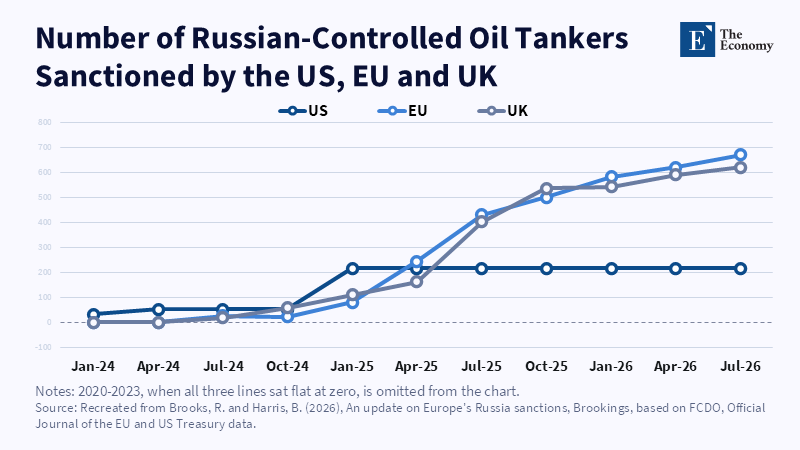
The clearest evidence of Europe's growing appetite for sanctions lies in the numbers surrounding Russia's "shadow fleet," the old tankers used by Moscow to sell oil above the G7 price cap. The EU had sanctioned just 25 such ships in July 2024. By July 2026, this number had reached 671. The UK went from 17 ships to 621 in the same period. The United States, by contrast, has not added a single shadow fleet tanker since the end of the Biden administration in January 2025, despite once leading the effort with 216 entries against 75 in the EU and 110 in the United Kingdom. Coordination has also improved: 178 ships are now under joint US, UK and EU sanctions, up from zero two years ago, while another 395 are under joint EU and UK sanctions alone.
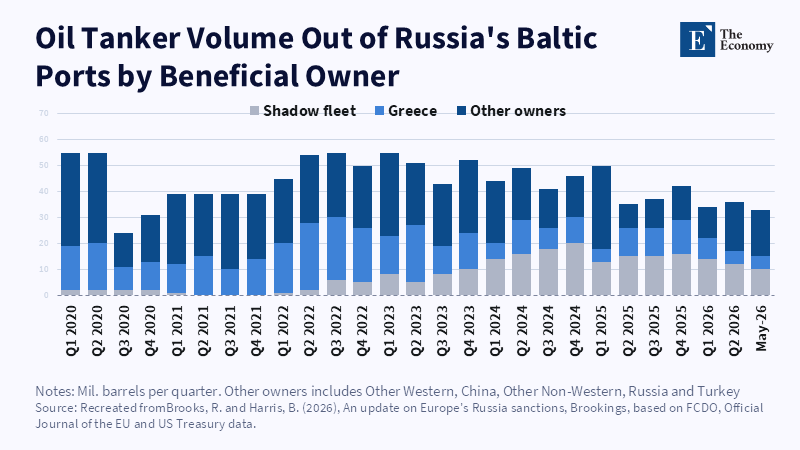
The higher numbers did not translate into a bigger blow to Russian oil exports. The traffic of tankers from Russian Baltic ports, the exit point for about half of the country's marine crude oil, reveals the most difficult side of the story: the share of this traffic carried by shadow fleet ships and other unidentifiable, uninsured vessels increased from about a quarter of total tonnage to 70 percent during 2025. Analysts who monitor tankers argue that a U.S. listing has a much greater deterrent weight than an EU or U.K. listing alone, mainly because Washington can threaten secondary sanctions on anyone who trades with a registered vessel, a tool Brussels lacks. When the Trump administration actually acted, imposing sanctions on the oil giants Rosneft and Lukoil, the discount on Russian crude widened sharply. Then the war between the United States and Iran sent global oil prices soaring and Washington granted exemptions that allowed the sale of Russian crude that had remained stored on tankers, canceling out much of the previous result. The U.S. Treasury Department has yet to approve a buyer for Luloil's assets, which the sanctions sought to force to be sold.
The EU's internal politics further complicate the picture. Greece delayed the bloc's most recent package of sanctions for weeks until it secured a special exemption allowing Greek-flagged ships to continue carrying Russian liquefied natural gas from the Arctic, an exception that caused outright discontent among diplomats from other member states who had pushed for a clean, uniform ban at the EU level. The episode mattered less for the volume of gas involved and more for what it revealed: national economic interests can still outweigh the collective appetite for a deeper blow to Moscow, even after twenty-one rounds of sanctions and years of rhetorical unity. A regime based on unanimous votes among 27 governments will continue to produce such compromises and each exception erodes a little more the uniformity on which the effectiveness of the entire policy depends.
The Energy Paradox That Undermines Pressure
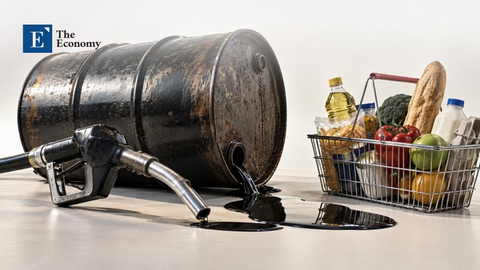
Much of this year's political appetite for sanctions clashes with a distinct, energy-determined reality. The war between the United States, Israel and Iran disrupted navigation through the Strait of Hormuz and forced Qatar to declare force majeure on the country's largest liquefied natural gas plant, responsible for a fifth of the global market. European gas benchmarks jumped more than 60 percent in a month, reaching around €53 per megawatt hour in March, while inventory levels fell to around 28 to 30 percent of capacity, versus a five-year average closer to 45 percent. Europe is now competing directly with Asian buyers for the same cargoes, with the Asian premium in the second quarter moving about a dollar and a half above European prices in the main benchmarks.
The predictable outcome followed: imports of Russian liquefied natural gas into the EU increased rather than decreased in the first half of 2026. Nearly 10 million tons arrived from the Yamal terminal alone, with most ending up in France, Belgium and Spain, drawn back to the European market in part by the very price increase caused by the war with Iran. The shipments remain legal because Yamal's existing contracts are exempt from the Russian gas phase-out regulation adopted by the EU in January 2026, until the end of this year; The gas pipeline is due to be banned until the fall of 2027, the liquefied version a little earlier, but transition clauses of this kind leave room for more, not less, imports every time prices rise elsewhere. This is the paradox at the heart of the matter that deserves to be said clearly: the same shock that makes EU governments talk tougher about Russia also makes their gas markets rely more on it.
Growth Headlines in Moscow, Doubt in the Data
The Kremlin has its own numbers to counter. Rosstat, the state statistics office, announced a 1.3 percent increase in gross domestic product in the second quarter of 2026, beating both government and central bank forecasts, after contracting in the first quarter, the country's first since 2023. The timing raised questions: the figure was published months after President Vladimir Putin publicly called for "concrete measures" from his economic team. Throughout the first half of the year, growth was just 0.6 percent, which is half the pace from last year and a fraction of the growth boom of 2023-24 due to the war.
Economists outside Russia read the same data differently. The recovery relies heavily on military spending and a temporary increase in oil revenues, rather than on the political economy, which continues to struggle due to high interest rates, while Ukrainian drone attacks have dropped refining volumes to their lowest level in twenty years. The International Monetary Fund forecasts Russian growth of about 1 percent for 2026, virtually unchanged from 2025 and comparable to some struggling EU economies, a comparison that Moscow prefers to present as resilience rather than stagnation. Oil and gas revenues have fallen by more than a quarter as the ruble has strengthened and sanctions have curtailed export volumes, forcing the government to raise its value-added tax from 20 to 22 percent and sharply lower the revenue threshold above which small businesses are required to subscribe to it, while defense spending remains close to 13 trillion rubles. A senior adviser to the Bank of Finland has described an economy essentially cut off from global capital markets, forced to finance domestically and procure highly specialized technological products through bypass solutions. Western intelligence agencies, meanwhile, suspect that Rosstat itself is underestimating the true extent of the pressure.
None of this settles the argument either way, and that is the point. The autumn package will add about 1,600 names, increase the total number under sanctions by a third and give Kallas the opportunity to call it the strictest round to date. Whether anything really changes depends on the same three gaps that this record continues to reveal: a U.S. government willing to announce sanctions but reluctant to impose measures against the tankers that carry the heaviest weight, a European gas market that turns back to Russian supply every time prices rise elsewhere in the world and a Kremlin capable of relying on war spending enough to produce a flattering quarter of growth. Penalties measured in new listings are easy to announce. Sanctions measured in barrels that were not loaded, cargoes that were not delivered and rubles that were not collected are much harder to build and the October vote will show which of the two Brussels has actually built.
This article reflects the analytical judgment of The Economy Editorial Board and does not constitute policy advice or the official position of any affiliated institution.
References
Brooks, R. and Harris, B. (2026) 'An update on Europe's Russia sanctions', Brookings, 6 August.
Euromaidan Press (2026) 'Russia's state statisticians report the growth Putin demanded — economists doubt it will hold', Euromaidan Press, 14 August.
Euronews (2026) 'After 20 rounds of sanctions, the EU sees cracks in Russia's economy', Euronews, 8 May.
Gwyn Jones, M. (2026) 'EU to propose tougher sanctions on Russia this autumn, Kaja Kallas says', Euronews, 17 August.
Istituto Affari Internazionali (2026) 'Europe wanted to quit Russian energy, Iran's war just complicated that', Istituto Affari Internazionali, 13 March.
Natural Gas Intelligence (2026) 'Russian LNG imports to EU rising despite looming import ban', Natural Gas Intelligence, July.
New Eurasian Strategies Centre (2026) 'The price of stability: what awaits Russia's economy in 2026?', New Eurasian Strategies Centre, 12 February.
The Moscow Times (2026a) 'Russia's economy in 2026: more war, slower growth and higher taxes', The Moscow Times, 2 January.
The Moscow Times (2026b) 'Russian economy returns to growth, but economists warn rebound may be short-lived', The Moscow Times, 13 August.
Ukrainska Pravda (2026) 'EU prepares "largest-ever" sanctions against Russia – details', Ukrainska Pravda, 17 August.
Working across research, policy, and data-driven analysis, the Editorial Board ensures that published pieces reflect a consistent institutional perspective grounded in quantitative reasoning and long-term structural assessment.