“Supplies Hard to Secure From U.S. and Russia” Iran War Exposes Limits of EU Energy Supply Chain as Gas Inventories Dwindle and Alternatives Remain Uncertain

Aoife Brennan is a contributing writer for The Economy, with a focus on education, youth, and societal change. Based in Limerick, she holds a degree in political communication from Queen’s University Belfast. Aoife’s work draws connections between cultural narratives and public discourse in Europe and Asia.
Authored On
Modified
EU gas storage levels decline as natural gas prices soar
Falling Russian gas imports and Middle East risks deliver a severe blow
Alternatives—including U.S. and Russian energy imports and greater diesel use—face clear constraints
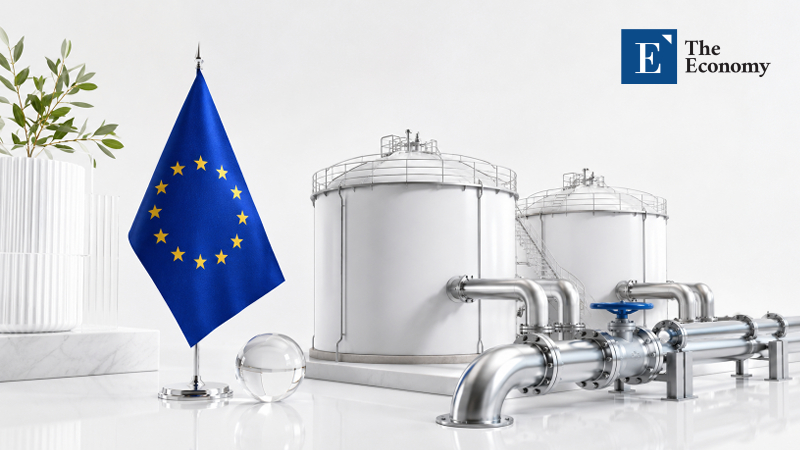
The European Union’s energy crisis is visibly intensifying. Disruptions to shipping through the Strait of Hormuz following the outbreak of the Iran war have impeded liquefied natural gas (LNG) supplies from Qatar and other Gulf states, accelerating the depletion of Europe’s gas inventories. Experts warn that Europe has few viable options available to mitigate these risks. U.S. LNG suppliers face liquefaction bottlenecks that constrain any rapid increase in shipments, while a return to Russian energy and additional diesel procurement remain effectively unfeasible.
EU Gas Inventories Flash Warning Signs
OilPrice.com reported on the 16th that “the volume of gas Europe can secure ahead of winter has become even tighter than during the 2022 energy crisis.” Data from Gas Infrastructure Europe (GIE) showed that EU gas storage facilities were only 57% full at the beginning of this month. That figure stood well below the 69–70% recorded during the same period last year and marked the lowest level since 2011. It also remained far short of the EU’s mandated 90% storage target, which must be reached between October 1 and December 1 each year.
The inventory shortfall has also driven prices sharply higher. Dutch Title Transfer Facility (TTF) futures, the benchmark for European natural gas prices, jumped more than 5% on the 10th alone to approximately $68.04 per megawatt-hour (MWh). Prices climbed above $71.75 during intraday trading on the 11th, approaching the recent peak of roughly $72.90 recorded on the 24th of last month. OilPrice.com estimated that European natural gas prices are currently about twice as high as before the Iran war began and warned that the burden could intensify once competition to replenish winter inventories gathers momentum.
Supply Risks From the Iran War
Europe’s energy crisis stems from a geopolitical bottleneck underpinning its inventory shortfall. Following Russia’s invasion of Ukraine in 2022, Europe reduced its dependence on Russian pipeline gas and rapidly expanded LNG imports, primarily from the United States and Qatar. Reliance on a single supplier declined, but the supply chain became correspondingly more exposed to international LNG prices and maritime transport networks. That shift collided directly with the Iran war that erupted this year.
Shipping through the Strait of Hormuz has been effectively paralyzed since military clashes involving the United States, Israel and Iran escalated in February. Before the war, approximately 20% of global seaborne oil and gas shipments passed through this critical maritime chokepoint. LNG exports from Qatar and the United Arab Emirates (UAE), which collectively account for 20% of global LNG supply capacity, also moved through the strait. Europe’s new LNG supply axis has consequently fallen within the direct reach of geopolitical risks emanating from the Middle East.
Qatar Declares Force Majeure
The Middle East’s aggregate gas supply has also declined. At Qatar’s Ras Laffan LNG complex, the world’s largest LNG export hub, two liquefaction trains were damaged in an Iranian attack, causing physical disruptions to production. The two affected trains have a combined annual production capacity of approximately 12.8 million metric tons, equivalent to about 17% of Qatar’s total LNG production capacity. QatarEnergy, the country’s state-owned energy company, subsequently declared force majeure, citing difficulties in fulfilling its existing long-term contracts.
The development dealt a severe blow to Europe’s energy supply chain. One of the most prominent casualties was Italian energy company Edison. Since 2009, Edison has received 6.4 billion cubic meters of gas annually under a 25-year contract with QatarEnergy, equivalent to about 10% of Italy’s annual gas consumption. QatarEnergy initially notified Edison that it would be unable to deliver 10 LNG cargoes scheduled between April and mid-June. By late June, however, the number of canceled cargoes had risen to 21, equivalent to approximately 2.7 billion cubic meters. Three additional cargoes were withdrawn late last month, bringing the total volume covered by the force majeure declaration to 24 cargoes, or approximately 3 billion cubic meters. That represents nearly half of Edison’s contracted annual supply from Qatar.
Scenario for Expanding U.S. LNG Supplies
Higher imports of U.S. LNG rank among Europe’s most plausible options for easing the current energy crisis, as U.S. gas inventories have continued to accumulate. In its latest outlook, the U.S. Energy Information Administration (EIA) projected that domestic natural gas production would rise to a record high and inventories would reach 3.985 trillion cubic feet by the end of October. Prices also remain relatively low. The U.S. Henry Hub natural gas benchmark is forecast to average $2.87 per million British thermal units during the third quarter.
U.S. natural gas export infrastructure, however, lacks the capacity to keep pace with demand. Natural gas cannot be loaded directly onto ships and must first undergo liquefaction at an LNG terminal. U.S. liquefaction facilities are already operating at high utilization rates, leaving limited scope to process substantial additional volumes over the short term. Maximum U.S. LNG export capacity is currently capped at approximately 18.3 billion cubic feet per day. Maintenance work at Freeport LNG in Texas, which began last month, has also temporarily sidelined more than 10% of total U.S. export capacity. Even with rising natural gas production, the United States has little immediate capacity to fill Europe’s LNG supply gap.
Sanctions on Russian Energy Remain in Place
Some observers have also raised the prospect of an EU return to Russian gas. Europe has already imported substantial volumes of Russian LNG since the Iran war began. EU imports of Russia’s Yamal LNG reached a record 9.89 million metric tons in the first half of this year, up 18% from the same period a year earlier. Calls to lift sanctions on Russian energy have also emerged in several Eastern European countries. Slovak Prime Minister Robert Fico publicly argued in April that the EU should lift sanctions on Russian oil and gas and restore normal supplies through the Druzhba pipeline to alleviate the energy crisis triggered by the Iran war.
The EU is nevertheless unlikely to reverse its decision to phase out Russian energy. The bloc adopted its 21st sanctions package against Russia last month, intensifying pressure on the country’s energy and financial sectors, while maintaining its existing timetable for a complete phaseout of Russian gas imports. Imports of Russian LNG under long-term contracts will be fully prohibited from January 2027, followed by a complete ban on pipeline gas in the second half of 2027. European Commission officials have also maintained a hard line. Valdis Dombrovskis, the European commissioner for economy, said in May that the energy crisis caused by the Iran war should not prompt a return to Russian energy and instead called for stronger sanctions against Moscow.
Table 1. Europe’s Energy Crisis Response Scenarios
| Response scenario | Constraints |
|---|---|
| Increase U.S. LNG imports | U.S. natural gas production and inventories are sufficient, but liquefaction and export infrastructure constraints limit the scope for a substantial short-term increase in supply |
| Resume Russian gas imports | The EU continues to pursue a phased, comprehensive ban on Russian gas imports |
| Use diesel and other petroleum products | Supply disruptions from the Middle East and Russia are becoming increasingly visible, while declining U.S. inventories and stronger winter domestic demand limit export growth |
Diesel Supply Chain in Severe Disarray
Meeting energy demand with diesel and other petroleum products also remains effectively unfeasible because the diesel supply chain itself has entered another crisis. The global diesel market has tightened rapidly under the combined impact of the Iran war and Ukrainian attacks on Russian refining facilities. According to Bloomberg, the Middle East and Russia together accounted for approximately one-third of global diesel exports last year. The disruption has placed Europe—where domestic diesel refining capacity is insufficient and import dependence remains high—on high alert. European diesel inventories currently stand at approximately 1.49 million metric tons, well below the five-year average of 1.89 million metric tons.
Europe also faces limits in covering the shortfall through U.S. diesel imports, its customary fallback option. U.S. diesel inventories are declining, while winter demand is expected to rise. Reuters reported that U.S. middle-distillate inventories, including diesel and heating oil, stood at 107.2 million barrels as of the 31st of last month. That marked the lowest level for the period in 30 years. “U.S. Gulf Coast refiners cannot continue exporting diesel to Northwest Europe indefinitely,” said Zameer Yusof, head of clean petroleum products analysis at commodity data analytics firm Kpler. “They have their own problems to address.” He added, “As the first quarter of next year approaches, U.S. refiners will typically begin redirecting supplies to the East Coast to meet winter heating demand.”
Aoife Brennan is a contributing writer for The Economy, with a focus on education, youth, and societal change. Based in Limerick, she holds a degree in political communication from Queen’s University Belfast. Aoife’s work draws connections between cultural narratives and public discourse in Europe and Asia.
Similar Post