EU Debt and Member States: Rivals in Bond Markets

Working across research, policy, and data-driven analysis, the Editorial Board ensures that published pieces reflect a consistent institutional perspective grounded in quantitative reasoning and long-term structural assessment.
Authored On
Modified
EU borrowing rose to 5.4 percent of GDP
Its bonds compete with national issuers for investors
Rising interest bills fall back on member states

In 2020, the debt issued by the European Union on behalf of member states accounted for 2.9 percent of their total GDP, while in 2025 the figure had reached 5.4 percent, according to Eurostat data. In absolute terms, borrowing increased fivefold in five years and the stock of EU debt approached the total public debt of Belgium and the Netherlands combined. The European Commission, which until 2019 appeared in the markets sparsely and almost always as an intermediary for states in difficulty, raised 11 billion euros with the seventh bond issue of 2026 through a syndicate of banks. The role of lender of last resort, as it was shaped in the crisis of 2008 to 2010, has given way to an issuer with a stable financing program, regular auctions and a network of primary dealers, which operates in the same field as the finance ministries of the member states.
The Lender that Became a Regular Issuer
Before the pandemic, the Commission's borrowing served three loan programmes: the European Financial Stabilisation Mechanism for euro area countries, balance of payments support for non-euro area countries, and macro-financial assistance to non-EU countries. They all worked in a matched way known as back-to-back, i.e. the country that received the money was directly charged with the principal and interest, while the Union essentially lent its creditworthiness. The size was small and the timing of issuances followed the needs of the beneficiaries. The European Court of Auditors has recorded that the Commission was in 2019 in 15th place among the largest debt issuers in the euro area and in 2021 it had risen to fifth, behind only France, Germany, Italy and Spain, a move that took two years.
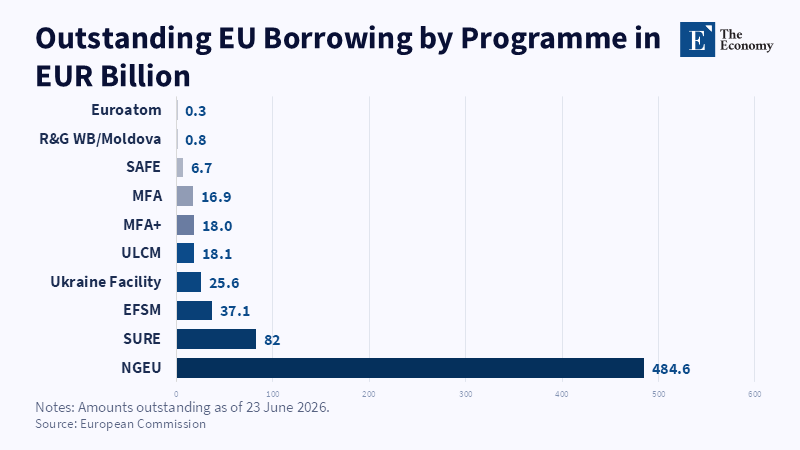
The pandemic made the old model insufficient. The SURE facility distributed €98.4 billion in loans to 19 countries, NextGenerationEU provided €338 billion in grants and loans of up to €385.8 billion through the Recovery Fund, with an additional €83.1 billion for other budget programmes, and Bruegel estimated that of the approximately €400 billion of EU debt in circulation in May 2023, 85 percent came from post-2020 borrowing. European Commission data shows around €375 billion of new bonds in the period 2020 to 2023, compared to €78 billion for the whole period 2009 to 2019. The SAFE program for defense investments, with a ceiling of up to 150 billion euros, was added later, after the Russian invasion of Ukraine, and so the list of funded programs continued to grow without the previous chapter having been repaid.
How EU Debt Competes with National Bonds
Union and Member State bonds are addressed to the same buyers. According to Bruegel, EU securities have the same favourable regulatory treatment as government bonds of the highest tier, with a zero risk weight for banks under Basel III and no capital charge for insurance companies, so that a fund or bank can choose between a Commission bond and a German or French one without regulatory costs. However, the market does not see them as equivalent. The ten-year yield spread of EU bonds against the German Bund hovered around 20 basis points in 2021 and exceeded 80 in October 2022, while the average bid-ask spread was twice that of French and German bonds, an indication of lower liquidity.
The picture of national issuers being crowded out by the new issuer, however, is more complex than it seems. Bruegel itself attributes most of the increase in 2022 yields to the ECB's monetary tightening and the divergence between the swaps and the Bund curves, as EU securities are contractually priced against swaps rather than the Bund. The abundance of supply added only a few basis points to the margin relative to other supranational issuers, and the institution itself notes that the effect cannot be measured accurately because the ECB does not detail its purchases of supranational bonds. The manner of issuance also matters: syndicated issues accounted for 50 percent of the volume in 2022, while in Germany 4 percent, in France 2 percent, and in Spain 13 percent, with an average oversubscription ratio of 9.6 in these issues and 1.9 in auctions. This pattern suggests that the Commission may be selling its debt cheaper than it would need.
The most common objection considers the issue exaggerated, with the argument that a stock of around €400 billion in 2023 was small compared to France's €2.3 trillion. The argument measures the total, while competition becomes week by week and maturity by maturity. A single transaction of €11 billion in 2026 exceeds the average volume of Spanish syndicated issues in 2022, which was 7.5 billion, and binds the same capacity of traders and the same investor demand for safe assets. This is competition for a limited share of demand, amplified when conditions tighten, and the exact intensity remains an open question.
Who Pays the Interest Bill on EU Debt
The benefits are real and must be recorded. For a Member State whose own borrowing costs exceed those of the Union, as may be the case in Eastern European economies, a loan based on the Commission's credibility is cheaper than the open market. The analysis published in Intereconomics in 2023 notes that EU borrowing costs were higher than those of Germany and France, but lower than Spain and Italy. The advantage therefore depends on the starting point of each borrower and shrinks as the Union's margin widens, as was the case in 2022, so it is not a fixed advantage.
Interest costs have already increased significantly. Eurostat records total EU interest expenditure of €17.9 billion in 2025, more than three times the 2022 level, while the Commission's initial forecast put the cumulative interest borne by the EU budget at just €14.9 billion by 2027. Bruegel had already estimated in 2023 that these costs would double, with an annual expenditure of €9.9 billion in 2027 instead of around €5 and given that interest on grants is covered by the Union budget, these amounts compete with programmes such as Erasmus+ and the European Social Fund Plus, which are subject to the same expenditure ceilings. The mid-term revision of the Multiannual Financial Framework at the beginning of 2024 has already created a dedicated instrument to cover higher service costs.
The resources that will cover the bill have not yet been secured. The tax on non-recyclable plastics is almost the only new own resource that has gone ahead and accounted for 3 percent of EU revenues in 2025, while the Commission has proposed five additional sources that it estimates will generate €44 billion per year, around 20percent of total 2025 revenues. Bruegel estimates that annual debt service on NextGenerationEU grant funding, interest plus repayment, could peak at €27 billion to €32 billion in 2030 in its 75th and 95th percentile scenarios, against interest of €10.8 billion in the baseline. Negotiations on the 2028 to 2034 budget are ongoing and the final package has not been decided. Any part that is not covered by new own resources will end up in national contributions or cuts in other spending, i.e. in the member states themselves.
Less Room for Manoeuvre in the Next Crisis
The EU's debt is based on a guarantee that member states have already given. In 2020, an increase in the own resources ceiling by 0.6percent of gross national income was agreed, and most rating agencies, according to Bruegel, perceive it as joint and several liability. Fitch, Moody's and DBRS rated the EU AAA and S&P AA+ at the time of Bruegel's analysis in 2023. Bruegel finds that even peak debt service stays well below that 0.6percent ceiling, so default risk is remote. The constraint lies elsewhere, because every euro of headroom that stands behind existing bonds cannot be counted a second time. In a shock reminiscent of the years 2008 to 2010, the debate would start with a balance sheet already committed, with repayments projected from 2028 to 2058 and with financing needs peaking around the years 2028 to 2030, as the same analysis by Intereconomics points out.
At this point, a second objection arises, that borrowing is temporary and that net issuance ends in 2026. Borrowing stops, but interest does not, and the securities will be repaid for more than thirty years. Bruegel itself estimates that the declared temporality comes at a cost because investors cannot include a programme with a fixed end date in long-term portfolios, and that the widening of the margin in 2022 was partly linked to signals from some member states that borrowing would be one-off. The Intereconomics analysis adds that, as of late 2023, continuing NextGenerationEU beyond 2026 was not part of the policy agenda, which leaves the Commission's future presence in the market without a clear framework.
For those managing public debt, the consequences are practical. Finance ministries and debt management agencies will need a full picture of their liabilities, and Eurostat has now created a separate sector for the EU in the national accounts, so that a comprehensive measure of government debt, calculated from Eurostat data, exceeds the conventional measure by almost 2 percentage points of GDP. Coordinating the issuance calendar with the Commission's funding programme can limit overlaps. Bruegel also proposes to exempt the interest line from the expenditure ceilings, as requested by the European Parliament in 2022, to increase the share of auctions over syndicated issuances, and to strengthen liquidity infrastructure, such as electronic quoting platforms and a repo facility. The review of own resources remains the biggest open issue.
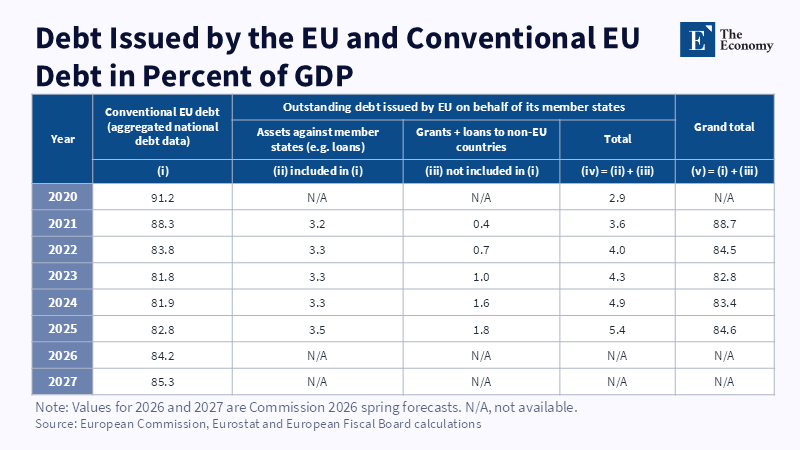
The 2.9 percent in 2020 became 5.4percent in 2025 and the annual interest expense exceeded €17.9 billion. The Commission's proposals for new own resources, if adopted in their entirety, would generate around €44 billion per year against peak annual debt service of €27 to €32 billion in 2030 in Bruegel's upper scenarios. Whether member states will accept the package in its entirety has not yet been decided.
This article reflects the analytical judgment of The Economy Editorial Board and does not constitute policy advice or the official position of any affiliated institution.
References
Claeys, Grégory, McCaffrey, Conor and Welslau, Lennard (2023a) 'The rising cost of European Union borrowing and what to do about it', Policy Brief 12/2023, Bruegel, Brussels.
Claeys, Grégory, McCaffrey, Conor and Welslau, Lennard (2023b) 'What will it cost the European Union to pay its economic recovery debt?', Analysis 28/2023, Bruegel, Brussels.
European Commission (2026) 'Commission issues €11 billion in its seventh syndicated transaction of 2026', Press release IP/26/1552, Brussels.
Larch, Martin and Lucius, Alice (2026) 'Lifting the curtain on the EU's debt', VoxEU, Centre for Economic Policy Research, 29 September.
Rodríguez-Vives, Marta (2023) 'Towards a common EU debt: where do we stand?', Intereconomics, 58(6), pp. 305-310.
The Larch and Lucius entry is the verified source for the 2.9%, 5.4%, €17.9bn, €44bn and 3% figures
Working across research, policy, and data-driven analysis, the Editorial Board ensures that published pieces reflect a consistent institutional perspective grounded in quantitative reasoning and long-term structural assessment.