“Yen Stays Weak Despite Highest Rates in 31 Years”: Japan’s Rate-and-Debt Spiral Raises Interest Costs Without Halting the Currency’s Slide

Siobhán Delaney is a Dublin-based writer for The Economy, focusing on culture, education, and international affairs. With a background in media and communication from University College Dublin, she contributes to cross-regional coverage and translation-based commentary. Her work emphasizes clarity and balance, especially in contexts shaped by cultural difference and policy translation.
Authored On
Modified
Continued U.S. tightening limits the yen-supporting effect of Japan’s rate hikes
Heavy public-debt servicing costs constrain Japan’s scope for further tightening
Persistent deficits threaten to increase bond supply and fuel a cycle of rising yields and debt
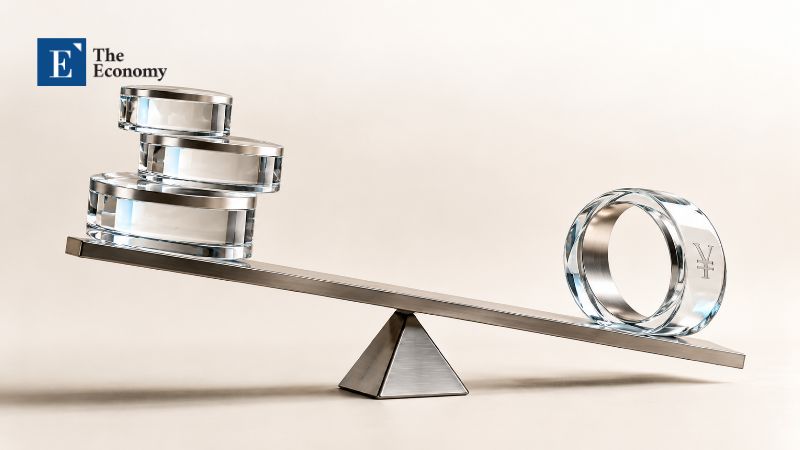
Japan has raised interest rates, yet it remains under pressure from both a weak yen and mounting interest costs. U.S. tightening has kept the two countries’ interest-rate differential from narrowing, limiting the support for the yen, while Japan’s swollen public debt makes further increases more costly. At the same time, higher government spending and reduced bond purchases by the Bank of Japan are expected to leave the market with more government debt to absorb. The prospect of further rate increases has also delayed the return of Japanese capital invested overseas, making it harder to secure buyers for the growing supply of bonds.
Overseas Capital Slow to Return Despite Japan’s Rate Hikes
Reuters reported on September 28 (local time), citing analysis from global asset managers, that uncertainty over where Japanese interest rates will ultimately peak is holding back a rapid repatriation of capital. Markets had initially expected the end of Japan’s long-standing negative-rate policy and the start of rate hikes to bring substantial amounts of Japanese capital invested abroad back home. Instead, rates that have fallen short of expectations and uncertainty over the path of further increases have left global asset managers reluctant to undertake a large-scale portfolio reallocation.
Paradoxically, uncertainty over further hikes has eased fears in global financial markets of a sudden unwind of the “yen carry trade,” in which investors borrow cheaply in yen to buy higher-yielding foreign assets. Experts have long warned that the simultaneous repatriation of trillions of dollars invested overseas could trigger a liquidity shock in global bond and equity markets. Because capital is returning more slowly than expected, however, the direct impact on global markets has so far been limited. Experts expect capital flows to become clearer once the Bank of Japan specifies the pace of future policy-rate increases and its schedule for reducing bond purchases.
Persistent Yen Weakness Adds Pressure to Tighten
With the repatriation of overseas capital delayed and the yen still weak, pressure on the Bank of Japan to tighten further is growing. Higher interest rates ordinarily raise returns on assets denominated in a country’s currency and thereby increase demand for that currency. The Bank of Japan continued tightening on September 18, raising its policy rate from 1% to 1.25%. The increase came just three months after its previous hike in June and brought the rate to its highest level in 31 years, since 1995. Despite the move, the yen fell as much as 1.3% against the dollar during the trading day, declining to approximately $0.00633. It showed no clear rebound afterward, trading around $0.00629 on September 25. Much of the yen’s appreciation earlier this month had thus been reversed, with no sustained recovery in its value following the rate hike.
As yen weakness persists despite the rate increase, Japanese authorities must weigh the scale of further hikes against the resulting interest burden. Government projections for next year’s budget already reflect higher debt-servicing costs as government bond yields rise. According to Kyodo News, Japan’s Ministry of Finance expects principal and interest payments on government bonds in fiscal 2027, which begins next April, to increase by about 17% from the previous year to approximately $230.4 billion. That would be a record, and the fiscal burden is set to accumulate as maturing bonds are refinanced at higher rates. The burden could also pass gradually to households and businesses that rely on borrowing. Monthly interest payments would rise if rates on floating-rate loans increase or existing loans are renewed at higher rates.
How much further the Bank of Japan raises rates is a key variable in assessing the future interest burden. In a Reuters survey conducted September 1–8, half of the 54 economists who answered an additional question about the terminal rate put it at 1.75%. That implies room for two more increases of 0.25 percentage points each from the current 1.25%. The share expecting a terminal rate of at least 2% also rose from 23% in July to 36% in August and 40% this month, indicating that more respondents anticipate a larger cumulative increase. On timing, about 62% expected the policy rate to reach at least 1.75% by the end of the second quarter of next year, bringing the projected date forward by three months from the previous survey. Some also expect the rate to reach 2% in the first half of next year. In a Reuters interview on September 24, former Bank of Japan board member Makoto Sakurai forecast a stepwise increase to 1.5% by year-end, 1.75% in the first quarter of next year and 2% around June.
Table 1. Key Factors Behind Concurrent U.S. and Japanese Tightening and Yen Weakness
| Category | Key details | Impact |
|---|---|---|
| Current policy-rate differential | The United States and Japan each raised rates by 0.25 percentage points, leaving the policy-rate differential at 2.5–2.75 percentage points. | Japan’s rate hike has done little to strengthen the incentive to buy yen. |
| Returns on dollar assets | The yield on the 10-year U.S. Treasury rose to 5.13% on September 23, its highest level since July 2007. | The yield advantage of dollar assets contributes to yen weakness. |
| Year-end rate outlook | Rates are forecast at 4–4.25% in the United States and 1.5% in Japan. Another 0.25-percentage-point U.S. hike would keep the differential at its current level. | Further Japanese hikes may have limited effect in supporting the yen. |
| Borrowing costs | The average rate on a 30-year fixed U.S. mortgage reached 7.03% on September 24. | Simultaneous tightening could increase refinancing costs for governments and businesses and interest costs on new household loans in both countries. |
Concurrent U.S. and Japanese Tightening Provides Little Incentive to Buy Yen
A principal reason the yen remains weak despite expectations of further Japanese rate hikes is the persistent interest-rate differential between Japan and the United States. The U.S. Federal Reserve (Fed) has also resumed tightening, offsetting the narrowing that Japan’s rate increase would otherwise have produced. On September 16, two days before the Bank of Japan’s hike, the Fed raised its policy-rate range by 0.25 percentage points to 3.75–4%. Because both countries increased rates by the same amount, their policy-rate differential remains at 2.5–2.75 percentage points. U.S. Treasury yields have also risen on expectations of further tightening, boosting returns on dollar assets. According to The Wall Street Journal (WSJ), the 10-year U.S. Treasury yield climbed 0.17 percentage points in a single day to 5.13% on September 23, its highest level since July 2007. With dollar assets retaining their yield advantage despite higher Japanese rates, the incentive to buy yen has not increased sufficiently.
Expectations of another U.S. hike further complicate the Bank of Japan’s decision on additional tightening. The Fed’s dot plot released this month projected a year-end policy-rate range of 4–4.25%, implying one more increase this year. Even if the Bank of Japan raises its rate to 1.5% by year-end as forecast, a further 0.25-percentage-point U.S. increase over the same period would leave the policy-rate differential unchanged. Japan could then incur higher domestic interest costs without securing much support for the yen through a narrower rate gap. The differential could remain in place even as borrowing costs rise in both countries. Japan faces additional interest costs from prospective hikes, while in the United States, the average rate on a 30-year fixed mortgage rose alongside Treasury yields to 7.03% on September 24. Continued tightening in both countries therefore raises the prospect of higher refinancing costs for governments and businesses, as well as higher interest payments for households taking out new loans.
Mounting Costs of Japanese Rate Hikes Make Deficit Reduction Urgent
As the costs of rate hikes mount, Japan has less policy room to defend the yen. Accelerating increases to narrow the gap with U.S. rates would require the government to bear higher interest costs on its accumulated debt. In a report released September 2, the Japan Research Institute projected that the effective interest rate on Japanese government debt would begin to exceed nominal economic growth persistently around 2030. The effective rate is the average interest rate the government actually pays on its total debt; the institute estimates that the gap between that rate and growth will widen to about 2 percentage points by 2040. Under those conditions, continued deficits even before interest payments would heighten the risk that debt grows faster than the economy. Issuing more bonds to pay rising interest could create a cycle in which debt and interest spending reinforce each other.
To escape that debt cycle, Japan needs to reduce its fiscal deficit and curb additional borrowing. Funding even its interest payments through bond issuance covers immediate expenses at the cost of larger future principal and interest obligations. As rates rise, interest takes up a greater share of the budget, making it difficult to reduce the deficit without cutting other spending or raising revenue. Breaking the cycle requires going beyond matching noninterest spending to revenue. When the effective interest rate exceeds nominal growth, the debt-to-gross-domestic-product (GDP) ratio rises even if the primary fiscal balance is in equilibrium. The government must run a primary surplus—leaving revenue after noninterest spending to cover part of its interest bill—to prevent the debt ratio from increasing. For a country with as much accumulated debt as Japan, even a small widening of the gap between interest rates and growth greatly increases the surplus needed to offset it. If debt continues to grow while fiscal adjustment is delayed, future spending cuts and tax increases will become correspondingly more onerous.
Persistent Japanese Deficits Add Upward Pressure to Bond Yields
Reducing the deficit quickly will be difficult, however, given the scale of spending increases sought by Prime Minister Sanae Takaichi’s government. Budget requests submitted by Japanese ministries for fiscal 2027 totaled approximately $900 billion as of the Ministry of Finance’s September 4 tally, approaching the scale of spending during the COVID-19 response. A change in budgeting practices also contributed: programs previously funded through supplementary budgets were included in the initial budget. Even allowing for that shift, the requests were approximately $15.7 billion above the roughly $884.3 billion combined total of the fiscal 2025 supplementary budget and the fiscal 2026 initial budget. In particular, approximately $75.5 billion in requests flowed into a new special-investment category for which the Takaichi government set no ceiling, increasing the amount that would need to be cut during the budget review. Spending requests could rise further once programs, including defense items submitted without finalized amounts, are included. If the government cannot reduce spending or raise revenue while finalizing the budget, it will have to cover the funding shortfall with another round of bond issuance.
The pressure from increased government-bond supply is likely to intensify as the Bank of Japan scales back its purchases. Under a plan adopted in June, the central bank will reduce its planned monthly bond purchases by approximately $1.26 billion each quarter through the first quarter of next year. From next April, it will maintain purchases at around $12.6 billion a month, an amount insufficient to reinvest all proceeds from maturing bonds in its portfolio. The Bank of Japan’s bond holdings will therefore continue to decline, leaving private investors to absorb more of the bonds the government issues to refinance maturing debt. If new bonds are also issued to finance fiscal deficits, securing sufficient demand from banks, insurers and other private investors could become harder still. The Japanese government may consequently have to offer higher yields to attract enough buyers.
Siobhán Delaney is a Dublin-based writer for The Economy, focusing on culture, education, and international affairs. With a background in media and communication from University College Dublin, she contributes to cross-regional coverage and translation-based commentary. Her work emphasizes clarity and balance, especially in contexts shaped by cultural difference and policy translation.
Similar Post