Chinese Rare Earth Supplies to Japan Dry Up, Putting EV and Chip Equipment Industries on Alert Despite 15-Year Decoupling Drive

Matthew Reuter is a senior economic correspondent at The Economy, where he covers global financial markets, emerging technologies, and cross-border trade dynamics. With over a decade of experience reporting from major financial hubs—including London, New York, and Hong Kong—Matthew has developed a reputation for breaking complex economic stories into sharp, accessible narratives. Before joining The Economy, he worked at a leading European financial daily, where his investigative reporting on post-crisis banking reforms earned him recognition from the European Press Association. A graduate of the London School of Economics, Matthew holds dual degrees in economics and international relations. He is particularly interested in how data science and AI are reshaping market analysis and policymaking, often blending quantitative insights into his articles. Outside journalism, Matthew frequently moderates panels at global finance summits and guest lectures on financial journalism at top universities.
Authored On
Modified
China blocks export licenses for heavy rare earth shipments to Japan
Manufacturing disruptions spread as stockpiles dwindle
Short-term supply resilience weakens, with the next year emerging as a critical juncture
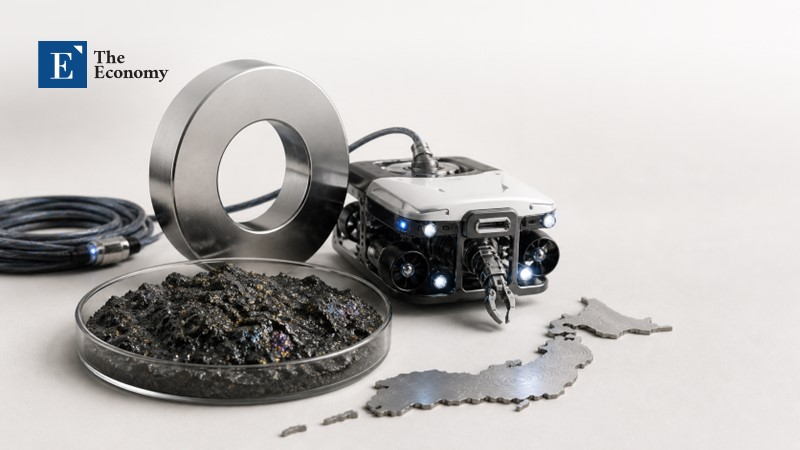
China’s rare earth export controls are striking at a critical vulnerability in the supply chain defenses Japan has spent 15 years building. Export licenses for Japan have faced successive blockages since Japanese Prime Minister Sanae Takaichi’s remarks about a potential Taiwan contingency involving military conflict, sending imports of two critical rare earth elements down approximately 80% in the first half of this year from the same period in 2024. Japan has reduced its overall reliance on China for rare earths to 60% over the past 15 years, but it still sources virtually all of its dysprosium and terbium from China. Alternative supply chains will require years to develop commercially viable capacity, leaving prolonged raw-material supply instability largely unavoidable.
Chinese Rare Earth Imports Plunge 80%
According to Japanese Ministry of Finance trade statistics released on August 19, Japan’s imports of two critical rare earth elements in the first half of this year plunged approximately 80% compared with the first half of 2024, before China imposed its export restrictions. Japan imported just 13 tons of dysprosium-iron alloy, an essential material that enhances the heat resistance of magnets used in electric vehicle and hybrid vehicle motors, representing an 82% collapse from the same period in 2024. Imports of yttrium oxide, used in durable coatings for semiconductor etching equipment components, also tumbled 74% year on year to 204 tons.
Official imports fell to zero in June. Chinese customs data show that shipments of gallium, dysprosium, terbium and yttrium from China to Japan all stood at “zero” that month. China’s total exports of rare earth permanent magnets rose from May to 5,649 tons over the same period, reinforcing the assessment that Beijing was deliberately delaying licenses for Japan. China continues to supply Japan with finished permanent magnets while blocking exports of the heavy rare earth feedstocks required to manufacture them. The policy precisely targets a supply chain bottleneck by pressuring Japanese magnet producers’ domestic output and increasing their reliance on finished Chinese products.
Rare Earth Retaliation Triggered by Taiwan Contingency Remarks
China, which controls approximately 70% of global rare earth mining and more than 90% of rare earth processing for permanent magnets, has wielded this dominance as a powerful instrument of economic coercion. The dispute began with Takaichi’s parliamentary remarks on November 7 last year concerning a potential Taiwan contingency. After demanding that she retract the comments, China prohibited exports of dual-use items destined for Japanese military end users and military applications in January. In February, Beijing added 20 companies, including affiliates of Mitsubishi Heavy Industries and Kawasaki Heavy Industries, to its export control list and placed another 20, including Subaru, TDK and Mitsubishi Materials, on a watchlist. Chinese authorities added 20 more entities to the watchlist in late June, extending their scrutiny across Japan’s defense, materials and electronics industries.
Heavy rare earths improve the heat resistance of high-performance magnets used in electric vehicle traction motors, industrial robots and semiconductor manufacturing equipment. They are consumed in small quantities but cannot be replaced rapidly, and a disruption involving a single material can reverberate through component certification and production planning. A Reuters review of Tokyo Stock Exchange filings found that regular disclosures mentioning rare earths had remained below 40 per month over the past decade but doubled after May this year. Of approximately 200 disclosures filed in May and June, more than two-thirds stated that China’s controls had adversely affected operations or could do so in the future.
Major Japanese Materials Companies Take a Direct Hit
The supply shortfall originating in China has already reached Japan’s magnet manufacturing operations. Shin-Etsu Chemical has reportedly suspended acceptance of new orders for magnets containing dysprosium. Mitsubishi Motors’ rare earth inventories are understood to be sufficient only through the middle of this year. Finished permanent magnets from China continue to arrive at normal volumes, but manufacturers that procure heavy rare earth feedstocks directly and produce their own magnets are contending simultaneously with dwindling stockpiles and rising prices.
Nonferrous metals conglomerate Mitsui Kinzoku is considering closing the rare earth sales office it opened in China’s Liaoning Province in April. The company has also encountered production disruptions involving rare earth products for semiconductor equipment that it intended to manufacture at its Fukuoka plant and export to China. Global magnet producer Proterial had received no export licenses for Chinese dysprosium as of last month and has been relying on its existing inventories.
Table 1. Japan’s Reliance on China in the Rare Earth Supply Chain and Vulnerabilities by Category
| Category | 2010 | Recent Status | Supply Chain Assessment |
|---|---|---|---|
| All rare earths | Chinese share approximately 90% | Chinese share approximately 60% | Average dependence reduced through supplier diversification |
| Light rare earths | Procurement centered on China | Supply sources diversified to Australia and Southeast Asia | Alternative procurement base secured |
| Dysprosium and terbium | Reliant on China | Dependence on China approaches 100% | Supply disruption risk remains concentrated |
| Response strategy | Supplier diversification begins | Expansion of national stockpiles, recycling and technologies that reduce consumption | Heavy rare earth procurement remains vulnerable |
Heavy Rare Earth Shortfall Persists Despite Stockpiling, Recycling and Efficiency Investments
At the beginning of this year, the Takaichi government maintained that Japan could withstand a prolonged confrontation with China because it had reinforced its rare earth supply chain. Since Chinese rare earth customs clearance effectively halted following the 2010 clash near the Senkaku Islands, known in China as the Diaoyu Islands, Japan has invested heavily in supplier diversification, national stockpiles, recycling and technologies that reduce heavy rare earth consumption. According to Nomura Research Institute (NRI), China’s share of Japan’s total rare earth imports has fallen from approximately 90% at the time to about 60% recently. The Takaichi government cited this figure to support its supply chain rationale for maintaining a hard line toward China.
The decline in average dependence failed to capture the wide disparities among individual materials. Japan has diversified its light rare earth supply sources to Australia and Southeast Asia, while its dependence on China for dysprosium and terbium still approaches 100%. Chinese pressure has concentrated on heavy rare earths for which Japan has yet to secure sufficient alternative supplies, exposing the weak point in the defenses built over the past 15 years. The reduction in China’s overall import share has provided little protection against the suspension of specific raw materials.
Australian and French Options Fall Short of Replacing Chinese Supply
Australian rare earth producer Lynas has emerged as the first commercial supplier positioned to fill the shortfall, but its production scale remains severely constrained. Japan Australia Rare Earths (JARE), a joint venture established by Japanese trading company Sojitz and the Japan Organization for Metals and Energy Security (JOGMEC), began importing Lynas-produced dysprosium and terbium into Japan last October. It expanded the contract this year to secure 75% of the company’s medium and heavy rare earth output. Lynas, however, produced a combined eight tons of dysprosium and terbium in the first quarter of this year, falling short of the 14-ton monthly average that China exported to Japan in 2024. Even with priority supply rights secured, replacing existing Chinese volumes will require substantial time to expand mine output and build additional separation and refining capacity.
Japan is simultaneously developing a French supply chain to address the volume shortfall, but that effort also faces considerable obstacles. French rare earth company Caremag, backed by JOGMEC and Iwatani, is building a heavy rare earth recycling and refining facility in Lacq in southwestern France, with operations scheduled to begin at the end of this year. The facility plans to process 2,000 tons of discarded magnets and 5,000 tons of mineral concentrate annually, producing 600 tons of dysprosium and terbium oxides, equivalent to approximately 15% of current global output. Japanese investors have secured 50% of production under long-term contracts, but the plant has yet to begin operations. Construction, commissioning and yield stabilization schedules leave it unable to fill the immediate supply gap created by China.
Minamitorishima Seabed Rare Earth Development Holds the Key to Supply Independence
Japan began accelerating the expansion of domestic refining capacity only after the supply restrictions took effect. Shin-Etsu Chemical plans to invest at least $220 million in a new rare earth refining facility in Fukui Prefecture, with the Japanese government providing half of the project cost, or approximately $110 million. The project will mark Shin-Etsu Chemical’s first construction of a new refining facility in Japan in 18 years, dating back to 2008. The company has yet to finalize the total investment, production capacity or launch date. With supply restrictions already in place for six months, the new facility will require considerable time for construction, commissioning and customer certification before entering commercial production.
Japan is also channeling public funding into “urban mining” projects that recover rare earth magnets from discarded appliances and electric vehicle motors, though the potential for substitution remains limited. A lengthy gap separates the surge in sales of electric vehicles and high-efficiency air conditioners from the point when those products enter the waste stream in large volumes. Even after recycling facilities begin commercial operations, initial supply is expected to cover only a fraction of total industrial demand. Japanese government subsidies are being deployed to bridge this gap, but they cannot immediately replace the physical volumes lost through the withdrawal of Chinese feedstocks.
Deep-sea rare earth development is also unlikely to prevent the immediate supply cliff. The Japanese government plans to develop rare earth-rich mud buried approximately 6,000 meters beneath the seabed in the Minamitorishima exclusive economic zone, about 1,900 kilometers southeast of Tokyo, with commercial utilization targeted for after 2028. Estimated reserves total 16 million tons, far exceeding Japan’s rare earth demand of 21,181 tons last year. Yet the Japan Agency for Marine-Earth Science and Technology (JAMSTEC) recovered only 50 tons of mud from a depth of 5,569 meters in February this year. Even if a demonstration project covering the mining, transportation, separation and refining of 350 tons per day begins next February, the economic feasibility assessment will not be completed until March 2028. The high-cost process of pumping the mud from the seabed, transporting it to Minamitorishima for dewatering and then shipping it again to mainland Japan for smelting also remains unresolved.
Successful development at Minamitorishima would give Japan a domestic supply chain integrating heavy rare earth feedstock procurement with separation and refining, while China would lose one of the world’s largest consuming countries as a critical customer. Failure to achieve commercial viability would signal to global markets that even Japan’s 15 years of investment in reducing reliance on China had failed to deliver heavy rare earth self-sufficiency, further consolidating Beijing’s dominance over supply. “The next year or so will be the decisive period for the rare earth market,” an industry expert said. “If Japan fails to reduce mining and refining costs during this period, its independent supply chain strategy will lose momentum and pressure will mount to renegotiate supply terms with China.”
Matthew Reuter is a senior economic correspondent at The Economy, where he covers global financial markets, emerging technologies, and cross-border trade dynamics. With over a decade of experience reporting from major financial hubs—including London, New York, and Hong Kong—Matthew has developed a reputation for breaking complex economic stories into sharp, accessible narratives. Before joining The Economy, he worked at a leading European financial daily, where his investigative reporting on post-crisis banking reforms earned him recognition from the European Press Association. A graduate of the London School of Economics, Matthew holds dual degrees in economics and international relations. He is particularly interested in how data science and AI are reshaping market analysis and policymaking, often blending quantitative insights into his articles. Outside journalism, Matthew frequently moderates panels at global finance summits and guest lectures on financial journalism at top universities.
- Previous “German Benchmark Remains a Distant Goal”: Government Unveils Zero-Tuition Plan for Regional National Universities, Raising Equity Concerns Among Private Institutions and Questions Over Educational Competitiveness
- Next “Supplies Hard to Secure From U.S. and Russia” Iran War Exposes Limits of EU Energy Supply Chain as Gas Inventories Dwindle and Alternatives Remain Uncertain
Similar Post