European Car Industry Faces a Scale Built by the State

Working across research, policy, and data-driven analysis, the Editorial Board ensures that published pieces reflect a consistent institutional perspective grounded in quantitative reasoning and long-term structural assessment.
Authored On
Modified
China's EV cost lead grew from state-backed scale
Lost European supplier capacity may prove hard to rebuild
Temporary protection must bind European producers too
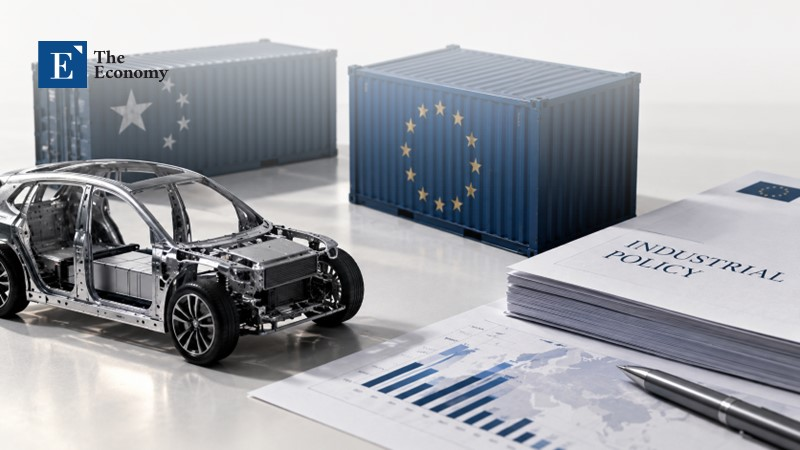
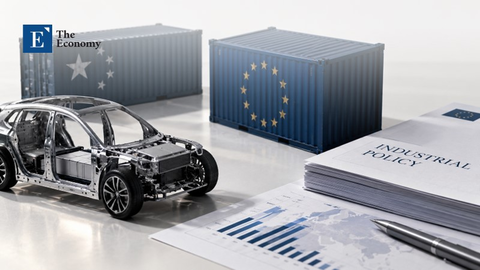
Of the more than 20 million electric cars sold worldwide in 2025, three in five carried the badge of a Chinese manufacturer, while European groups, according to the International Energy Agency, held around 15%, roughly the same as North American ones. In the same year the European market grew faster than any other major market, with electric cars reaching 28% of sales, which makes the picture even more uncomfortable for the European car industry, since demand was growing while an ever larger share of it was met by factories outside Europe. In August 2026 Chinese brands reached, according to Dataforce data, 11.7% of passenger car registrations in Europe, the highest share they have recorded. The usual policy response asks European manufacturers to restructure and become cheaper, with as little protection as possible. It overlooks that the Chinese cost advantage was formed under conditions far removed from ordinary market competition.
An Advantage Financed Before It Became Profitable
The diagnosis of the European lag is well known and largely correct, with high labor and energy costs, insufficient scale in batteries, weak software and slow model development cycles and the pressure is first seen on suppliers, who according to CLEPA announced 54,000 job cuts in 2024 and another 50,000 in 2025, against about 7,000 new jobs. The recipe for restructuring without protection makes serious economic sense. Tariffs drive up domestic prices, relax competitive discipline and keep alive producers that the market would have withdrawn and the Kiel Institute's simulations of a 20% tariff concluded that consumers would pay significantly more for their electric cars because production within the Union costs more. The weak point of the recipe is an implicit assumption that the Chinese advantage arose mainly from ordinary competition.
The speed at which the Chinese electric car industry was set up is difficult to explain with cheaper labor or the flexibility of private companies. The Center for Strategic and International Studies estimates government support for the sector from 2009 to 2023 at $230.8 billion, an amount equal to 18.8% of the value of all electric car sales in the period, with just over half being for the exemption from purchase tax and describes the estimate as conservative, since it leaves out local programs, cheap land, electricity and credit. Support went beyond money, as for a time purchase subsidies required batteries from approved domestic suppliers, an arrangement that helped Chinese companies get ahead at the expense of consumers and foreign competitors. In 2025, China accounted for over 80% of the world's battery cell production.
These amounts do not coincide with the legal concept of the subsidy. In October 2024, the European Commission imposed definitive five-year countervailing duties on Chinese battery electric cars, above the usual 10% tariff, with 17% for BYD, 18.8% for Geely, 35.3% for SAIC and 7.8% for Tesla Shanghai. Such a duty measures specific subsidies in a specific investigation period and leaves out the concentration of suppliers in industrial zones of local governments or the demand created in years when no private individual would bet on such a scale, so the legal measurement acts as a floor for the broader state support. There is no need for a moral judgment about the Chinese choices, since, from Beijing's point of view, they succeeded, as long as it is recognized that the Chinese state bore some of the financial risk before the industry became profitable.
How Subsidies Turn Into Scale and Learning
The simple version of the argument wants the subsidy to lower the price and its abolition to bring it back, so a tariff equal to the subsidy would suffice. The mechanism that matters works more slowly and lasts longer, because support finances expansion, expansion brings scale, scale accelerates learning through production and attracts supplier investment and lower cost per unit gains shares that, in turn, bring even more scale. In batteries, where costs fell by more than 90% in a decade, a paper by the National Bureau of Economic Research estimates the learning rate at 9.2%, meaning that each doubling of cumulative production cuts unit costs by roughly that much. A subsidy that bought early volume also bought a place on the learning curve, which a later entrant has to go through from the beginning, with its own funds and without the volume that would finance the route.
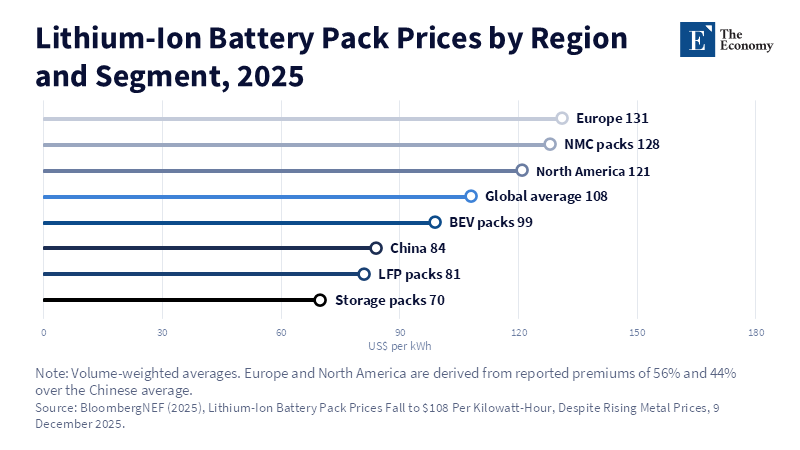
Prices clearly show this. BloombergNEF recorded an average lithium-ion battery pack price of $108 per kilowatt-hour for 2025, the lowest ever measured, with China at $84 and Europe 56% more expensive, while in the same year China produced, according to the International Energy Agency, almost 75% of the world's approximately 22 million electric cars. The time course of the support says even more about how resilient the advantage is, since according to CSIS, its ratio to electric car sales fell from over 40% before 2017 to just over 11% in 2023, at the same time that the industry's international competitiveness was rising faster than ever, which is only easily explained if the advantage has already been passed on to scale, learning and supplier density.
The Rhodium Group estimated in April 2024 that even with a 30% tariff BYD would earn from each Seal U in Europe about 4,700 euros more than in China and that 45% to 55% tariffs would be needed to stop exports from profiting, while the tariff finally imposed on BYD was 17%. Chinese manufacturers are not lagging technologically and the scale allows them to reinvest in battery chemistry, software and faster model refreshes. The transition from subsidy to efficiency is not self-evident, however, as shown by Chinese shipbuilding, where a study in the Review of Economic Studies found that government support spectacularly increased investment and global share, but yielded low returns and left behind fragmentation and idle capacity. In batteries, the steep learning curve and margin squeeze seem to have discarded the less efficient, with a consequence that is not at all comforting for Europe, since the advantage it faces is largely real efficiency and it is not going to fade away on its own as the support that gave birth to it weakens.
Why the European Car Industry Is Hard to Rebuild
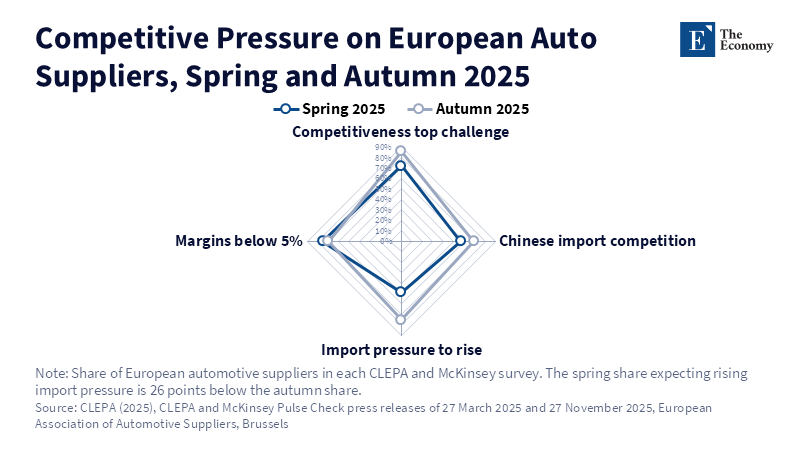
The argument for smooth adjustment wants inefficient production to shrink and resources to go to higher-value uses, as if factories were independent units that are closed today and reopened when conditions improve. The European car industry operates as an ecosystem of specialized suppliers, machine tools, engineering teams, test laboratories and supply networks and much of its value lies in the relationships between them, built over decades and not bought ready-made. Suppliers bend first, with tighter margins and greater dependence on their customers' volumes. In a CLEPA survey published in May 2025, 62% of businesses reported overcapacity and rising fixed costs, while at the beginning of the year 57% of announced job losses were due to bankruptcies or factory closures, compared to an average of 22.5% in 2020 and in January 2026, 70% of suppliers expected margins below 5%, the threshold below which investments in technology and skills are difficult to continue.
The shift from internal restructuring to closure is qualitatively important because a shrinking company keeps its capabilities on a smaller scale while one that closes loses them along with its relationships, setting up a reverse cycle of the Chinese one, where the lost share reduces expected volumes, smaller volumes cut investments and cuts drive up relative costs. Northvolt, one of the most prominent European efforts in battery cell production, filed for bankruptcy in Sweden on March 12, 2025, citing increased cost of capital, geopolitical instability and severe difficulties in scaling up production. Scaling up is precisely the phase where the learning curve begins, when scrap rates fall and processes stabilise and whoever cannot finance it never reaches the point where costs recede, which is why the European Commission, in the final findings of its investigation, based the threat of injury mainly on investments that would be hindered by cheap imports and much less on current sales.
The Consumer Price and the Costs It Leaves Out
The argument in favor of free trade holds all its strength. If Chinese electric cars are cheaper, European buyers win, while a tariff that delays the adoption of electric cars also has an environmental cost that is not offset by any jobs it saves. The simulations of the Kiel Institute gave this logic a specific form, since a 20% tariff would reduce imports of electric cars from China by 25%, about 125,000 vehicles worth $3.8 billion based on 2023 volumes and only part of the European increase would come from new production, with the rest moving from exports. The researchers also noted that Chinese companies could meet demand from new factories within Europe and that the simulation did not involve retaliation, which they considered to be expected.
Consumer prices, however, do not contain what is lost with production, such as skills passed on to related industries, supplier networks and regional economic activity. The National Bureau of Economic Research's work on batteries gives a concrete reason for the discrepancy between static and dynamic welfare, since it finds that suppliers retain only a small part of the benefits of learning and that subsidies to consumers correct this under-provision, which means that the price that the buyer sees today does not contain the value of learning on which tomorrow's price will depend. The same finding limits expectations, however, because protection pays off mainly when applied early and Europe is starting the effort in a market where the learning curve has already been crossed by others.
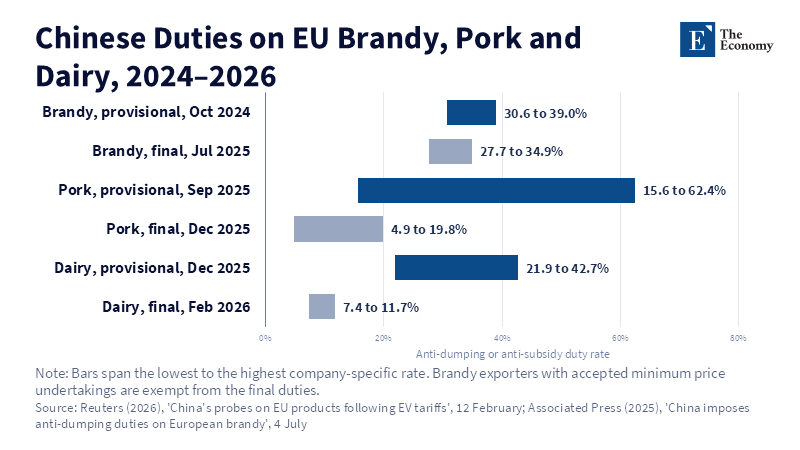
Retaliation did not remain theoretical and came in sectors that have nothing to do with cars. Beijing imposed tariffs of up to 34.9% on European brandy from July 2025, with exceptions for 34 companies that committed to minimum prices, definitive tariffs of 4.9% to 19.8% on pork from December 2025 and tariffs of 7.4% to 11.7% on dairy in February 2026, so that the sectors that pay the bill are not the ones that are protected, which turns trade policy into an internal distribution problem among farmers, distillers and the car industry. Added to these are inflationary effects, higher costs for industries using Chinese intermediate inputs, restrictions under World Trade Organization law and pressure from incumbent producers to make protection permanent.
Temporary Protection With Conditions for All Producers
Protection can allow inefficient companies to avoid restructuring by driving up prices, holding margins and postponing investment and if the European car industry responds to tariffs in this way, it will come out weaker. A convincing scheme would provide a time-limited window of protection that is gradually decreasing and linked to measurable targets, such as the production of pure electrics, the capacity of battery cells in actual operation rather than in announcements, productivity per vehicle, investment and cost convergence with international competitors. The experience of the first two years already shows the limits of a measure that covers a single drive technology, as according to the Bank of Finland's Institute for Emerging Economies, Chinese exports quickly returned to pre-tariff levels as manufacturers switched to plug-in hybrids and internal combustion engines.
The expiry of the definitive duties in 2029 lends itself to being a natural checkpoint, with any prolongation depending on published progress indicators rather than on the general intensity of imports. The conditions that exist today, such as the commitment to a minimum price, volume cap and intra-Union investments accepted by the Commission from a Chinese exporter in February 2026, apply almost entirely to foreign firms, while incumbent European producers enjoy protection without any corresponding published commitment to investment, volumes or cost convergence. If competitiveness does not improve after a reasonable period of time, the protection results in a transfer of resources from consumers to the shareholders of protected undertakings and then it is hardly economically justified. The Commission and the Member States, as financiers through the Battery Programme and national State aid, can give the support in instalments against achieved production milestones, with recovery clauses in case of failure.
The picture of 2025, with three out of five electric cars on the planet bearing the Chinese brand, shows that Europe does not choose between free trade, which is efficient by definition and protection that is inefficient by definition, because the competitive environment already reflects extensive government intervention. The recommendation for restructuring and innovation is correct in principle, but it needs capital, volumes and supplier confidence and unrestricted competition can erode these conditions before the restructuring is complete, so the requirement to make the European car industry competitive while losing the scale that would finance the effort ends up internally contradictory. Maintaining the current regime is also a policy choice. By 2029 it will have been seen whether European manufacturers took advantage of the window opened by the 2024 tariffs or whether the 11.7% share simply continued to rise.
This article is based on an original research article published by The Economy Research. For the original version, please refer to European Car Industry: The Case for Temporary Protection.
The views expressed in this article are those of the author(s) and do not necessarily reflect the official position of The Economy or its affiliates.
References
Barwick, P.J., Kalouptsidi, M. and Zahur, N.B. (2025) 'Industrial policy implementation: empirical evidence from China's shipbuilding industry', Review of Economic Studies, 92(6), pp. 3611-3648.
Barwick, P.J., Kwon, H.-S., Li, S. and Zahur, N.B. (2025) Drive down the cost: learning by doing and government policies in the global EV battery industry. NBER Working Paper 33378. Cambridge, MA: National Bureau of Economic Research.
BloombergNEF (2025) Lithium-ion battery pack prices fall to $108 per kilowatt-hour, despite rising metal prices. Press release, 9 December. New York: BloombergNEF.
CLEPA (2026) Structural pressures on Europe's suppliers: policy delivery is key. Data Digest 24. Brussels: European Association of Automotive Suppliers.
European Commission (2024) Commission Implementing Regulation (EU) 2024/2754 of 29 October 2024 imposing a definitive countervailing duty on imports of new battery electric vehicles designed for the transport of persons originating in the People's Republic of China. Official Journal of the European Union, L series, 29 October.
International Energy Agency (2026) Global EV Outlook 2026. Paris: IEA.
Kennedy, S. (2024) The Chinese EV dilemma: subsidized yet striking. Trustee China Hand, 20 June. Washington, DC: Center for Strategic and International Studies.
Kiel Institute for the World Economy (2024) EU tariffs against China redirect trade of EVs worth almost USD 4 billion. Press release, 31 May. Kiel: IfW Kiel.
Panait, M. (2026) 'Chinese automakers hit record market share in Europe as lawmakers discuss tariff policy', autoevolution, 23 September.
Reuters (2026) 'China's probes on EU products following EV tariffs', Reuters, 12 February.
Sebastian, G., Barkin, N. and Kratz, A. (2024) Ain't no duty high enough. Rhodium Group Note, 29 April. New York: Rhodium Group.
Working across research, policy, and data-driven analysis, the Editorial Board ensures that published pieces reflect a consistent institutional perspective grounded in quantitative reasoning and long-term structural assessment.