[Russian Sanctions] What Satellite Data Reveals Behind Moscow's Growth Claims

Working across research, policy, and data-driven analysis, the Editorial Board ensures that published pieces reflect a consistent institutional perspective grounded in quantitative reasoning and long-term structural assessment.
Authored On
Modified
Russia claims stability; satellite data suggests otherwise
Nighttime lights show persistent slowdown despite recovery claims
Sanctions redistribute costs, concentrating damage in Russia's core

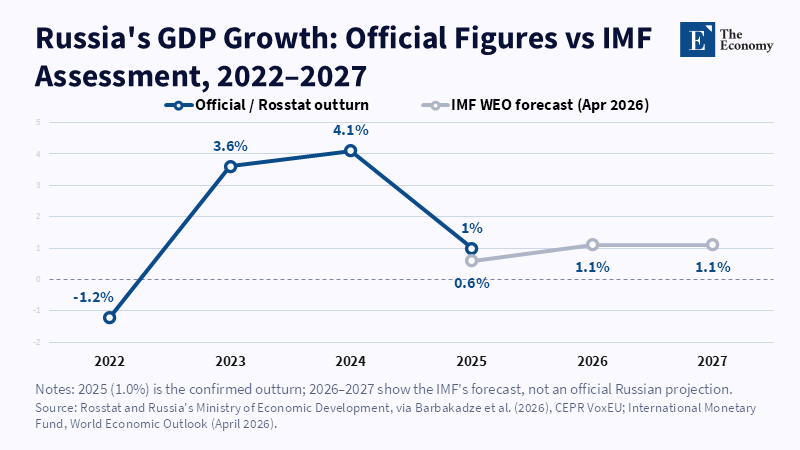
The Russian Ministry of Economic Development declared GDP growth of 4,1% in 2024, after a recession of just 1,2% in 2022, the year of the invasion of Ukraine. In 2023, the rate reached 3.6%, while for 2025 the government predicted a slowdown to around 1%, which it presented as a conscious choice to tame inflation and not as a sign of weakness. Vladimir Putin described it as the result of planned policy by the government and the central bank. These numbers feed into a narrative of resilience: the Russian economy withstood Russian sanctions, adapted quickly and continues to finance the war at no visible cost to civilians. But Russia has stopped publishing a series of regional and sectoral statistics since 2022 and a regime with a strong incentive to convince domestic and foreign audiences that it is hard-pressed can be seen as an unbiased source for the extent to which it actually holds.
Moscow's Story: A Controlled Slowdown, Not a Crisis
The official line does not deny that there is a slowdown; it simply frames it as an option and not as a weakness. Inflation fell from 9.5% to less than 6% in 2025, the result of tight fiscal discipline and a series of reductions in the key interest rate from 21% to 16%. The ruble's appreciation, from around 110 per dollar at the end of November 2024 to below 80 by mid-May 2025, was presented as a sign of confidence in the economy, although it came mainly from restrictions on the outflow of capital. Public debt remains low, around 17% of GDP, unemployment is close to historic lows and wages continue to rise nominally. These figures are not invented and explain why the narrative of stability finds an audience both at home and in parts of international public opinion that question the effectiveness of Russian sanctions.
The problem is that the government itself chooses what data it publishes and how it presents it. Five official indicators of activity remain available after the invasion, albeit fragmented: building permits, fixed capital investments, number of profitable businesses, number of employees and financial results of profitable companies. Only the first two show a statistically significant improvement after 2022. The remaining three do not show any significant change in any direction. If one selectively trusts only favorable indicators, the war seems to have stimulated the economy rather than burdened it. It is precisely this selectivity that makes an independent, non-manipulable source of data necessary.
Why Satellites Cannot Lie About Russia's Economy
Satellite imagery of night lighting offers just that. Coverage spans 1,058 Russian cities from January 2012 to January 2025, excluding the summer months, when nights in the northern latitudes do not get dark enough for a reliable measurement, rather than relying on data provided by Russian ministries. The logic is simple. Human activity produces light at night and this light is recorded by NASA satellites without passing through any ministry. The method has already been used to estimate the economic damage of civil conflict in Somalia, the consequences of the Arab Spring and even the extent to which authoritarian regimes inflate their official growth figures, averaging up to 35% according to previous research.
The findings are in direct contradiction to the official narrative. Instead of a mild recession in 2022 and a full recovery since then, the lighting data shows a persistent, not temporary, slowdown in economic activity after the invasion, which has been maintained throughout the period under review. One important caveat should be noted. Factories and businesses may turn off lights at night to save energy, especially when electricity costs rise due to sanctions and supply chain redirection, so night lighting is not a perfect substitute for real GDP. A dark part of a city, however, means nothing less than what it seems at first glance: that there is a potential gap between what the Russian government says and what is actually happening on the ground.
Winners and Losers Under Russian Sanctions
The resulting picture is not a uniform recession but a redistribution. Russia's western regions, which have traditionally maintained close trade ties with European countries, are recording statistically significant losses, especially those bordering Ukraine, Belarus, Poland, Estonia and Finland. At the same time, areas of the south and east are recording gains, with the most pronounced rise near the border with China and especially Georgia. The explanation is not mysterious. Western sanctions cut off traditional trade routes, while creating an incentive for indirect trade through neighboring countries in the Caucasus, Central Asia and China that did not participate in the sanctions regime.
In other words, the cost of war is not shared equally. It is concentrated where it matters, in the economic and political core of the country around Moscow and European Russia, while regions that act as channels for circumventing sanctions benefit. It is worth noting that areas with large ethnic minorities, which have borne a disproportionate share of personnel losses at the front, do not show a statistically significant change in lighting in either direction. The possible explanation is that the loss of a worker leaving for the war is partially offset by enlistment bonuses, soldiers' salaries and compensation in the event of injury or death, money flows that will stop when the war ends but that for now keep local consumption in balance.
Structural Fatigue Confirmed Beyond the Lights
Lighting data doesn't stand alone. The average annual growth rate of the Russian economy since 2012 has been just 1.37%, according to the Eurasian Strategies Centre, well below the dynamic rate estimates of more than 4% in force at the beginning of the decade. Military spending, according to statements by Defense Minister Andrey Belousov in December 2025, amounted to 7,3% of GDP in 2025, a whole percentage point above the budget, while direct spending on the war reached 5% of GDP. Oil and gas revenues, the backbone of the budget, fell by 25.4% in the first eleven months of 2025, mainly due to the appreciation of the ruble and US sanctions against Rosneft and Lukoil.
The Ministry of Economic Development itself was finally forced to admit it. On May 12, 2026, it published a revised forecast predicting at least two more years of stagnation with no recovery at the end, the first official document to treat the war and Russian sanctions not as a temporary shock but as a permanent change in the trajectory of the economy. Military spending increased from 3% of GDP in 2021 to 8% in 2025, absorbing labor from the civilian sector and financed first by the National Welfare Fund, then by tax increases and finally by expensive domestic borrowing, sources that are now drying up.
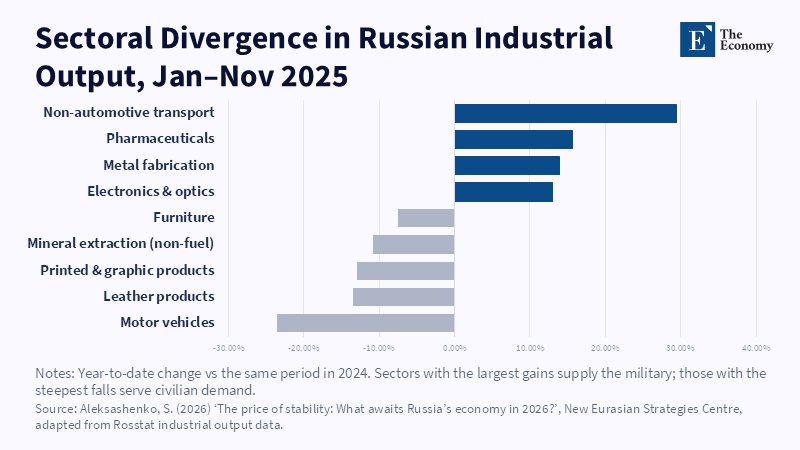
Industry-by-sector analysis confirms the same dichotomy that satellite imagery shows. Sectors related to military needs recorded double-digit growth in 2025, with non-automotive transport increasing by 29.5%, pharmaceuticals by 15.6%, metal fabrications by 13.9% and electronic and optical products by 13%. On the other hand, the production of cars fell by 23.6%, leather products by 13.4% and furniture by 7.5%. These are two different economies within the same country, one fueled by government war orders and one political economy that is shrinking. The International Monetary Fund recently revised down its forecast for Russian growth to 0.6% for 2025 and 0.8% for 2026, the weakest estimates since 2014, excluding the pandemic period.
It is expected that the recovery of the second quarter of 2026, when GDP grew by 1.3% after a contraction of 0.2% in the first quarter, the first contraction since 2023, will be put forward as a counterargument. This performance, however, is attributed to disposable factors: more working days compared to last year, a temporary rise in oil revenues due to the war in Iran and a 16% increase in government spending, a third of which went to the military and armaments. Non-military industry continued to shrink by 3.2% year-on-year over the same period. A recovery fueled by government arms orders does not negate the finding of structural fatigue, it simply delays it by a quarter.
What Russian Sanctions Enforcement Should Track Next
The practical consistency for Western analysts and policymakers is clear. The assessment of the effectiveness of Russian sanctions cannot be based solely on data published by the regime itself, which has every incentive to embellish them. Independent indicators are needed, such as night lighting, monitoring of trade flows through third countries, recording of the tanker fleet transporting Russian oil outside official channels and tax energy revenues, precisely because none of it goes through a propaganda ministry before it reaches analysts. The EU's 21st package of sanctions is moving in this direction, intensifying pressure on the energy and financial sectors and maintaining the timetable of full disengagement from Russian gas. The next generation of sanctions must specifically target the bypass passages revealed by the lighting data, i.e. indirect trade through the Caucasus, Central Asia and China that absorbs some of the loss from the West.
Relative economic strength remains crucial in assessing any pressure strategy. The nominal GDP of European NATO members, excluding the United States, stood at $26 trillion in 2024, compared to about $2 trillion for Russia, a ratio the recent U.S. review of the military presence in Europe cites in arguing that Europe has the resources for deterrence without permanent American support. In this context, this year's G7 announcement of additional sanctions against Russia's war economy is not a mere declaration of intent but a recognition that resource asymmetry remains the most powerful tool of pressure available, as long as it is used on the basis of data that Moscow cannot manipulate.
The argument that lighting data is inherently incomplete does not negate the conclusion, it reinforces it. The convergence of independent sources, satellite monitoring, energy tax revenues, bond issues and the Russian ministry's own forecasts all point in the same direction despite the different methodological weaknesses of each. A single indicator could be challenged as a random measurement error. Four or five independent indicators converging on the same conclusion show something more difficult to ignore.
Russia's GDP of 4,1 points in 2024 was not a lie in the strict sense, but it was an incomplete picture designed to look more complete than it was. NASA satellites have no reason to favor Moscow and this is precisely what makes them valuable. The Russian sanctions did not collapse the economy, but pushed it into a slow, structural deterioration that official statistics have no interest in accurately recording. For any Western government planning the next phase of pressure, the conclusion is simple: surveillance should be based on what cannot be manipulated, not on what is most convenient to publish. As long as policy analysis continues to borrow Russia's numbers to judge Russia, the narrative of stability will be kept alive much longer than the actual data on the ground allows.
This article reflects the analytical judgment of The Economy Editorial Board and does not constitute policy advice or the official position of any affiliated institution.
References
Agence France-Presse (2026) 'Russian economy rebounds in second quarter despite Ukrainian strikes', France 24, 12 August.
Aleksashenko, S. (2026) 'The price of stability: What awaits Russia's economy in 2026?', New Eurasian Strategies Centre, 6 January.
Barbakadze, I., Fidrmuc, J., Hulényi, M. and Kapanadze, K. (2026) 'When statistics lie: Using satellite data to track Russia's wartime economy', VoxEU, CEPR, 19 August.
Kolyandr, A. (2026) 'Russia Settles for Stagnation', Center for European Policy Analysis, 20 May.
Meduza (2026) 'Russia's economy is growing faster than expected. It probably won't last.', Meduza, 18 August.
Peach, L., cited in Moscow Times (2026) 'Russian Economy Returns to Growth, but Economists Warn Rebound May Be Short-Lived', The Moscow Times, 13 August.
Working across research, policy, and data-driven analysis, the Editorial Board ensures that published pieces reflect a consistent institutional perspective grounded in quantitative reasoning and long-term structural assessment.